Turkey

A woman of some importance | 6 July 2017

From our UK edition

It might seem unlikely that a Christian noblewoman could have had influence over a Muslim city in the 13th century, when women were considered by Muslim society as being ‘underlings without complete intelligence’ and by Christian society as ‘a fish hook of the devil… a source of evil… a treasury of filth’. However, Tamta — a woman of Armenian Christian heritage, who travelled extensively and acted as a link between people of various faiths and backgrounds — seems to have governed, influenced taxation, provided passage for pilgrimage and even, possibly, played a role in battles and military negotiations, in Akhlat, a Muslim city in what is now Turkey, in the early 1200s.

Holding court

From our UK edition

A hundred years after the Russian revolution, Russia has a tsar and a court. Proximity to Putin is the key to wealth, office and survival. The outward signs of a court society have returned: double-headed eagles, the imperial coat of arms, the cult of Nicholas II (one of whose recently erected statues has ‘wept tears’), an increasingly wealthy and subservient Orthodox Church. In 2013, ‘to strengthen the historical continuity of the Russian armed forces’, the main honour guard regiment in Moscow was renamed Preobrazhensky, after the oldest regiment of the Imperial Guard, founded by Peter the Great in 1683.

Trump and Erdogan: the new populists

From our UK edition

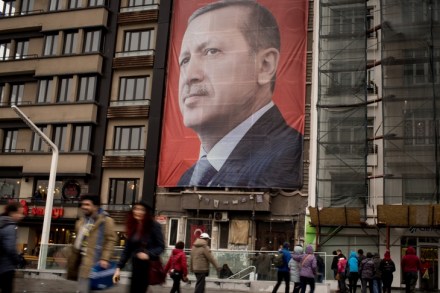
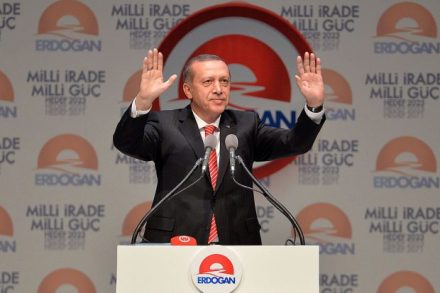
Istanbul The most dramatic part of President Erdogan’s visit to Washington this week was the punch-up between his security guards and Kurdish demonstrators on the lawn outside the Turkish embassy.  The protest was nothing unusual for a president who seems to provoke adoration and disgust in equal measure wherever he goes. Neither was the violent scuffle a surprise; Erdogan's bodyguards did the same last time he was in the States. The news barely touched the Turkish press, and not only because there are few titles left on the news stands which offer opposition to Erdogan. When similar fights break out in the Turkish parliament, as they have done regularly over the past year, such scenes are barely worth writing about.

Portrait of the week | 20 April 2017

From our UK edition

Home Theresa May, the Prime Minister, having repeatedly said that there would be no election until 2020, surprised the nation by suddenly standing at a lectern in Downing Street, while the wind ruffled her hair, and saying that she sought a general election on 8 June. ‘Britain is leaving the EU and there can be no turning back,’ she said. ‘The country is coming together but Westminster is not.’ She said later that she had taken the decision after a walking holiday in Wales, and had spoken to the Queen on Easter Monday.

Erdogan keeps winning because his opponents never learn

From our UK edition

Istanbul President Erdogan hardly swept to victory yesterday. But with 51 per cent of the electorate turning out in favour of his plans to transform Turkey into a state ruled by a hugely powerful presidency rather than the parliament, he now has his mandate to reshape the country in his own image – more religious, more authoritarian, and set to swivel away from Europe while forging new relations with its old Ottoman territories. His supporters celebrated well into the night, lighting flares, driving around the cities with their horns blaring, and waving flags bearing the face of their hero. Meawhile, thousands of distraught people took to the streets in my Istanbul neighbourhood, a proudly secular district which delivered an 81 per cent no vote.

Turkish democracy has just died; Europe could not have saved it

From our UK edition

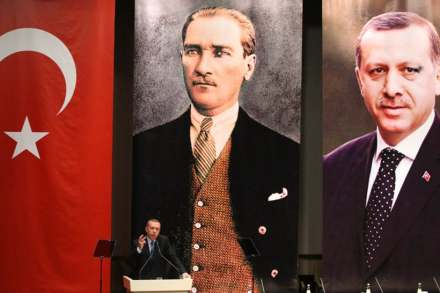
Well farewell then Turkey.  Or at least, farewell the Turkey of Kemal Ataturk.  It’s a shame.  Ataturk-ism nearly made its own centenary. But the nation that he founded, which believed broadly in progressive notions such as a separation of mosque and state, has just been formally snuffed out.  President Erdogan’s success in the referendum to award himself Caliph-like powers for life finally sees the end of Turkey’s secular and democratic experiment. Perhaps the poll which gave him victory was rigged.  Perhaps it wasn’t.  In the same way that perhaps the ‘coup’ last summer was real.  Or perhaps it wasn’t.

Will Turkey dare to vote ‘No’ in Erdogan’s referendum?

From our UK edition

Istanbul The Istanbul skyline is famous for being punctuated by mosques. Great domes of worship, with minarets reaching towards the heavens. The most famous is the mesmerising Blue Mosque. Built under the reign of Sultan Ahmet I, it was used as a symbol to reassert Ottoman power. Most people gasp in awe at its ornate ceiling, but I’ve always been fascinated by another feature; its minarets. There are six in total and in Turkey that’s unique, or at least it was. A few miles up the milky blue waters of the Bosphorus, another now stands to equal it. On the hills of Camlica on the Asian side, President Erdogan has been building his own symbol, a new mosque. It will be the largest in the country and like the Blue Mosque, it has six minarets.

President Erdogan’s nationalist game plan

From our UK edition

Ask any two Turkish nationalists how they will vote in their country’s upcoming referendum, and you’re likely to get two different answers. In just under a month, Turks will vote on a constitutional amendment that, if passed, will usher in the biggest political revolution since Kemal Ataturk founded the modern republic. It would shift the country from parliamentary democracy to executive presidency. This weekend I called round my contacts from Turkey’s various nationalist groups and asked them how they will vote. Exactly half said they will tick the box supporting President Recep Tayyip Erdogan in his bid to become executive president with almost unchallenged power, and a potential mandate until 2029.

Europe’s elite rightly feel extinction breathing down their necks

From our UK edition

Allahu Akbar! Greetings from Samsun, where Turkish protestors — their eyeballs spinning in orgasmic Islamic rage — tried to set fire to the Dutch flag while chanting the usual ‘Allah’s dead good’ stuff. They used cigarette lighters and some lighter fuel and up it went — and was then jubilantly trampled on by the inflamed, howling masses. Except that it wasn’t the Dutch flag — they had got hold of the French flag by mistake. I wonder if any of the similarly inflamed Turkish protestors in the Netherlands would have noticed? My guess is most of those demonstrating in Rotterdam had spent their entire lives in the Netherlands, but possibly still wouldn’t know what the country’s flag looked like.

Europe’s politicians rightly feel extinction breathing down their necks

From our UK edition

Allahu Akbar! Greetings from Samsun, where Turkish protestors — their eyeballs spinning in orgasmic Islamic rage — tried to set fire to the Dutch flag while chanting the usual ‘Allah’s dead good’ stuff. They used cigarette lighters and some lighter fuel and up it went — and was then jubilantly trampled on by the inflamed, howling masses. Except that it wasn’t the Dutch flag — they had got hold of the French flag by mistake. I wonder if any of the similarly inflamed Turkish protestors in the Netherlands would have noticed? My guess is most of those demonstrating in Rotterdam had spent their entire lives in the Netherlands, but possibly still wouldn’t know what the country’s flag looked like.

How Erdogan used the Dutch as political pawns

From our UK edition

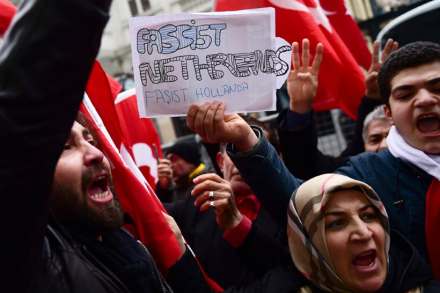
Rotterdam What started as a minor disagreement between Turkey and the Netherlands has now expanded into an unprecedented diplomatic spat. Turkish attempts to hold rallies in Germany, Austria, Switzerland and the Netherlands have been blocked - and President Erdogan is now using this to his advantage. In April, Erdogan will hold a referendum on changes to constitutional powers in Turkey. This has been his goal for a long time. Even the slight possibility of losing terrifies him. In Turkey the electorate has effectively been told they are ‘terrorists’ if they vote against the motion. Yet despite that, polls showed until recently that the vote was still split.

How the Turkey question could swing the Dutch vote

From our UK edition

Douglas Murray and Melle Garschagen, UK and Ireland correspondent for NRC, discuss the Dutch election: The Dutch public go to the polls tomorrow, and the question of Turkey is on the menu. This past weekend the Dutch government forbade a plane containing the Turkish Foreign minister from landing in the country.  The Turkish minister had been due to address a crowd in Rotterdam.  Another Turkish minister – the hijabi Fatma Betul Sayan Kaya, due to attend a similar rally – was prevented from entering the Turkish consulate in Rotterdam.  All of which led the Turkish government to dismiss the Dutch people (and then the Germans as well) as ‘Nazis’. Last night, Turkey then banned the Dutch ambassador from returning to Ankara.

Light in the East | 9 March 2017

From our UK edition

Christopher de Bellaigue, a journalist who has spent much of his working life in the Middle East, has grown tired of people throwing up their hands in horror at Isis, Erdogan and Islamic terror, and declaring that the region is backward and in need of a thorough western-style reformation. As he argues in this timely book, the Islamic world has been coming to terms with modernity in its own often turbulent way for more than two centuries. And we’d better understand it, because it’s an interesting story, and often a positive one — the way vast crowds streamed onto the streets of Cairo, Istanbul and Tehran in demonstrations against authoritarian rule over the past decade, for example. Western-style participatory democracy remains the dream of the man and woman in the souk.

Frontier territory

From our UK edition

In Ali’s Café, just inside Turkey on the Bulgarian border, Iraqi and Syrian refugees spend their days drinking tea. Now and then, someone goes into the back room to give bundles of money to smugglers who have promised to get him into the European Union. Only when piano chords strike up on the radio does Kapka Kassabova realise what Ali’s reminds her of: Rick’s Bar in the movie Casablanca, a transit realm ‘where the homeless of the day come in search of passage’. The Syrian refugees literally walked into Kassabova’s book.

‘Isis? Bomb those suckers’

From our UK edition

These are the last days of the ‘caliphate’. The place Isis made their capital, Raqqa, in Syria, is encircled and cut off. They have already lost half of Mosul in Iraq, their largest city. Really, what did they expect? This was inevitable from the moment Isis declared war on everyone not in Isis. Defeat was even foreseen by one of the group’s leading thinkers, Abu al-Farouq al-Masri. ‘Announcing enmity to the world will strangle the caliphate in its cradle,’ he said last year. ‘This will bury our project alive.’ Al Masri (the ‘Egyptian’) is or was an elderly cleric and he was delivering a sermon in Raqqa meant as a warning to the leadership.

Foreign journalists consider abandoning Turkey after Reina nightclub attack

From our UK edition

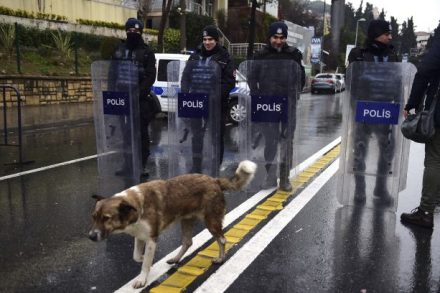
It's a sobering start to 2017 for many in Istanbul. Dozens dead and many more wounded after a man in a Santa suit opened fire on revellers at the Reina nightclub. For a city so used to attacks this one seems to have struck a deeper chord, perhaps because it was at the heart of a residential area called Ortakoy, rather than a big tourist mecca. With its narrow winding streets and wooden houses, Ortakoy is normally a pleasant place to sip Turkish coffee and watch ships float by on the aqua blue waters of the Bosphorous. It's home to an abundance of cafes and trinket shops, but just one street back from the strait you get a feel for real life in Istanbul. Fruit and veg shops spill out onto the pavement at the foot of Ortakoy's steep hills. Vendors shout to their friends across the road.

Boris Johnson’s award-winning entry in the ‘President Erdogan Offensive Poetry’ competition

From our UK edition

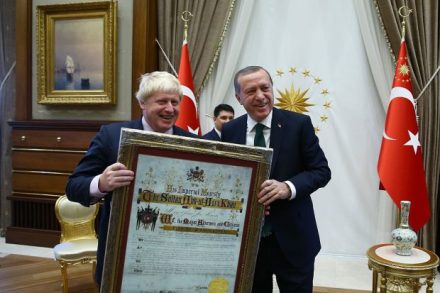
We’re closing 2016 by republishing our ten most-read articles of the year. Here’s No. 4, in which the future foreign secretary Boris Johnson was named as the winner of Douglas Murray's 'President Erdogan Offensive Poetry' competition I’m pleased to announce that we have a winner of The Spectator’s President Erdogan Offensive Poetry competition, and here it is: There was a young fellow from Ankara Who was a terrific wankerer Till he sowed his wild oats With the help of a goat But he didn’t even stop to thankera. The author of this winning entry is former Mayor of London and chief Brexiteer, Boris Johnson MP.

Ambassador Karlov’s killing leaves Turkey’s relations with Russia hanging in the balance once again

From our UK edition

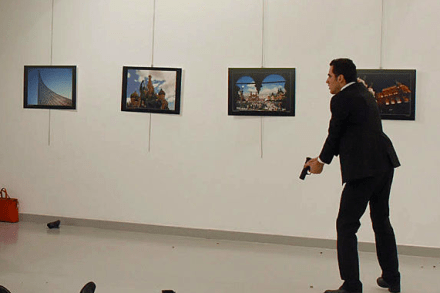
They say a picture is worth a thousands words. The one of an off-duty police officer standing triumphantly over the body of Russia’s ambassador to Turkey in Ankara, says so much more. On what was due to be an ordinary evening in the Turkish capital, Andrei Karlov attended a photo exhibition to make a few remarks at the opening of a collection entitled 'Russia as seen by Turks'. They turned out to be his last. As he addressed the small crowd, nothing seemed out of the ordinary. The 62 year-old was, as you’d expect of a man of his status, flanked by men in suits. Little did anyone expect that one of the suits would open fire and kill him. Captured on camera, the gun fire can be heard before ambassador Karlov falls to the ground.

With populism on the rise, Erdogan can now blackmail the EU

From our UK edition

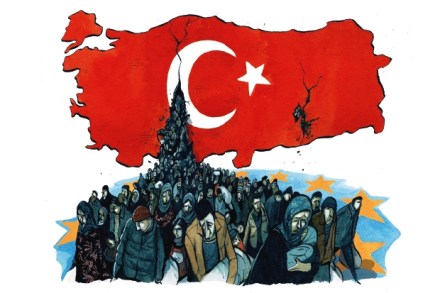
President Erdogan is no stranger to blackmailing the EU. He has previously used migrants as a ‘loaded gun’ with which to threaten European leaders. The message is clear: do what I say, or I’ll open the floodgates. This week, he’s been back to his old tricks – bashing the EU and making it clear that if membership talks failed, Turkey would open its borders and allow its three million refugees to stream into Europe. But what sparked this latest resurgence of fighting talk from Erdogan? The clue lies in the vote last week in Strasbourg, when 479 MEPs backed a decision to halt the process of Turkey’s EU accession.

President Erdogan’s media mouthpiece aims to woo the west

From our UK edition

‘Until the lion learns how to write, every story will glorify the hunter,’ bellowed Turkey’s President Erdogan as he officially launched the country’s first and only global English language public broadcaster this week. Thousands gathered for the booze-free spectacular to welcome TRT World onto their screens. But elsewhere in Turkey, the media has been punished. In 2016 more than a hundred media outlets have been closed. Thousands of journalists have been left unemployed and many have been jailed, all for simply being a potential thorn in the side of Erdogan. So when I heard the President saying TRT World was needed to tell Turkey’s story, because other channels are ‘partial’, I almost choked.