Travel

A miracle: French hotels actually like dogs

From our UK edition

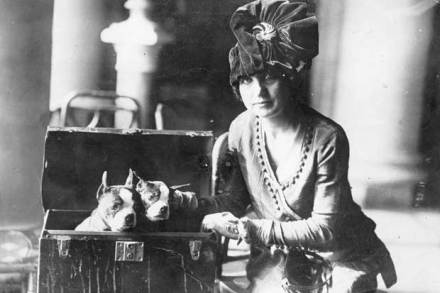
The first time I checked in to a French hotel with a golden retriever — his name was Gregory, predecessor of the incumbent Douglas — I left him, clearly unhappy, in the bedroom when I went to dinner. Then I realised that every other party already in the dining room included a dog, in some cases a lapdog enjoying morsels direct from its mistress’s plate. So I fetched Gregory, shoved him under the tablecloth and told him to keep quiet. But each time a tasty dish went past, his big hairy head emerged and sniffed the air. Eventually the maitre d’hotel approached. ‘You’re in trouble now,’ I whispered (to Gregory). ‘Ah, quel beau chien,’ said the maitre d’. ‘Would he like to order anything?

A buffet in an Egyptian tomb

From our UK edition

Atlantico is a vast buffet inside the Lopesan Costa Meloneras Resort Spa and Casino in Gran Canaria. The Lopesan Costa Melonoras Resort Spa and Casino — or, as I will henceforth call it, TLCMRSAC — looks like Citizen Kane’s Xanadu without the art, the metaphor or the tragedy. It has towers, chandeliers, vistas, pools, terraces, tennis courts, a swim-up bar, a miniature golf course and palm trees. It is a synthetic paradise for Europeans who want sun in November in their own time zone; it is more unnatural than Las Vegas. Atlantico has roughly one thousand covers, if you include an annexe room styled like an Egyptian tomb with a coffee machine, and an annexe terrace. (Each terrace has its own familiar, or cat.

What you’re missing now that you don’t read this in print

From our UK edition

Liverpool airport is a curiously unreal place in the half-light before dawn on a cold November morning. Out across the Mersey at high tide, raindrops turn the silver to lead, and at the easyJet departures gate people in tracksuit bottoms brush against the occasional tweed and Remembrance Day poppy. Intending stag-weekenders, and the set who have a little place in the Pyrenees, coincide but do not mingle. A young woman is trying to buy rosé wine, and an elderly gent is trying to find a copy of that morning’s Times. The elderly gent is me, flying to Barcelona for the day for my sister’s 60th birthday lunch, to return that night to Manchester.

The one economic indicator that never stops rising: meet the Negroni Index

From our UK edition

This dispatch comes to you from Venice — where I arrived at sunset on the Orient Express. More of that journey on another occasion, I hope. Suffice to say that if you happen to have been wrestling with the moral choice of bequeathing what’s left of your tax-bitten wealth to ungrateful offspring or spending it on yourself, don’t hesitate to invest in a last fling on this time capsule of elegant extravagance. Made up of rolling stock built in the late 1920s, the train itself symbolises everything that 20th-century Europe was good at — engineering, craftsmanship, style, cross-border connections — when not distracted by political folly and war.

A voyage along my grandfather’s coastline

From our UK edition

My grandfather was born in a huge white house on the Baltic coast of eastern Germany, and ever since I was a child I’ve been fascinated by this enigmatic tideless sea. I’ve travelled along its southern shore, from Germany to Estonia, but I’d always wanted to sail across it, and last month, at last, I did, aboard the Queen Victoria on Cunard’s Royal Viking Adventure. I joined the cruise in Stockholm (the other passengers had sailed here from Southampton). Why had no one ever told me what a stunning city this is? Perched on a little island, the old town is perfectly preserved — a cluster of cobbled alleys, patrolled by blond, athletic Swedes. As we set sail, the view became even better.

Eight of the best river cruises

From our UK edition

While ocean liners are hardly butterflies, they have a habit of flitting carelessly between countries, often visiting several within a week. A river cruise, however, takes its (relatively few) passengers to the heart of a country, the aim being to seduce with dramatic, ever-changing vistas and evocative insights — cruises for the connoisseur, if you will. Because of its many different micro-cultures and magnificent backdrops, Europe is where river cruises thrive.

Visiting the Greek islands in a reverse Tardis

From our UK edition

In Huddersfield, where I grew up, a town-centre department store boasted a ‘cruise wear’ section. In the window display the gentleman dummies wore deck shoes, starched white shorts and flannel jackets, while the ladies struck elegant poses and held designer sunglasses in their slender moulded hands. In Huddersfield, the opportunities to flaunt such clothes were limited. The shop closed down, but for as long as it existed it provided a vision of continental chic and luxury living, nestled between Burger King and the Polish mini-mart. Cruising is no longer an exclusive activity: even a half-hearted search on the internet throws up dozens of companies offering thousands of departures to hundreds of destinations.

Discover the blissful peace of Laos

From our UK edition

There’s a company I came across the other day called Value Added Travel. And despite the horrible name, it seems to be doing good business — which got me thinking. If I were starting a travel business I’d be tempted to name it something along the lines of Guaranteed To Make You Feel Better About Life — a mouthful, I grant you, and a little twee, but doesn’t it describe the reason we go places? Even the great Patrick Leigh Fermor’s epic walk from the Hook of Holland to the Golden Horn was underpinned by an innate sense of optimism. In a word, hope. Which is why I have no wish to revisit Vegas and little desire ever to drink beer on the strip in Magaluf. But give me a regular dose of Luang Prabang and I promise to help old ladies across the street for ever more.

It takes an elephant to get my teenage son up early

From our UK edition

Having just turned 13, my boy Ferdy doesn’t really do early mornings. Indeed, during the summer hols we rarely glimpsed him before noon and then only fleetingly whenever he chose to assemble himself a triple-decker jam and Nutella sandwich and flee back upstairs to his darkened room and repeats of Top Gear on his iPad. I saw more of our neighbours’ kids than I did of our own. But there Ferdy was at 5.30 a.m., bright-eyed, bushy-tailed and raring to go. ‘Come on, daddy, for heaven’s sake shake a leg, everyone’s waiting!’ I hardly recognised the boy. We were staying at Phinda Forest Lodge in KwaZulu-Natal, south-east of Johannesburg, for three days’ safari and some father-and-son bonding, and it was time for the first early-morning game drive.

Prue Leith’s diary: I want to be green, but I’ve got some flights to take first…

From our UK edition

‘Please God, make me good, but not yet.’ I know the feeling. As I get older and more deeply retired, I globe-trot more and my carbon footprint is horrendous. And guilt does not result in abstinence. The brain is persuaded but the flesh is weak. Years ago I chaired Jonathon Porritt’s sustainability organisation, Forum for the Future, and I remember holding a fund-raising dinner for rich Cotswolders and hoping no one would notice my gas-guzzling old car, toasty warm house, and melon with more air-miles than flavour. I’ve tried harder since then, but it’s not easy. A couple of years ago I converted my ancient barn into an eco-friendly house with heat-exchange pump, grey water collection, massive insulation, the lot.

Why you should never meet your heroes

From our UK edition

As we become steadily accustomed to life in the Age of Celebrity, it’s become a truth that, as Mark Mason put it in the Speccie last month, ‘meeting your heroes is almost always a bad idea’. Reading the letters page in the London Review of Books, it seems that this advice extends to visiting any place associated with your heroes. Last summer Max Long, an undergraduate at Magdalen College, Oxford, arrived at Patrick Leigh Fermor’s old house at Kardamyli in Greece, hoping to pay homage to one of his heroes.

Spectator letters: St Augustine and Louise Mensch, war votes and flannel

From our UK edition

Faith and flexibility Sir: What a contrast in your two articles on religion last week: one liberal atheist parent (Claire Stevens) concerned about her son’s turn to conservative Islam, and one conservative Catholic (Louise Mensch) determined that her children understand her unbending fidelity to the tradition.  Ms Mensch’s problem is endemic throughout the western church, Catholic and Protestant alike: greater confidence in human sinfulness than in God’s forgiveness. Mrs Stevens’s problem is the opposite: a lack of confidence in her atheism. Brought up to believe in nothing, one is prone to believe in anything.

Napoleon’s birthplace feels more Italian than French

From our UK edition

Napoleon’s birthplace, Casa Buona-parte, in Ajaccio, Corsica’s capital, is pretty grand. It has high ceilings, generous, silk-lined rooms and a gallery that could double as a mini-ballroom. The house fits Napoleon’s upper-middle-class roots, as the son of a lawyer and Corsica’s representative to the court of Louis XVI. But the odd thing is, the home town of the world’s most famous Frenchman doesn’t feel very French. Corsica is only 14 miles from Sardinia — and 110 miles from the Côte d’Azur. It only became independent from Genoa in the late 18th century and the place names are still a mixture of Italian and the Corsican dialect.

The hell of being Michael Palin

From our UK edition

In these diaries, which I found excellent in a very specific way, Michael Palin tells us about his life between the late 1980s and the late 1990s. At the start of this period, he was about to become a hugely successful presenter of travel programmes. Ten years later, he was wondering if this was, in fact, what he wanted to be. ‘Should I accept that this is what I’m best suited for?’, he writes. Or should he try to do something else, like be an ‘arts presenter’ or a novelist? His own verdict: ‘I don’t know.’ Palin is obviously a man of great qualities. For instance, he’s almost always an optimist, but never a bore. He’s clever, he’s charming, he has good taste.

The wonder of learning to fly

From our UK edition

We’d taken off smoothly and the two-seater Cessna 152 was climbing through 1,000 feet on full power. Then my instructor, Gill, reached over and closed the throttle. As the plane’s nose began to sink, she told me calmly, ‘We’ll simulate an emergency now. Can you find a suitable field to land in?’ Hurrying panic wouldn’t look good, I felt. On the other hand, finding somewhere more or less immediately might be appreciated. An empty-looking golf course fairway below looked promising. It had two sand bunkers, probably easier to avoid with a plane than a golf club, but what if previously unseen golfers pulling buggies strolled out of the trees into my flight path on touchdown? A lush-looking green field to the right looked big, firm and long enough.

On safari in Gloucestershire

From our UK edition

The heat was still sweltering as we headed off at dusk towards the hide to watch wildlife with our enthusiastic guide, Leonie. My wife and I were on our first ever safari — or rather ‘stayfari’. No, we weren’t in deepest Africa, but in deepest Gloucestershire. And we weren’t on the look out for lions and elephants, but beavers. We were staying at Lower Mill Estate, near Cirencester. Consisting of 550 acres of beautiful lakes, fields and woodlands, it’s been described as the most important private nature reserve in Europe. In Lower Mill, the houses fit around the wildlife, and not the other way round: all of them have bird boxes and bat-friendly roofs.

Four gadgets to take on holiday — and two to leave behind

From our UK edition

One inarguably good thing about electronic publishing is that it solves that old quandary about what books to pack for your holiday — you just take a tablet or Kindle and buy books on a whim. The downside, however, is that this old dilemma has been replaced by an entirely new one: what bits of electronic crap need you take on holiday and what should be left at home. One thing you will never see on these pages is a review of headphones. I have owned lots of these over the years, costing between £10 and £150. Unfortunately all of them are completely useless. This is because I am married.

The ultimate guide to Cornwall

From our UK edition

Before writing this review I spent an hour looking for my original Pevsner paperback on Cornwall, published in 1951 (the first in the ‘Buildings of England’ series). It was falling apart, but I always took it with me on an architectural jaunt, together with my father John Betjeman’s Shell Guide to Cornwall, of course. The two books were good companions. The Pevsner was littered with notes in the margin, made by my dad, like ‘absolute balls,’ ‘what?’ or ‘wrong’ underlined. (I did not find the tattered book and can only conclude that some light-fingered book dealer has stolen it within the last year.) Admittedly there were inaccuracies but with no official buildings ‘list’ at the time, Nikolaus Pevsner was out on his own.

Joan Collins’s diary: Why I gave up on Ascot – and where I go instead

From our UK edition

Can there be anything more perfect than early July in London, when the sun is shining, the sky a cloudless azure and the temperature hovers in the mid-seventies? Sorry, I still do Fahrenheit. It’s party time everywhere, with all the annual events happening, but I don’t do Ascot any more, too waggish, or Henley, too wet, or Wimbledon, too warm. The former has changed radically over the last 20 years, when I was fiercely censured for borrowing another woman’s Royal Enclosure badge, on a dare that no one would recognise me. Now these high jinks would be deemed innocent in comparison to the behaviour that goes on: people snogging, passing out and throwing up in public hardly raise an eyebrow. Everyone was super-elegant then, most women wearing gorgeous hats and outfits.