Tony blair

Why Blair’s return is good news for the Tories

From our UK edition

Blair's return will be worth a good 2-3 points to the Tory lead. Like Mandelson, he can dazzle journalists who admire his tradecraft. Like Mandelson, he is loathed by the public who see a snake oil salesman. Blair mis-sold the country a project in 1997, and delivered none of what he promised (and it was with those broken 1997 problems in mind that the News of the World backed the Conservatives last weekend). He is not very popular now. When he gave evidence to the Chilcott Inquiry, the crowds came from near and far to denounce him. One placard, which I found outside my office, said "Blair is a war criminal" then someone had taped below it "and a w****r" but without the asterisks.

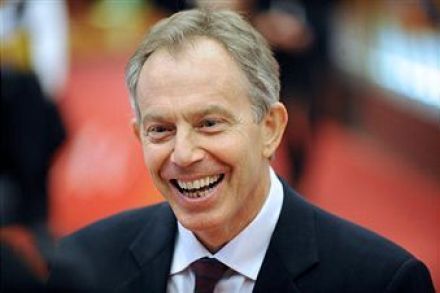
Guess who’s back

From our UK edition

Yep, you guessed right: Tony Blair was doing his bit for the Labour cause this morning, with a speech in his old constituency.  In truth, there was little in it of any note – or that we haven't heard countless times from his successor.  Thus the Tories were derided as either the "old Tory party," or as confused about their direction of travel.  Gordon Brown and Alistair Darling were hailed as the men who brought us through the worst of the economic storm.  And even the soundbites ("meeting not just future challenges, but seizing future opportunities") sounded as if they had come from straight from the Brownite copybook.

Cab for Hire: Dispatches and the Moral Collapse of the Political Class

From our UK edition

I am still reeling from Antony Barnett's Dispatches investigation into MPs and lobbying. Truly brilliant TV. Horribly watchable. Exquisitely awful. I watched half of it from behind my hands. This was Curb Your Enthusiasm meets the Office: political Dr Who for grown-ups. Why is it always the Blairites who get themselves into these messes? Is it simply because they bought the New Labour compact with the market more fully than the rest of the party? Or is that they waded so far into unfamiliar territory that they lost their moral compass? None of this completely explains what is going on here.  There was something rather sad about watching Stephen Byers wade so deep into a sewer of his own making. In the post-Blair world he seems utterly without direction.

Introducing the Nelson tax

From our UK edition

In the News of the World today, I propose a new tax on the rich: specifically, on ex-ministers who go on to earn a crust advising companies how to avoid the regulations with which they have saddled the British economy. I proposed this before the news broke about Byers and Hewitt etc, but their appalling story makes it all the more pertinent. The Nelson tax should be above the top rate, and imposed on any activity such as giving speeches to the Chinese, lobbying, consultancy, etc. - anything which trades from contacts or reputation built up while serving the taxpayer. It would not be levied on activities which the ex-minister could plausibly claim he would have taken on anyway. So if Blair were to return to law, his earnings would be taxed at the normal rate.

Two blasts from the past

From our UK edition

Michael Savage observes that Cameron’s denunciation of Brown’s 'weak' premiership recalled Tony Blair’s famous savaging of the ‘weak, weak, weak’ Major government . Here it is: After watching that, I chanced upon an exchange between Blair and Cameron, dated November 2006. Their subject? NHS budget cuts. The first two minutes of the clip reinforce just how complicit the Conservatives were in Brown and Blair’s free for all. Cameron was aghast that "budgets were being raided to solve financial deficits".

Cameron Must Show a Ruthless Streak

From our UK edition

There is an excellent piece on the Ashcroft affair from Martin Ivens in the Sunday Times today. He quotes a member of Team Cameron: "Why didn't David just take Ashcroft out and shoot him? His work is done. What's the point of him hanging about?" Well said. No one has quite got to the bottom of why the Tory lead has shrunk. But one reason might be the sense that David Cameron is not quite as decisive as he ideally should be. He lost his nerve over George Osborne when he became an embarrassment in Corfu and he seems to have lost it again over Ashcroft.  Cameron has modelled his rise on Tony Blair but has never shown Blair's brutal approach to his own party. This is why the base of the party remains unreformed.

All quiet on the Chilcot front

From our UK edition

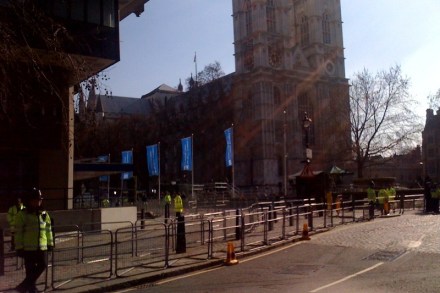
I just took a quick stroll around the block from Old Queen St, to check out the situation on the ground outside the Chilcot Inquiry.  The most striking thing is how few protestors there are – about ten at most, I'd say, and a fraction of the number that marched out against Blair a few weeks ago.  Brown doesn't even make one placard's list of – and I quote – "Lying R. Soles," which includes Blair, Campbell, Straw and Goldsmith. It's all rather suggestive of how Brown has managed, over the years, to separate himself from those who made the political and moral case for war.  But there lies the problem.  In distancing himself from Blair et al, Brown has emphasised how he – as Chancellor – did little more than control the purse strings.

Available from all good bookshops…

From our UK edition

... this September: Tony Blair's memoirs, entititled The Journey.  Question is, what does this say about his hopes for a Labour victory?  Or will all the juicy Blarite-Brownite stuff be cut out?  Either way, the cover will be what you see on the left.

Brown v Blair: a comedy

From our UK edition

First the tragedy, then the farce: if there was something dark, perhaps shocking, about last weekend's bullying allegations, then the latest Rawnsley revelations veer towards the hilarious.  They're centred around Brown's efforts to oust Tony Blair, and the Guardian covers them here.  I won't pre-empt your enjoyment of them, except to highlight this passage from the report: "Rawnsley reveals that Brown rang Blair while he was staying with the Queen at Balmoral. He was furious that Alan Milburn, Blair's close ally, had written a piece supporting the prime minister's right to stay at No 10. Rawnsley writes: 'The chancellor's fury was titanically demented even by his standards. 'You put fucking Milburn up to it,' Brown raged down the phone. 'This is factionalism!

The best publicity Brown is ever likely to get

From our UK edition

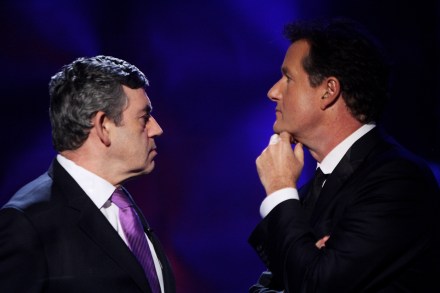
Brown is very lucky to have a friend in Piers Morgan. He did him a great service in the ITV interview tonight - and while it would have made CoffeeHousers nauseous (if they watched it), it will be the best television the PM will get this year and probably ever. Mark my words: the Labour Party will not produce anything that shows Brown in such a sympathetic light. It was powerful, I'd say, because it was not party political propaganda: Morgan genuinely likes Brown and did his utmost to project the human side of him. Those hours of coaching from Alastair Campbell paid off. He kept smiling in a credible way - telling anecdotes in exactly the way that he does, in private, when he's trying to charm people.

The rebirth of history

From our UK edition

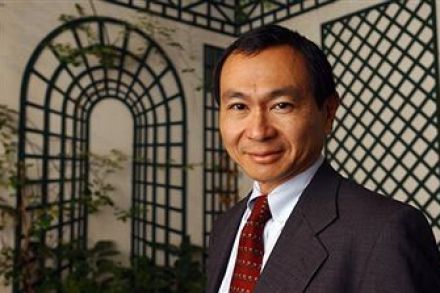
We have Francis Fukuyama writing a cover piece for us this week, revisiting his 'End of History' thesis. When he first published it, in 1989, he anticipated what was to become a consensus shared by many, including myself: that autocracy was on the way out. Communism had failed, and was being supplanted by the free society (aka the free market). Capitalism was creating wealth and liberty, and from Minsk to Gdansk people wanted it. Eastern Europe was managing a transition brilliantly. Fukuyama¹s thesis seemed to sum up an incredible spirit of optimism. Perhaps this optimism turned to hubris. After 9/11 Tony Blair and George Bush wanted to accelerate history, and bring democracy to countries which just needed to get rid of their dictatorships.

Lance Price: Brown became PM when his skills were declining

From our UK edition

Gordon Brown is a creature of habit. Every morning at 7:30 he holds a telephone conference with his cabal of Shakespearean fools, who review the papers for him. I imagine a scene of domesticity, of coffee and muffins, an adoring wife and child milling about offering tactile affection – a hand on the shoulder, a kiss on the head. But then again Brown is a latter day John Knox and this morning he must have sat in pale fury as an aide summarised the extract from Lance Price’s latest book, published in the Independent. Price, Andrew Rawnsley and Peter Watt share the same lexicon. ‘Unforgivable’, ‘not a nice place for people to work’, ‘psychologically flawed?

Blair on Chilcot…

From our UK edition

...well, sorta.  5:25 into his interview with Mike Huckabee, our former PM gives his take on the constant stream of Iraq inquiries: You can certainly see his point. Although I doubt the government will be too impressed with Blair trawling through all the Iraq stuff on American television, only weeks before he hits the campaign trail for Labour.

Beyond doubt

From our UK edition

For a moment, Andrew Marr had Alastair Campbell by the short and curlies. Marr attacked (that verb is not an exaggeration) Campbell over his clarification to the Chilcot Inquiry, the phrase ‘beyond doubt’ and the possibility that Blair knowingly misled parliament over the strength of WMD intelligence.   Marr was at his incisive and dramatic best. It was the first time I’ve seen Campbell under pressure and he wobbled, his lower lip did so markedly. Perhaps I do him a disservice, but I didn’t buy Campbell’s blubbing act; it was just theatre. His defence of Blair and himself rested on the tried and tested refrain that Tony’s a pretty straight kind of guy, and what he described as the “careful and meticulous” case that both prepared.

Brown and Blair, together again

From our UK edition

Strange that there's really only one major political point arising from Gordon Brown's interview in the Standard today.  But, then again, maybe that is the point.  Like the PM's interview with the News of the World a few weeks ago, the emphasis is far more on the personal than anything else: his relationship with Sarah Brown, the death of his daughter Jennifer, his upbringing, and so on.  We even learn why his handwriting is so bad ("due to the way he was taught to write at school," apparently).  And with a TV appearance alongside Piers Morgan in the schedules, it does seem that Brown is keen to present a more human front. As for that political point, it's Brown's confirmation that Tony Blair will play a "major role" in Labour's election campaign.

The Iraq War may or may not have been a crime – but was it in the national interest?

From our UK edition

If you read the press after Clare Short’s testimony to the Iraq inquiry you would be forgiven for believing that there are only two ways to judge the Iraq War – whether it was legal or not, and whether Tony Blair lied. But while these are important issues, they get in the way of another key question: was it in Britain’s interests? There are many problems with looking simply on the issue of legality. First of all, international law is not domestic law. It is a framework without an overarching "sovereign", so "enforcement" of international law is different than in the domestic context. International law is also based, at least in part, on norms. But norms change – thus changing what the law means.

Stop these excuses: someone dig up Robin Cook

From our UK edition

So there we have it, straight from the horse’s mouth, and to round off a sentence of tired clichés all that needs to be said is that Clare Short was “conned”. Everyone was in fact: “We were in a bit of a lunatic asylum… I noticed Tony Blair in his evidence to you kept saying, ‘I had to decide, I had to decide.’ And indeed that’s how he behaved. But that is not meant to be our system of government.” The sofa was barred to all except Bush and the Cabinet exercised collective ignorance. Even Brown was left to brood over cups of coffee and macaroons with Clare Short. Short’s evidence must not be entirely discounted.

Because of Blair, Britain will now be shaped by the world

From our UK edition

It's striking how Tony Blair, the most successful election winner in Labour party history, is now so despised in the country that gave him three landslides. This matters politically, because he has - I fear - poisoned the cause of liberal interventionism. I look at this in my News of the World column today. Blair's Chicago speech of 1999 laid out what I regarded as a bold and coherent foreign policy case. It was time to stop letting genocides happen because they take place within the borders of sovereign states protected by the UN Security Council. I agreed with him when he said that, if the Rwandan genocide happened again, we would have a moral duty to act there. But if it happens again, what are the chances of Britain joining a multi-national coalition? Pretty close to zero.

I bear a charmed life, which must not yield to one of woman born

From our UK edition

If Tony Blair were to go to the newsagents to day to see how his performance is being reported on the front pages,  he'd be in for a pleasant surprise. He does not feature - certainly not in the biggest sellers. The extra-curricular activities of John Terry make the the lead story on the Mail, the Sun, the Daily Telegraph and the Daily Mirror. Blair himself is relegated to the inside pages on most.  Of all today's press coverage, The Times is probably the most damaging. "Tony Blair was branded a murderer and a liar last night,". But even Blair-hating papers like the Daily Mail find it hard to compete with the John Terry story, which journalists have known about for days but been unable to report (I gather that there are more explosive revelations to come).

Tony Blair: The Next Labour Prime Minister?

From our UK edition

There has been a general consensus that Tony Blair was a class act in front of the Chilcot Inquiry. Even those who see him as a liar and a war criminal must have been impressed by the way he handled himself - although choosing to show no contrition in a room of people that included the bereaved parents of fallen soldiers was a mistake.  I was not a supporter of the war. Like most people in the country I was an agnostic: I hoped the removal of Saddam would lead to a democratic domino effect across the middle east, but I thought it probably wouldn't. I thought it far more likely that an invasion would lead to the three-way split of the country into Kurdish, Sunni and Shia enclaves. I wasn't entirely right about that either.