Tony blair

Will the coalition defeat the roadblocks to reform?

From our UK edition

The biggest reform to the NHS since its inception since 1948. A move away from bureaucracy towards a proper internal market. GPs commissioning. A revolution, taking on the vested interests. Yes, there was so much to savour in the NHS Plan of 2000 - enough, Alan Milburn would later joke, that he kept re-announcing its policies for the next three years and getting headlines. Well, the Tories can play at that game too. Now, it has been reannounced by Andrew Lansley and called the coalition NHS White Paper. This is, in my book, a compliment to Lansley. In opposition, he sided with the unions and attacked Labour from the left on the "stop the cuts" platform. Now, he is picking up some of the discarded Blair reform agenda – centrally, GP commissioning.
Five highlights from the Mandelson serialisation

From our UK edition

So now we know what happened during those uncertain days following the election in May – or at least we know Peter Mandelson's side of it.  The Times begins its serialisation of the Dark Lord's book today with a front-page photo of Nick Clegg and the legend, "Clegg the Executioner".  And, inside, Mandelson explains how the Lib Dem leader made Gordon Brown's departure a precondition of any coalition deal with Labour.  Not the most surprising news ever, but worth having on record nonetheless. Aside from that, there's little of much weight in these first extracts, but plenty of titbits for political anoraks. Here are five that jumped out at me: 1) Blair thought that a LibLab deal was an "error".

Mandelson and Miliband kick open the hornets’ nest

From our UK edition

Oh joy, Labour are at war again.  The animosities which have largely been kept in check since the election are now piercing through to the surface again – and it's all thanks to Peter Mandelson's memoirs.  After the ennobled one's insights about Gordon and Tony in the Times yesterday, Charlie Whelan is shooting back from the pages of the Sunday Telegraph.  And, elsewhere, Brown is said to have told friends that "this is going to be a very difficult time for me."  Yep, it's just like the glory days of last summer. Amid all this, there's a sense that Mandelson and David Miliband have coordinated their efforts to trash Brown and, by extension, his "advisers".

Labour holds its breath for the Dark Lord’s memoir

From our UK edition

Peter Mandelson’s memoirs are out in just over a week. Despite being one of the last off the stage, Mandelson has beaten his colleagues to the first full account of the Blair Brown era. Tony Blair’s ‘The Journey’ is not out until September. Indeed, some Blair allies think that Mandelson should have had the good manners to let the former Prime Minister publish first. There’ll be some people who dismiss any Mandelson book as old news. But from what I’m hearing these memoirs could be more interesting than people are expecting. Apparently, many of Mandelson’s political friends have not heard from him recently and fear they could be painfully frank. The media will be looking to see what Mandelson says about Blair and Brown.

Sign of the times | 28 June 2010

From our UK edition

This week’s New Yorker has a little piece about Cherie Blair’s efforts to get an International Widows’ day recognised. Most of it is about Blair doing the diplomatic rounds, she compares the process to the one for trying to win the Olympics for London. But there is an interesting anecdote about what happened when the Blairs were both looking for chambers to join: “When Tony and I were looking for jobs, they said they had a boy and a girl and they couldn’t possibly take another girl, so I went to another chambers, and Tony was taken on.” It is easy sometimes to forget just how much things have changed in the past thirty odd years.

Cameron settling in nicely

From our UK edition

David Cameron was on punchy form at PMQs today. He jibed that in Harriet Harman’s case the Budget Red Book should be called ‘the unread book’ and called Labour backbenchers ‘dunces’ who didn’t know what the last government was planning. The Cameron Harman exchange was interesting. Harman had come armed with some classic follow-up questions using the details in the Red Book. Cameron didn’t want to engage on the detail, suggesting that Harman might have had a point. But his ability to attack Labour for having got the country into this mess allowed him to win the exchange on points quite comfortably. Bob Russell, a Lib Dem MP who said he may oppose the Budget yesterday, roared out three nil after Harman’s first three questions.

A day that re-opens old wounds

From our UK edition

Building on a peace process of compromises, Tony Blair called the Bloody Sunday inquiry to placate nationalists in Northern Ireland. But I wonder if he ever intended its findings to be published? The Saville Report was only ever going to re-open old wounds. With the greatest respect to Lord Saville, who is a distinguished lawyer, this report cannot dispense justice. Establishing the facts is impossible 30 years after the tragedy, and the punishment can only be collective. Yet the political dictates of peace mean that the British army must be blackened. The soldiers who beat both sets of paramilitaries to the negotiating table will be branded as criminals. Whatever their impulse, British officers took a disastrous decision to disobey orders and open fire.

The French ambassador has not contradicted Straw’s evidence to Chilcot

From our UK edition

The drowsy Hay festival has been shaken by two bespectacled academics igniting a rather too intricate political bomb. Under the guise of a literary interview, Philippe Sands QC and the French ambassador to London, Maurice Gourdault-Montagne, have connived to attack Jack Straw’s evidence to the Chilcot Inquiry.   Straw was adamant that President Chirac was ‘unambiguous, whatever the circumstances’ in his refusal to back a second UN resolution. The Guardian reports that Gourdault-Montagne told the Hay festival: ‘Chirac had made it clear that he meant France could not have supported a new UN resolution at that time since it would have triggered an invasion despite the lack of evidence that Iraq possessed WMD.

Cameron should seek the common ground

From our UK edition

Last weekend, David Cameron had few rebels at all in his party. This week, he has 118. The vote on the 1922 Committee membership was a free vote, of course, so this can by no means be compared to a proper, whip-defying Commons rebellion. But we have seen there are scores who are not prepared to support the leadership automatically. As I say in my News of the World column today it was unnecessary to draw such a dividing line over a party that badly wants the coalition to succeed. True, Tony Blair bossed his party about. But Blair earned the right to when he won a landslide victory. His message was “if you follow my modernising path, we get mass popular support”.

Message to the Tories: Grow Up About the New Labour Era

From our UK edition

I have been deeply disappointed by Tory negative campaigning in the past few days. The Cameroon coup was inspired, in part, by Tony Blair, so to decry 13 years of New Labour is deeply hypocritical. The message, pioneered by Oliver Letwin, was that praise would be given where it was due. Britain has become a better place since 1997 and that is true for readers of the The Spectator as much as (and perhaps more than) anyone else. At the same time, Brown's leadership of the country and his party has been woeful. The Labour Party has only itself to blame for this. It should have put up a candidate against Gordon Brown in 2007 and it should have removed him a year later.  This blog is here to give you an insight into thinking on the left.

The curtain starts to fall on Gordon Brown

From our UK edition

There's a strange fin de siècle air about Labour this weekend: a new appreciation that the forthcoming election marks either the end of their reign, or – at best – is the start of a different, diluted kind of power.  There are still a few signs of life and struggle, sure.  I mean, Gordon Brown's interview with Jeremy Paxman last night was fairly proficient by his standards, if typically disingenuous.  But, even then, the PM is struggling to move the conversation on from Gillian Duffy.  In interview with the Telegraph today, he admits that he has "paid [a] heavy price" for his gaffe. That line forms the headline of the article. Even Tony Blair can't inject much joy into Labour's campaign.

Too little, too late | 30 April 2010

From our UK edition

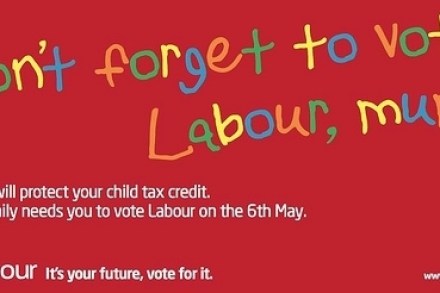
My gosh, these latest Labour posters are open for all kinds of spoofery. But at least they're positive and colouful - unlike Gordon Brown's performance in the TV debate last night.  Which, really, highlights Labour's fundamental problem during this campaign.  The big set-piece events have been almost relentlessly negative, whilst they've left what passes for a positive prospectus to posters which will barely make it past the confines of the political blogosphere.  But, never mind - Tony Blair thinks that "Labour's got every chance of succeeding."  So all's well then.

Ten reasons why this is a catastrophe for Brown and Labour

From our UK edition

Every politician will be thinking "there but for the grace of God..." today - but the Gillian Duffy incident is not just a gaffe. It is bad for Gordon Brown and Labour on very many levels. Here are ten of them.   1. The image of the Politburo pulling away in the Jag, slagging off the proles. This confirms the idea of an elite, who sneer at voters in private but try to charm them in public. And the idea that politicians (of all parties) say one thing on camera, and another when they think no one is listening. 2. The is not just a gaffe, but the PM on tape insulting the voters. It's the worst thing you can do in an election campaign (ie Obama¹s "cling to guns and religion" remark). Far worse than if Brown were, say, caught swearing, Nixon-style.

The ex-factor

From our UK edition

One of the interesting features of this election campaign is the near-absence of ex-leaders in national election roles. Tony Blair has been stuck in the Middle East because of the eruption of the Eyjafjallajökull volcano and has, at any rate, been “Gored” by Gordon Brown, who is as keen to have his predecessor canvassing for Labour as Al Gore was to see ex-president Bill Clinton in the 2000 election. The former Deputy Prime Minister John Prescott has been more active. For the Tories, Michael Howard is standing down and has not been particularly visible. When I saw him recently in Portcullis House, he looked chipper and relaxed – not like a man about to electioneer for all he is worth.

Why Not Vote Lib Dem?

From our UK edition

There is a terrible desperation about the Tory approach to the Lib Dem surge. There is a clear desire to find some sort of killer story about Nick Clegg or a killer strategy to reassert David Cameron's claim to be the candidate of change. What is odd is that Cameron seems to have forgotten what made him so attractive in 2005, which was that he was the candidate of the moderate, progressive centre ground.  The recession pushed the Conservative Party into the language of austerity - a message the British public is not yet ready to hear - and they have not recovered.  I have never understood why David Cameron and his allies stopped short of marching further onto the centre ground of British politics.

Are the Tories ready for joined-up government?

From our UK edition

The Civil Service is readying itself for a new government. The BBC has already reported a discussion of efficiency savings among senior officials. In another part of Whitehall, work is a foot on how to set up a National Security Council should the Tories win. I have in the last few weeks been interviewing ex-ministers and senior officials as research for a RUSI paper, due out soon after the election, on how to improve the government's security set-up. Traipsing around various departments, a number of interesting conclusions have come to light: - Conservative ideas for an NSC are not the same as the government's NSID committee, however much ministers say it is, but there is yet no clarity on the Tory detail of what one official called "the second layer" of reforms.

The Inter-Generational Election

From our UK edition

Geoffrey Wheatcroft has kicked off the election campaign with possibly the most depressing article I have ever read about British politics. Jetting off to the States for an academic engagement, the old curmudgeon says he feels no regret at missing an election in which he has lost interest.  This say more about the author of the piece than the election, which promises to be the most fascinating in my adult life. But then I am nearly twenty years younger than Mr Wheatcroft. His central argument is that the Labour and Conservative messages are uninspiring. The Labour government will admit that the situation is dire, but claim it would be worse under the Tories; the Tories will call for change, without having much to offer.

Grayling’s gay gaffe

From our UK edition

The Tories have weathered Chris Grayling’s gay gaffe. The story could only gain momentum if the papers had gone to town on it. They have not. The Times gives it a couple of paragraphs at the bottom of an inner page and even the Independent and the Guardian relegate it to the interior. The news agenda has gone into election over-drive, but I doubt this story would have had legs anyway, even before his denial. Grayling is no homophobe and whilst he voted for the Equality bill he is right that it should be applied with a soft-touch where the boundary between public and private space is blurred. The State should not dictate how you use your property unless you contravene criminal law by doing so.

The speed of schools reform

From our UK edition

Michael Gove is always worth listening to when he speaks on schools reform – offering passionate rhetoric supported by detailed policy. But this morning he excelled himself. If you want a clear sense of what the Tories have in mind for making "opportunity more equal," then I'd recommend you track down a copy of his presentation. I'll try to link to it, if it appears online later. One point that jumped out at me was when Gove said a Tory government would introduce a bill "within days" of entering power, aimed at "making it harder for bureaucracies to block the creation of new schools".  He added that he'd hope to get this signed off before Parliament breaks up for the summer.

Take that, Tony

From our UK edition

Yesterday, David Cameron offered a punchy response to Tony Blair's return to the frontline of British politics, saying: “It's nice to see him make a speech he's not being paid for”. But I reckon the more stinging rebuke might come today. Nestled in the schedule at today's Tory 'Big Society' event are two video messages from a couple of the most prominent independent political figures of the Blair era. The first is Anthony Seldon, the reform-minded headmaster of Wellington College, who has written numerous books on Blair, and who has recently done some eyecatching work on the big subject of Trust. And the second is Ray Mallon, the zero-tolerance elected mayor of Middlesbrough, who has been working to help communities and local groups act against youth crime.