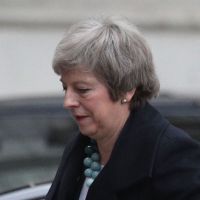
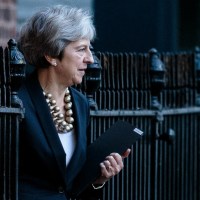
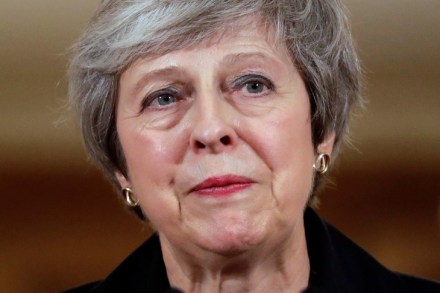
Theresa may

Diary – 10 January 2019

From our UK edition

As a hack who lived and breathed the financial crisis, you might think that at the start of 2008 and 2009 I would have been more anxious about what lay ahead than I am today. Wrong. In my understanding of the mechanistic link between a bust banking system and the wallop to our prosperity, I could at least broadcast about what needed to be done to clean up the mess. A problem understood is a mendable problem. I am more unsettled today than at any time in 35 years as a journalist because of a political paralysis that makes the destiny of this nation so uncertain. The Prime Minister’s Brexit plan, which would have us pay £39 billion for a largely unknown future relationship with the EU, is set to be defeated. But then what?

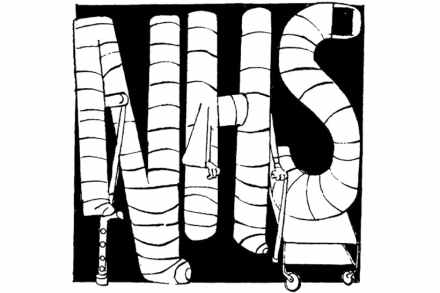
The NHS 10-year plan is a metaphor for Theresa May’s government

From our UK edition

Today's NHS 10-year plan is the health service's response to the £20.5 billion funding boost announced by ministers last year. The Prime Minister is unveiling further details of the plan this morning, with NHS England chief executive Simon Stevens doing his own broadcast tour to sell it. He argues that the plan 'tackles head-on the pressures our staff face' and also 'sets a practical, costed, phased route map for the NHS's priorities for care quality and outcomes improvement for the decade ahead'.

Sunday Shows Roundup: Theresa May – Meaningful Brexit vote will ‘definitely’ be in January

From our UK edition

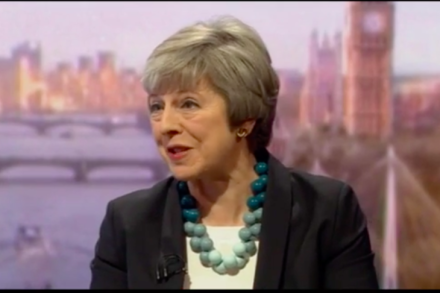
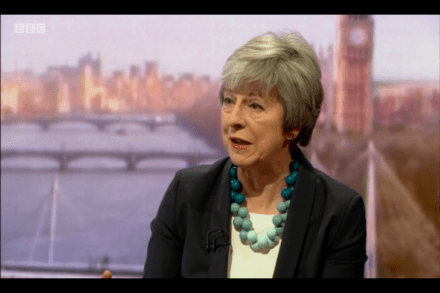
As MPs prepare to return to Westminster following the Christmas recess, the Prime Minister has given her first TV interview of the new year. With the deadline for Brexit fast approaching, Theresa May again put the case for her Brexit deal, on which she postponed a crucial Commons vote in December. Andrew Marr asked her if this time, the vote would definitely be going ahead: TM: Yes we are going to hold the vote... The debate will start next week and it will carry on until the following week, but we will be holding the vote. AM: We’re talking about the 15th or 14th? TM: That sort of timing, yes. However, when Marr asked if she would invite the Commons to vote for her deal again if it was rejected first time round, May was non-committal.

New Year, same old May

From our UK edition

Theresa May doesn’t yet have anything concrete to offer MPs who have concerns about her Brexit deal. On Marr this morning, May repeatedly talked about how she was seeking ‘assurances’ on the backstop. But she clearly hasn’t got them yet. Interestingly, May indicated that the assurances she’s looking for are around a start date for the new relationship; rather than a time limit or clearer exit mechanism. This would mean that the backstop would not be ‘indefinite’ as there’d be a start date for the future trade relationship. However, this approach immediately raises two questions. First, would the future relationship apply to the whole of the UK or just Great Britain?

The beginning is nigh

People do inexplicable things in January, like laying off drink for a month, taking out gym memberships they will never use, and making predictions about the year to come. As I shall not be ‘going dry’ this month or any other, and as I do not intend to alter a ‘fitness regime’ of afternoon naps in a sauna, the only remaining way to make a public fool of myself is to predict what will happen in 2019: 1. Look to the skies. I don’t know what a Super Blood Wolf Moon Eclipse is, but it’s coming to the US on the night of January 20. And the year will end with a transit of Mercury, and an annular eclipse over the Arabian Peninsula. I don’t know what that means, either, other than that the atmospherics aren't good. 2. The atmospherics are no better in the markets.

new years predictions

Where does May go from here?

From our UK edition

How does Theresa May break the Brexit logjam? Well, as I write in the Sun this morning, there are three ways to do this being discussed by Cabinet Ministers—the situation is now such that ministers don’t feel there’s anything disloyal about discussing contingency plans. The first option would see the government back an amendment to May’s deal when it comes to the Commons for a vote in January. The government would accept an amendment that added a sunset clause to the backstop, this would mean that it would expire after a defined period of time unless parliament voted to keep it going. With that change, May’s deal would have a fighting chance of passing the Commons. Some in government think that this might just be enough to win over the DUP.

A nebulous press conference: Theresa May insists progress made on backstop

From our UK edition

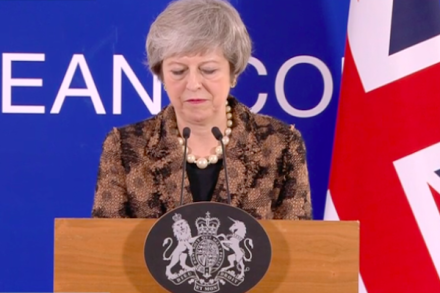
After a nightmare EU Council summit, Theresa May attempted to put on a brave face in her summit press conference. The Prime Minister told hacks that despite the fact the EU had refused to agree to her request for a 12 month limit to the backstop, progress had been made. As for that heated exchange between May and Jean Claude Juncker in which she appeared to call the European Commission president out for describing her as nebulous, that was merely the type of 'robust' conversation good friends can have. While there is reason to believe Juncker was being disingenuous in calling May 'nebulous' over her requests (the UK side insist the EU side know what it wants), this press conference did manage to fall into the nebulous category.

Brussels reject Theresa May’s plea for backstop concessions

From our UK edition

Theresa May's week has gone from bad to worse. In order to win the confidence vote tabled against her on Wednesday, May had to make several promises to her MPs: not to fight the next election, to get the DUP back on side – and to find a legally binding solution to the Irish backstop. The latter pledge appears to have already hit the buffers after a disastrous night for May at the EU council summit. The Prime Minister attended the summit on Wednesday evening in the hope of securing new concessions to her Brexit deal. She asked the EU 27 to 'work together intensely' to tweak the deal – with the UK suggesting a new target for a trade deal by the end of 2021, in order to show the backstop was not indefinite.

The confusion of the Confucians

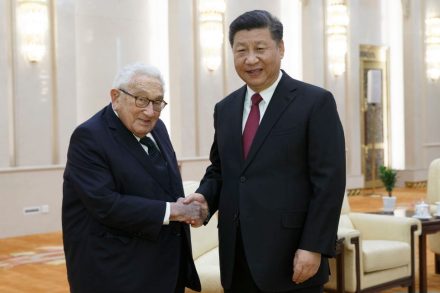
The French fight it out in the streets, the British leave it to their politicians to stab each other in the back, and Americans turn to the market. This is normal service in abnormal times. The turbulence affecting Western societies isn’t going to stop soon, and the ship cannot be steadied by the hand of government on the tiller, whether by small changes to the tax code or big subsidized boondoggles. In fact, the voters suspect that government — not government in principle, but government as practiced — is the problem. And they’re right. I’ve been in Washington, DC for a couple of days, so excuse the world-historical reflections. Two big changes are afoot in the world now, digitization and the shifting of global GDP away from the Euro-Atlantic region to Asia.

Kissinger

Brogues gallery

From our UK edition

I spend most of my time drawing politicians, trying to work out what makes them distinctive. The eyes, the expression, their mood: it’s all about finding people’s peculiarities and accentuating them. When I started, I’d focus on the face. Everything else was an afterthought. It wasn’t until I came across a drawing by the Norwegian cartoonist Finn Graff – a cartoon of Helmut Kohl, I think – that I realised what I had been missing. How much you can tell from someone’s shoes. I didn’t discover this, so much as rediscover it. When I was a teenager, I worked in a shoe shop in my home town of Arendal, Norway. I used to challenge myself to identify the right shoe for a customer the moment they walked in.

Victory? No, yesterday’s result weakens May’s authority still further

From our UK edition

Theresa May has survived the vote, but her authority is weakened still further. More than a third of Tory MPs have voted against her and this is after she pledged not to fight the next election and to get legally enforceable changes to the backstop. If May had kept the number of those voting against her below 100, it would have been a good result for her. If she had kept it to below 80, it would have strengthened her position considerably. But anything over 105 was always going to be tricky for her as that meant a 1/3rd of her MPs didn’t have confidence in her. This became truer as the day went on and May offered concessions to try and win over wavering MPs.

Heavy-handed rebel operation in no confidence vote deters Tory MPs

From our UK edition

One of the factors driving wavering Tory MPs towards saying they will vote for Theresa May tonight is the way in which the rebel operation appears to be being conducted. It's not just that the airwaves were dominated this morning by rather strident Brexiteers as opposed to MPs from a range of persuasions. It's also the heavy-handed language that May's opponents are using behind the scenes as they argue with colleagues. A number of MPs tell me they have been galvanised to support May after a 'fairly brutal' exchange in the Conservative MPs WhatsApp group in which Nadine Dorries, who has long called on May to consider her position, managed to insult her colleagues.

Number 10: Confidence vote is not about who leads the Tories into the next election

From our UK edition

Theresa May doesn't see today's vote of no confidence as being about who will lead the Conservative party into the next election, her spokesman has just said. This is significant as it removes the possibility that the Prime Minister sees today's result as being a mandate for her continuing as leader, when many Tory MPs do not want her to. This therefore makes it much easier for those MPs to support the Prime Minister this evening. Speaking to journalists after Prime Minister's Questions, her spokesman said: 'She does not believe that this vote today is about who leads the party into the next election. It is about whether it is sensible to change leader now.

How the Tory vote of no confidence in Theresa May will work

From our UK edition

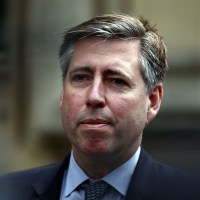
Two Tory MPs who are currently suspended from the party whip could be brought back in order to take part in today's vote of no confidence against Theresa May, 1922 Committee Chair Graham Brady revealed this morning. Briefing journalists on the vote, Brady said he was waiting for confirmation from the Chief Whip of the size of the Tory party electoral roll, and that it depended on whether Charlie Ephicke or Andrew Griffiths had the whip restored. Both men were suspended following allegations of sexual harassment, though the Conservative party concluded in November that no further action would be taken against Griffiths. Brady also said that any MPs who were unable to return to Westminster for the vote would be able to apply for a proxy vote by 4pm today, with the result announced at 9pm.

How No. 10’s shredded credibility could make today’s vote much closer

From our UK edition

One of the factors that led to the triggering of a no confidence vote and that will play a huge part in the result of that vote is the way in which Number 10 has shredded its credibility in the past few days. It isn't just the way in which Theresa May's press operation pushed back against rumours over the weekend that the meaningful vote on Brexit would be delayed, or the way in which ministers such as Michael Gove were still claiming that there wouldn't be a delay just hours before the announcement to the contrary. It's also that last night Downing Street was trying to dampen speculation that the 48 letters calling for the vote had been received.

Tory MPs talk up a swift Christmas leadership contest

From our UK edition

Theresa May will tonight face a confidence vote by her MPs. Conservative MPs will vote on her fate early evening – and the results are expected to be counted immediately. The arrival of 48 letters took government figures by surprise last night. While it was clear May's decision to shelve the vote on her Brexit deal had gone badly with chunks of Tory MPs ministers had seen its postponement as crucial to her short term survival. Now May will have to fight to stay on until that vote. Speaking to MPs in the Commons last night, it became clear that the hostilities towards May are far wider ranging than just the European Research Group.

Mounting speculation that the 48 letters are in

From our UK edition

The talk in Tory circles this evening is that the 48 letters are in. Two putative leadership campaigns are saying they are. But, perhaps more significantly, so is one close ally of the Prime Minister. There has, though, been no word from Sir Graham Brady, the chairman of the 1922 Committee. However, we wouldn’t expect him to say anything until he has spoken to Theresa May directly. If the letters are in, expect a quick vote. Tory MPs are on a three-line whip for Thursday and that would be the obvious time to have it. I think there is very little chance of Theresa May resigning before any vote. One long-time backbench ally of hers says that she is in ‘defiant mood’.

Can May really win back MPs’ trust?

From our UK edition

How can MPs trust what ministers say after the Brexit fiasco of the past few days? That’s been the theme of the Commons emergency debate on the meaningful vote so far, with phrases like ‘shredded her credibility’ being bandied about. Initially, the most stinging criticism came from opposition MPs, but those MPs are not the usual suspects who chant blandly about how you can ‘never trust the Tories’. They’re senior backbenchers like Hilary Benn and Angela Eagle. And they speak for a large number of Tory MPs, too, who feel that there is little reason to trust what a minister or indeed a whip tells them.

Speaker Bercow says MPs should get a say in delaying Brexit vote

From our UK edition

Speaker Bercow has told MPs that they do deserve a vote on the government’s plan to delay its Brexit deal vote. He told the Commons this afternoon that ‘any courteous, respectful and mature environment, allowing the House to have its say on the matter would be the right and obvious course to take’. We will find out more details on the procedural aspects of the government’s plan later when Andrea Leadsom gives a statement. Bercow’s statement shows why Labour were so keen to protect him as Speaker when his job was in peril over the bullying and harassment scandal. He was always likely to be an interventionist speaker over Brexit, and in this instance, he is making life as uncomfortable for the government as he possibly can.