Theresa may

Letters | 29 June 2017

From our UK edition

The Tory quagmire Sir: While the media has been preoccupied in divining what went wrong with the Conservatives’ appalling election result, Fraser Nelson (‘What are the Tories for?’, 24 June) neatly perceives some of the more obvious causes. Quite what possessed seemingly intelligent people to come up with so many half-baked ideas that found their way into a poorly thought-through manifesto is beyond comprehension. To witness the volte-faces was truly nauseating and not worthy of a party with such a long and distinguished record in government. The quagmire Mrs May finds herself in bodes poorly for both Brexit and a host of pressing domestic issues. The Tory party have an enviable economic story to tell — one that should be trumpeted from the rooftops.

France is finally looking forward to some Brit-bashing

From our UK edition

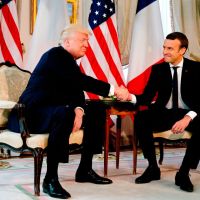
Was that a touch of gloating I detected last night as I watched the news on French television? The lead item was Donald Trump's acceptance of President Macron's invitation to attend the Bastille Day commemoration in Paris next month. It's always a prestigious occasion and this year marks the centenary of America's entry into WW1. Hence the invitation to the American president which came in a telephone conversation where the pair also agreed on a joint military response against the Syrian regime should Bashar al-Assad launch another chemical attack.

What the papers say: Is it time for a tax hike?

From our UK edition

The 48 per cent have spoken - and they want higher taxes, according to the British Social Attitudes survey. In the wake of a general election in which Labour won support based on a manifesto of free spending, is it time for a rethink on tax? And should we wave goodbye to the era of austerity? Here’s what today’s newspapers make of the case for a tax hike: We are ‘at a fiscal crossroads’, says the Daily Telegraph. During their dismal election campaign, the Tories 'failed to make the case for living within our means’ and the ‘public appetite for prudence’ appears to be waning.

Why May must stay

From our UK edition

Sometimes crises end simply because all of the participants are exhausted. Essentially, this is what has happened with the post-election Tory leadership crisis. No one has the energy for a fight, so Theresa May carries on as Prime Minister. Conservative MPs say it is now almost certain that she will make it to the summer break and will still be in place at party conference. If the coronation of a new leader could be arranged, things would be very different. But it can’t be. From the great offices of state down, the Tories are simply too split – over both policy and personnel – for the succession to be resolved without a contest.

The Corbyn coalition

From our UK edition

One of the most disappointing things about the general election for me was how few people must have read Nick Cohen’s article ‘Why You Shouldn’t Vote For Jeremy Corbyn’ before entering polling booths on 8 June. Or perhaps they did read it and thought: up yours, mate. The more I think about it, the more I suspect it’s a case of the latter. Mr Cohen, quoting from a Labour party member, listed the perfectly sensible reasons why sane people would not want Corbyn as prime minister.

Letter from a Corbynista

From our UK edition

Dear Uncle James, Thank you for your note (‘Letter to a Corbynista’, June 24). Firstly, of course we’re still friends, so there is no need to worry about that. The world would be a boring place if we all agreed on everything, and probably a backward one too if no one was challenged on their views. I should also explain my background for the benefit of readers not related to me. I come from a Conservative-voting family, I’m privately educated and I work as the financial controller of a multinational group. If there is a stereotypical Labour voter, or even a ‘Corbynista’, I’m not sure I’d fit the mould. In fact, some of my colleagues expressed surprise that I voted Labour, and had expected me to be a Conservative.

Theresa May diverts Grenfell blame onto Tony Blair

From our UK edition

It was the first PMQs since Mrs May crawled triumphantly back into Downing Street after her humiliating victory in the general election. She has brilliantly disposed of her cumbersome Commons majority – always a drawback to a statesman – and replaced it with a thrillingly unstable parliament and a government characterised by its ruthless indecision and single-minded hesitancy. The genius of Mrs May is to keep her gift for politics so fully concealed that it appears to be non-existent. And the historic alliance she has forged with her despised colleagues in the DUP looks set to endure for a hundred years. Or maybe days. The high-rise crisis dominated the session. We were given an update from the PM who told us that so far the cladding on just 102 buildings has been fire-tested.

Theresa May reassures Tory MPs at PMQs

From our UK edition

This PMQs was always going to be a very different affair for Theresa May. Post-election, her aura has gone and, for the first time, Jeremy Corbyn now has his benches behind him. Given the circumstances, Theresa May turned in one of her best PMQs performances. She has never been a natural at the despatch box, but she was solid today. Her performance will have reassured Tory MPs that she is able to keep going. Jeremy Corbyn began on the Grenfell fire. At first, his questions were detailed and precise. He got May to admit that her understanding is that the cladding on Grenfell tower was not compliant with building regulations. But then Corbyn went uber-partisan, blaming Grenfell on austerity and ‘disregard for working class communities’.

Why Philip Hammond will spend the Autumn down the back of the sofa

From our UK edition

The government is considering lifting the 1pc public sector pay cap in the autumn Budget. In the post PMQs briefing, a No 10 spokesman said they had 'heard the message' from the 'weary' electorate and would look at recommendations from review bodies on the issue. However, just hours later at the afternoon lobby briefing, hacks were given mixed messages. The Prime Minister's spokesman said 'the policy has not changed'. Now there are a few things to note here. Firstly, the fact they are even looking at the pay cap is a win for Labour. Not only have they tabled amendments to the Queens’ Speech calling for the cap to be dropped, it suggests that the Conservatives are losing the economic argument.

Theresa May will be feeling the heat at today’s PMQs

From our UK edition

What a very different atmosphere the House of Commons Chamber will have today for its first PMQs since the election. In the week before Parliament dissolved, Tory MPs were in a most obsequious mood, reciting the ‘strong and stable’ slogan that Theresa May started her campaign with, and even telling the Prime Minister that ‘I am confident that the country will be safe after the election under strong and stable leadership’ (sadly Peter Lilley, who made this prediction, stood down at the election and so is not in Parliament to offer his insight into how he feels about the state of the country now). It will be interesting to see if anyone bothers to praise May at all in this session.

While Theresa May retreats, the Tories must reform

From our UK edition

It’s hardly a surprise that the Tories aren’t pushing ahead with plans for new grammar schools, and hardly a surprise that Education Secretary Justine Greening confirmed this quietly in a written answer to a parliamentary question. They neither want to cause an upset with a policy not universally supported by Tory MPs when they now have no majority to pass it, nor draw attention to the fact that the party can no longer be a radical reforming force in Parliament. Greening wrote in an answer published today that ‘there was no education bill in the Queen’s Speech, and therefore the ban on opening new grammar schools will remain in place’.

Give the DUP a chance

From our UK edition

A political party barely known outside Northern Ireland now holds the balance of power in Parliament. Nobody saw it coming, but then that’s the new catchphrase in politics. So who are the DUP? And do they deserve the pillorying that has been coming their way since the general election catapulted them into the spotlight? I have been watching the party up close for decades. Yet while the DUP isn't always a pretty sight to behold, the party is much more complicated than the hysterical stereotyping makes out. It's true that the DUP has its roots in uncompromising unionism and religion. And for many years it was little more than a one-man’s fan club: the political extension of Ian Paisley’s hardline Free Presbyterian Church.

Labour’s nonsensical Brexit position is perfect opposition politics

From our UK edition

After Theresa May received a hostile response in Brussels, perhaps she was hoping for a more amiable reception today in the Chamber when she revealed more details of her pitch to EU nationals living in the UK. In a statement, the Prime Minister told MPs that hers was a fair and serious offer (confirming she remains opposed to European Court of Justice adjudicating on rights of EU nationals after Brexit) but went one step further – telling EU nationals: 'we want you to stay'. Alas, her words did little to appease Jeremy Corbyn. Boosted by rowdy opposition benches, he accused the government of treating EU nationals like bargaining chips.

Why some Tories are deeply worried about the DUP deal

From our UK edition

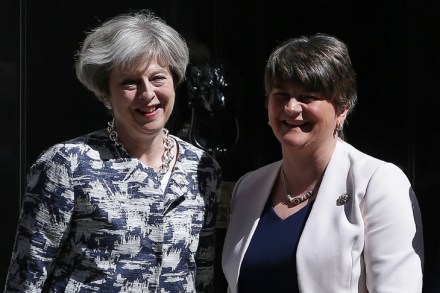
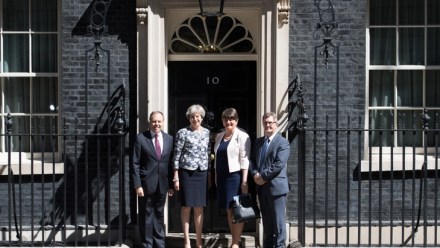
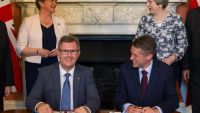
The Tory DUP deal has been signed in Downing Street this morning, the text of it is on the government website and there’ll be a statement in the Commons on it later. This is as formal as a confidence and supply deal can get. So, why were the Tories so keen on such a formal deal? Well, there were three reasons for it. The whips’ office wanted the certainty of a written agreement rather than having to survive hand to mouth; note that the deal was signed by the chief whip not the Prime Minister. The whips’ hope that this certainty will mean both that the government can get its business through and that there won’t be constant speculation about it collapsing.

What the papers say: Corbynism isn’t funny any more

From our UK edition

The laughing should stop, says the Sun, which calls Corbynism a ‘joke’ which ‘simply isn’t funny any more'. The Labour leader has now said himself that he could be PM within six months. If he does make it to Downing Street, ‘terrifyingly, says the Sun, Trident could be gone'. And in just a few days 'Corbyn would leave Britain open to attack’. A Corbyn government would also be ‘financially ruinous, militarily empty and so confused on Brexit and immigration that his own party contradicts itself at every turn’. After Corbyn’s rapturous reception over the weekend at Glastonbury, ‘let’s hope’ says the Sun, that the ‘enthusiasm’ for Corbyn ‘remains in a Somerset field’.

How Philip Hammond could be PM by October

From our UK edition

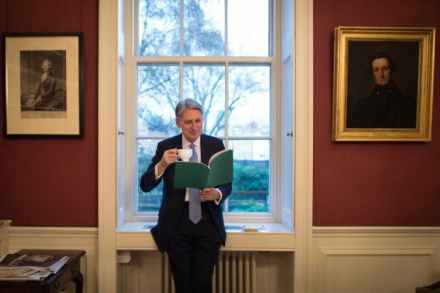
The biggest factor keeping Theresa May in office is the absence of an alternative Conservative leader with broad enough backing in the party to be crowned her successor, without causing a messy contest that could destabilise the party and put it out of power.  That is why some Tories are grimly resigned to Mrs May limping on until 2019 or so, when they hope Brexit talks may have come to something resembling a conclusion.  But there is an alternative scenario emerging. Philip Hammond is increasingly seen by some colleagues as the man to replace Mrs May in a relatively smooth and bloodless transition later this year.  The Chancellor's name has come up in several conversations I've had with Conservatives this week.

Why Theresa May’s position is safe, for now

From our UK edition

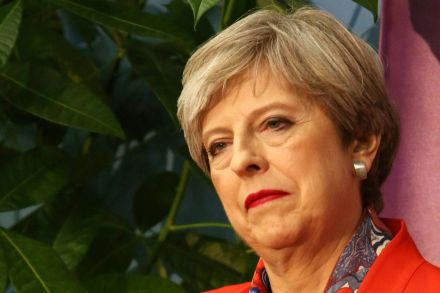
It would be hard to describe Theresa May’s post-election, premiership as anything other than weak. But, weirdly, this weakness is turning into something of a strength as I say in The Sun this morning. No one in the Cabinet thinks that May can recover sufficiently to lead the Tories into the next election, so no one is in a huge rush to replace her. May is also helped by the fact that there would have to be a leadership contest if she went. ‘No candidate is reconcilable with both Leave and Remain’ laments one Cabinet Minister who has explored whether a coronation would be possible. With no appetite for a time consuming and potentially bloody leadership race, May’s position is safe for the immediate future.

Why the right is losing its way

From our UK edition

If the British Conservative party is feeling stunned, having calamitously misread the public mood in a general election, then it is in good company. Across Europe, right-wing parties are struggling to find messages that resonate. It’s not that voters have turned away from conservative ideas: polls show a huge number interested in individual liberty, lower taxes and the nation state. The problem is that conservative parties have given up on those ideas — and, as a result, voters are giving up on them. Take Fredrik Reinfeldt, prime minister of my native Sweden between 2006 and 2014. He started off well, reforming welfare and cutting taxes. But then it all went downhill. He lost his taste for economic freedom and, with it, his edge.