Theresa may

Theresa May says she’s ‘in this for the long term’ – what does she mean by that?

From our UK edition

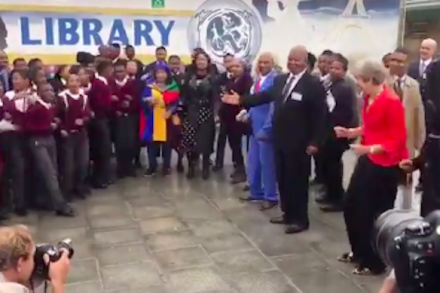
Until 5pm this evening, the main news from Theresa May's first trip to Africa as Prime Minister was that she isn't much good at dancing – after she attempted to join in on a dance with school children in Cape Town. However, the Maybot has since managed to set the news agenda alight by telling hacks that when it comes to her premiership she is 'in this for the long term'. Asked by the accompanying press pack, whether it was still her intention to lead her feuding party into the next election, May said she was in it for the 'long term' – adding that her focus right now is on delivering 'what the British people want'.

Watch: Theresa May puts on her dancing shoes

From our UK edition

With Brexit negotiations stuck at a stalemate and a warring cabinet to contend with in the UK, the famously robotic Theresa May could be forgiven for wanting to let her hair down as she begins her tour of South Africa today. Which could possibly explain why she decided to throw caution to the wind, and join in with a spot of dancing when visiting a senior school in Cape Town this morning: https://twitter.com/DIRCO_ZA/status/1034341700532142085 Although, Mr Steerpike thinks if her dance moves are anything to go by, the ‘Maybot’ may be struggling to fully let go of her inhibitions.

Washington Post: Theresa May could be one of the greatest prime ministers of our time

From our UK edition

There’s something going on across the pond. Less than twenty-four hours after Mr S informed readers of the New York Times’s struggle with the London foodie scene, Steerpike has come across another incident of an American journo who seems divorced from reality. The American Enterprise Institute's Dalibor Rohac has waded into the debate over where Theresa May, by the time she hangs up her heels and looks back on her legacy, will find herself in the pantheon of great British Prime Ministers. In the UK, that debate has been pretty much limited to three from bottom, two from bottom, or bottom. But across the pond, a more optimistic view is being taken.

The Boris burka row exposes Theresa May’s lack of political nous

From our UK edition

The Spectator's editorial ‘Bravo Boris’ (11 August) suggests that the treatment meted out to Boris Johnson by the Prime Minister and the party chairman makes a leadership challenge more likely. That is correct. This duo have demonstrated a breathtaking lack of political sophistication. Not only have they promoted Boris Johnson’s chances of the leadership, but they have also diverted the media spotlight from the Labour party’s very real anti-Semitism to a fictitious Tory party Islamophobia. Mr Johnson plainly argues a position that is more liberal than those of many European governments, including those of Denmark, France, Belgium and Germany.

The Spectator Podcast: Bluffers and Royals

From our UK edition

We often complain that our politicians are all bluffers who know very little about a lot. But is the very structure of our political institutions at fault? And speaking of bluffers, Theresa May is so far successfully fudging her way through the Brexit negotiations, but can she survive after March 2019? And last, maybe all this politics has made you long for the good old days of monarchy. With Prince Charles’s art collection on exhibit, we talk about how it reflects Charles’s One Nation Toryism. PPE – that notorious Oxford degree that ostensibly teaches its students Philosophy, Politics, and Economics – and apparently, how to govern a country. Or at least, how to sound like you’re governing.

Theresa May’s social housing plans are another step away from Cameronism

From our UK edition

These days Theresa May has less time to spend distancing herself from her predecessor. With blue-on-blue warfare rife and her premiership at a continual rocky patch, the Prime Minister's priorities tend to be getting through the day/week rather than killing David Cameron's pet projects. However, this week's social housing green paper serves as a reminder of the difference in their approaches. After leaving the coalition government, Nick Clegg recalled a senior Conservative minister telling him: 'I don't understand why you keep going on about the need for more social housing – it just creates Labour voters.' This dismissive attitude to social housing could be found in the policies the Cameron government adopted.

The Conservatives prepare for battle

From our UK edition

It’s been all out civil war in the Tory party since the disastrous snap election which saw Theresa May lose the Conservative majority. Now it looks as though the party, tired of all the infighting, might finally be turning their attention to Labour. A job advert on the site w4mp went up over the weekend for a Conservative ‘Battleground Manager’: Key tasks for the role include planning election campaigns, working out target seats, and taking the fight to the opposition. The ideal candidate will of course be a ‘self-starter,’ ‘manage multiple tasks under pressure,’ and have excellent campaigning skills.

What happened to Je Suis Charlie, Prime Minister? | 11 August 2018

From our UK edition

On January 11 2015, I was one of two million people who marched slowly and silently through Paris to honour the memory of the people slaughtered days earlier for being blasphemers and Jewish. It was an extraordinary day, an emotional one, too, soured only a little by the sight of presidents and prime ministers at the head of the march. These were the people who for years had been pretending there wasn't a problem with the rise throughout the West of political Islam. Now, following the murder of the Charlie Hebdo cartoonists and the shoppers in the Kosher supermarket, they had muscled their way to the front to claim they were the standard-bearers of liberty in the fight against an evil ideology.

Bravo Boris

From our UK edition

Ever since Boris Johnson resigned as foreign secretary, it was generally assumed that there would — in time — be a dramatic clash with Theresa May. But it was thought that the Prime Minister would pick her battle over a point of principle, perhaps on Europe, rather than over a joke in his Daily Telegraph column. Boris was defending the right of Muslims to wear what they like in public, but added that he thinks niqabs look like letterboxes. The ministerial reaction has been extraordinary, and deeply unedifying. Boris’s point was that, in banning the niqab, Denmark had passed a surprisingly illiberal piece of legislation — all the more surprising in that it has emerged from a country often viewed as a bastion of liberty.

Theresa May needs a Brexit back-up plan

From our UK edition

Since Chequers, the UK has been making a big diplomatic push to try and move the Brexit talks along. As I say in The Sun this morning, this has had some success. Inside government, the view is that the chances of a deal are inching up. There is also cautious optimism that the British message on the Irish backstop, that a customs border between Northern Ireland and the rest of the United Kingdom is unacceptable, has finally been understood. But Mrs May hasn’t had a breakthrough yet. There is no sign of the European Commission moving away from its position that the four freedoms of the single market can’t be separated.

Why Boris Johnson is now the favourite to succeed Theresa May

From our UK edition

As Theresa May and her ministers spend their summer holiday trying to convince European leaders of the merits of her widely-panned Chequers Brexit blueprint, one of her departed ministers has cause for celebration. According to the latest ConservativeHome poll of Tory members, since resigning as Foreign Secretary Boris Johnson has become the favourite among party members to be the next leader. Supported by nearly a third of members, this is an impressive turnaround given that a month ago – when he was still in government – he was backed by only 8 per cent of members.   However, it's also not that surprising. As I said in the i paper last week, Johnson looks to be on course to turn Theresa May’s Brexit disaster into his big opportunity.

Why have the Tories abandoned their promise to fight ‘burning injustices’?

From our UK edition

This week the Conservative Party quietly abandoned the promises made by Theresa May to the British people on the steps of Downing Street when becoming Prime Minister. As a then-new First Lord of the Treasury, May vowed to her fellow citizens that she would right the 'burning injustices' that confronted society’s worst-off and prevented them from meeting their fullest potential. The United Kingdom would, she said, 'be a country that works for everyone' and made reference to the disadvantages facing minorities in areas like the justice system.

Barnier’s dangerous assumption

From our UK edition

So what happens now Michel Barnier has laid into Theresa May’s customs plan? That’s the question I try and answer in my Sun column this morning. Those close to May are trying to downplay Barnier’s criticisms. One Cabinet Minister remarks, ‘It is not a great surprise. He’s been saying no all along’. This Minister’s view is that it is now ‘up to the member states’ what happens next. But they aren’t likely to come to the rescue of May’s plan: I understand that only a handful of them are interested in it. Barnier’s real aim, as May has told the Brexit inner Cabinet, is to keep Britain in a customs union with the EU. His calculation is that faced with a choice between a customs union and no deal, Britain will buckle.

Has Chequers been chucked?

From our UK edition

Theresa May heads to Italy this weekend for her summer holiday with her Brexit proposals hanging by a thread. Not only has the Chequers plan divided her party, led to front bench resignations and talk of a 'no confidence' vote, Brussels don't seem all that keen on it either. As James notes on Coffee House, Michel Barnier appeared to deal it a fatal blow in his joint press conference with Dominic Raab on Thursday. The EU's chief negotiator made clear that the UK collecting tariffs on behalf of the EU – a key plank of the proposal – was a non-starter: ‘The EU cannot and the EU will not delegate the application of its customs policy and rules and VAT and excises duty collection to a non-member who would not be subject to the EU’s governance structures.

Watch: Return of the Maybot

From our UK edition

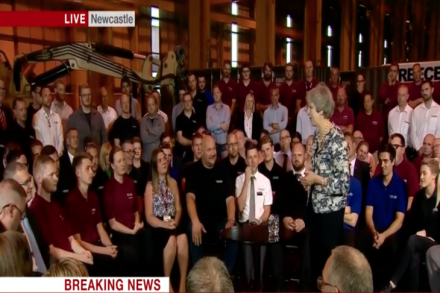
The Maybot is back. The Prime Minister has just been doing a Q and A with workers in Newcastle when she was asked how she likes to unwind. Here's what she had to say: 'There are several things I like to do. I like walking...I enjoy cooking, which has a benefit because you get to eat it as well as make it. I have over 150 cookbooks, so I spend quite a lot of time looking at cookbooks. And...I quite like watching NCIS when I can.' Time for a reboot?

Theresa May goes on tour – can the Prime Minister turn things around?

From our UK edition

On Tuesday, the House will – finally – rise for the summer recess. Before we get there, and with MPs on a one-line-whip, Theresa May is decamping from SW1 and taking her Cabinet to Gateshead for an away day. As well as a Cabinet meeting in Gateshead, May will take part in a Q and A with staff at a local business. This is the first stop in a series of visits over the summer holidays in which May and her ministers will attempt to sell her Brexit vision at home and abroad. When I suggested May did this just last week by embarking on a town hall tour to sell her Brexit blueprint, it was met with a healthy dose of scepticism.

Theresa May should enjoy her summer break, for the autumn will be her toughest time yet

From our UK edition

‘She’s safe until September’. That’s the verdict on Theresa May of one of those who knows the Tory parliamentary party best, I write in The Sun this morning. Number 10 want to use the summer to try and turn opinion around on Mrs May’s Chequers plan. Under consideration, is a plan for her to do events at various venues around the country to try and convince voters of the merits of it. Every Cabinet Minister has been told that they must devote one day over the summer to selling Chequers, including doing broadcast interviews on it. Ministers are already watching closely to see how Esther McVey, the Welfare Secretary, and the Aid Secretary Penny Mordaunt, who are known sceptics of the scheme, handle this request.

Theresa May’s Brexit fear is selling Britain short

From our UK edition

The EU is afraid of us, but we’ve got a prime minister who is afraid of the EU. The declaration by the European Commission that member states should prepare for ‘no deal’ is a powerful reminder that EU oligarchs are petrified that we will make a success of independence and expose the flaws in their dream of domination. They fear that we will reform our taxes and update our regulations to raise productivity and take market share from them. Their reaction is not to start improving their own competitiveness but to try to suppress our ability to compete, unfortunately with the willing compliance of the Chequers agreement and its anti-competitive ‘common rulebook’. Competition frightens the EU because it knows only too well what kind of people we are.

Boris Johnson’s resignation speech, full text

From our UK edition

Thank you Mr Speaker for granting me the opportunity to pay tribute to the men and women of the Foreign and Commonwealth Office, who have done an outstanding job over the last two years, and I am very proud that we have rallied the world against Russia’s barbaric use of chemical weapons with an unprecedented 28 countries joining together to expel 153 spies in protest at what happened in Salisbury. We have rejuvenated the Commonwealth with a superb summit that saw Zimbabwe back on the path to membership and Angola now wanting to join. And as I leave we are leading global campaigns against illegal wildlife trade and in favour of 12 years of quality education for every girl.

Theresa May’s premiership enters ‘last days of Rome’ mode

From our UK edition

'I used to worry that something bad would happen, now I worry that something catastrophic will happen.' This is how a Cabinet minister sums up the new political crisis facing the Conservative party – and soon the country. Last night one such catastrophe was narrowly avoided. The government managed to defeat the Tory rebel amendment calling for a customs union if frictionless trade was not agreed by January. Had they lost it, Theresa May's Brexit strategy would be dead in the water and the Whips allege that a confidence vote would have been brought – and an early election loom. The reason May avoided this fate? Labour rebels came to her rescue.