Renaissance

Antony Gormley: why sculpture is far superior to painting

From our UK edition

Antony Gormley: In the beginning was the thing! The reason I chose sculpture as a vocation was to escape words, to communicate in a physical way. It was a means of confronting the way things were, of getting to know them in material terms. The origins of making physical objects go back to before the advent of Homo sapiens, earlier even than the appearance of our Neanderthal cousins. Sculpture emerges from material culture. At the beginning there was an urge to make objects and you could argue that making them was the catalyst for the emergence of the modern mind.

Entertaining – but there’s one abomination: National Gallery’s Sin reviewed

From our UK edition

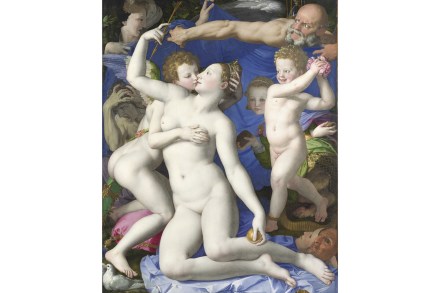
Obviously, we’re living through an era of censorious puritanism. Granted, the contemporary creeds are different from those of the 16th century. But the imperious self--righteousness is much the same — which gives the entertaining little exhibition at the National Gallery entitled Sin an unexpectedly contemporary edge. Personally, I’ve always thought that the doctrine of original sin has a great deal of explanatory power (it explains why history can’t ‘end’ and plenty of things will always go wrong — because that’s the way people are). Arguably, the medieval list of deadly failings — anger, pride, sloth, etc — provides a better summary of human nature than many later attempts.

Sumptuous and saucy: Compton Verney’s Cranach show reviewed

From our UK edition

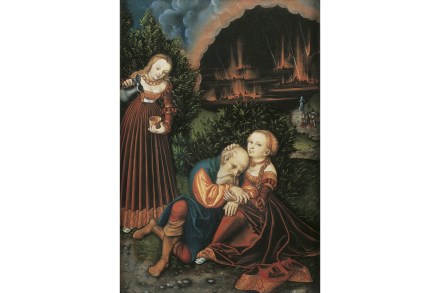
‘Naughty little nudes,’ my history of art teacher used to say of Cranach’s Eves and Venuses. Aren’t they just? Coquettish and compact. Kenneth Clark thought they had ‘chic’. Cranach’s nudes are rarely truly naked. They wear Ascot hats, golden chokers, filmy wisps of gossamer girdle. Take the goddess in the National Gallery’s ‘Cupid Complaining to Venus’ (c.1526–7). Don’t you long for her to take off her ostrich feather hat and tickle you with it? ‘Hallo, Jungs.’ See how she plays footsie with a branch of the tree. How she brushes the back of her hand against its trunk. Note the double necklace. Always accessorise.

To ‘review’ such supreme paintings is slightly absurd: Titian at the National Gallery reviewed

From our UK edition

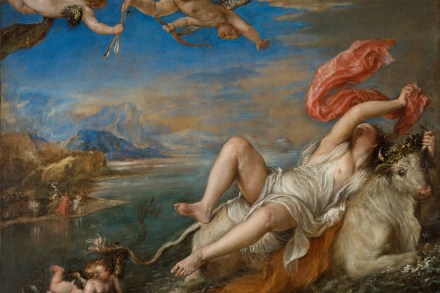
In 1576 Venice was gripped by plague. The island of the Lazzaretto Vecchio, on which the afflicted were crammed three to a bed, was compared to hell itself. In the midst of this horror Tiziano Vecellio, the greatest painter in Europe, died — apparently of something else. He was in his eighties and working, it seems, almost to the end. Titian: Love, Desire, Death, which was briefly on at the National Gallery, before it was closed down this week by our own plague, contained several of the greatest masterpieces of his old age — and also of European art. It comprises just seven canvases, all done for Philip II of Spain — a villain of English history, the man who launched the Armada, but as far as Titian was concerned his most discerning patron.

The shock of the nude

From our UK edition

Early in the 16th century, Fra Bartolomeo painted an altarpiece of St Sebastian for the church of San Marco in Florence. Though stuck full of arrows, the martyr was, according to Vasari, distinctly good-looking in this picture: ‘sweet in countenance, and likewise executed with corresponding beauty of person’. By and by the friars of San Marco discovered through the confessional that this image was giving rise to ‘light and evil thoughts’ among women in the congregation. It was removed and eventually sold to the King of France (who was presumably less bothered by that sort of thing). So even during the heyday of Michelangelo and Raphael depictions of human bodies without any clothes were not necessarily all about art.

Martin Gayford visits the greatest one-artist show on Earth

From our UK edition

For a good deal of this autumn, I was living in Venice. This wasn’t exactly a holiday, I’d like to point out, but a suitable place to work while beginning a new book. The result was, though, that week after week, when I had finished writing, I went for a stroll around the neighbourhood, Dorsoduro, which very quickly came to feel like home. One thing I realised as I wandered around, between buying the groceries and admiring the view, was just how crammed the city was with works by Tintoretto. There must have been well over 70 within a few minutes of the apartment where I was staying. There are other painters who are rightly classed as ‘Venetian’ — Titian, Veronese, Giorgione and the Bellini family among them.

Birth of a masterpiece

From our UK edition

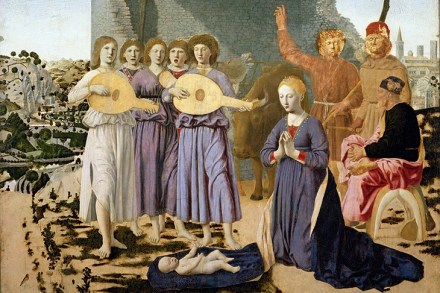
In the early 1370s an elderly Scandinavian woman living in Rome had a vision of the Nativity. Her name was Birgitta Birgersdotter, and she was later venerated as St Bridget of Sweden. In her account of the experience, transcribed by her confessor, she described herself as an eye witness. Her narrative began: ‘When I was present by the manger of the Lord in Bethlehem…’ Around a century later, Piero della Francesca (c.1412–92) used Bridget’s vision — or parts of it — as a starting point for a painting. This picture, now in the National Gallery, is one of the best-loved depictions of this immensely popular subject in the history of art. In some respects, Piero followed Bridget’s visionary account closely.

Renaissance man

From our UK edition

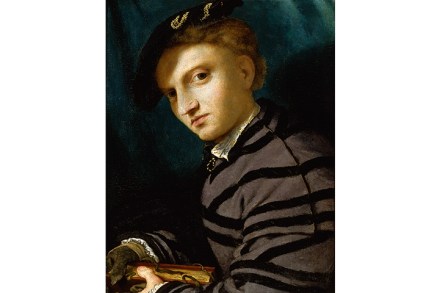
Lorenzo Lotto’s portraits — nervous, intense and enigmatic — are among the most memorable to be painted in 16th-century Italy, but his fellow Venetians didn’t see it that way. In a letter to Lotto of 1548, the poet and satirist Pietro Aretino wrote that he was ‘outclassed in the profession of painting’ by Titian. Now, though, with an exhibition of his portraits in store at the National Gallery next year, it looks as though Lotto’s time may finally have come. On a bright day this autumn my wife and I went on the trail of this most fascinating and idiosyncratic of Renaissance artists.

Face time | 15 November 2018

From our UK edition

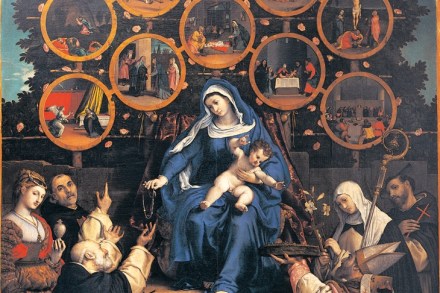
You can, perhaps, glimpse Lorenzo Lotto himself in the National Gallery’s marvellous exhibition, Lorenzo Lotto: Portraits. At the base of an altarpiece from 1541 a gaggle of paupers stretch their arms up in hopes of receiving the charity being handed out by Dominican friars above. One of these, a bearded, red-robed man, is supposed to be a self-portrait. If that is the case, it was a characteristic place to put himself. Lotto (1480/1–1556/7) was an intensely pious man and, in later life, poverty-stricken. But the most unusual point about this picture is that for the rest of the crowd of indigents he made studies from life of genuine poor people (and noted the modelling fee he paid them in his book of accounts).

The big sleep | 8 November 2018

From our UK edition

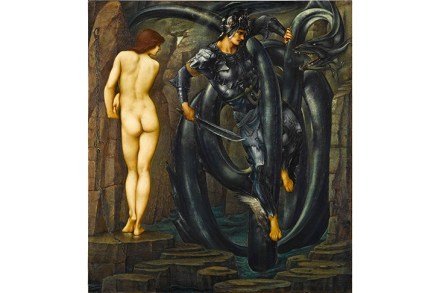
‘I want big things to do and vast spaces,’ Edward Burne-Jones wrote to his wife Georgiana in the 1870s. ‘And for common people to see them and say, “Oh! — only Oh!”’ That, however, was only the first part of my own reaction to the exhibition at Tate Britain of Burne-Jones’s works. Perhaps I’ve got a blind spot when it comes to B-J, but time and again I found myself thinking, ‘Oh no!’ Nonetheless, this comprehensive display and the accompanying catalogue give plenty of clues as to where he went wrong. Sir Edward Coley Burne-Jones (1833–98) followed an extremely unusual career path.

All together now | 18 October 2018

From our UK edition

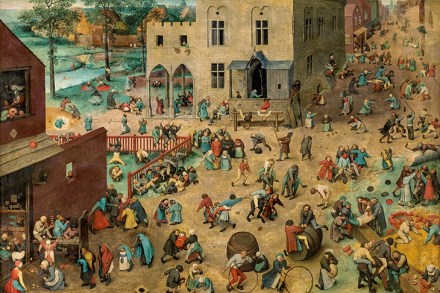
‘About suffering’, W.H. Auden memorably argued in his poem ‘Musée des Beaux Arts’, the old masters ‘were never wrong’. Great and terrible events — martyrdoms and nativities — took place amid everyday life, while other people were eating, opening a window or ‘just walking dully along’. As an example, Auden took ‘The Fall of Icarus’ by Pieter Bruegel the Elder. As it happens, Auden himself was wrong there, because the work he cited is no long thought to be by the painter after all. This picture is not, therefore, included in the exhibition Bruegel at the Kunsthistorisches Museum, Vienna.

The stirrer and the monk

From our UK edition

Sometimes Andrea Mantegna was just showing off. For the Palazzo Ducale in Mantua, he painted a false ceiling above the Camera degli Sposi. Around a great trompe l’oeil oculus, apparently open to the sky, assorted gawpers and cherubs lean nosily over the parapet: ‘What’s going on down there, then?’ Only the Duke and Duchess of Gonzaga entertaining their friends from Ferrara. A terracotta pot is half off the edge, supported only by a thin rod. One nudge from a misbehaving putto and — whoops! — just missed the Duchess. Some of the putti stick their heads through the trellis. Another stands on a ledge, flashing us his bare, plump, crinkly bottom, brilliantly foreshortened by Mantegna. Giovanni Bellini’s figures tend not to show us their bums.

The little cloth dyer who made it big

From our UK edition

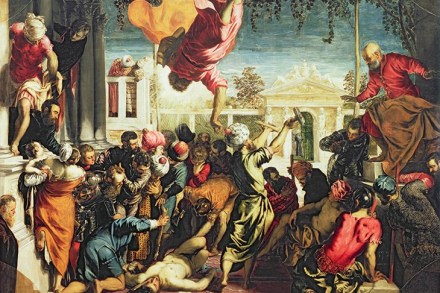
Tintoretto was il Furioso. He was a lightning flash or a thunderbolt, a storm in La Serenissima of Renaissance Italy, a maverick and a cheat. One of his friends, a fellow Venetian, likened him to a peppercorn overwhelming ten bunches of poppies. More often than not, those poppies were rival artists. He trampled them like an overgrown child. Henry James said that ‘if Shakespeare is the greatest of poets, Tintoretto is assuredly the greatest of painters’. He was at least the most aggressive. A series of exhibitions opens in Venice this autumn to mark the 500th anniversary of Tintoretto’s birth. If they show him to be half as devious as his first biographers described him, then it will be all anyone can do to salvage his good name.

All black and white

From our UK edition

Leonardo da Vinci thought sculpting a messy business. The sculptor, he pointed out, has to bang away with a hammer, getting covered in the process with a nasty mixture of dust and sweat. In contrast the painter can sit at his easel, dressed like a gentleman, and portray the whole wide world and everything in it. (Michelangelo, not surprisingly, disagreed.) Such spats were by-products of the paragone — a sort of Punch-and-Judy debate, much enjoyed in 16th-century Italy, about which of the arts was the most powerful. Intriguingly, the National Gallery has revived the paragone in one section of its new exhibition, Monochrome.

The journey of Adam and Eve

From our UK edition

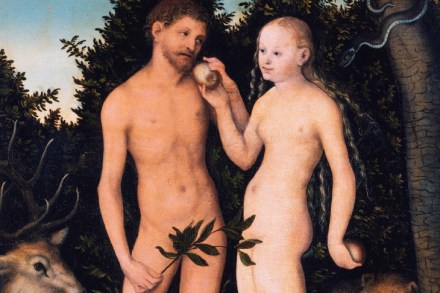
Trying to reconcile a belief in the literal truth of the Bible with the facts of the world as we observe it has never been the easiest of things. But heaven knows, people did try. Well enough known, I suppose, is the work of the 17th-century Archbishop of Armagh, James Ussher, who totted up all those begats to establish that the creation of the earth took place at six in the afternoon on 23 October 4005 bc. (‘He added,’ reports Stephen Greenblatt, ‘that Adam and Eve were driven from Paradise on Monday, November 10.’) In like manner, in the 18th century, a French mathematician called Denis Henrion calculated, from a bunch of what were presumably dinosaur bones, that Adam had been 123’ 8” tall and that Eve had been 118’ 9”.

Silent films

From our UK edition

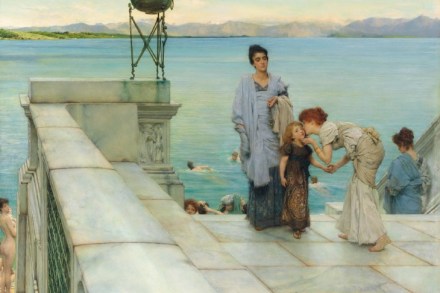
On 15 September 1888 Vincent van Gogh was intrigued to read an account of an up-to-date artist’s house in the literary supplement of Le Figaro. This described a purple house in the middle of a garden, the paths of which were made of yellow sand. The walls were glass bricks ‘in the shape of purple eggs’. Such aesthetic dwellings were all the rage; Van Gogh dreamed of having one himself in Arles. But as one learns from an exhibition at Leighton House, it was another 19th-century Dutch artist, Lawrence Alma-Tadema, who actually inhabited two such establishments — one off Regent’s Park, the other in St John’s Wood. On paper, Van Gogh and Alma-Tadema have a great deal in common.

The better angels of our nature

From our UK edition

Late one afternoon, early in the year, I was walking through the Vatican Stanze with a small group of critics and art historians. While we were admiring the Raphael frescoes that fill these private apartments of the Renaissance popes, Matthias Wivel, curator of the Michelangelo & Sebastiano exhibition at the National Gallery, made the most eloquent case for the painter I have ever heard. Suddenly, I felt a new enthusiasm for Raphael. Essentially what he said is that Raphael is the supreme master of depicting human beings in interaction. Each of the frescoes around us, Wivel pointed out, was made up of a huge number of figures, all engaged with each other in fluently orchestrated groups.

The odd couple | 16 March 2017

From our UK edition

Only once did Michelangelo sign a sculpture. It was the ‘Pietà’ of 1497–1500, and he did so using an incomplete sentence in the past imperfect: ‘Michelangelo Buonarroti the Florentine was making…’. The implication was that actually completing a perfect masterpiece was an unattainable goal, so instead he just had to leave off (a great many artists still feel the same about finishing a picture). The ‘Pietà’ is included in Michelangelo & Sebastiano, a remarkably ambitious new exhibition at the National Gallery: not, of course, the original marble, which remains in St Peter’s, but a plaster cast from 1975.

Home help

From our UK edition

There have been many explanations for what happened in the Italian Renaissance. Some stress the revival of classical antiquity, others the rise of individualism. A pioneering exhibition at the Fitzwilliam Museum, Cambridge, Madonnas and Miracles: The Holy Home in Renaissance Italy, takes a different line. It’s all about the 15th- and 16th-century household — and the religious furnishings and fittings it contained. To a 21st-century eye some of these are distinctly bizarre. Early on, there is a painting of the ‘Madonna and Child’ by a follower of Filippo Lippi — just the kind of thing one expects to find in an art gallery. Underneath it is a brightly painted wooden figure of the infant Christ, very similar to the one in the picture.

Passing through Bologna

From our UK edition

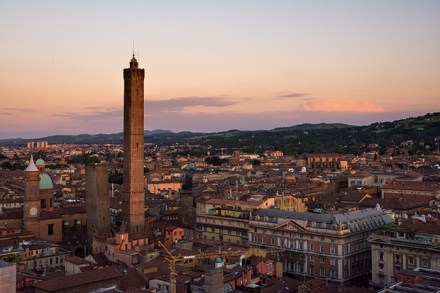
Sooner or later, no matter where you are travelling on Italian railways, you are likely to pass through Bologna Centrale. The city is the main junction between the north and south of the country, close to the route through the mountains. It always has been. The teenage Michelangelo stopped off while journeying between Venice and Florence, and — after a contretemps at the customs office, since Bologna was then a city state — carved some small sculptures for the Basilica of San Domenico. In 1786 Goethe spent a few days in this ‘venerable, learned’ place, ‘thronged with people’. It still is all those things. In the 21st century, however, not too many linger — as Goethe did — to look at the paintings or eat the marvellous food.