Quarantine

The Canadian wildfire is a reboot of Covid panic mode

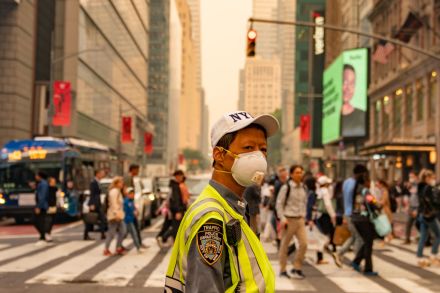
I was skeptical when my children arrived home from school Wednesday and informed me they could not play outside, irritated when they used the faculty fearmongering to demand screen time, irate when we pulled into the drop-off line Thursday morning. There was the crossing guard in an N95, a teacher in the same. A small boy was wrapped in useless cloth, dragged to the front steps by a mother sporting a surgical mask and a smart business suit. Evidently, cartoonish shoulder pads are making a comeback after a three-decade slumber, but mass panic barely had time to take a nap here in Washington before bureaucrats roused it in the name of public safety. It feels as though we are living in a horror movie and a particular one at that: the rushed sequel to a surprise box office hit.
wildfire canada covid

Reading during a pandemic

The experience of having Covid is, by now, well-documented. You spend seven to ten days in your room or house feeling ill and sorry for yourself. The world outside becomes a distant dream, and one of the few pleasures of spending twenty-four hours a day in bed is the time to read. This winter, the Omicron bell tolled for me — as it seemed to do for half of the global population. I was very lucky with the virus: after two days of unbelievable complaining and texting everyone I knew to tell them I was either like Beth in Little Women or a fevered Marianne in Sense and Sensibility, I recovered from my gothic heroine-like swoon and set about ploughing through novels. At the outset, there were endless articles and tweets about what one should read during a pandemic.

How’s ‘shutting down the virus’ going, Joe?

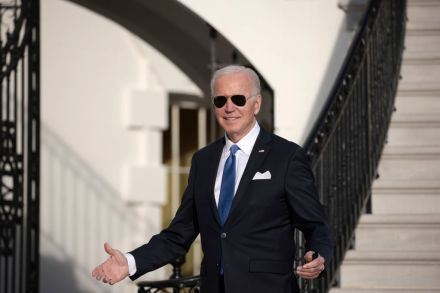
We are less than a month away from entering 2022 — so why does it feel like March 2020 all over again? Cable news networks are obsessively covering the new Omicron variant of Covid-19. They are hellbent on scaring the daylights out of any unsuspecting viewer who accidentally flips onto their programs. To be fair, the media is taking cues from the president. According to the Washington Post, the Biden administration is reportedly weighing up a seven-day self-quarantine for all travelers arriving on our shores, regardless of vaccination status, including US citizens and permanent residents. Travel bans, which fell out of fashion in the Trump years because they were "xenophobic", are suddenly back in vogue. It all begs the question: didn’t Joe Biden promise to shut down the virus?

biden quarantine

Donald McNeil described Americans as ‘selfish pigs’ in email to Fauci

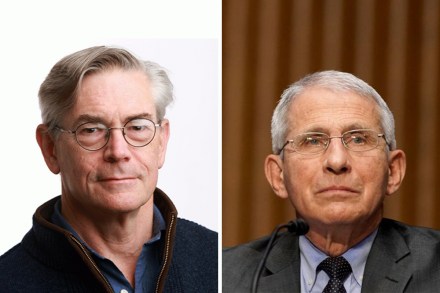
There are some wondrous revelations in Dr Anthony Fauci's over-3,200-page email trove acquired by BuzzFeed and the Washington Post through the Freedom of Information Act. A number of people — particularly Republican politicians — are fixating on the several emails from other experts mentioning the possibility that the SARS-CoV-2 virus may have been engineered at and emerged from the Wuhan Institute of Virology. They are right to do so — but there are some other gems in there too. A tipster pointed Cockburn to a February 2020 email from then-New York Times science writer Donald G. McNeil Jr, in which he describes how Americans 'tend to act like selfish pigs'. In contrast, McNeil tells Fauci that 'a lot of average Chinese behaved incredibly heroically'.

mcneil

Homes, sweet homes

The moment lockdown restrictions eased, my wife Anna booked up trips to Europe, to visit houses and villages I thought I’d never see again, such were the initial predictions about the zombie apocalypse. I’d not been to Barenton, Normandy, for example, since last autumn, but that hadn’t stopped the plumber and the builder from sending me regular bills. It is in this decaying granite villa, stretching over four floors, that the accumulated junk from the Herefordshire Balkans has been shoved — thousands of books, crates of manuscripts and letters, the children’s toys, even the children. Oscar, the middle son, spent time here, depleting the cellar after he broke up with a girlfriend. He ran back to England terrified when a mouse leapt out of an oven glove.

homes

Killing time in Thailand

Thailand is famous for many things, some of which are unmentionable in these pages. It has long been considered the perfect location for ‘winter sun’, if you are the type of person to whom a piña colada on a white sandy beach appeals. In recent years, it has become a hotspot for hypochondriacs requiring non-essential medical care and hysterics after a nip-and-tuck (pre-COVID, the health-tourism industry was thought to be growing at 14 percent a year). Home to the orchid, pad thai, the Monkey Buffet festival (what it says on the tin), the Siamese cat and the bumblebee bat, Thailand’s gentle and healing culture has earned it a reputation as a cleaner, greener land.

thailand

Cooking for dad: real food is nothing fancy

I fled New York City in March for my hometown in Pennsylvania. I brought with me one suitcase, a good chunk of it filled by my favorite book: the bestselling Nothing Fancy by Alison Roman of the New York Times. I’m now facing weeks here with three shirts and an impractical selection of underwear, but I regret nothing about my packing. As my father drove up the turnpike to evacuate me, I had decided in a burst of wartime can-do spirit that my contribution to the household would consist in cooking for the family, and damn if I wasn’t going to make a go of it. There was more than a little self-interest in this idea. Like all middle children, I long for a chance to shine in front of my family.

alison roman

Lockdown is over. Someone tell the government

The coronavirus shutdown is over by public demand. There are crowds of sunbathers in the parks of New York City and mobs on the steps of the statehouses. Pedestrian and road traffic are rising and businesses are defying orders by informally reopening. The people are speaking — the people who used to work on a hand-to-mouth economy, the people who cannot afford to stay indoors indefinitely, the people who cannot be bothered to stay in when the sun comes out.These people are not all the people. They are not the doctors, who counsel caution. They are not the state governors, who are terrified of votes being washed away by a post-reopening second wave of casualties. They are not state employees, who can trust that their jobs will be waiting for them.

lockdown
myself

It’s gonna be a long day with myself

I wake up confused. Oh. This is really happening. I wasn’t dreaming that the entire world is on house arrest. It’s actually real. I’m disoriented. What day is it? What month is it? What is time anyway? I’ve lost all concept of it. Am I in Vegas? Oh that’s right, Vegas is closed. Today is going to be the day. The day I live my best quarantine life. I’ll practice guitar and spend an hour learning Arabic and bake sourdough bread and do some YouTube workouts. This is the 19th day in a row I’ve said that. Who am I kidding? I don’t even own a guitar. And where the hell am I gonna use Arabic other than when I’m binge-watching Jack Ryan? Again. I don’t trust the subtitles. I don’t trust anything anymore. Except the mirrors.

The changes to come in the post-COVID world order

The Democrats are taking their stand on the coronavirus crisis in an untenable position. It is like building a defensive redoubt in a valley surrounded by hills in the hands of the enemy (like the French at Dien Bien Phu in 1955, as President Eisenhower warned them). Whether this is tactical stupidity by the president’s enemies or strategic genius by the president or — more likely — a bit of both, is not clear except to insiders. Readers will recall that the Democrats charged out of the gate on the issue of taking science seriously and reacting comprehensively; the president picked up the gauntlet, brought prominent scientists forward, and 'flattened the curve'.

changes come covid pakistan

Why men don’t read books anymore

When John F. Kennedy was dating Jacqueline Bouvier, he gave her two books. One was Pilgrim’s Way (1940) a memoir by the British spy and author John Buchan. The other was The Young Melbourne (1939) by Lord David Cecil, which describes the raffish exploits and political intrigues of a Whig aristocrat, and later prime minister, in the early 19th century. Quite what Jackie thought of this is unrecorded. Later President Kennedy told Life magazine what his favorite books were. Both of the titles above were in this proto-listicle, along with works about Byron, John C. Calhoun, Talleyrand and Gibbon’s The Decline and Fall of The Roman Empire.

read books
connected lockdown heads covid-19

Heads in the cloud

‘Nothing will ever be the same again.’ You hear a lot of that glibly categorical punditry around the COVID-19 outbreak. Already, the progress of a mindless virus through the human population is being touted as the herald of the reorganization of the world’s economic system and the end of neoliberalism, the harbinger of a world in which nurses and shelf-stackers are valued more highly than investment bankers. Well, we’ll see. There are, as has been often said, two great things of which we can always be certain: death and taxes. The former is currently enjoying a bit of a moment. But the latter, sooner or later, is going to make the sort of roaring comeback not seen since First Blood Part II.

Why Joe Biden’s America loves a lockdown

COVID-19, the Wuhan virus, is an epidemiological scourge — but it’s also a clarifying catalyst for American politics. The virus’s relevance for globalization has been widely noted: this disease of Chinese origin has exposed how incapable the de-industrialized West has become of providing its own masks, drugs, and ventilators. It has highlighted the class divide that globalization produces within countries such as America as well. The highly educated professional classes can work from home, and their jobs are relatively secure; the service class, on the other hand — the waiters and cooks and hotel maids and retail clerks and others — are out of their jobs and shit out of luck. Not to worry: the professional class will write all of them checks for $1,200.

joe biden lockdown

Liberate…Michael Cohen?

President Trump sent out a number of tweets today demanding liberation, but he probably wasn’t thinking of his old fixer Michael Cohen. Cohen, who squealed on Donald Trump before Congress, went to jail for a variety of financial and campaign finance crimes. Thanks to the coronavirus, his own problem is largely fixed. He’s getting an early reprieve from his three-year jail sentence at a medium-security prison in Otisville, New York and headed for home confinement. Another member of Trump’s rogues gallery, Paul Manafort, has asked to be released from Loretto federal prison in Pennsylvania because of the pandemic, but there’s no word yet whether his request will be granted. Unlike Cohen, Manafort remained unflinching.

liberate michael cohen
cowardice

Coronavirus lockdowns are cowardice

This is a piece about death. Obviously death is a serious topic, perhaps as serious as anything you could possibly write about, but in these truly weird times of a global pandemic and unprecedented threat to what most people would conceive as normality, let’s start with a joke. How do you make ordinary citizens accept an indefinite period of economic shutdown and deprivation of their most basic civil liberties? Two weeks at a time!There seems to be a bit of a trend regarding disclaimers among those who have an opinion in favor of a return to everyday life anytime soon so I’ll start with the usual caveats: I accept that coronavirus, COVID-19, SARS-CoV-2 or whatever you prefer to call it, is a serious health threat.

Trump walks the recovery tightrope

President Trump’s decision to set the United States back on the path to work will be decried as mere politics, but it is the right decision. It is the task of politicians to consider the general welfare. This consideration sets the current emergency against the coming one, the need to reduce deaths from COVID-19 against the need to forestall the human cost of an economy in open-ended limbo. The data on COVID-19 remains insufficient and will probably remain so. The economic prognosis is, however, clearer, and we have the data too.The IMF is warning that a prolonged shutdown will lead to a Thirties’-style Depression.

recovery
climbing

Climbing the walls

Colombo In January, I promised a visiting Army reservist friend that we’d climb Adam’s Peak. That plan was scotched when I came down with dengue fever. But I’d climbed Adam’s Peak before (the first time, Christmas 2004, when the tsunami struck, probably saved my life) and there would always be another chance to do it, right? Things change. Like everyone else in town, I was already bored and irritable from the first week of our lockdown when I saw a burst of British news items on COVID-19 nixing Everest expeditions, pensioners trying to keep fit indoors and some chap figuring out how many stairs it took to ‘top’ the mountains of the British Isles. Challenge accepted.

COVID in Colorado

Denver, Colorado is not New York City. There are not thousands of people stacked on top of one another here. To borrow from Arcade Fire, it’s a ‘massive sprawl with mountains beyond mountains’. The population skews toward young professionals in the downtown area and upper middle class families in the immediate suburbs. It’s a city and a state full of recreationalists, participating in a natural social distancing of the mountains in Aspen So how does a city population known for their isolated outdoor activities handle a statewide lockdown order, like the one issued by first-term Gov. Jared Polis on March 25? Colorado faced the grim reality of ranking within the top 15 states for reported cases of COVID-19.

denver colorado
liquor alexandria northern virginia

Lacking liquor in Northern Virginia

It’s been one day since Northern Virginia closed its liquor stores and already civilization has collapsed. Fires burn on the horizon as the cry of the sober mob reverberates through the streets. People nail boards over their windows and spray paint ‘NO VODKA’ on them. Yuppies have descended into the underground Metro stations, where rumor is they’ve become something less than human. Harvesters, we call them, and last night they came for my friend Bone Saw… That, of course, is not what’s happened in Virginia since the state ordered the temporary closing of some liquor stores last week. Life in the quarantined DC suburbs has mostly continued as usual.

Actually, it’s not ‘OK’

‘It’s ok’ is a meme that enables lazy millennials across social media to bail on plans last minute in favor of wallowing in self-pity. It seemed to have already completed its meme rounds, having come to its satirical end in January. Now, however, ‘It’s ok’ has experienced a resurgence — thanks to Lord COVID.Social media has been even more drowned in comforting posts than normal. ‘It’s ok’ posts are in overdrive. Would-be influencers insist, ‘It’s ok to eat chips three meals in a row,’ ‘It’s ok to do literally nothing!

ok