Politics

College-town blues

College towns are “decimating the GOP,” reported Politico in July, the reason being, in part, that “more college students and more faculty tend to be a recipe for more Democratic votes.” The college-town blues are a phenomenon with which I’m quite familiar. I live in Philipsburg, an old lumber and coal-mining town about twenty-five miles from State College, home to Pennsylvania State University. Though we’re in the same county, “the mountain” separates us physically, and as for politics... well, at last month’s Rush Township supervisors meeting, an old-timer floated the idea of seceding from Centre County (his main concern being that Centre County requires emissions testing on vehicles, and neighboring red counties don’t).

college

Markwayne Mullin: the Senate’s stoic brawler

Stilwell, Oklahoma Out of the ancient belly of the earth and through the pitch-black night, the giant wigwam rises, gold-tinged and glorious, the glint of rare winnings and the sound of 2,000-plus slot machines rolling toward despair rollicking through the dark in east Oklahoma. Inside, the electric-fused honkytonk band blares Del Shannon’s “Runaway” — “And I wonder, I wa- wa- wa- wa- wonder” — from a starlight backlit stage above the sea of penny slots, the bald lead singer strumming a skull-festooned full bass as he sweats through his camo shirt. Outside, there is a distinct noise coming from beneath a neon-yellow Maserati where a timber rattlesnake has found a warm asphalt home.

mullin

Inside RFK Jr.’s kooky White House quest

After Linda Como, a sixty-four-year-old administrative assistant from Quincy, Massachusetts, was fired from her hospital job for refusing to be vaccinated against Covid, she discovered Robert F. Kennedy Jr.’s anti-vaccine activism, and it resonated with her. But that’s not the only reason Como came to the Boston Park Plaza hotel one morning in April to see Kennedy launch his long-shot 2024 presidential campaign. “I grew up in Boston, went to Boston public schools, so you know the Kennedy family,” Como told me. “They’re like the royal family. So I’ve always been a fan of the Kennedys.” Kennedy lore runs deep in Boston. This is where Robert Kennedy’s father Robert F. Kennedy and his uncles John F. Kennedy and Edward M.

RFK Jr
republic

Is America a republic in name only?

Is the United States a one-party state? Surely not. Just look at the ballots the next time you vote. There are nearly always Republican as well as Democratic candidates, and often there are candidates from other parties as well (Green, Working Families, Libertarian, etc.). But when you go beyond the labels, what do you find? Tucker Carlson, a recent victim of the uniparty monopoly, put it very well. “Suddenly, the United States looks very much like a one-party state,” he said in a post-Fox video. “That’s a depressing realization,” he added. “But it’s not permanent.” I think he is right about both things: the depressing reality that the United States looks more and more like a one-party state and the fact that the situation is not, at least not necessarily, permanent.

heritage

Can the Heritage Foundation unite the right?

Last September I was sitting in the crowd at the annual National Conservatism Conference, lamenting the fact that my hotel room had no hot water, when Dr. Kevin Roberts, the president of the Heritage Foundation, took the stage at Miami’s JW Marriott for his plenary address. Nationalists and populists at the conference were suspicious of Dr. Roberts’s presence. The “New Right” had spent the past few years accusing the right-wing establishment, including the cache of center-right DC-based think tanks like Heritage, of selling out ordinary Americans for profit and influence.

White House braces for its biggest immigration test yet

Ever since Biden took office, immigration has been one of those things his administration would rather not talk about. It’s not hard to understand why. The polls show a consistent and heavy slant in favor of the Republican Party on the issue; internal Democratic Party divisions (between pro-immigration liberals and open-border absolutists) make for awkward conversations; and a president and party that opted for moral outrage on the issue in opposition struggled with the transition to power — which brings with it the difficult tradeoffs inherent to immigration policymaking.

How Karl Hess went from Mr. ‘Ultra-Conservative’ to supporter of the New Left

Some of the more interesting political figures of our day — Tulsi Gabbard, Glenn Greenwald, Tucker Carlson — crossed the street to find new friends, but few in our history have ever switched teams with the dramatic flair of Karl Hess, the centenary of whose birth we will toast this May 25. Born in Washington, DC to a beautiful switchboard operator and a rakish Filipino millionaire, Karl Hess quit school at fifteen and embarked on a career that turned into an anti-career. He was a police reporter, a Newsweek editor, a corporate flack, a Republican ghostwriter, and, ultimately, Barry Goldwater’s speechwriter and traveling companion during the Arizona senator’s 1964 presidential candidacy.

hess

The other DeSantis

The woman with a starring role in perhaps the most talked about campaign ads of both the 2018 and 2022 election cycles wasn’t on the ballot. In both, a politician whose stock has risen as much as anyone’s in the last half decade was happy to let his wife do the talking. Five years ago, Casey DeSantis narrated a thirty-second clip in which she testified to her husband Ron’s admiration for Donald Trump. You’ve probably seen it. “Everyone knows my husband is endorsed by President Trump, but he’s also an amazing dad. Ron loves playing with the kids,” says Casey. The ad cuts to footage of the Republican gubernatorial candidate building a toy wall with one child, reading The Art of the Deal to another, and so on. “People say he’s all Trump,” says Casey.

Casey

Why the national divorce worked: a future history

The following is an excerpt from Yale University law professor Elizabeth Friedkin’s remarks to the 2026 International Federation of United Conscious Uncoupling Professionals. When then-Representative Marjorie Taylor Greene first proposed the dissolution of the United States of America in 2023, many feared she was threatening a second Civil War, including most of us in this room. Over the past two years, however, we have witnessed a benign break-up that is now a beacon to dissatisfied land conglomerates the world over. I was skeptical when I was chosen to serve as arbitrator, but I will be the first to admit that I underestimated the shrewdness of Ms. Taylor Greene.

national divorce

Biden’s strategy-free SOTU

Biden delivered a strategy-free State of the Union The loudest line of Tuesday’s State of the Union was ad-libbed. “Name me a world leader who’s change places with Xi Jinping,” he shouted in a departure from his prepared text. “Name me one, name me one.” There may not have been a Chinese spy balloon drifting above the United States as Biden was speaking, but foreign policy hung awkwardly over the president’s address. In the wake of a major spat with America’s most powerful adversary and in the longest speech of his presidency, Biden spent about as much time talking about hotel resort fees as he did discussing the US’s relationship with China.

The great anti-ESG backlash

For more than thirty years, Scott Adams has captured the absurdity and humor of office life in his popular syndicated newspaper cartoon strip “Dilbert.” The title character, an oblong-headed, cubicle-dwelling everyman, is one of the most familiar cartoon characters in America, but last September he vanished from more than seventy newspapers. Shortly before Dilbert’s partial disappearance, his opinionated creator had set his sights on ESG. Adams’s views on the vogue for “Ethical, Social and Corporate Governance” investment strategies weren’t exactly difficult to discern. In one strip, for example, Dilbert asks, “What is this ‘ESG’ thing I keep hearing about?

esg woke

My travels in DeSantisland

Long before he became a darling of the right and the left’s second favorite villain, Ronald Dion DeSantis was just a Florida kid they called “D” who played baseball, worked at a grocery store and dreamed of becoming president of the United States. Florida’s audacious forty-four-year-old governor earned legions of fans — and plenty of enemies — for keeping his state open during the pandemic. And he’s become a national figure since – a reinvented Florida Man – by playing offense on issues ranging from parental rights in education to illegal immigration to Critical Race Theory to fighting woke corporations.

ron desantis

Connecticut and the rise of blue-state MAGA Republicans

The year was 2006 and something unprecedented was happening: people were actually paying attention to the state of Connecticut. Senator Joe Lieberman, a long-serving moderate Democrat and Al Gore’s former running mate, had just lost his primary to a left-wing activist named Ned Lamont. Lieberman then jumped in as an independent and suddenly Connecticut had a real Senate race on its hands: two center-leftists plus a plucky yet overlooked Republican named Alan Schlesinger. Lieberman won in a rout. That the far-left Lamont is now governor of Connecticut should tell you everything you need to know about that state’s political drift.

Connecticut

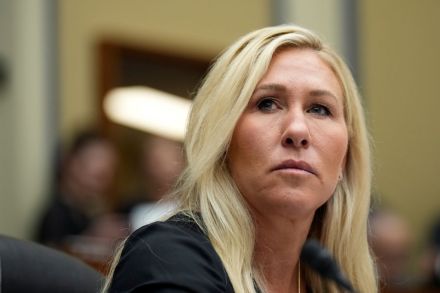
You, too, can shoot feral hogs from a helicopter with Marjorie Taylor Greene

A little bleary-eyed from not yet partaking in his morning Bloody Mary, Cockburn thought at first that he was hearing one of those Newsmax commercials for Tanto Paronto’s HD Vision Night Ops glasses. He listened more closely, and thought it might be “Top Gov” Ron DeSantis dogfighting with the corporate media. But upon closer inspection, it was something altogether more extreme: Representative Marjorie Taylor Greene’s latest YouTube video, in which she braves a lightning storm to carry a gigantic gun toward a camera, then appears to be struck by the lightning, giving her white glowing eyes à la Storm from the Marvel comics. It gets way more normal after that, don’t worry.

Trump is still the orange elephant in the room

The big news stories this morning are not just about the results of yesterday’s primary elections, but about how big of an impact Donald Trump’s endorsements did or did not have. Politico, CNN, the Washington Post, the Guardian, the Hill, and others have all sounded off on this subject — proving that Trump is, indeed, still quite influential. To center-left publications, at least. Until very recently, Trump had an impressive 55-0 endorsement winning streak. He finally struck out with Charles Herbster, who was running for governor of Nebraska amid several sexual misconduct allegations. Last night’s results, however, have called into question Trump’s “status as GOP kingmaker” (as Newsweek phrased it). As the Hill reports, “Tuesday was a mixed night at best for Trump.

Trump endorses his clone, MAGAland freaks out

Cockburn started his day yesterday afternoon scratching his head, and the confusion wasn’t due to a hangover (this time). “Trumpworld Goes Into Meltdown After Trump Endorses Dr. Oz” was one headline Cockburn found puzzling. “Ex-president faces fierce GOP backlash after endorsing TV’s Dr Oz in Senate race” was another. Things were equally befuddling on Twitter. “This endorsement could divide MAGA in the only way that matters: he could lose America First conservatives over it,” tweeted Breitbart’s editor-at-large Joel Pollak. “It’s like Donald Trump’s staff is sabotaging Trump by convincing him to make the worst possible endorsements,” echoed right-wing radio host Erick Erickson.

Stop hating on celebrity politicians

I recently had the chance to peek behind Dr. Mehmet Oz’s curtain, and what I saw made me view the TV doctor-turned candidate for Pennsylvania’s US Senate seat in a new light. As I waited for Oz to appear, I decided to take the pulse of the patient crowd. The first woman d’un certain âge (I’d estimate the average age in the room was 62 and majority female) said she was absolutely decided in her support for Oz. She enjoyed watching his show for years and came to the political rally more as a fan than a voter. But then she revised her unequivocal vote to say, “Well, if Trump endorses him. I’ll vote for whoever Trump picks. There’s no question.” The next person I talked to was of an identical demographic and also a big fan of The Dr. Oz Show.

I was on the floor in ’74

Canadian schlockmeister Bryan Adams, born within a fortnight of yours truly, waxed profitably wistful over his Summer of ’69, but I shall extol, for rather less remuneration, the Autumn of ’74. The goad is my editing of the newly published Congressional Journal of Barber B. Conable, Jr., 1968-1984. I was honored to undertake the task; the late Mr Conable, with whom I became friends, is without question the greatest public man to hail from our boondock. Selected on different occasions as the most respected member of the House of Representatives, the Republican Conable had among his many quirks a refusal to accept campaign contributions greater than $50.

conable

The art of politics: what ministers hang on their walls

If I am ever appointed to one of Britain’s Great Offices of State — stranger things have happened to Spectator hacks — the first thing I’d do is furnish my office. A raid on the Government Art Collection is a perk of being a minister, and better than the car and the driver. A few Hogarth engravings, a set of David Jones’s ‘Ancient Mariner’ etchings, Cedric Morris’s ‘Irises and Tulips’, Edward Bawden’s ‘The Coal Exchange’...I’d have liked to nab Winifred Nicholson’s ‘Flower Piece’, if only Carrie, the new Mrs Boris, hadn’t got there first. A Freedom of Information request from The Spectator has lifted the little red velvet curtains on which works of art ministers have got from the vaults.

art

The monsters we become

Nietzsche would have been great at Twitter. He excelled at epigrams, which are to philosophy as the fortune-cookie motto is to Chinese takeout, and he loved to hate. Scholars divide as to whether his epigrammatic excellence came from using a typewriter — he was the earliest philosophical adopter of this technology — or because he was no good at joined-up thinking but very good at vituperating about the news. It was Nietzsche who spotted that the emerging theme of democratic society was not the reign of reason and universal brotherhood, but the ‘stupidification of the world’ and resentment. He called it ressentiment. Philosophy goes better in French, and Nietzsche had lately turned against Wagner, anti-Semitism and German nationalism.

Nietzsche