Political correctness

Accidental hero | 28 February 2019

From our UK edition

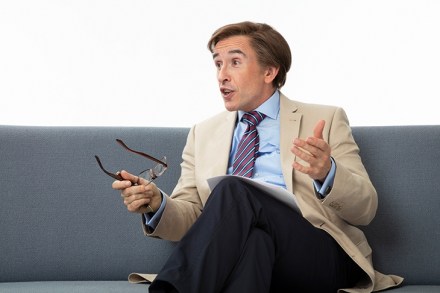
Steve Coogan is back as Alan Partridge but frankly who cares? Like Ali G, I’ve long thought, he’s one of those ‘classic’ 1990s comedy characters funnier in recollection than ever he was in reality. He should have been confined to brief sketches — like Paul Whitehouse and Harry Enfield mostly did with their cheesy has-been DJs Smashie and Nicey — not cruelly exposed in endless TV series where you’ve got the joke in the first five minutes and the rest is pure cringe. Actually, though, This Time with Alan Partridge (BBC1, Mondays) is genuinely funny, clever and enjoyable because finally he has scriptwriters who don’t hate him.
The digital age hasn’t made society more forgiving

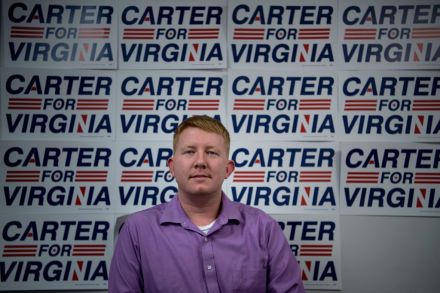
In the fall of 2018, 31-year-old Lee Carter – a member of Virginia’s House of Delegates and a self-described socialist – took to Twitter to expose just about all the proverbial skeletons in his closet. His rationale: he wanted to air it before it showed up in opposition research. Some of it, such as his custody battle over his kid and an arrest for assault at Marine boot camp that was ‘quickly ruled self defense’ was the sort of thing that could have been used against any politician going back for generations. But other admissions were very specific to his having grown up in a world where everything is digitized – possibly permanently.

lee carter forgiving

Masculinity isn’t toxic – corporate moralizing is

The first thing that astonishes about Gillette’s effort to alienate an entire customer base in a single two-minute slickly produced virtue signal is the arrogance. The unblinking temerity of a brand believing it’s somehow its duty not merely to make an appeal for commercial inclusion, but rather to instruct millions of people on how to lead their lives. If the ideological vacuum left by the decline of Christianity in the West really is being filled with a rush of competing forces, then surely we can view Gillette’s ad as consumerism’s most blatant effort yet from the pulpit of modernity to claim the hearts and minds (and souls) of the lumpen masses.

toxic masculinity

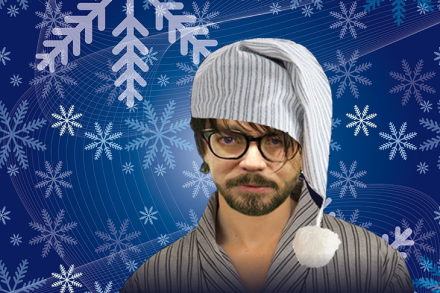
The Winterfest Carol of Godfrey Elfwick

Last night, as I was safely tucked up in bed with a kale smoothie, I was visited by three apparitions, each one determined to change my outlook on the toxic nature of Chr*stm*s. The first ghost appeared at midnight, a shimmering androgynous specter floating in front of my window. ‘Godfrey Elfwick, I am here to show you the error of your ways. Come with me on a journey into your past...’ they said, proffering me a semi-transparent hand. ‘Erm, excuse me, what are your pronouns?’ I inquired respectfully. ‘I’m sorry what?’ was the answer. ‘Well, do you prefer to be referred to as he, she, they, xe, xie, ze, ve, yo...’ As I listed all 592 currently available pronouns, I could see the spirit’s eyes begin to glaze over, and so I took hold of their hand.

godfrey elfwick

Let’s admit that comedy is problematic

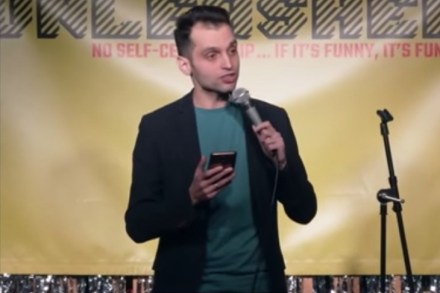
‘Songs of joy and tears of laughter are all we need, to lift our hearts – Godfrey Elfwick’ I penned the above quote for an article in my university’s weekly student magazine ‘Wotz Woke?’ while trying to combat the negative effects of Trump and Brexit. Since then however, things have changed, and my outlook on ‘tears of laughter’ has altered drastically. When it comes to comedy these days, ‘tears of laughter’ has become merely tears. This week, a ‘stand up comedian’ by the name of Konstantin Kisin was handed a very reasonable contract by the School of African and Oriental Studies (SOAS) in London, organized by university society Unicef on Campus.

konstantin kisin

Welcome back Titania McGrath!

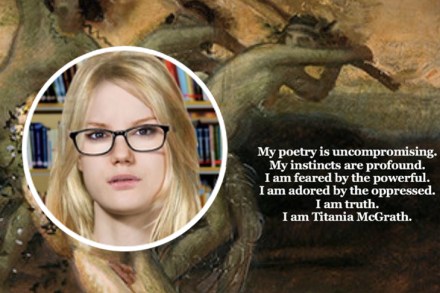
I met Titania McGrath at the Genderfree Silent Poetry Class I used to attend on a Thursday evening at the Basement Bar in York. I remember her standing out from the rest of the artistes because of the amount of screaming she did. Since her first draft of ‘My Ovaries Are The Devil’s Kidneys’ which she wrote back in 2013, her work has come on in leaps and bounds, and improved with every court summons. More recently she has found her niche on Twitter. She inspires thousands of followers, or dare I say, disciples, with a heady mixture of defiant slam poetry and staunch feminist views. Her poems are raw, unbridled, angry, and often nonsensical. Like Lewis Carroll meets Quentin Tarantino.

titania mcgrath

Stop pretending you don’t love Thanksgiving

Is there anything better than the sound of a bustling kitchen, the scent of turkey roasting in the air and children laughing, free from the burdens of gender identity? At least that what I tell my sister-in-law, as I urge her to let my nephew, Cody, watch Dora the Explorer instead of giving into the gender stereotypes permeating Go Diego Go. It seems obvious she should use the show as a tool for teaching Cody about the ‘explorers’ bravely making their way from South America in the migrant caravan — the people our racist president wants to kill. Many Americans watch football on this national holiday, but with the culturally insensitive Redskins not on yet, my opportunities to bring some social justice perspective on the toxically masculine game are limited.

thanksgiving

High life | 18 October 2018

From our UK edition

New York   There is fear and loathing in this city, with men looking over their shoulders for the thought police and hard-eyed women roaming the television studios with lists of sexual predators. There is also dread over the latest exports from the city’s youth detention centres, thanks to Kerry Kennedy, daughter of Robert Kennedy and ex-wife of Governor Cuomo, who is now busy bailing out criminals who cannot afford bail through the Robert F. Kennedy Human Rights foundation, of which she is president. This is one hell of a city. While the criminals are being released, the innocent (presumed) are losing their jobs, having been accused of sexual harassment. The 500lb gorilla in the room, of course, is the R-word.

The new Doctor Who Jodie Whittaker is a delight – but the script isn’t

You won’t be aware of this because the BBC has been keeping it very quiet. But the new Doctor Who is — wait for it — a woman! Let me say straight away that Jodie Whittaker is a delight. Opening as the new Doctor is never easy — all that tiresome establishing rigmarole you have to go through along the lines of ‘I’m feeling all funny. Almost like I’m a completely different actor but in the same body. What can it be? Who am I? Has anyone watching at home worked it out yet?’ But already we like her. Yes, at the moment she’s still a bit of a mishmash of previous Doctors but this will change as she grows into the role.

Doctor Who Jodie Whittaker

Get woke, go broke

From our UK edition

You won’t be aware of this because the BBC has been keeping it very quiet. But the new Doctor Who is — wait for it — a woman! Let me say straight away that Jodie Whittaker is a delight. Opening as the new Doctor is never easy — all that tiresome establishing rigmarole you have to go through along the lines of ‘I’m feeling all funny. Almost like I’m a completely different actor but in the same body. What can it be? Who am I? Has anyone watching at home worked it out yet?’ But already we like her. Yes, at the moment she’s still a bit of a mishmash of previous Doctors but this will change as she grows into the role.

Shark treatment

From our UK edition

All the good non-fiction things that were ever on TV — from Kenneth Clark’s Civilisation to David Attenborough’s Planet Earth (the bits where he’s not proselytising about climate doom, I mean), from Andrew Graham-Dixon’s arty jaunts to Italy to Jonathan Meades’s bizarro forays into architecture, from The World at War to all those more recent war porn documentaries narrated by Sam West, from Werner Herzog’s Little Dieter Needs To Fly to Louis Theroux doing a number on Jimmy Savile — have one thing in common: they were all made by middle-aged men. Middle-aged men are the business.

His dark materials | 16 August 2018

From our UK edition

Apparently there’s a new ‘character’ on University Challenge. I wouldn’t know. Last year, I vowed never again to raise my blood pressure by exposing myself to its new, gender-balanced questions: ‘Your starter for ten: which composer of Serenade for My Cat, rated by her father as the equal of Bach’s Goldberg Variations…’ Don’t know. Don’t care. You bastards ruined it, just like you ruined Sanpellegrino and Lucozade. Same applies, now I think about it, to all the other programmes on the BBC.

The Spectator Podcast: the Diversity Trap

From our UK edition

In recent days, Lionel Shriver has been in trouble. Her criticism of the publishing industry’s diversity drive has led to her marked as a racist and even dropped from a literary judging panel. She argued that ethnic quotas harm rather than help diversity - is she wrong? As Robert Mueller’s investigation continues, several dodgy links to Britain have surfaced that could bring down Trump. And last, in the age of MeToo, is sex becoming sexier? Find out at this week's Spectator Podcast. Do quotas help or hinder racial equality? That’s the big question we’ve been asking at the Spectator recently. Since we published Lionel Shriver’s critique of Penguin Random House’s diversity drive, she has been labelled a racist and even dropped from a literary panels.

When diversity means uniformity

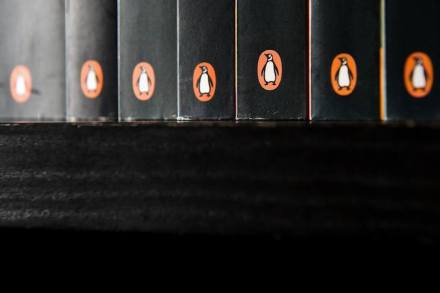
I’d been suffering under the misguided illusion that the purpose of mainstream publishers like Penguin Random House was to sell and promote fine writing. A colleague’s forwarded email has set me straight. Sent to a literary agent, presumably this letter was also fired off to the agents of the entire Penguin Random House stable. The email cites the publisher’s ‘new company-wide goal’: for ‘both our new hires and the authors we acquire to reflect UK society by 2025.’ (Gotta love that shouty boldface.) ‘This means we want our authors and new colleagues to reflect the UK population taking into account ethnicity, gender, sexuality, social mobility and disability.

Penguin wants its authors to represent all UK minorities. What about just publishing good books?

I’d been suffering under the misguided illusion that the purpose of mainstream publishers like Penguin Random House was to sell and promote fine writing. A colleague’s forwarded email has set me straight. Sent to a literary agent, presumably this letter was also fired off to the agents of the entire Penguin Random House stable. The email cites the publisher’s ‘new company-wide goal’: for ‘both our new hires and the authors we acquire to reflect UK society by 2025.’ (Gotta love that shouty boldface.) ‘This means we want our authors and new colleagues to reflect the UK population taking into account ethnicity, gender, sexuality, social mobility and disability.

High life | 31 May 2018

From our UK edition

I’m back in New York and digesting the five glorious days spent in Normandy. What was the fighting all about, you may ask: was it about freedom, equality, cultural diversity, man’s dignity — all liberal catchphrases these days? Liberty and freedom are also big words nowadays, but all I see are massive central governments with arbitrary powers à la Brussels and Washington DC. Normandy promised us a lot but, as far as I’m concerned, delivered little. If freedom of speech was non-existent in Germany in 1940, political correctness makes it just as rare in London and New York in 2018. Our stifling culture of PC makes the sacrifices of those young men who fell in Normandy seem, well, not in vain exactly, but hardly worth it.

Women on top | 7 December 2017

From our UK edition

Boy came to me the other night in a state of dismay. ‘Dad, I just turned on Match of the Day to watch England vs Kazakhstan and guess what: they never mentioned this, but it’s the women’s game.’ What bothered him was not so much being forced to watch a slower, less athletic, duller version of real football — though obviously that too — as that the BBC was being so utterly disingenuous about it. This policy of pretending there’s absolutely no difference between men’s and women’s international sporting fixtures has, I know, been operational for some time. But for those of us living outside the PC metropolitan bubble — i.e. most of the BBC’s actual audience — it still feels insulting, hectoring and dishonest.

High life | 23 November 2017

From our UK edition

The faux Leonardo that sold for 400 million greenbacks — plus a 50 million fee for Christie’s — was a subject dissected again and again by the glitterati at two rather splendid dinners given in the Bagel by George Livanos and Mick Flick. My fellow guests were not the types to be outraged or shocked at the obscenity of the amount of moolah involved, but it beat talking about the weather or why the media hate Trump as much as they do. For any of you who might have missed it, the Leonardo — originally thought to have been painted by Leo’s pupil Giovanni Boltraffio — was partly painted over, then scrubbed. It is now thought to have been by the master, after all. But not everyone (me, for one) is convinced.

High life | 2 November 2017

From our UK edition

I have a message for the London mayor, Sadiq Khan: you and your policies stink! While the fuzz are busy scanning the internet for racist or sexist material, crime in the capital is up by six per cent over the past 12 months and the police — handicapped by PC orders from above — have made 20 per cent fewer arrests. Statistics show youth violence and murder soaring in London, with the latter up by 84 per cent on last year. But here’s a story that’s not a statistic. Last week, my little girl Lolly was viciously attacked and robbed near the World’s End pub on the King’s Road after going to dinner with her cousin. She had spotted a hoodie (does Cameron still wish us to hug them?) on her way to dinner, a man of North African or Middle Eastern appearance.

When did fiction become so dangerous?

From our UK edition

The assignment of books for review has always been haphazard. Fellow fiction writers can be tempted either to undermine the competition, or to flatter colleagues who might later judge prizes or provide boosting blurbs. There are no clear qualifications for book reviewing — perhaps publication, but most of all, because reviewers are paid for their text but not for the many hours it takes to read the bleeding books, a willingness to work for atrocious wages. Mitigating the gravity of this matter? Aside from the authors whose work is on the block, almost no one reads book reviews, and I say that as someone who writes a fair number. It’s a publishing truism that ‘reviews don’t sell books’ — although negative ones can un-sell books.