Parliament

Shoesmith strikes at Balls and executive power

From our UK edition

Sharon Shoesmith cut into Ed Balls on the Today programme this morning. She said: "Why don’t we ask Ed Balls why he acted on November 12, 2008 when he knew for 15 months that Peter Connelly had died and I was working with his officials, I was going to the government office, they were reading the draft reports. Haringey council knew all about it. We examined the conduct of our social workers, we found a disciplinary against them, but they weren't sacked - all of that was open and clear and on the table and everyone knew everything about that. It wasn’t until the spat in the House of Commons when David Cameron taunted Gordon Brown that everything changed overnight. That is the one occurrence that changes all of this story.
Obama re-affirms the special relationship

From our UK edition

The speech was not a classic but Barack Obama's address to both Houses of Parliament covered the bases today. He started with a winning line, remarking that the previous three speakers in Westminster Hall had been the Pope, the Queen and Nelson Mandela which is either "a very high bar or the beginning of a very funny joke."   As is traditional in these kinds of speeches, Obama paid tribute to the special relationship, lauding it as the embodiment of the values and beliefs of the English-speaking tradition. He went on to say that both the British and the Americans knew that the "longing for human dignity is universal." Indeed, at times Obama sounded remarkably like the last president as he proclaimed his own freedom agenda.

Hemming divulges

From our UK edition

‘Mr Speaker, With about 75,000 people having named Ryan Giggs on Twitter it is impractical to imprison them all and with reports that Giles Coren is facing imprisonment’ This was as far as John Hemming got in his question to the attorney general before the Speaker interrupted him to warn that he should be talking about the principles involved in super-injunctions not the people. But now that it has been said in parliament it can be reported by the press, although I do not believe any newspaper is allowed say which super injunction he has taken out or whether those naming Giggs on Twitter are correct. There were gasps in the chamber as Hemming mentioned Giggs by name and there was cold anger in John Bercow’s voice as he upbraided him for mentioning him.

The World Service versus al-Jazeera

From our UK edition

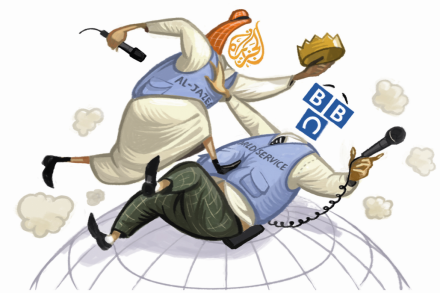
Yesterday’s debate on the future of the World Service was an unqualified success for its convener, Richard Ottaway. His motion received very extensive cross-party support and the MPs involved are confident of victory. As one source put it, “I haven’t met anyone – anyone – who agrees with that cut.” For its part, the government will “reflect carefully on the issue.” Parliament and Whitehall ring to anxious talk that cuts to the World Service will diminish Britain’s status abroad, and that less impartial state broadcasters, notably al-Jazeera, are capitalising on our withdrawal: al-Jazeera’s dominant coverage of the Arab Spring is a case in point.

Tory backbenchers oppose cuts to the World Service

From our UK edition

There is a debate in the Commons this afternoon, urging the government to spare the BBC World Service from cuts. The resistance is being led by Richard Ottaway, chairman of the Foreign Affairs Select Committee and author of a report condemning the Foreign Secretary’s decision to cut funding for the service.   Ottaway is likely to be well supported, as the Tory right is exercised by the effect that cuts are having on Britain’s standing in the world. John Whittingdale is on side, and there were plenty of backbenchers (among them, David T.C.

Sex and Westminster

From our UK edition

Just who is Carrie Fox, the pseudonymous author of this week's Spectator cover piece? And, more to the point, who is the "political big beast" who once pinned her down and slathered his amorous intentions in her ear? (She declined). There's plenty of speculation on both fronts in Westminster today, so we thought we'd let CoffeeHousers in on the intrigue. The entire piece, featuring a complete bestiary of Parliament's sexual predators, has been made freely available here.

PMQs live blog | 18 May 2011

From our UK edition

VERDICT: That was probably the most straightforward PMQs that Ed Miliband will ever experience. Thanks to Ken Clarke, the Labour leader had several shots into an open goal — and most were excuted efficiently, if not skilfully. Cameron was left in an unforgiving position, and he just about hung in there, eventually mustering some sort of defence and then turning it around to Labour's mismanagement of the criminal justice system. It was an intriguing exchange, not least because it presaged what could become a major problem for the Tories — their crime and justice policy — and how Labour might exploit it. And it was all supplemented by a set of backbench questions that ran the gamut from blistering to blithering. For once, a PMQs to really remember.

The Tory right are the true liberals of this parliament 

From our UK edition

In yesterday’s speech to commemorate 12 months of the coalition, Nick Clegg promised a stronger liberal identity in the future. His party was ‘not left, ‘not right’ but ‘liberal’ and would judge other parties by their commitment to liberalism. Above all, and despite professed disavowal of tribal politics, he claimed that the Lib-Dems were ‘more committed at heart to fairness than the Conservatives’. Critics of the coalition on the Tory backbenches are often dismissed as the Tory Right, a term intended to paint them as disgruntled reactionaries who can’t reconcile themselves to partnership with the Lib-Dems.

PMQs live blog | 11 May 2011

From our UK edition

VERDICT: An inconclusive sort of PMQs, where neither leader particularly triumphed, nor particularly sank. Ed Miliband was persistent, and more aggressive than usual, with his questions on the NHS — but failed, really, to properly discomfort the PM. Cameron dwelt lazily on the extra money going into the service, but it was enough to carry him through the session. Perhaps the most striking moment was when, during the backbench questions, Cameron pointed out that "[the Tories] were the only party at the last election to promise [real-terms spending increases for health]. If it wasn't for us, it wouldn't be happening." This is, I suspect, all part of the new drive to distinguish the two parties of government. But it will have jarred with some listening Lib Dems nonetheless.

The press becomes the story

From our UK edition

The power of the press has, almost from nowhere, become one of the defining leitmotifs of this Parliament. Only two years ago, the Telegraph exerted that power to (partially) clean out British politics, and won general acclaim in the process. But now, it seems, the media is more likely to have its actions attacked, or at least questioned and contained. Whether it is the Press Complaint Commissions's censure today for those clandestine Cable tapes, or the continuing hoo-hah over super-injunctions and their infraction, there is a question hanging unavoidably in the air: how much does the public have a right to know? This is a precarious political issue, not least because of the immediate problems it has thrust upon the coalition.

An election before 2015 could soon be illegal

From our UK edition

Amazingly, the forces of conservatism derided by Tony Blair, are in the ascendant, their enemies scattering and in retreat. Bin Laden is dead, the oil price tumbling, the Royal Wedding was a triumph and now Labour and the Lib Dems beaten at the ballot box. Surely, we tell ourselves, this is an alignment of the stars, a Conservative moment. David Cameron must seize the day, or at least the year, by abandoning the Coalition and calling a general election soon. Landslide, here we go! Hold your horses. Britain’s electoral machinery is off the road, its parts all over the workshop floor. Thanks to the constitutional tinkering of the Coalition, the procedural and practical obstacles to holding a general election in the next four years are substantial and rising.

PMQs live blog | 4 May 2011

From our UK edition

VERDICT: A sedate sort of PMQs today, particularly in comparison to the fizz and fire of recent sessions. The reason is simply the date: with the local elections tomorrow, much of the emphasis was on making a straightforward pitch for votes. Miliband's was to attack the "broken promises" of the coalition — a charge that, if not exactly new, is one he is deploying more and more. Whereas Cameron's was to emphasise that councils can make cuts while improving services — and that Tory councils have been particularly successful in doing so. Both men broadcast their messages today, without really scarring the other. The winners and losers will be better judged on Friday morning. 1231: And that's it. My short verdict soon.

PMQs live blog | 27 April 2011

From our UK edition

VERDICT: To paraphrase that famous football cliché, this was a session of two halves. Cameron put in a confident performance against what should have been the trickier set of questions: on the economy. But when it came to Ed Miliband's second topic of choice, the NHS, it all went suddenly awry. The PM's arguments were unusually messy and convoluted, lost in themselves. And he only made matters worse with his Winner-esque exhortation at a Labour frontbencher, "Calm down, dear!" You can argue whether it was sexist of the PM, or not, particularly as it's not clear whom the remark was aimed at (although the smart money's on Angela Eagle). But it was, at least, a moment of frustration that played up to the worst Flashman caricatures of the PM.

The coalition’s self-repair effort will meet backbench resistance

From our UK edition

This week, breakage. Next week, super glue. Given the noises emanating from Downing Street, there's little doubt that the Tory and Lib Dem leaderships are going to do a repair job on the coalition once the AV referendum has been decided. As Rachel Sylvester puts it in her column (£) today, "Mr Cameron and Mr Clegg have had several amicable meetings to discuss how to handle the fall-out from the referendum. Both agree that whoever wins should be gracious, and allow the lower to take a bit more of the limelight in the weeks after the vote." They will be looking for quick and easily triggered bonding mechanisms, not least to repel Labour's charge that the coalition is damaged goods. But the question is: what do those bonding mechanisms look like?

Slippery Jack

From our UK edition

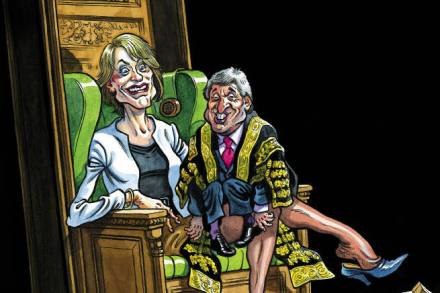
A mad, muscular Sally Bercow cavorts on the Commons chair, diminutive husband on her knee, his features impish. With a few scratches of the nib, the Independent’s merciless Dan Brown, in his cover design for this biography, passes judgment more viciously than Bobby Friedman manages over the next 250 often unexciting pages. The book is not entirely without merit. It is earnest in the manner of a schoolgirl’s essay. There are not too many spelling mistakes. The author has plainly made scores of telephone calls to old acquaintances of the man we must now, revoltingly, call Mr Speaker. Friedman deserves a B-plus for effort. His book is not, however, as vivid as it should have been, given the preening, sycophantic, short-tempered grotesque it has for a subject.

The Treasury Select Committee gets prescriptive

From our UK edition

Andrew Tyrie promised that the Treasury Select Committee would be an assertive, insistent body under his stewardship — and he hasn't disappointed so far. The committee's recent evidence sessions have been fiery affairs, particularly by the usual standards of these things. And today they have released the result: an extensive and prescriptive report into last month's Budget. Several of the report's observations are worth noting down — not least that advance briefing of the Budget is "corrosive of good government," and that "almost all the evidence received [about the government's Enterprise Zones] is unsure about the extent to which they will contribute to UK growth.

The health select committee delivers its verdict

From our UK edition

Grenades are seldom expected – yet Andrew Lansley knew that one was going to fall into his lap this morning. The Health Select Committee has today released its much trumpeted report on the government's plans for NHS commissioning. In normal circumstances its dry take on an even drier subject would evade public notice. As it is, with the coalition rocking and reeling as they are, this is fissile stuff. It is yet another voice in the chorus of opposition to Lansley's reforms.

Parliamentary privilege must be protected from over-mighty judges

From our UK edition

Sometimes, one does really wonder about the British judiciary. Its decision to issue injunctions which bar people from talking to their MPs about an issue, as revealed in The Times this morning, displays a shocking contempt for parliament. It suggests that the court have learned little from the Trafigura case. The justification for these so-called ‘hyper injunctions’ is that if someone tells an MP about a case, it can then be raised in parliament and what the MP said reported under parliamentary privilege. But parliamentary privilege exists for a reason: MPs must be able to raise any issue they want in parliament. For judges to try and limit it goes against the spirit of our unwritten constitution.