Palestine

Should Britain recognise Palestine?

From our UK edition

17 min listen

The government is expected to press ahead with recognition of Palestinian statehood, before a formal declaration at the United Nations. Prime Minister Keir Starmer set out plans earlier this year to recognise Palestine – but what does this actually mean? And what does the move actually achieve; is it driven by principle, by politics – or by pressure from within his own party? Michael Stephens of RUSI and Gabriel Pogrund of the Sunday Times join James Heale to assess the significance of this shift. They discuss the backlash from countries like the US, the unease within Labour ranks and the growing tension between domestic politics and Britain’s standing with allies in the Middle East.

Starmer’s authoritarian turn – with Ash Sarkar

From our UK edition

15 min listen

Since the government’s decision to proscribe the group Palestine Action, arrests have mounted across the country, raising questions not only about the group’s tactics but also about the government’s handling of free speech and protest rights. On today’s special edition of Coffee House Shots, Michael Simmons is joined by The Spectator’s James Heale and journalist Ash Sarkar to debate whether this is evidence of an increasingly authoritarian bent to Starmer’s Labour. Has the ban made prosecutions easier, or has it created a chilling effect on freedom of expression? And is this further evidence of the overreach of the attorney-general, Lord Hermer?

The oppression of Sally Rooney

From our UK edition

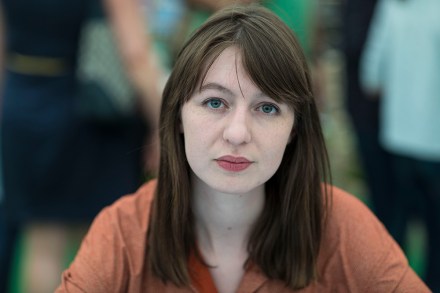
Almost a decade ago the Irish academic Liam Kennedy published a tremendous book with the title Unhappy the Land: the Most Oppressed People Ever, the Irish? It is a dissection of one of the most curious pathologies in the world: the desire to have been oppressed; a glorying in being repressed. Kennedy, like a few other brave writers (Ruth Dudley Edwards, Malachi O’Doherty, Kevin Myers) has the courage to point to an under-examined seam in Ireland’s history. Specifically he takes aim at the mawkishness that exists in contemporary Irish affairs. The desire to be the first victim, perhaps the greatest victim, of all victims, anywhere in the world. You see similar strains of aspiring victimhood in other mini-nationalisms.

Portrait of the week: Palestine Action arrests, interest rate cuts and an Alaska meeting

From our UK edition

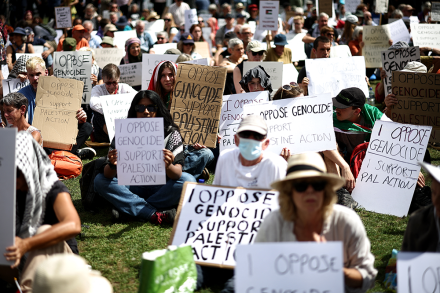
Home Sir Keir Starmer, the Prime Minister, said: ‘The Israeli government’s decision to further escalate its offensive in Gaza is wrong… It will only bring more bloodshed.’ Police arrested 532 people at a demonstration in Parliament Square at which people unveiled handwritten signs saying: ‘I oppose genocide. I support Palestine Action’; the group was proscribed by the government in July under the Terrorism Act of 2000. J.D. Vance, the Vice-President of America, stayed with David Lammy, the Foreign Secretary, at Chevening House in Kent before going on holiday in the Cotswolds at a house rented for £8,000 a week. Work began on removing 180 tons of congealed wet wipes near Hammersmith bridge.

The Romans would have been baffled by the Gaza protests

From our UK edition

Why are people in the UK protesting about the situation in Gaza? Surely it should be because the helpless Gazans cannot protest about their plight, caused by Hamas, because if they did, Hamas would kill them. But in that case, why isn’t it Hamas that people are protesting against? Or are they in favour of Hamas and therefore hate Israel for wanting to destroy Hamas? But wouldn’t that free Gazans? The whole situation would have baffled the Romans. Romans protested only when their own interests were at stake. On one occasion around ad 50, the emperor Claudius was confronted by a mob in the forum, cursing him and pelting him with bread crusts because of a grain shortage.

Will the junior doctors regret picking a fight with Wes?

From our UK edition

13 min listen

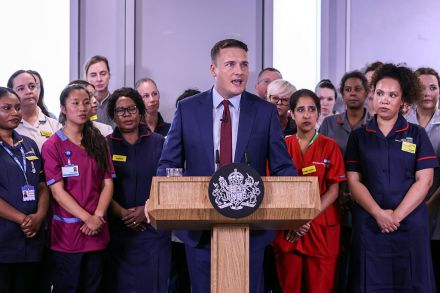
The dispute between the British Medical Association (BMA) – a trade union for doctors – and the government continues, following the five-day strike by junior doctors. Doctors argue that pay is still far below relative levels from almost two decades ago, combined with the cost of study, the cost of living and housing crises, as well as challenging conditions within the NHS. Nevertheless, with an average pay rise of 5.4% for resident doctors this year, support for the strikes appears to be falling – both with the public at large, and within the BMA. Health Secretary Wes Streeting has hit back at the BMA and said they 'will not win a war with this government'. Tim Shipman and Lucy Dunn join Natasha Feroze to discuss whether the junior doctors are wise to pick a fight with Wes.

Letters: The case for recognising Palestine

From our UK edition

State of emergency Sir: As someone who spent time undertaking research in Israel and Egypt, living for almost a year on Kibbutz Re’im, one of the communities attacked on 7 October 2023, I find myself in agreement with much of the description in your leading article ‘State of denial’ (26 July) – but not the conclusions. Many of us are aware that Israeli intelligence knew what was being planned for 7 October, but did nothing to prevent it. Why? The horrors that have happened since have played into the hands of Benjamin Netanyahu and his supporters as they seek to create a Greater Israel, with no room left for a Palestinian state. Hence the need for recognition now, while there is still some territory left.

Portrait of the week: Recognition for Palestine, victory for the Lionesses and no name for Corbyn’s party

From our UK edition

Home Britain will recognise Palestinian statehood in September, Sir Keir Starmer, the Prime Minister, announced, ‘unless the Israeli government takes substantive steps to end the appalling situation in Gaza, reaches a ceasefire, makes clear there will be no annexation in the West Bank, and commits to a long-term peace process that delivers a two-state solution’. He had convened a cabinet meeting to discuss Gaza, although parliament was in recess, a few days after a meeting by telephone with Germany and France. President Emmanuel Macron had said that France would recognise a Palestinian state in September. Some 255 MPs, 147 of them Labour, had signed a letter to Sir Keir calling for the recognition.

Israel has gone too far

From our UK edition

If any other country in the Middle East had behaved as monstrously as Israel has in recent weeks, the jets would be lined up on our runways ready to do a bit of performative bombing. Never mind BDS (boycott, divestment and sanctions) and diplomatic pressure. I mention this because those of us who support Israel, and have done so largely uncritically since 7 October 2023, need the scales to fall from our eyes a little – for the good of Israel, as well as the good of those starving Palestinians. I have been to Israel many times, as a journalist, as a holidaymaker, as a friend.

UNESCO is America’s toxic ex

“I’m having financial problems,” a long-ago ex-girlfriend desperately messaged me some years after our third breakup, before tossing a convoluted word salad trying to make a case that I should give her money. I refused and told her that although I felt very sorry for her, it would be better for both of us if we had no further contact. Fortunately, we haven’t. As President Trump cuts America’s ties with the United Nations Educational, Scientific and Cultural Organization for the third time, this would seem to be the best approach. UNESCO was founded in 1945 to advance the cause of international peace through intellectual and cultural programs under the auspices of the newly created United Nations.

trump israel iran ceasefire

What does Trump really want in Gaza?

UK Prime Minister Keir Starmer, French President Emmanuel Macron and the rest of Europe’s leaders are clear about what they want to see in Gaza: an immediate ceasefire, the release of the 50 remaining hostages in Hamas’s grasp, an acceleration of aid supplies and an end to a nearly two-year war that has turned the coastal enclave into a real-life version of Dante’s Inferno. Macron went one step further several days ago, announcing that France will recognize an independent Palestinian state at next month’s UN General Assembly meetings in New York. Starmer, under pressure from Labour backbenchers, is moving in a similar, albeit more conditional, direction.

The political climate at Glastonbury was not especially febrile

From our UK edition

Everyone who wasn’t at Glastonbury this year knows exactly what it was like: a seething mass of hatred and rabid leftiness, characterised by an angry punk duo named Bob Vylan calling for the death of the IDF. But that’s just the tabloid hysteria talking – betraying also maybe a hint of envy towards those lucky enough to have bagged one of the £400 tickets. The truth is, the political climate was not especially febrile. Sure, the jaunty red, white, green and black of the Palestinian flag was very en vogue, but a few years back it was the blue and yellow of Ukraine and the EU. A few decades before that it was free Tibet. Flags of various communist regimes with questionable human rights records, meanwhile, dip in and out.

How the French left made Mamdani

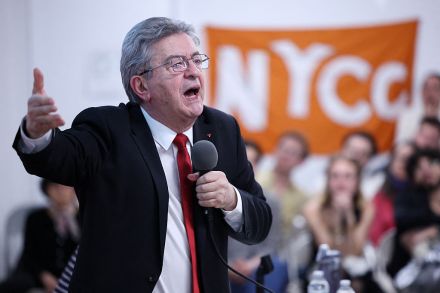
It should come as no surprise that Zohran Mamdani’s surprise victory in last week’s Democratic primary for mayor of New York was celebrated so vociferously by the French far left. Jean-Luc Mélenchon’s La France Insoumise (LFI) regard the 33-year-old Socialist as a chip off the old block. In a post on X Mélenchon delighted in Mamdani’s defeat of Andrew Cuomo, saying: "Opposed to the genocide of the Palestinians, he is obviously already accused of anti-Semitism. He won against a figurehead of the centre-left backed by the local leaders of the cheating Democratic party." As in France, continued Mélenchon, the "traditional" left no longer speaks to the people; it is the radical left.

Melenchon

Let Kneecap play

From our UK edition

During the Troubles, some 2,500 people were victims of kneecappings – punishment shootings, dished out by paramilitaries, for perceived crimes ranging from fraternising with British soldiers to drug dealing and rape. The term is something of a misnomer. The torture entails a low-velocity gunshot to the knee from a handgun. That isn’t guaranteed to destroy one’s kneecaps but could cause tissue or nerve damage and joint fractures. At least 13 victims had to have their limbs amputated; one in five was once estimated to limp for the rest of their lives. Until recently, a mention of kneecapping was a reminder of the terror that plagued Northern Ireland within living memory. Yet this week, thousands will descend upon Glastonbury, at £373.

Donald Trump – the Orange Mandela?

Diplomatic heads are still spinning following Donald Trump’s extraordinary Oval Office press conference with South African President Cyril Ramaphosa yesterday. The media has taken to using the word “ambush” to describe the way Trump sprung his evidence on Ramaphosa to make the point that white South Africans are being violently persecuted. The scene turned into gemors, as they say in Afrikaans, or chaos, and reminded many observers of the wild meeting between Trump and Volodymyr Zelensky in the same room back in February. Ramaphosa had wanted to perform the usual niceties, flanked by a delegation including three white South African golfers, Elon Musk, some of his officials, his minister for agriculture John Henry Steenhuisen and the luxury goods billionaire Johann Rupert.

The ICC’s moral reckoning over sex abuse claims

By any standard, the International Criminal Court (ICC) is in crisis. But the revelations in The Wall Street Journal – detailing explosive allegations of non-consensual sexual acts and abuse of office against its chief prosecutor, Karim Khan – have not just shaken the court’s credibility. They have obliterated it. The Journal reported that Khan faces “multiple allegations of coerced sexual intercourse,” based on documents, testimony and interviews with ICC officials. At the heart of the Journal’s investigation is a horrifying accusation: that Khan, while leading the most controversial prosecution in the ICC’s history, was allegedly engaged in a sustained pattern of sexual abuse against a junior female lawyer on his team.

How come the only Palestinians Louis Theroux met were non-violent sweeties?

From our UK edition

Louis Theroux: The Settlers was never likely to be a programme with much of a narrative arc – and so it proved. In the first 30 seconds, Louis put it to a Jewish householder on the West Bank that his house was ‘quite deep in what are called the Palestinian Territories’. ‘You call it the Palestinian Territories,’ the man replied. ‘I call it the heart of Judea.’ And that, on the whole, was that. Louis travelled from one Jewish settlement to another, doing his best to challenge the inhabitants with his faux-naif questions and impressive range of quizzical expressions. And yet, of course, none of them budged an inch.

Mahmoud Khalil is not the victimized cuddlebear the media would have you believe

A federal immigration judge ruled on Friday that the government could deport Mahmoud Khalil, not a student, but a “Columbia University graduate.” Judge Jamee Comans, a former Mississippi police officer and a Biden appointee in 2023, said that Khalil’s political activities posed “potentially serious foreign policy consequences” for the United States, which is claiming that Khalil is undermining “US policy to fight anti-Semitism.”  Khalil supporters talk about him like he’s Nelson Mandela on Robben Island, Dr. King writing letters from Birmingham jail or Oscar Wilde staring wistfully at the moon from his cell in Reading Gaol. But anyone looking to ding the Trump administration on its deportation policy could find a better example of injustice.

How to deal with the student mob

Last week’s violent anti-Semitic protest at Stanford is yet another sign of a pernicious climate on many campuses. The immediate targets are Jews and Israel. The larger targets are many of the values we prize in the West. At Stanford, students broke into the university president’s office using hammers and crowbars. They proceeded to barricade themselves inside, destroy the furnishings, and scrawl noxious graffiti there and on the building outside. Some estimates say they caused $700,000 in damages. Twelve students were arrested by local police. The Santa Clara District attorney announced that the break-in had been carefully organized in advance, caused enormous damage and warranted criminal charges. But, he said, it did not warrant severe punishment.

student