Opera

Forza majeure

From our UK edition

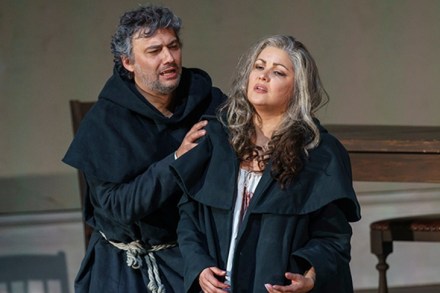
To stage Verdi’s Il Trovatore, they say, is easy: you just need the four greatest singers in the world. The Royal Opera has applied this principle to La forza del destino. Jonas Kaufmann sings Alvaro, Anna Netrebko is his beloved Leonora, and Ludovic Tézier her brother Carlo, with the mighty Ferruccio Furlanetto completing the set as the priest Padre Guardiano. The results have been pretty much as you might expect, ranging from the now-traditional speculation about whether Kaufmann would actually show up (he did) to reports of tickets changing hands privately for £5,000 apiece. And yes, it was extraordinary: a four-hour rush of some of the most glorious singing anyone born after 1970 will probably ever have heard in one place.

Deft and daft

From our UK edition

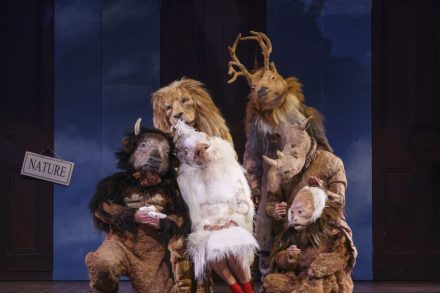
Operas are like buses. Both are filled with pensioners and take ages to get anywhere, but more importantly they always seem to arrive en masse. You wait ages for a Magic Flute, then five come along at once. Opera North started us off in January, Welsh National Opera and English National Opera are currently following suit, with Scottish Opera and Glyndebourne covering the summer shift. It’s a mess and, when you consider that at least four of these are touring with inevitable overlap, a wanton, self-destructive splitting of an already small opera-going audience. With more Flutes than a school wind-band to choose from this season you can afford to be picky (assuming you haven’t already exhausted yourself with the three concurrent Katya Kabanovas).

Sinking the unsinkable

From our UK edition

Garrick Ohlsson is one of the finest pianists of his generation. Why, then, was the Wigmore Hall not much more than half full for his recital last week? Brahms. Ohlsson is at present touring with four programmes, all Brahms’s solo piano music. He treated us mainly to solid chunks, though he ended with the enchanting and almost light-hearted Paganini Variations, fiendish for Ohlsson but enlivening for us. Actually, he played an encore by Chopin, the solitary Op. 45 Prelude, preceding it with a charming lecturette about how Brahmsian, avant la lettre, Chopin could be. Ohlsson was a student of the great Claudio Arrau, whose attitude to Brahms verged on the frosty.

‘They’re finally going to play my music’

From our UK edition

According to his friend and fellow-composer Ernest Reyer, the last words Berlioz spoke on his deathbed were: ‘They are finally going to play my music’. It has taken time, but he was right. A century and a half later, Berlioz 150 is the watchword of the hour. That is as it should be. Berlioz was a devotee of the ancient world (‘I have spent my life with that race of demi-gods’), where it was believed that at the moment of death one might be granted foreknowledge of the future. Why has it taken so long? In his native France there were plenty of reasons. As a forceful, witty but sardonic music critic he inevitably put Parisians’ backs up with his attacks on modern Italian music, which he regarded as frivolous, formula-ridden and fatally undramatic.

The Rite stuff

From our UK edition

It was Stravinsky himself who suggested that, in order to preserve its difficulty, the opening bassoon solo of The Rite of Spring should be raised by a semitone every decade. And it was a performance by Birmingham Royal Ballet in 2005 that convinced me that he wasn’t entirely joking. The audience nattered away over the opening bars; the unlucky bassoonist wobbled and cracked. Clearly, this orchestra was not remotely prepared for what was about to hit it. Rhythms splintered like shrapnel and misplaced entries spattered across every silence. As they hurtled into the final Sacrificial Dance, you could almost hear the prayers of musicians audibly struggling simply to hang on. It’s still, without question, the most thrilling Rite of Spring I’ve ever heard.

The Berlioz problem

From our UK edition

Hector Berlioz was born on 11 December 1803 in rural Isère. ‘During the months which preceded my birth my mother never dreamed, as Virgil’s did, that she was about to bring forth a laurel branch,’ he writes in his Memoirs. ‘This is extraordinary, I agree, but it is true… Can it be that our age is lacking in poetry?’ And so on, for nearly 600 candid, facetious, outspoken pages. Berlioz’s Memoirs are the inner voice of the Romantic generation as you’ve always imagined it, and everyone who’s interested in music in the 19th century — no, scrub that, everyone who’s interested in European culture — should read them.

Pearls and swine

From our UK edition

The best booers, in my experience, are the Germans. There’s real purpose and thickness to their vocals. Italians hiss. The English grumble. The French? A bit of this, a bit of that. I approve of booing — or feedback, as I like to think of it. It’s galvanising and exhilarating, even when infuriating. Are you with them or not? One caveat: save it till after the performance, please. The French do not hold to such niceties. One piggy old Parisian thought it appropriate to shout at the stage during Sunday’s performance of Opéra Bastille’s new Troyens. And not once. But three times. On that third cry, he got on to his trotters to hurl his abuse. Was it feeding time?

Janacek’s rare gem

From our UK edition

Janacek’s upsetting opera Katya Kabanova, which hasn’t been seen in the UK for some time, turned up in two different productions over the weekend, with a third to follow in Scotland. The Opera North production by Tim Albery dates from 2007, when it was conducted by Richard Farnes with the clarity and passion which characterises all his work. This revival had Sian Edwards making her Opera North debut, and all told it had a slightly muted quality. The paradoxical jagged lyricism of Janacek’s orchestral writing only struck home intermittently, and there were stretches which could almost have been by Smetana, against whom Janacek partly defined himself.

Dream ticket

From our UK edition

Spoiler alert: it’s all a dream. At least, I think that’s what we’re meant to take away from the business with which director James Brining accompanies the overture to Mozart’s The Magic Flute. A little girl in ochre pyjamas is trying to sleep while in an adjacent room braying, guffawing adults sit down to a formal dinner. Servants bustle about, and there’s a suggestion that all is not well in the hosts’ marriage. Then sleep descends with a David Lynch-like fizzle of electric lights and we’re pitched into a world of princes, serpents and enchantment. Opera directors love unloading on overtures: obscuring the composer’s own musical pathway into their world with elaborately mimed footnotes to a text you haven’t yet read.

Mirror, mirror…

From our UK edition

We increasingly accept the collision between life and art. Whether we’re puzzling over the real identity of Elena Ferrante, choosing our own adventure in Bandersnatch, or boycotting the latest Polanski film, we’re buying into culture that’s more mirror than window. But wasn’t it ever thus? It’s a case Barbara Strozzi would certainly argue. The most-published Italian composer of her age, a musician whose work could stand alongside Cavalli, Rossi, even Monteverdi, was caught throughout her career in the double-bind of biography. You have only to look at her famous portrait — gazing insolently out at the viewer, breast bared — to see the erotics of performance at work.

Heuberger: Der Opernball

From our UK edition

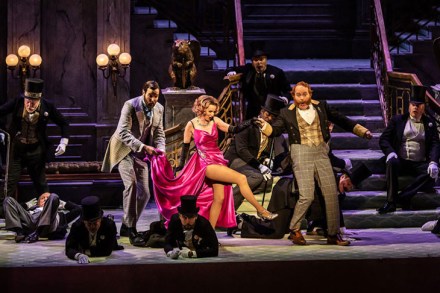
Grade: A– 1898: two Parisiennes and a housemaid secretly invite each other’s partners to the Paris Opera ball and… c’mon, you can guess the rest. It’s Christmas: you don’t want Götterdämmerung. You want luxury, you want tunes and you want irresponsible fun. Richard Heuberger’s waltz-operetta Der Opernball is basically a deluxe box of musical liqueur chocolates, and it’s never been easier to guzzle the lot. Heuberger was a moonlighting music critic (he famously remarked that Schoenberg’s Verklärte Nacht sounds ‘like someone smeared the score of Tristan while the ink was still wet’), and he was working to a tight deadline.

Voices of doom

From our UK edition

It’s December, and while musical theatre is busy celebrating ‘warm woollen mittens’, opera, as usual, is far more interested in the tiny frozen hands inside them. Because nothing says Christmas quite like consumption, and I’m not talking turkey and mince pies. London’s opera companies are serving up a heaped sleighful of heartbreak this year. English National Opera is going traditional with La bohème, while the Royal Opera is thinking outside the snow-covered coffin with Carmen. There’s something for everybody, so long as it’s tragedy. ENO’s Bohème is the safe option, the show you take your granny to.

The saddest music in the world

From our UK edition

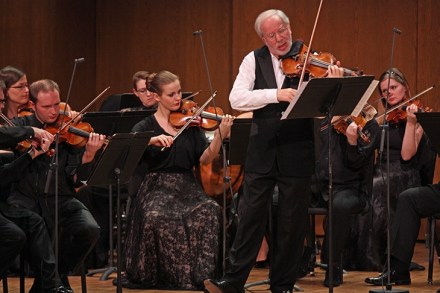
It’s a strange compliment to pay a composer — that the most profound impression their music makes is of an absence. I can’t claim much prior experience of the composer Mieczyslaw Weinberg, who died in 1996: a vague sense of a Shostakovich-like figure who had a bad time of it under Stalin, and the composer of an opera, The Passenger, for which great claims are made by people whose judgment I respect but who probably, on balance, spend too much time with their heads in Eastern Europe. By the end of the first evening of this ‘Weinberg Weekend’, devised by Mirga Grazinyte-Tyla and the City of Birmingham Symphony Orchestra, I felt slightly ashamed about that. Gidon Kremer played his own violin transcription of Weinberg’s 24 Preludes for solo cello.

Breaking his silence

From our UK edition

Arriving in Budapest, I receive a summons I cannot refuse. Gyorgy Kurtag wants to see me. Famously elusive, the last of the living avant-gardists is about to present his first opera at La Scala Milan this month and, if past form is anything to go by, he’s unlikely to utter much about it beyond a cryptic Magyar aphorism. Kurtag is 92 and his Scala opera — Fin de Partie, after Samuel Beckett’s Endgame — is a hefty 450 pages long, which may be as much music as he has written in half a lifetime. So why is this master miniaturist — famous for compressing his ideas down to a few chords — submitting a vast opera to the unforgiving glare of an Italian first-night audience?

Chills and thrills

From our UK edition

How do you solve a problem like Lucia? Murder, madness, abuse, possibly even incest, all set to a soundtrack of rollicking, rum-ti-tum tunes. Add to that a Scottish setting (nothing sabotages dramatic seriousness quite like a kilt, just ask Mel Gibson) and you have Gilbert & Sullivan in an Italian accent, Ruddigore with a cigarette and a suntan. Recently at the Royal Opera House Katie Mitchell tried to naturalise Donizetti’s opera into submission, but ended up tussling with a score she clearly didn’t trust and a cast who didn’t seem to trust her, giving her audience what she wanted Lucia to be, rather than what’s actually there.

On the road | 25 October 2018

From our UK edition

Wolverhampton; Workington; Blackburn; Sheffield; Lancaster; Hackney. Every year English Touring Opera does what our national opera company doesn’t: packs up its props and takes to the road, bringing opera to the bits of the UK other companies don’t even think about reaching. And not just Traviatas and Toscas either, but properly interesting, often unusual, repertoire. With a core staff you can pretty much count on your fingers, and ticket prices that would scarcely buy you a sandwich at the Royal Opera House, let alone a seat, the whole operation is one of those minor miracles of the arts world — a company where a little bit of funding goes an awfully long way, and not just geographically. Then there’s the talent.

Top scorer

From our UK edition

Gershwin’s Porgy and Bess springs to life fully formed, and pulls you in before a word has been sung. A whirlwind flourish; the hectic bustle of violins and xylophone, and then a quick fade into an image of a woman cradling a child and ‘Summertime’, the very first number we hear sung. The aria’s fame actually serves the drama. The thrill of musical recognition as the curtain rises on an unfamiliar world is replaced by astonishment at the dramatic instinct that allows Gershwin to expend a melody like that before his story has even started, in the certain knowledge that what follows can, and absolutely will, live up to what for any composer other than Gershwin would be a once-in-a-lifetime inspiration.

Ring leader

From our UK edition

‘On Brünnhilde’s rock I drew the breath that called your name; so swift was my journey here.’ It’s Act Two of Götterdämmerung. Siegfried, entoiled in evil beyond his comprehension, has unwittingly committed the betrayal that will tip the whole vast drama into its final collapse, and at this point Covent Garden’s Ring cycle really does feel like it’s swept by in a breath. True, Keith Warner’s 2007 production is looking creaky. But there’s still no mightier assertion of an opera company’s ambition than to stage all four music-dramas of Der Ring des Nibelungen in the space of a week; and no artistic experience remotely comparable to witnessing it. So, about that experience.

The naked and the dead

From our UK edition

Yes, Oscar Wilde never wrote it. No, Strauss didn’t intend it. In fact, the composer famously demanded the Dance of the Seven Veils be ‘thoroughly decent, as if it were being done on a prayer mat’. But that doesn’t stop this striptease and musical money shot being the look-but-don’t-touchstone of any Salome. A blonde, blank-faced Barbie doll in gym knickers, vest and shiny trainers stands in a spotlight, a baseball bat in her hands. Strauss’s oboe begins its suggestive arabesques but Salome remains quite still, her eyes fixed impassive, unblinking on the audience. Eventually her hips begin to twitch, her back arches and she goes sullenly through the motions of sensuality, never breaking her gaze, defying us to find her desirable.

Murderer or Madonna?

From our UK edition

At the end of Act Two of Tosca there are some 30 bars of orchestral music — accompaniment to a very specific set of stage directions. During this time Tosca takes two candles and places them on either side of the dead Scarpia’s head. She then removes a crucifix from the wall and lays it on his chest. The tableau is a messy, bloody one, but the message is clear: here the politics of religion and the religion of politics are one and the same. A pietà or the body of a thug? A murderer or a Madonna? It’s all just a matter of spin. In a year of embattled Supreme Court nominations and moral muscle-flexing by our own DUP, Edward Dick’s new, 21st-century Tosca for Opera North relishes these slippery elisions and entanglements of church and state.