Northern ireland

At least Martin McGuinness made old age. Many others didn’t

From our UK edition

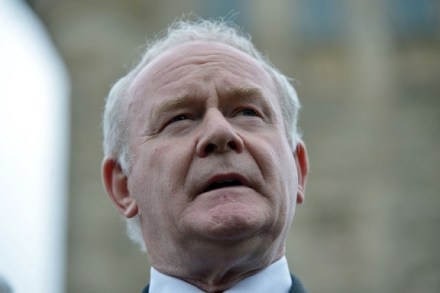
When Martin McGuinness said he was retiring from politics due to serious illness it gave vent, almost immediately, to the sort of ‘How McGuinness became a man of peace’ stories. Personally I have always thought the salient point about the man is not that he became a man of peace but that he was ever a man of violence. Over recent years a narrative has developed around the Troubles, that the people who ‘became men of peace’ are much to be admired.

Northern Ireland’s political crisis could cause Brexit problems

From our UK edition

And so there we have it. Shortly after midday in Stormont, Sinn Féin’s Michelle O’Neill declined to nominate a replacement for Martin McGuinness, causing the collapse of the power-sharing executive after five months shy of a decade.  At 5pm, authority to hold elections passes, under the Northern Ireland Act 1998, to Secretary of State for Northern Ireland James Brokenshire. By custom (though not law) these are held after six weeks. Sometimes the election you get isn’t the one you want.  And Northern Ireland, which last went to the voters all of eight months ago, is now slouching towards snap election mode.

There may be trouble ahead for Northern Ireland

From our UK edition

It now seems obvious that Northern Ireland's power sharing executive has fallen. Because of the way the country's devolved government is set up, when deputy First Minister Martin McGuinness fell on his sword (or semtex) yesterday, the First Minister - Arlene Foster - goes as well. So the two-headed monster tumbles down and Her Majesty's Principal Secretary of State for Northern Ireland, James Brokenshire, takes over until new elections. This is the situation we’re in now. Admittedly it isn’t quite direct rule—the Northern Ireland Assembly hasn’t gone away. But elections to it needn’t be immediate, and they probably won’t be.

Politics can be sexist, but Arlene Foster was wrong to play the misogyny card

From our UK edition

Let’s say you’re a rising minister put in charge of the department for enterprise. You have the great idea to incentivise businesses to invest in low-carbon energy by offering a subsidy for renewable fuel used. Unfortunately, something goes wrong in the planning or execution of the scheme, with the result that claimants are paid more for low-carbon fuel than the amount the fuel actually cost them. Market forces kick in, businesses use as much fuel as possible to gain the maximum profit, the fancy renewable energy scheme ends up £490 million over budget. The opposition, the media, and most importantly the public are understandably very upset, and call for you to resign.

What the papers say: The trouble with Boris, and McDonald’s Brexit boon

From our UK edition

Boris Johnson was slapped down by Theresa May yesterday for his comments about Saudi Arabia. And the Foreign Secretary earns himself a similar rebuke in the Guardian this morning. The paper describes his remarks as ‘plain speaking without a purpose’ and says that ‘he frequently shoots from the hip or goes off half-cocked’. It warns that while speaking out of turn as a columnist could be ‘embarrassing’, now the ‘potential consequences are far graver’. But if so, why is Theresa May still tolerating Boris? In the eyes of the Guardian’s editorial, it’s because the PM thinks that ‘a cannon that misfires so often is less dangerous in front of her than on the benches behind her’. But how long will the PM's patience persist?

Tony Blair’s IRA amnesty should also apply to British soldiers

From our UK edition

This morning’s Sun carries the story that all British soldiers involved in killings in Northern Ireland during the three decades of the Troubles now face investigation.  More than 1,000 ex-service personnel ‘will be viewed as manslaughter or murder suspects in legal inquiry.’  According to information received by the paper, 238 ‘fatal incidents’ involving British forces are being re-investigated by the Police Service of Northern Ireland’s Legacy Investigations Branch. This is especially timely.  In recent days I have been reading Austen Morgan’s new and so-far under-noticed book Tony Blair and the IRA.  To my knowledge it is the first full account to date of the ‘on the runs’ scandal.

All’s well that ends well

From our UK edition

The last ten minutes of any Don Giovanni tell you more about a director than the previous two hours. Mozart’s elastic ‘dramma giocoso’ can take a lot of pulling about, can be stretched taut into tragedy or squeezed into the tight confines of a farce, but whatever option (or combination of options) you choose, those final moments are the test of success — the point at which the dramatic threads either sag, snap or hold firm. Oliver Mears’s production — first seen at the Bergen National Opera and now at NI Opera in Belfast — lets them fall limp. Seemingly unsure which choice to make, he makes no choice at all, leaving us with an ending that isn’t so much elusive as it is evasive.

Why is this church offering diva pics and videos?

From our UK edition

In Northern Ireland recently, I sought out the Mass times of the local Church of the Immaculate Conception. Its website duly listed them, but I was surprised to find roughly half its web-page filled with a picture of a young woman’s all-but-naked torso and the invitation to click for more ‘Diva pics and videos’. I couldn’t tell whether this was a viral invasion or an Irish parish’s highly unimmaculate conception of how to make extra money for its good causes. When I met the priest, I was about to ask him, but he looked so young. I remembered that this is still the Year of Mercy, and stayed silent.

The view from my Belfast bus: tribalism as the enemy of prosperity

From our UK edition

At Stormont on Saturday, we observed a minute’s silence for the dead of Paris. Our conference group of Brits and Americans had convened two days earlier to discuss conflict resolution, the idea that nationalism and tribalism are the enemies of peace and prosperity, and how all this might relate to the migration crisis; so the moment could not have been more poignant.

The troubling logic at the heart of the ‘Gay cake’ ruling

From our UK edition

My late father was a pottery maker, and very good at it. Question is, if a Northern Protestant had come to his studio to request that he produce a teaset decorated with the legend: 'Taigs Out of Ulster!' or 'Kick the Pope!' perhaps with decoration to match, would my daddy have been obliged to oblige him on the basis that he was offering to make ceramics for all comers, regardless of their religious persuasion? Would the production of Protestant ceramics have been part of his offer to the teaset-buying community? Or could he have declined on the basis that this was offensive to his beliefs as a non-practising Roman Catholic?

Letters | 13 October 2016

From our UK edition

Cathedral going Sir: While I enjoyed much of Simon Jenkins’s analysis of why England’s cathedrals are thriving (‘Why cathedrals are soaring’, 8 October) his article misses the point. As a self-confessed non-worshipper, his understanding of these buildings and their significance lacks a crucial dimension. The raison d’être of our churches and cathedrals is faith and worship. By focusing exclusively on historical and aesthetic elements and ignoring their continuing important spiritual role, Jenkins risks behaving like a restaurant critic who never bothers to taste the food on offer.

Letters | 30 June 2016

From our UK edition

A rational vote Sir: There has been a lot of bile poured out about those who voted Leave by the Remainers. Their intelligence, their racial tolerance and their general moral standing has been called into question. I was a Remain voter, but live in an area that was 69 per cent Leave, and work with people who were strongly anti-remaining. To take one example, being anti-free migration is being referred to as racism. For many people migration is not anything to do with race or even nationality: 1,000 people from the next town would create the same degree of concern as 1,000 Poles. When jobs, houses, school places and so on are limited, it is the amount of competition faced that creates the problem, not where the competition comes from.

A merry guide

From our UK edition

If you have legs, or a bicycle, or indeed both, you are going to love this book. Chaps, no matter how old or how fat or otherwise incapacitated you are, if you haven’t already received it for Father’s Day the chances are it’s coming your way this Christmas. Ladies: if you are a fell-runner, a hill-walker or a budding Victoria Pendleton, pop this into your backpack or saddlebag with your energy bars and your old Ordnance Survey. Graham Robb — yes, that Graham Robb, the biographer and historian of all persons and all things French, and also the author of an excellent history of homosexuality, Strangers: Homosexual Love in the 19th Century (2003) — has written a book about British and Irish cols and passes. But wait: British and Irish whats?

Diary – 9 June 2016

From our UK edition

When an old friend X came to dinner in London, I sampled what it must have been like during the American Civil War, when families were split asunder from aligning on opposite sides of the Mason-Dixon. Lo, this warm-hearted, well-read, intelligent Midwesterner is backing Donald Trump. This was my husband’s introduction to X, whose electoral preference clearly queered the first impression. Our threesome didn’t talk long on the matter. The disconnect being so absolute, there was little to say. X is the only Trump supporter I wittingly know. But I was chilled by the difference between this and countless heated-but-civil suppers of yore, at which a dinner guest plumped rambunctiously for a candidate I opposed — Romney, McCain, even George W.

Deluded continent

From our UK edition

Les Blancs had a troubled birth. In 1965 several unfinished drafts of the play were entrusted by its dying author, Lorraine Hansberry, to her ex-husband, Robert Nemiroff, who mounted a debut production in New York in 1970. Nemiroff has created a fresh version with the help of a ‘dramaturg’ (or ‘colleague’, in English) named Drew Lichtenberg who believes not only that this ramshackle script is a masterpiece but also that Hansberry belongs in the first rank of dramatists alongside Ibsen, Sophocles and Aeschylus. This does not bode well. But the result is surprisingly good. Or good-ish.

The Easter Rising centenary shows Ireland more at peace with its past

From our UK edition

Here in Dublin, Ireland is busy marking 100 years since the Easter Rising of 1916. It is being celebrated, but with far less chest-beating and bombast than met the 50th anniversary in 1966.  And this is a good thing entirely. The Rising lasted for six days.  Its leaders seized key buildings around Dublin and proclaimed an Irish Republic.  It started a series of events that led to an independent Irish state in the south, but also to the partition of Ireland and a bloody civil war which claimed between two and three thousand lives. Emblematic of this year’s commemoration was an event on Good Friday, at a Unitarian church on St Stephen’s Green.

Rebel angels

From our UK edition

This is the first exhibition I’ve been to where the Prime Minister joined the hacks at the press view. A week after the Irish general election, the Taoiseach, Enda Kenny, came to the biggest show in Ireland devoted to the centenary of the Easter Rising. Kenny’s presence at the press launch just goes to show how the Irish rebellion against British rule at Easter 1916 is still the defining story of modern Ireland. In fact, the Easter Rising was a pretty good failure, although I didn’t suggest that to the Prime Minister at the press view. The rebellion lasted only six days before it was put down by the British army. Other attacks on British barracks in Meath, Galway and Wexford didn’t get very far either. Planned attacks in Cork, Tyrone and Donegal never happened.

Letters | 28 January 2016

From our UK edition

Levelling the cricket pitch Sir: As a cricket addict and believer in state education, it pains me to agree with Michael Henderson’s assertion that the future of England’s Test side rests in the hands of private schools (‘Elite sport’, 23 January). The high-performing, 1,700-strong school where I am the head teacher has a grass area for sport that is not large enough for a rugby pitch, let alone a cricket square. As far as the coaching, equipment and pitch maintenance required to play our summer game properly, money talks. While we receive £4,000 a year from the government for each sixth-former we educate, at a local independent school parents are charged over £5,600 per term even before ‘extras’ such as exam entry fees are added in.

Northern Ireland’s pro-choice lobby couldn’t care less about democracy

From our UK edition

Well, the High Court in Belfast has driven a coach and horses through Northern Ireland’s abortion law. The Northern Ireland Human Rights Commission (NIHRC) sought a ruling to allow women to have abortions in local hospitals in cases of fatal foetal abnormalities, rape and incest; today, it got it. This judgment is plainly at odds with the opinion of the democratic forum in the north, the Northern Ireland Assembly, where every attempt to have abortion introduced upfront, in law, has been thrown out. Instead abortion seems likely to be brought in through the courts, that weaselly, undemocratic method of choice by the human rights lobby, whose concept of human rights never seems to extend to prenatal life.

Northern Ireland Opera’s Turandot will fill you with awe and revulsion

From our UK edition

Chords as bright and sweet as pomegranate seeds burst and spill in Turandot, a splinter of bitterness at their centre. Left incomplete at Puccini’s death in 1924, the opera is his most radical and most cruel. You can taste something of Stravinsky’s Rite of Spring in the instrumentation, a musky roughness that rubs against the Italian composer’s customary silky precision. Woodwind and strings cling to the voices of the monstrous princess Turandot, her intoxicated suitor Calaf, and Liù, the slave who slavishly adores him because he once smiled at her. So closely scored is the writing that it is almost suffocating. This is love as an addiction: violent, sleepless, lethal. The renaissance of opera in Northern Ireland has not been timid or gentle.