Nhs

Why Whitehall is failing to solve the social care crisis

From our UK edition

The government's cash boost for the NHS isn't going to solve its problems. That's the verdict of pretty much every independent spending scrutiniser, including the National Audit Office's Comptroller, Amyas Morse. He's said today that the £20bn founding increase announced by Theresa May and Jeremy Hunt will maintain current standards, but won't enable the health service to grow as the population needs it to. There is also no way that the cash set out recently will solve one of the biggest drains on the health service: the crisis in social care. The Treasury only agreed money for the NHS, not the services that many patients need to be able to go home, and ministers are clear that spending on social care now needs to be discussed separately.

Sunday shows round-up: NHS preparing for a no deal Brexit

From our UK edition

Simon Stevens: the NHS is making ‘significant preparations’ for no deal Brexit This morning Andrew Marr sat down for an interview with the Chief Executive of NHS England. With the 70th anniversary of the foundation of the NHS approaching this week, Marr asked Simon Stevens about the implications of a no deal Brexit on the health service, and whether he was making appropriate preparations for such an event: https://twitter.com/MarrShow/status/1013347688086061056 AM: ...When you were talking to MPs last autumn, you said that you hadn't been asked by government to plan for no deal. Has that changed? SS: There is now significant planning going on around all the scenarios, including medicine supply scenarios... AM: Really?

Barometer | 28 June 2018

From our UK edition

Nursing numbers Was there ever a time when the NHS wasn’t in crisis? According to a report by NHS Health Improvement in February 2016, the health service was then short of 15,000 nurses. A year later the Royal College of Nursing was claiming a shortfall of 24,000. But that is a lot less than the shortage of nurses reported in its early years. In December 1948, five months after the NHS was founded, it was reported by the government to be short of 48,000 nurses, 30 per cent of the number employed. The shortage meant that 53,000 beds were lying unused (a disproportionate number in women’s psychiatric care). In early 1949 the NHS recruited an extra 4,000 full-time and 2,250 part-time nurses.

The Spectator’s Notes | 28 June 2018

From our UK edition

Gordon Brown, echoing Aneurin Bevan, says that the greatest gift that the NHS brings to people is ‘serenity’. He is surely right that this is what it brought 70 years ago — for the simple, important reason that people would no longer need to say of treatment, ‘I just can’t afford it’. But comparable ‘serenity’ is provided, in different ways, in, for example, Germany, the Netherlands and Australia. Defenders of today’s NHS have to explain not why it is more serene than pre-1948, but whether it matches the current arrangements of comparable countries. ‘Serenity’ is not the word one would apply to many British hospitals today. In these Notes last week, I mentioned the fear felt by the old.

Jeremy Hunt tells Tories that a ‘low taxes at all costs’ party would lose the next election

From our UK edition

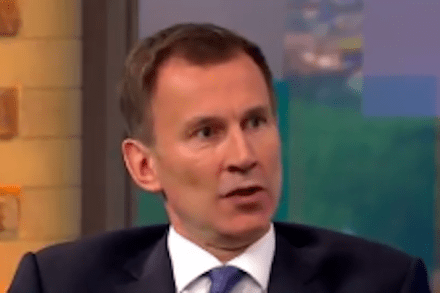
In conversation with Andrew Neil at a Spectator event this evening, Jeremy Hunt defended the principle of increasing taxes to pay for more spending on the NHS. He warned Tories unhappy with the idea that if in an election you offer voters a choice between a low taxes at all costs party and decent public services, they’ll vote for decent public services. He said that this extra money for the NHS was needed to deal with a ‘once in a generation change in demography’ and that it was important that the Tories show the public they are on the right side of this argument. In language reminiscent of David Cameron, Hunt declared that ‘as a Conservative I want to say it is not a choice between lower taxes and decent public services: you can have both’.

What is Jeremy Hunt up to?

From our UK edition

'What you can see is someone who has the instincts of a Brexiteer, but the cautious pragmatism of a Remainer, which is where I think the British people are.' This is how Jeremy Hunt tried to sell Theresa May's leadership on the Andrew Marr sofa this Sunday. After a choppy few weeks for No. 10, the Health Secretary made clear that he felt May was still the right person for the job of Prime Minister. Perhaps it's just pure coincidence then that one could also substitute Hunt's name with May's in that endorsement. Like May, Hunt is a Remainer turned Brexiteer. A point he also proved on Sunday when he said that Airbus's Brexit 'threat' over potential loss of jobs was 'inappropriate'. The blunt comments were surprising given that Hunt was once seen as mild-mannered.

Treasury X Factor: Tory MPs belatedly summoned to find the money for NHS pledge

From our UK edition

How do you find the money to pay for a £20bn NHS funding pledge? Usually such discussions – and eventual calculations – would be made before the money was announced. However, Theresa May decided to ditch the rulebook this week when she unveiled her government's funding package to boost health spending by an average of 3.4 per cent over the next five years. Far from a fully costed pledge, May referred to a rarely-sighted Brexit dividend, potential borrowing and future tax rises. The uncertainty has led to criticism from Jeremy Corbyn's Labour – not usually known for fiscal restraint. But happily it seems the Treasury now has a plan – or at least a plan to come up with a plan.

Lost in the NHS maze

From our UK edition

Next month the National Health Service turns 70. The institution is greatly loved, and not for nothing. The fear of ill-health runs deep in most of us and is ineradicable; but the fear of not being able to afford treatment, which must haunt most of the world’s population, has been abolished in Britain — and for that inestimable benefit we have the NHS to thank. It is, of course, possible to overrate the quality of this country’s health care. Many do. All things considered, and in a world of first-, second-, third-, fourth- and fifth-rate medical provision, I’d say we British get a second-rate health service for the price of a third-rate one. However, funds are not unlimited, and second-rate isn’t bad.

Why are NHS funding critics silent on Quantitative Easing?

From our UK edition

After the prime minister’s announcement that the NHS would be given a large boost in funding only partly paid for by taxes, some backbenchers called for fiscal responsibility. For them it is paramount that a government should live within its means and avoid increasing the budget deficit. And yet they have nothing to say about monetary policy. Quantitative Easing (QE), the creation of money out of thin air by the Bank of England, with the intention of boosting demand has been carried out in a manner highly beneficial to owners of existing assets. The Bank’s website explains how it works.

The ‘Brexit dividend’ for the NHS is Theresa May’s new Magic Money Tree

From our UK edition

So the Tories have, as The Spectator predicted last month, announced an extra £384 million a week for the National Health Service - something Theresa May was perfectly happy to sell this morning as being the 'Brexit dividend' that Boris Johnson had been pressuring her for. This is an odd choice, given it is impossible to know what the real 'Brexit dividend' will be when we haven't yet left the European Union. Indeed, May couldn't say very much at all about how this extra NHS money will be funded: that's presumably because no Prime Minister wants to tell voters how much more tax they'll be paying, regardless of whether that tax is funding something as salient as the health service.

The NHS bus pledge could have a sting in the tail for the Tories

From our UK edition

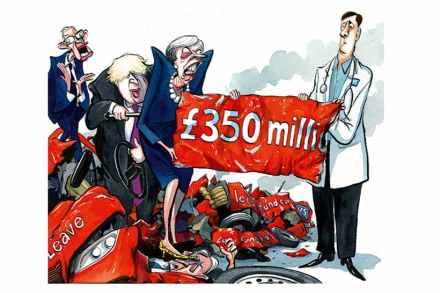
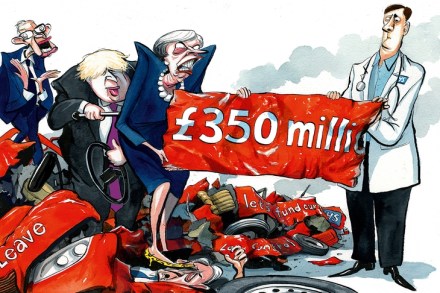
Today’s newspapers have managed to catch up with our cover story from last month: Theresa May has agreed to a massive cash splurge on the NHS. Rather than wait until the spending review to announce this, there will be a political stunt presenting the cash as a 70th birthday gift to the health service. But it is instructive nonetheless: it underlines how this is not a serious assessment of the health service’s needs but a politically motivated gesture. Once it would have been opposed by the fiscal hawks in the Tory party but now these people tend to be keener the Brexit bus pledge of £350m a week for the NHS being honoured – which, by the time of the next election, it will be. The biggest question is how to fund this.

Change to visa rules shows May has learned from her recent immigration messes

From our UK edition

The government has finally climbed down on visa restrictions for foreign doctors and nurses, scrapping the cap on numbers who can be employed using the tier 2 visa route. This was costing NHS trusts shocking amounts of money in processing applications from overseas medical professionals which were in large part turned down by the Home Office. It is striking that the government decided this week to relax these restrictions, given they are part of the tough immigration policy introduced by Theresa May. Time was when the then Home Secretary would repeatedly upbraid David Cameron for handing her a net migration target to deliver which her Cabinet colleagues were frequently trying to flout.

In defence of Love Island’s Dr Alex George | 6 June 2018

From our UK edition

Love it or hate it, you’re likely well aware that season four of Love Island launched on Monday night. The media frenzy is impossible to escape. Traditional and social media are a-buzz about the contestants, the couplings, and the budding drama that is bound to escalate in coming weeks. But the first episode had its critics – and I’m not just referring those who think the sexual escapades of Brits on holiday shouldn’t be at the top of the news agenda. One of the contestants received particularly intense backlash from the public – presumably not for the same reasons the ladies didn’t step forward to choose him, but because of his job. Or rather, a job he’s put on hold.

Letters | 31 May 2018

From our UK edition

What the NHS needs Sir: James Forsyth and Fraser Nelson are right (‘The great Tory health splurge,’ 26 May): an extra 3 per cent will not solve the Tories’ political problem. Labour will still trumpet NHS deficiencies, waste will continue and the NHS will demand ever more resources. Only structural change will solve the problems inherent in our state healthcare monopoly. First, we need to set sustainable limits on what the NHS should provide, learning from other countries how to restrain demand responsibly. Second, we need to look beyond how adult social care is funded, to how it should fit with the NHS. Third, we must slash the top-heavy bureaucracy and split NHS England into manageable units (the size of NHS Scotland, say).

Can Ruth Davidson snap Theresa May out of her Brexit delusion?

From our UK edition

Ruth Davidson’s Glasgow speech is making headlines about the NHS because that’s where most political village attention is right now. We all know that a big government announcement on health funding is coming and Davidson knows it too. As a former hack, she also knows how to hijack someone else’s story, so her speech is deftly done. (In the trade, this would be known as byline banditry, and it’s Jeremy Hunt’s byline she’s attempting to bandit, or at least share.) But I’m more interested in what she said about immigration. Yes, she repeated a previous call to scrap the stupid “tens of thousands” target because it’s, well, stupid. That’s not news because she’s said it before and the target has been stupid before.

The problem taxing the Tories

From our UK edition

Political Cabinet on Tuesday was treated to a polling presentation that highlighted the dilemma the Tories are facing. When voters are asked what the most important issue facing the country is, they reply Brexit and the NHS. But when they are asked what the most pressing issue for them personally is, they say the cost of living. And what’s the most popular Tory policy since the election? The stamp duty cut for first time buyers. As I write in the Sun this morning, the political implications of all this is clear: Voters, who are most worried about the cost of living, won’t thank politicians who hike their taxes.

The Spectator Podcast: Health Cheque

From our UK edition

In this week’s issue, the Spectator reveals that the government is planning a significant yearly increase in the NHS’s budget. But, Lara Prendergast asks in the podcast, isn’t this the £350 million a week bus pledge? And how will the government pay for this (00:40)? We also talk about the difficulties in modern adoption with Prue Leith (15:30), and finally, we talk to Martin Tyler and Mark Palmer on whether this year’s World Cup, held in Russia, is set to be the most political ever (26:35). One of the most infamous images of the EU referendum campaign was that bus. The one which promised £350 million to the NHS each week if we were to leave. Many thought it fantasy, but is that promise now coming true?

The great Tory health splurge

From our UK edition

A fortnight before Philip Hammond delivered his last Budget, the chief executive of the NHS gave a speech making the case for more funding. Simon Stevens had brought with him picture of a Vote Leave poster, promising £350 million a week for the health service, which he showed to his audience. What a good idea, he said. He wasn’t coming out as a Brexiteer, but he did think the Leavers had a point about giving an extra £350 million a week to the National Health Service. In fact, he went so far as to say that the ‘public want to see’ this promise honoured. And if politicians don’t cough up?

Podcast: Why do we insist on worshipping the NHS?

From our UK edition

Nigel Lawson once wrote that 'the National Health Service is the closest thing the English have to a religion'. It's a justly celebrated line because it rings so true – though the second half of the sentence, even more uncomfortably true, is invariably left out: '... with those who practise in it regarding themselves as a priesthood'. This summer, adherents of our national quasi-religion are marking the 70th anniversary of its foundation by St Aneurin Bevan. The ceremonies – less preposterous but just as intense as Danny Boyle's tribute to the NHS in Britain's Olympic opening ceremony – have the unqualified blessing of our actual religions.

Capitalism won’t fix the NHS’s bureaucracy problem

From our UK edition

James Delingpole is right, of course, to extol the virtues of capitalism (‘We don’t deserve capitalism’, 5 May) but wrong to imagine that if only we stuck to strict capitalist principles we could cure problems like the allegedly system-clogging bureaucracy in the NHS. The United States probably has the most ‘capitalistic’ health service in the world; but it has seen an even greater rise in numbers of bureaucrats than the NHS, contributing to its ranking as the world’s most expensive healthcare system. Or take US universities: they too operate on a very capitalistic model which has seen student fees rise steeply over the past three decades and has burdened the campuses with huge bureaucracies.