New york

Trump’s gilded age, the ‘hell’ of polyamory & is Polanski Britain’s Mamdani?

From our UK edition

31 min listen

A year on from his presidential election victory, what lessons can Britain learn from Trump II? Tim Shipman writes this week’s cover piece from Washington D.C., considering where Keir Starmer can ‘go big’ like President Trump. Both leaders face crunch elections next year, but who has momentum behind them? There is also the question of who will replace Peter Mandelson as ambassador to the United States. Can Starmer find a candidate who can get the Americans on side? Host Lara Prendergast is joined by The Spectator’s political editor Tim Shipman, features editor Will Moore and commissioning editor Mary Wakefield.

New York is not the city that Mamdani pretends it is

There is an unhappy history of left-wing Britons getting involved in US elections. Back in 2004, the Guardian – the flagship organ of the British left – organized a letter-writing campaign, urging voters in the swing state of Ohio not to re-elect George W. Bush. The good people of Ohio didn’t take kindly to a bunch of North Londoners telling them how to vote, and although the Guardian’s campaign probably can’t be given all the credit, the voters of Ohio duly went to the polls and swung firmly behind Bush. One wishes that London Mayor Sadiq Khan’s intervention in this week’s election in New York might have had a similar result.

New York

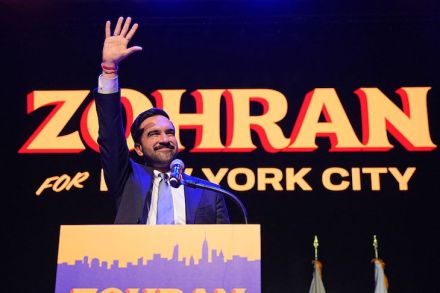
The cost of Zohran

William F. Buckley Jr. once quipped that he would rather be governed by the first 2,000 names in the Boston phone book than by the Harvard faculty. New York City is about to be governed by the Columbia University student body. A city that used to think of itself as grown up has just elected a mayor who seems the very embodiment of the American college student: uninformed, entitled and self-important, enjoying a regal quality of life that depends parasitically upon a civilization about which he knows nothing, yet for which he has nothing but scorn. American college students regularly act out little psychodramas of oppression before an appreciative audience of diversity deanlets and associate vice-provosts of inclusion and belonging.

Sixties Surreal at the Whitney is a bad trip

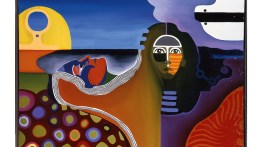
The Whitney’s Sixties Surreal is not about Surrealism. I spent about a week trying to figure out what it might actually be about, before I gave up. The show claims to seek to answer a simple question: what if Surrealism, rather than Cubism, had been the dominant thread in modern American art? This is funny to me, as Dalí’s melting clocks are far better known in America than any Cubist painting. Regardless, the museum never provides an answer. Instead, the Whitney jumps right to its agenda: reviving what it deems an overlooked thread of countercultural art. Ah, yes, the woefully neglected subject of… counterculture in the 1960s.

sixties surreal

Why is the Met making medieval art perverse?

Unwitting historians often reveal just as much – if not more – about their own time and place than the time and place they claim to describe. The curators of Spectrum of Desire: Love, Sex, and Gender in the Middle Ages, a new exhibition at the Met Cloisters, are prime examples. Gathering manuscript illustrations, paintings, sculptures, jewelry and more from the 13th to 16th centuries, the exhibition promises to uncover “the hidden sexuality and sensuality of medieval art.” The intent is “queering the past,” and the objects were chosen to show expressions of “desire” in as many forms as possible – a saucy premise that appeals to contemporary trends. But many of the new interpretations range from the woolly to the laughable.

met kinky

Mayor Mamdani will terrify America

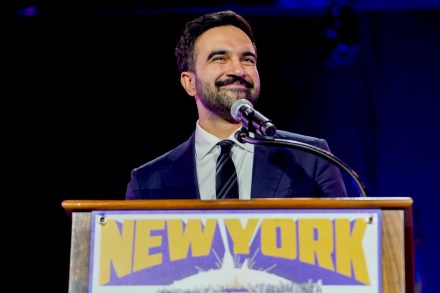
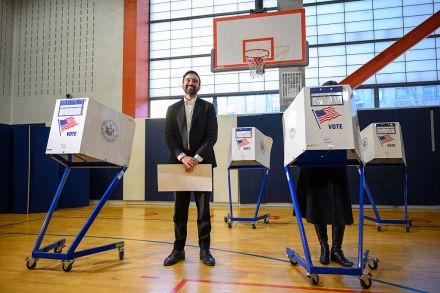
Zohran Mamdani is the mayor-elect of New York City, and the progressive wing of the  Democratic party is Champagne drunk celebrating his ascension.  But should it be? Mamdani has only narrowly prevailed in a race with a clear spoiler candidate, Republican Curtis Sliwa, lead-blocking for him against a charmless opponent, former governor Andrew Cuomo. With tougher, more honorable competition, it’s possible – likely, even – that he may not have even made it to the general election, much less won it. Only when compared to a corrupt, sleazy, nepobaby with blood on his hands, and a beret-clad, narcissistic cat-man whose own friends begged him to step aside, did voters view Mamdani as a much-needed alternative.

Zohran Mamdani
New York

What to expect from today’s elections

Americans head to the polls today, with gubernatorial elections in Virginia and New Jersey and mayoral elections in New York City and Minneapolis. The races are being talked of as an early test for Trump, a bellwether for the public mood after a breakneck ten months back in the Oval. A qualifying remark. Each of these races are taking place in traditionally blue cities and states – Virginia has not voted for a GOP presidential candidate since 2004; New Jersey since 1988; Minnesota since 1972. Still, these places – even New York – trended strongly purple at the last election; in this sense, today’s elections will be a test of the so-called “vibe-shift" and its extent.

How Republicans can win New York?

Is Maud Maron crazy? Bill Ackman certainly thought the Republican candidate for Manhattan DA was, she tells me, when she asked him for $2 million. While the billionaire hedge fund CEO said he could easily raise the money she needed to fund her campaign in a single night, ultimately he chose not to – and instead focused on backing Andrew Cuomo for mayor.Ackman thought “oh, she's a nice lady, but she's crazy,” Maron recalls. “She's running as a Republican in a Democratic city.”Fast forward six months and Cuomo is on the brink of losing to Zohran Mamdani – and Ackman has cast a vote for Maron, who he now calls “great.

Maud Maron

De Blasio ‘imposter’ hoodwinks British paper

Of all the people to go as for Halloween, why would you choose Bill de Blasio, an undistinguished Mayor of New York and flame-out 2020 presidential candidate?  That’s a plausible explanation for the recent howler from the Times of London – Great Britain’s newspaper of record – whose veteran US correspondent Bevan Hurley quoted a man identifying himself as de Blasio on his misgivings about Zohran Mamdani. “While the ambition is admirable, the cost estimates – reportedly exceeding $7 billion annually – rest on optimistic assumptions... about eliminating waste and raising revenue through new taxes,” this total imposter told Mr. Hurley, with strange eloquence. “In my view, the math doesn’t hold up under scrutiny, and the political hurdles are substantial.

Bill de Blasio

Is OCD hip?

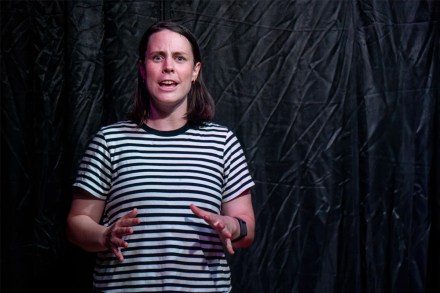
About half-way through the one-woman show Unstuck, the American comic Olivia Levine admits that it’s “hip” to talk about one’s obsessive-compulsive disorder.   She’s right. In Unstuck – which tracks Levine’s at times paralyzing battle with the illness – Levine is following a well-trod path, seen on many a movie and television show. The OCD character can’t stop counting or washing their hands or looking over their shoulder. Often their symptoms are played for laughs or sympathy or to showcase their weird but essentially charming quirkiness. Rarely is the more menacing side of OCD shown.  Levine is here, then, to disrupt the stereotypes and, with humor and likability, discuss the symptoms that are less often depicted in media.

Olivia Levine (Bryan Berlin)

Boomer New York’s last bellow

New Yorkers received visits from two ghosts of Christmas past and one ghost of Christmas present at its last 2025 mayoral debate on Wednesday night. Republican nominee Curtis Sliwa and champion of himself Andrew Cuomo lobbed Grumpy Old Man insults across the stage at each other while Zohran Mamdani stood center stage, fresh and gleaming, deflecting blows and acting with all the confidence of a football team that has a three-touchdown lead at the two-minute warning. The historical turn, potentially tragic, that will lead to the Democratic Socialists taking over America’s largest city, is reaching its conclusion, and there won’t be a final twist.

Mayoral debate

In memory of Saul Zabar

On what is controversially called Columbus Day weekend, which this year fell uncontroversially at the end of Sukkot, my wife, daughter and I found ourselves in our native habitat: New York. Naturally, this meant a trip to Zabar’s, though because our daughter is a toddler who travels by stroller when she is not toddling, I decided to make this Saturday different from all other Saturdays: “to” Zabar’s meant this time “up to but, alas, not inside.” After all, weekends are always a madhouse in the country’s most famous “appetizing” store, founded in 1934, but especially so four days after patriarch Saul Zabar’s death on October 7 (of all days) at the age of 97. An awful lot of pilgrims journeyed last week to the mecca of this self-described “lox-smith.

zabar’s

The Spectator state of mind

From our UK edition

It is party time in New York as we toast the launch of The Spectator’s swish new office on Fifth Avenue. The building, an art deco number originally designed by George F. Pelham, thrusts skywards, just a few blocks from the Empire State Building – and we’re right at the top. The Spectator State of Mind. The office is a work in progress: walls half-demolished, wires hanging out, plaster on show. Yet even in its unfinished state, it looks beautiful. We spend the day getting the place in shape for our ‘hard hat party’, improvising with gaffer tape and a few well-placed lamps to conjure up a vibe. I lay out the napkins, each printed with amusing quotes about the magazine. My favourite? ‘You can go to hell – you and your irrelevant rag’: Sebastian Gorka.

Mamdani declares war on excellence

New York Assemblyman Zohran Mamdani has a bold plan for the city’s schools: phase out the Gifted and Talented program in elementary education. His rationale is that these programs create disparities and feed inequality. It’s a familiar progressive argument. If some students are excelling, others must be suffering. If a child is recognized as gifted, it’s unfair to those who aren’t. The logic is as simple as it is destructive: equality means sameness, even if sameness means mediocrity. There is nothing wrong with recognizing giftedness. In fact, it’s common sense. If a child demonstrates unusual ability in math, science, writing, or the arts, you nurture it. You don’t bury it under a misguided notion of “equity.” Excellence, like athletic talent, must be cultivated.

Zohran Mamdani

Andrew Cuomo is the lesser of two evils

New York City politics has rarely offered voters a clean choice. This year, with Eric Adams out of the mayor’s race, the city faces one of its grimmest dilemmas yet: Andrew Cuomo or Zohran Mamdani.Let’s be clear – this is not an endorsement of Cuomo. The former governor has baggage that most voters can recite from memory. But politics isn’t about picking saints; it’s about survival. And when survival is on the line, sometimes the only responsible thing to do is choose the lesser of two evils.Cuomo may be corrupt, arrogant and heavy-handed. But at least he governs from a place of pragmatism.

Eric Adams

Why black voters won’t come around to Mamdani

When Zohran Mamdani took the pulpit at Brooklyn’s Bethany Baptist Church last Sunday, he had a golden opportunity. He could have spoken to the hopes of black New Yorkers, their resilience, their aspirations for safer neighborhoods, better schools and paths to prosperity. Instead, the first thing he brought up was police shootings. There is nothing wrong with addressing police shootings. They are tragedies that wound communities deeply. But it is telling that when Democrats step into black churches, their reflex is to start with pain. They do not speak to us as whole citizens with complex desires. They reduce us to our wounds, assuming that the surest way to earn our votes is to rehearse our traumas.This is what I call “pain politics,” and frankly, I am tired of it.

Zohran Mamdani

Crimes that aren’t crimes in New York

There were lots of shocked people when state terrorism charges against Luigi Mangione – the man accused of murdering UnitedHealthcare CEO Brian Thompson – were dismissed on Tuesday. I wasn’t one of them. As the partner of a homicide victim and an advocate for victims for more than 20 years, I’ve seen firsthand how New York’s penal code is a disaster. It doesn’t just fail victims; it rewards predators. It protects the violent. It gives them loopholes and light slaps on the wrist. And then we all act surprised when killers like Mangione benefit. Here’s a reality check that most people don’t know: punching someone in the face is not considered assault in New York. It’s classified as “harassment” – not even aggravated harassment.

Luigi Mangione

In love with a Luigi Mangione chatbot

In July’s Spectator, I covered the peculiar case of individuals supporting Luigi Mangione, now in custody for the public murder of UnitedHealthcare CEO Brian Thompson. A month later, Lara Brown wrote about the similarly curious trend of people falling in love with online chatbots. Neither of us, I think, ever imagined that there could be a situation in which both of these stories would combine. Yet it looks like nothing about our dystopian world can surprise me anymore, because I have discovered it is indeed possible. A woman has fallen in love with a Luigi Mangione chatbot.

Luigi Mangione

Don’t watch the murder video of Iryna Zarutska…

There are precious few people who should watch the video released yesterday of Ukrainian refugee Iryna Zarutska slowly dying as she cowered in bewilderment and abject fear on a train carriage in Charlotte, NC, after being slashed three times in the neck by a violent repeat offender. Certainly not rubberneckers on the internet whose depraved interest will only intrude on her family’s private grief. And absolutely not her family, for them it is the worst nightmare they could imagine come alive. A jury will have to. Two other groups who should: Democrats and the media.  They created this nightmare so they should be forced to see the uncomfortable truth and direct result of what they have done.

iryna zarutska

Camus comes to America

The 20th-century French writer Albert Camus remains a living author, a permanent contemporary, in a way that the far more dogmatic and ideological Jean-Paul Sartre does not. The latter provided a caricature of “existentialism,” nihilism dressed up as absolute freedom, beholden to no limits and no enduring truths. In contrast, the author of The Stranger and The Plague rejected Sartre’s facile nihilism, as well as his repellant accommodation with murderous messianism, typically conveyed in fashionable leftist nostrums. The more hopeful side of Camus comes through in his recently re-released Travels in the Americas: Notes and Impressions of a New World.

camus