Neil Armstrong

Reflections on the Moon

We Americans have been instructed to burst our buttons with pride over Artemis II’s drive-by of the Moon. But out here in cratering America, far from Mission Control, we remain buttoned-up. This is not due to our skinflint nature or lack of imagination; nah, it’s just that Big Science – “corporate socialism,” as the late parsimonious populist Democratic senator William Proxmire of Wisconsin termed the space program – is spiritless, mechanical and inhuman.

The inside story of how America got to the Moon

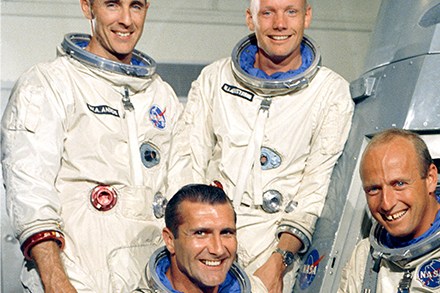
On March 16, 1966, Neil Armstrong and David Scott became the first astronauts ever to dock with another spacecraft when they linked their Gemini 8 capsule to the uncrewed Agena target ship. However, the cheers had barely died down at Mission Control Houston when Scott realized they had a problem. The conjoined spacecraft had begun a gentle leftward pitch. Armstrong and Scott watched in horror as the capsule’s gentle pitch became a tumbling motion that increased, turning the craft into a centrifuge. In desperation, Scott undocked the two ships before gravity ripped them apart. But Gemini 8 continued to spin faster. At 60 revolutions per minute, the astronauts began to slip into unconsciousness.

When the moon brought America together

The Artemis rocket is back from the moon. Within a couple of years, if all goes to plan, it will bring men to the moon’s surface. It is a great loss that a bigger deal hasn’t been made of this expedition. I was only three when John F. Kennedy died, and his famous 1962 pronouncement that we would go to the moon not because it was easy but because it was hard was already history. The picture books I got on birthdays always included him in the history of space exploration. Those books made sure every kid knew how “we” were going to get to the moon. They changed us, and with us, America. We started with Mercury, baby steps mostly proving we could launch men into space. Then Gemini, a long proof-of-concept program to try out the technology of docking.

Apollo 11 was nowhere near woke enough

If you do ever find yourself in Moscow with a spare morning or afternoon to discharge, might I recommend a visit to the Museum of Cosmonautics? Roosting below the grandly named ‘Monument to the Conquerors of Space’, the frigid, rather shabby rooms of this museum contain exhibits that are as moving as anything that’s ever been placed in a glass box for tourists to gawp at. When you consider that Soviet Cosmonauts ‘touched the face of God’ using crude, dangerous technology that contained less processing power than the average contemporary fridge – when you consider the sheer bravery of men like Gagarin, Belyayev and Komarov – the major response is (and ought to be) pride. Pride on a human level, that is to say, a species-level pride.

apollo 11