Nazism

A good editor and a good man

From our UK edition

Before embarking on this book, Jeremy Lewis was told by his friend Diana Athill that his subject, the newspaper editor and philanthropist David Astor, was too ‘saintly’ for a lively biography. As a publisher, she had worked on an earlier authorised tome, and thought she knew. Lewis, and Astor, proved more resilient. There are always column inches in a well-connected plutocratic clan such as the Astors. And Astor’s mother, Virginia-born Nancy, was the gold-plated battle-axe who made Cliveden, the family house in Buckinghamshire, the centre of 1930s appeasement. The story is really how Astor (born in 1912) took on his Christian Scientist mother, threw off the trappings of privilege, and became the owner and editor of the Observer during its mid-20th-century heyday.

Purifying the gymnasium

From our UK edition

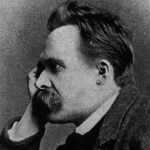
When Friedrich Nietzsche was offered a professorship in classical philology at the university of Basel in 1869 he was so happy he burst into song. He was only 24 at the time — a year younger than Enoch Powell, who became a professor of Greek at the university of Sydney aged 25 — and looked forward to a brilliant academic career. Three years later, when he delivered the six lectures contained in this book, he was already showing signs of disillusionment. His teaching duties included six hours at the local gymnasium — the German equivalent of a secondary school — and he wasn’t impressed by what he found there.

Mr Spock and I

From our UK edition

For a show with a self-proclaimed ‘five-year mission’, Star Trek hasn’t done badly. Gene Roddenberry’s ‘Wagon train to the stars’ is celebrating its 50th anniversary, although, as Marcus Berkmann’s entertaining and irreverent history points out, things could have been very different. Roddenberry’s initial idea was for a troupe of disparate 19th-century adventurers to explore the undiscovered corners of the New World in a grand airborne dirigible. While the prospect of Leonard Nimoy arching an eyebrow in a flimsy, flying gondola is irresistible, it’s hard to imagine such a concept proving as enduring as Roddenberry’s eventual brainchild.

Why are children in Guernsey extolling Islam to their parents?

From our UK edition

I have never been to the island of Guernsey. This is a large world and we have a finite amount of time on it and must make our decisions about where we visit based on necessarily limited information. We cannot know everything. I have never been to Japan, for example, because I do not wish to be crushed to death by a mass of jabbering humanity, nor take part in unpleasant sadomasochistic sex acts, nor watch people disembowelling themselves in order to affirm their masculinity. I realise that this is not all that Japan has to offer. There is also sushi, for example, and buttock-clenched politeness. I could get both of those things in Harrogate. So that’s Japan off my itinerary.

The Mann who knew everyone

From our UK edition

Thomas Mann, despite strong homosexual emotions, had six children. The two eldest, Erika and Klaus, born in 1905 and 1906 respectively, were delinquent almost from the word go: shoplifting, prank phone calls, trickery on old ladies, special schools. They were also artistically precocious; the frantic pair took German Expressionist cabaret to Berlin, Paris, Amsterdam, London, New York and Moscow. By the time Klaus reached 21, he and his sister had frolicked right round the globe. Klaus never stopped travelling, and this biography is a feverish sequence of arrivals and departures. Erika was more the performer, Klaus more the writer. Both were openly gay. Klaus explored his homosexuality in his first book, published in 1925, and in many works thereafter.

Putting Germany together again

From our UK edition

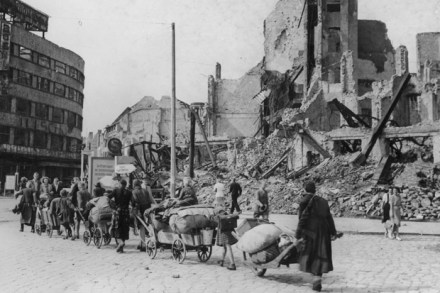
The purpose of Lara Feigel’s book is to describe the ‘political mission of reconciliation and restoration’ in the devastated cities of Germany after 1945 (though no politicians were directly involved). The chief needs of the shattered population at the time were, of course, practical: food, water, sanitation and the reconstruction of buildings. But a vital supplementary effort was made to address what was left of German culture and history after the crimes and falsifications of the Nazis. The idea was that the arts should revive an alternative, peaceful and civilised way of life in the ruins of the country.

No end to the Final Solution

From our UK edition

David Cesarani, Research Professor of History at Royal Holloway University of London, died at the age of 58 on 25 October 2015. The book now appears without its author, a kind of huge mausoleum for an astonishing enterprise. Cesarani wants to change our view of the Holocaust and to close the yawning gap between popular understanding of this history and current scholarship on the subject… to challenge the traditional concepts and periodisations … the term itself. He substitutes the ‘Final Solution’ for the Holocaust, but that Nazi term has become an alternative name for the Holocaust, which remains after 900 pages entirely unchallenged.

Hitler’s émigrés

From our UK edition

Next week Frank Auerbach will be honoured by the British art establishment with a one-man show at Tate Britain. It’s a fitting tribute for an artist who’s widely (and quite rightly) regarded as Britain’s greatest living painter. Yet although Auerbach has spent almost all his life in Britain, what’s striking about his paintings is how Germanic they seem. Born in Berlin in 1931, Auerbach was only seven when he came to England (his parents subsequently perished in the Holocaust). By rights, he should stand alongside British artists such as Peter Blake and David Hockney, yet his work feels far closer to German painters like Georg Baselitz or Anselm Kiefer. Auerbach is a one-off, a unique painter with a unique vision.

The continent in crisis

From our UK edition

Sir Ian Kershaw won his knight’s spurs as a historian with his much acclaimed two-volume biography of Hitler, Hubris and Nemesis. He is now attempting to repeat the feat with a two-volume history of modern Europe, of which this is the opening shot.Inevitably, the figure of the Führer once again marches across Kershaw’s pages as they chronicle the years dominated by Germany’s malign master. First the Great War that gave Hitler his chance to escape obscurity, and then the greater one he launched himself. Opening with the continent’s catastrophic slide into generalised conflict in 1914, Kershaw apportions blame or the disaster more or less equally to all the combatant nations.

The devil’s devoted disciple

From our UK edition

It is ironic that this weighty biography of Hitler’s evil genius of a propaganda minister is published on the day of a general election filled with Joseph Goebbels’s hallmarks: mendacity, media manipulation and the big lie. Seventy years after the spectacular suicide of Goebbels and his wife Magda, and their murder of their six children, in the Berlin bunker, the ‘little doctor’ is still a byword for the black arts of political spin and politicians regularly accuse each other of telling fibs ‘worthy of Goebbels’.

Process of elimination: the horrors of Ravensbrück revealed

From our UK edition

Concentration camps in Nazi Germany were originally set up in 1933 to terrorise Hitler’s political enemies; as war drew near, their function expanded to gratify his obsession (and that of Reichsführer Himmler, as head of the SS which administered them) with ‘purifying the race’ by getting rid of gypsies, Jews, ‘asocials’ — prostitutes, criminals, vagabonds — as well as the mentally ill and handicapped. An all-female camp at Ravensbrück, set up in 1938, soon afforded the prison doctors a steady supply of women — the ‘rabbits’, as these prisoners became known — for medical experiments .

Germany is shackled in the immigration debate. But Britain isn’t so must lead the way

From our UK edition

Today Angela Merkel will meet David Cameron in Downing Street. She will tell him what she can do – and what she cannot do – to help keep Britain in the EU. Yet she might like to begin by telling him what she plans to do to keep her own people behind the EU project, for in Germany the Eurofederalist consensus is being challenged like never before. In Germany, as in Britain, the most emotive issue is immigration. In Germany, as in Britain, people are scared to discuss this issue frankly, for fear of being branded racists. And now a new movement has emerged to fill this vacuum: Patriotische Europaer Gegen die Islamisierung des Abendlandes, aka Pegida – Patriotic Europeans Against the Islamisation of the West. Who are Pegida? What do they want?

Game of thrones: five kings spanning five centuries launch a new series on royalty

From our UK edition

It is a strange paradox of our egalitarian age that a progressive publisher like Penguin should commission — at considerable expense, since the series editor Simon Winder has netted some top academic authors — brief lives of all 44 English, and later British, monarchs, from Athelstan to his distant descendent, our own Queen Elizabeth. The 45th book in the series is devoted to our sole non-royal ruler, Oliver Cromwell. The biographies — each costing £10.99 — though not exactly ‘potted’, are necessarily squeezed by space — none is longer than 150 pages — into extended essays that can be comfortably devoured in a couple of hours; ideal for a railway journey or a short-haul flight in our cash-rich, time-poor era.

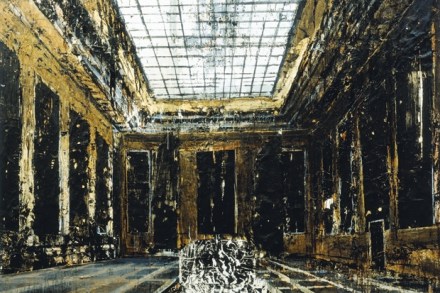
‘I like vanished things’: Anselm Kiefer on art, alchemy and his childhood

From our UK edition

At the entrance to Anselm Kiefer’s forthcoming exhibition at the Royal Academy visitors will encounter a typically paradoxical Kiefer object: a giant pile of lead books, sprouting wings. When I asked Kiefer to explain this strange object, he immediately — and characteristically — began talking about alchemy. Lead, of course, was the material from which alchemists hoped to make gold. ‘But at the beginning,’ Kiefer explained, ‘it wasn’t just a materialistic idea, it was a spiritual one: to transform matter into a higher spiritual state.’ So, I suggested, in a way all art is alchemy: transforming one substance — paint and canvas, for example — into something else entirely. ‘Yes, certainly,’ Kiefer replied.

Germans see the best of their soul in Weimar. Everyone else, on the other hand..

From our UK edition

Thuringia, a region of former East Germany, occupies a special place in the thoughts of Germans, who like to regard it as the origin of all their best virtues. It’s an alluring place, full of wonderfully untouched stretches of densely forested hills; the occasional small historic town seems hardly to have changed for decades, and the tourist can spend a happy week pottering from Schmalkalden to Ilmenau to Eisenach in the illusion that none of those unpleasant realities of the last century ever touched this place. I once asked the guide at the Wartburg, the magnificent medieval and mock-medieval castle on a snowy crop outside Eisenach, what this place meant to modern-day Germans.

Andrew Marr’s diary: Seeing shadows of Syria in Limousin’s ghost village

From our UK edition

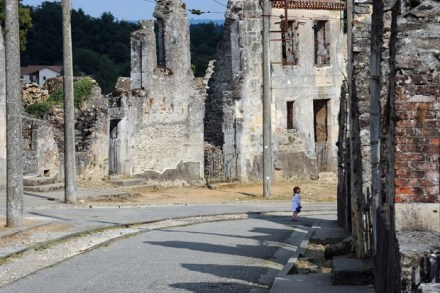
No, no, no, you don’t want a house abroad — the paperwork, the taxes, the piping, the cost of the pool. What you want are good, kind, generous friends with houses abroad. That’s what we’ve enjoyed this summer, meeting scores of interesting new people and being looked after by our best friends. We pay them back with wine, little presents and London hospitality. The only downside to ‘les vacances ligging’ is having to book extra seats home on Ryanair for our vastly swollen and moaning livers. The most striking thing we did in France was to visit Oradour-sur-Glane, the Limousin village where on 10 June 1944 a Panzer division of the SS massacred 642 men, women and children as a reprisal operation against the Resistance.

Three cheers for all those who fought fascism, from Cable Street to Berlin

From our UK edition

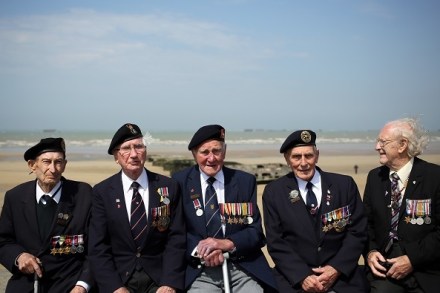
70 years have passed since, in the words of General Dwight D. Eisenhower, 'Allied naval forces, supported by strong air forces, began landing Allied armies on the northern coast of France.' Operation Overlord, or D-Day as the invasion is known to posterity, was astonishing in every sense; not least because weather conditions on 5/6th June 1944 were far from ideal to execute an amphibious landing against a well-entrenched enemy. Even military men were surprised by the comparatively light casualties (4,413 killed); many had anticipated a bloodbath. Major General Sir Frederick Barton Maurice (a retired soldier who later turned to teaching military history at the University of London) wrote in the Spectator at the end of August 1944: 'The campaign of Normandy is unique.

Yorkshire village bans Nazis. Why didn’t Neville Chamberlain think of that?

From our UK edition

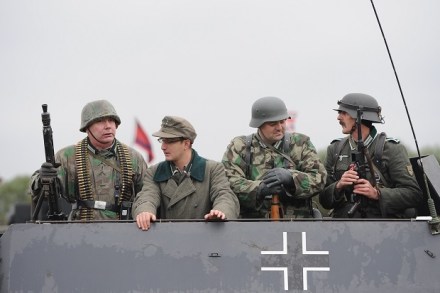
D-Day would have been effected with far less trouble if, at the time, we had insisted on the same rules that pertain in Haworth’s annual commemoration of the event. The Yorkshire village holds what is now called a “1940s Weekend” – don’t mention the war – and people who wear Nazi uniforms, or the SS insignia, have been told that they are not welcome. This is because the uniforms “give offence”. Previously, people turned up dressed as Nazi soldiers and others as allied soldiers – much as actually happened the first time the event was staged, on the beaches of Normandy in 1944. But some people complained about the uniforms and so signs have gone up all around the town telling them they’re not welcome.

I’m proud to say The Book Thief couldn’t pull my heartstrings

From our UK edition

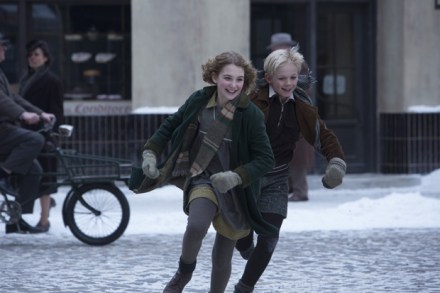
The Book Thief is based on Markus Zusak’s novel of the same name which, although written for young adults, appears beloved by many, judging from the readers’ reviews on the internet, and the frequent declarations of ‘it’s the best book I’ve ever read!’, and there is our first worrying clue, right there. Over the years, of which there have been more than enough — I am quite ready to shuffle off now — I have come to learn that when anyone declares a book ‘the best book I have ever read!’ it tends to be the only book they have ever read.

Did Hollywood moguls really make a pact with Hitler?

From our UK edition

At the recent Austin Film Festival, at every ruminative panel or round-table discussion I attended, I slapped my copy of this book down in front of me. The cover, I felt, was bound to catch the eye of the screen legends and louche suits from the big production companies. Above the uncompromising title, it shows a photograph of Adolf Hitler watching a movie with his entourage, his stern, blunt features palely lit by the glowing screen, his mouth small, his nostrils flared in concentration. What, one wonders, was he watching? Laurel and Hardy? Mickey Mouse? It’s not impossible, actually. We know for a fact that the psychotic cinephile adored cartoons and slapstick of this kind.