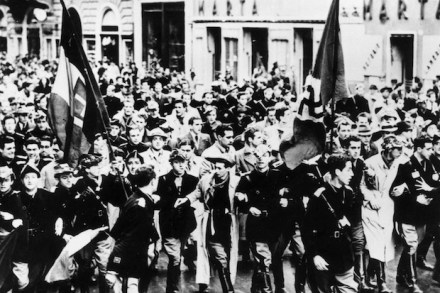
Mussolini

Ezra Pound – the fascist years

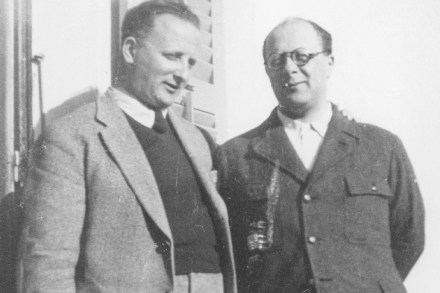
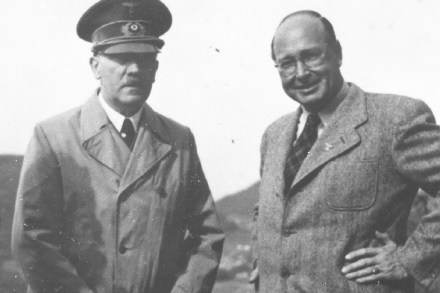
‘There are the Alps. What is there to say about them?/ They don’t make sense. Fatal glaciers, crags cranks climb, /Jumbled boulder and weed’, was Basil Bunting’s 1949 opinion of Pound’s Cantos; but as the sometime friend of Pound continued: ‘There they are, you will have to go a long way round / If you want to avoid them.’ This judgment has proved wise. Here we are in 2014, not avoiding one of the most contentious figures in 20th-century literature: poet, midwife of Eliot’s The Waste Land, economist, translator, committed Fascist, anti-Semite, avid supporter of James Joyce and Mussolini, later alleged traitor to the United States of America and —

A Hello! magazine history of Venice

When Napoleon Bonaparte captured Venice in 1797, he extinguished what had been the most successful regime in the history of the western world. The Venetian Republic had lasted over 1,000 years — longer than ancient Rome — without a revolution, a coup d’état or a successful foreign invasion.  Yet after 1797 it was never to be independent again: it was given to Austria, taken back by France, allotted once more to Austria and finally, in 1866, handed over to the young Kingdom of Italy. Most visitors to Venice are interested in its distant past, in the struggles to build a city on the mudbanks, in the glories of its gothic

Soldier, poet, lover, spy: just the man to translate Proust

Charles Kenneth Scott Moncrieff’s Englishing of Proust — widely and immediately agreed to be one of the greatest literary translations of all time — very nearly didn’t happen. Scott Moncrieff only suggested the project to his publisher after they rejected a collection of satirical squibs in verse (sample: ‘Sir Philip Sassoon is the Member for Hythe;/ He is opulent, generous, swarthy and lithe.’). Like any good hack, he had another suggestion up his sleeve: there was this character Proust just starting to be published — making a bit of noise in France. Constable didn’t immediately see the value: ‘They replied that they did not see much use in publishing a

The Italians who won the war – against us

Italy entered the second world war in circumstances very similar to those in which it signed up for the first. Its leaders waited for nine months after the outbreak until they thought they had identified the winner and extracted promises of territorial rewards. In 1915 they guessed rightly and attacked Austria, their formal ally for the past 33 years, and they seemed to have chosen correctly again in June 1940, when France was already beaten and the British had evacuated Dunkirk. Italy’s new enemies were even older allies than Austria. Without the military aid of the French and the diplomatic support of Britain, Italy would never have become unified between

Churchill was as mad as a badger. We should all be thankful

Land sakes! Another book about Winston Churchill? Really? Give us a break, the average reader may think. Actually though, as title and subtitle suggest, this isn’t just another biographical study. It’s at once odder and more conventional than that. More conventional because, in some ways, it is just another biographical study. Odder because — instead of being a straightforward discussion of Churchill’s literary work — it sees literature as the key to his biography. More than that, its author seems to think he has hit on a ‘new methodology’ in which ‘we can write political history as literary history’. Well, perhaps. At one end of that notion is the banality

When Mussolini came knocking on Hollywood’s door

John Ford was the first of the five famous Hollywood film directors to go to war. He went expecting to get given a sword, which he could then brandish. After all, he knew about swords; they were things that came out of props baskets in his cavalry epics, but that was in films. Unfortunately in real life he found he had an arthritic thumb, which meant that having once drawn one he needed help to put the sword back in its scabbard. It had not been like that in his films, where he had only to say the word for anything to happen. There he could put a coal mine

Beppe Grillo: Italy’s new Mussolini

The stand-up comedian Beppe Grillo, like the fascist dictator Benito Mussolini before him, has a craving to take over the piazza and mesmerise the crowd. Where once young Italians chanted the mantra ‘Du-ce! Du-ce!’ now they chant  ‘Bep-pe! Bep-pe!’. But it is not just a shared need to rant and rave at large numbers of complete strangers that hirsute Beppe and bald Benito have in common. Worryingly, for Italy and also for Europe (where democracy seems incapable of solving the existential crisis), there is a lot more to it than that. Beppe Grillo founded the MoVimento 5 Stelle (M5S) in Milan on 4 October 2009. The capital ‘V’ stands for