Martin luther

The pointlessness of the German Peasants’ War – except in Marxist ideology

From our UK edition

The preservation of a strict social hierarchy rests very often on the enforcement of correct modes of address. In America today any university student may address any other as ‘dude’, but those who have attained a certain level of prestige will object if an unwary low-status blunderer ventures to call them ‘bro’. Rebels seeking to overturn rigid class systems will often start by violating such regulations. The German revolutionaries of 1968, for example, made a point of addressing everyone as arschloch, or ‘arsehole’ – a radical usage I remember being startled by it in mid-1990s Kreuzberg bars until it was explained to me that I wasn’t being insulted. Their other move, to use the intimate du, rather than the formal Sie, for ‘you’, has taken much stronger hold.
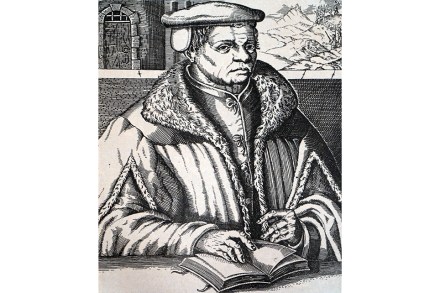
The firebrand preacher who put Martin Luther in the shade

From our UK edition

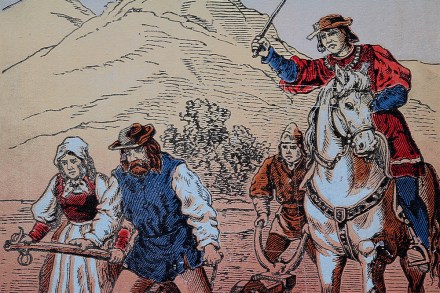
‘Now tell us, you miserable wretched sack of maggots,’ wrote Thomas Müntzer, sounding like the love child of Owen Jones and Ian Paisley, ‘who made you into a prince over the people whom God redeemed with his own precious blood?’ The question Müntzer posed Count Albrecht of Mansfeld was, you’d think, rhetorical. Like his contemporary Martin Luther, if less unremittingly scatological, the radical millenarian preacher wielded a sharp pen. Don’t forget Ezekiel’s prophecy, he wrote to Count Albrecht’s brother Ernst: ‘God would command the birds of the air to feast on the flesh of the princes and command the unthinking beasts to lap up the blood of the bigwigs.

Are cancel-culture activists aware of their sinister bedfellows?

From our UK edition

Is there a woke case to be made for freedom of expression? Jacob Mchangama certainly seems to think so. This 500-page door-stopper, which combines a history of free speech with a persuasive case for its defence, is aimed squarely at snowflakes and social justice warriors. Mchangama deals patiently and methodically with all the objections they might make to ‘the first freedom’ and then tries to convince them it’s in their interests to defend it. Take the assumption that untrammelled free speech perpetuates current inequalities, favouring the privileged and penalising the disadvantaged.

The reason of Jordan Peterson

If only Hamlet had known Jordan Peterson. To be or not to be, Dr Peterson believes, is indeed the burning question — but it’s a question that can be resolved decisively in favor of Being with a capital B. And he’s willing to walk any modern-day Hamlet who cares to listen through the math. This reasoned position in favor of existence is at the heart of Jordan Peterson’s latest book, Beyond Chaos: 12 More Rules for Life. It’s also, I’d argue, at the heart of his popular appeal. Sure, his undeniable charisma doesn’t hurt; and of course, he’s brilliant, well-read and articulate. But so are many other public intellectuals.

cultural marxism jordan peterson

The importance of giving offence

From our UK edition

As dons at Cambridge vote on a new protocol on constraints to free speech, we mark this month the 500th anniversary of the public burning of Martin Luther’s books outside the west door of Great St Mary’s, the university church at Cambridge. After the 1517 publication of his famous 95 Theses, raging against the Church’s sale of ‘indulgences’ that purported to pardon sin in exchange for money, Luther had been denounced by Pope Leo X in a papal Bull. This accused him of (among other things) saying things that were ‘offensive to pious ears’. Luther then burned the papal Bull on 10 December 1520, giving further offence. He was excommunicated the following year. Make no bones about it: Martin Luther intended to offend.

Sumptuous and saucy: Compton Verney’s Cranach show reviewed

From our UK edition

‘Naughty little nudes,’ my history of art teacher used to say of Cranach’s Eves and Venuses. Aren’t they just? Coquettish and compact. Kenneth Clark thought they had ‘chic’. Cranach’s nudes are rarely truly naked. They wear Ascot hats, golden chokers, filmy wisps of gossamer girdle. Take the goddess in the National Gallery’s ‘Cupid Complaining to Venus’ (c.1526–7). Don’t you long for her to take off her ostrich feather hat and tickle you with it? ‘Hallo, Jungs.’ See how she plays footsie with a branch of the tree. How she brushes the back of her hand against its trunk. Note the double necklace. Always accessorise.

How Onofrio Panvinio made the popes history

Just over 500 years ago, in June 1519, the castle hall of the German city of Leipzig was expecting a throng of spectators. The room had been specially decorated: two pulpits stood dramatically facing each other. Under the eyes of the Duke of Saxony, Martin Luther was challenged to defend some of his writings by which he attacked abuses in the Church. The scene was set for an intellectual battle — a rebellious friar, Luther, taking on the Catholic establishment. Physical threats made the atmosphere all the more tense. Two hundred axe-wielding students accompanied Luther. His opponent, the Catholic theologian Johann Eck, protected himself with 76 armed guards. Their ensuing debate dealt to a large degree with history.

onofrio panvinio

Why is Ilhan Omar still on the House Foreign Relations Committee?

Ilhan Omar is a confused anti-Semite. In 2012, she thought Israel (translation: the Jews) controlled the world through hypnosis. Now, seven years later, she believes something else: ‘it’s all about the Benjamins.’ Both ideas are classic anti-Semitic tropes. In a piece for Commentary magazine late last month, Abe Greenwald dissected the trope that had inspired Omar’s 2012 tweet. He writes: ‘The history of mystical anti-Semitism is long indeed. It predates Christendom and thrived, at times, long afterward. Martin Luther wrote that “a Jew is as full of idolatry and sorcery as nine cows have hair on their backs, that is: without number and without end.

ilhan omar anti-semitism