Margaret thatcher

Trying to get the mad, broody chicken off her addled eggs

From our UK edition

A friend who is not normally receptive to left-wing or republican ideas suddenly exclaimed at dinner in my house the other day that he was bored, sickened and disgusted by the Queen and all the royal family, and thought it was high time they were removed. In the mood of the moment, nobody seemed disposed to disagree, although compassionate noises were made from some quarters about the Queen Mother and the Waleses. In the ensuing discussion, everyone observed that they were not aware of having felt this way before, but agreed that they felt it now — that is to say, at about 9.45 p.m. on Saturday, 12 August 1989. There had been nothing to annoy us about the royal family in the news. It traditionally keeps a low profile at this time of year.

Three faces of Thatcher

From our UK edition

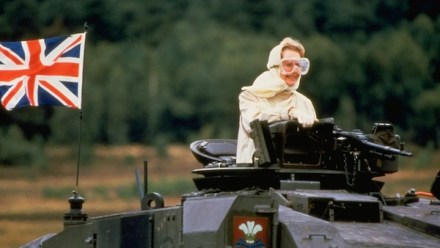
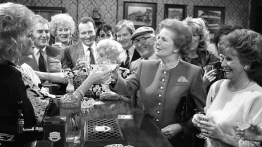
Politicians can be divided into two categories; those whose public face is different from their private face and those for whom they are the same; put another way, those who feel it necessary in public appearances to put on an act, and those who manage to remain themselves. Among the latter are (or were) such disparate characters as Jack Kennedy, Willy Brandt, Jo Grimond, Edward Heath, Neil Kinnock; and among the former Adolf Hitler, Winston Churchill, Richard Nixon, Harold Wilson and Arthur Scargill (if you don’t like that list, you are welcome to make your own). Prominent among the last-named is our Prime Minister, but she is almost unique in having not two faces but three.

After the Brighton bomb

From our UK edition

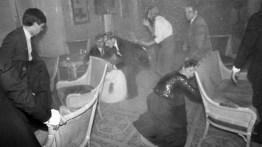
It is worth pointing out yet again that Mrs Thatcher really was very brave last Friday. It would have been no disgrace to her if, once she had realised how narrow had been her escape, she had felt weak and — as did a few of the Tory wives in the Grand Hotel — had sat down and cried. There would have been nothing cowardly in cancelling what remained of the Conference in honour of the dead and injured. But the fact that she did neither of these things and the way that she conducted herself that day confirms that she has an extraordinary amount of that particular kind of courage which rises to an occasion, appearing more magnificent the greater the challenge.

Mrs Thatcher goes to Brussels

From our UK edition

‘Délégation Royaume Uni. Salle 4’ announces a scruffy piece of paper projected onto the black and white television screens of the Centre Charlemagne. The journalists hurry upstairs for the latest from Mr Bernard Ingham, Mrs Thatcher’s press secretary. Mr Ingham is not conspicuously communautaire. He tells us who spoke in the session — Mr Lubbers, Herr Kohl, Mrs Thatcher and ‘Mr Papandreou — I always call him Mr Papadopoulos’. A nodding acquaintance with recent Greek history would have made Mr Ingham realise that such a slip, though easier on the tongue, is as politically uncomfortable as calling M. Mitterrand ‘Marshal Pétain’. But then Mr Ingham is not paid to spread sweetness and light.

Mrs Thatcher’s triumph

From our UK edition

There was never a more disenchanted victory. The moment the size of the Tory swing was known, the doubts began, not least among those hundreds of thousands who had voted Conservative for the first time in their lives. Would the unions allow Mrs Thatcher to govern? Would the promised tax cuts be blown in betting shops and strip clubs, instead of fructifying in the pockets of the people? Would investors once again be fatally attracted to the hustlers and twisters? Was there any way of bridging the growing gulf between North and South? Did the British people as a whole have any stuffing left in them? Could any government muster the zest to halt the de-industrialising of Britain? Was this to be yet another false dawn, a surrender to a fresh set of illusions?

Clear choice for the Tories

From our UK edition

If I start with a reference to the sorry condition of the Tory party, I hope readers will not immediately turn to another page. If only the Tories can take a fairly cool look at themselves, it will quickly be apparent that the condition is not as serious as all that; and that it is certainly capable of repair. Housman’s ancient ‘three minutes of thought’ will suffice to show that there is only one direction in which the Tories can go. Once their collective mind is concentrated on that fact the rest will be, if not easy, at least far advanced in ease from the complicated and tragic business of the present run-up to what looks like being a bitter leadership contest. A commonsense analysis of this confused situation would run as follows.

Her brilliant career

From our UK edition

In 1975, when Keith Joseph dropped out of the race for the Tory leadership and his campaign manager stepped into his place, almost no one took it seriously. She was ‘precisely the sort of candidate… who ought to be able to stand, and lose, harmlessly’ said the Economist. Only one publication in Britain backed her then, and our endorsement is reprinted in our supplement. The values she represented are the ones The Spectator has championed for decades: small government, low taxes and personal freedom. And a preference for those who enter politics to do something, rather than be someone.

‘If only people could see the real Margaret Thatcher’: Lords pay tribute

From our UK edition

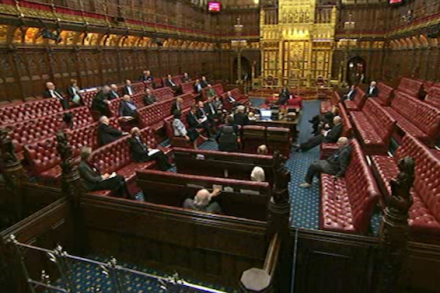
Today's debates in Parliament about Baroness Thatcher were supposed to be a tribute to the first female Prime Minister. If you were looking for the most faithful rendition of this, you should have been sitting in the House of Lords, not the Commons this afternoon. In the Other Place, the debate is always rather more civilised and measured, though it has grown rather rowdier in recent years. But today the speeches painted a fascinating picture of Margaret Thatcher, not least because many of them came from those who worked with or in opposition to her when she was in power. Some were notable by their silence: Lord Howe arrived with notes, but left without speaking. Lord Heseltine was nowhere to be seen.

‘She was Steve Jobs, Richard Branson, Lady Gaga; all rolled into one’ – Steve Hilton on Margaret Thatcher

From our UK edition

Tomorrow's Spectator includes a three-page symposium on Margaret Thatcher from a selection of her friends colleagues, admirers and sparring partners. Here's the full version of what Steve Hilton - No.10's strategy officer from 2010-2012 - has to say about our first female Prime Minister. I was lucky enough to meet Mrs Thatcher (as I will always think of her) on a few occasions, and one in particular stood out. We talked about Communism, and my family’s experience in Hungary. I was feeling incensed at the time because of the way in which the ruling elite dabbled in capitalism for their own personal enrichment, but denied the opportunities of enterprise to most people. 'Yes!” she exclaimed, 'I hate that. Hate it. That’s how elites always behave!

The guru speaks

From our UK edition

A Maggie-tastic jam-packed Spectator tomorrow. Amongst the tributes, the words of Steve Hilton stuck out: ‘I saw her as thrillingly anti-establishment; as much of a punk, and as brilliantly British, as Vivienne Westwood, who once impersonated her on the cover of Tatler. Margaret Thatcher had the virtues most valued in today’s culture: innovation, energy, daring. She was Steve Jobs, Richard Branson, and Lady Gaga all rolled into one — and a thousand times more consequential than any of them. In today’s techno-business jargon, she was the ultimate political disruptor: determined to shake things up, unleash competition, challenge and confront vested interests. To be transformative, being reasonable doesn’t get you very far.

Margaret Thatcher in six graphs

From our UK edition

With the debate swirling about Margaret Thatcher's legacy and her government's record, it's worth taking a look at what the cold, hard economic data has to say about her time in office. Of course, growth rates and unemployment figures can't tell us everything about a period, but they can at least provide a bit of substance to mix with the well-worn rhetoric. 1. Average growth. Under Thatcher, GDP rose by 29.4 per cent — an average of 0.6 per cent growth per quarter. (That's the same as the average growth rate from 1955 to 2013.)   2. Manufacturing jobs lost, but more service jobs created. A net of 1.6 million jobs were created under Thatcher. The manufacturing industry lost 1.9 million, while the services sector grew by 3.6 million.   3.

Margaret Thatcher: An Accidental Libertarian Heroine

From our UK edition

It is 34 years since Margaret Thatcher became Prime Minister. Coincidentally, she entered Downing Street 34 years after Clement Attlee won the 1945 general election.  The whole history of post-war Britain is cleaved, neatly, in two. If the first half of that story was dominated by a left-led consensus, the second has been a triumph for liberalism. We have lived in an era of liberal emancipation and are much the better for it. Mrs Thatcher, of course, was a great economic liberal. Her approach to economics, guided by Smith, Hayek and Friedman, stressed the importance of individual endeavour. Remove the dead hand of state control and Britain could flourish again. The many individual invisible hands of the market would improve our collective lot. Decline was not inevitable.

Introducing our first ebook: Margaret Thatcher in The Spectator 1975-1990

From our UK edition

No publication understood the Thatcher project better than The Spectator. We backed her for the leadership in 1975 when no other national publication would. We understood her opportunities, foibles and genius when many of our rivals were baffled by this coarse-sounding lady and her popular appeal. We have put together 21 essays from the period into our first-ever ebook: Margaret Thatcher in The Spectator 1975 - 1990. It's available today on the Kindle, for just 99p. It begins with Patrick Cosgrave advocating Thatcher as Tory leader, then gives a six-month and one-year progress report. Ferdinand Mount describes the uneasiness that followed the 1979 triumph. Then, as now, The Spectator was no a Tory fanzine and we gave vent to critical voices.

MPs line up to pay respects to – and criticise – Margaret Thatcher

From our UK edition

This afternoon's tribute debate in the House of Commons will continue until 10pm, with many MPs wanting to pay their respects to Margaret Thatcher. There will be many speeches about how the former Prime Minister inspired and shaped the politics of those speaking. But there will also inevitably be those who want to talk about the negative aspects of her legacy. Ed Miliband, who gave a measured tribute on Monday, faces the challenge of giving a speech that isn't insincere but that remains respectful too. Some of his MPs, such as John Healey, who has written a forceful piece for PoliticsHome, are boycotting the event. Others, such as David Winnick, say they will attend and criticise Thatcher.

Andrew Neil on The People’s Margaret Thatcher

From our UK edition

This morning, Andrew Neil presented a Radio 4 special recalling how voters felt about Margaret Thatcher. Including opinions from her supporters and detractors, it's a fascinating look into how she was perceived by the electorate throughout key moments in her premiership. Here is what people had to say: On her public perception: 'She doesn't convince me for a start she doesn't understand the problems of working class people. She talks down to people' Debating the cost of the Falklands War: 'Our village school is going to be closed. The cost of keeping it open would be about a hundredth part of £1 million. Wouldn't our school be a better use for money than wasting £454 million a year 8,000 miles away?

‘No such thing as society’: what it means for today’s welfare debate

From our UK edition

Any Tories who might be asking 'What Would Thatcher Do?' about some of the political rows bubbling away today would surely wonder what her response to the current benefits debate might be. She kept well away from welfare reform, but she did have strong views on the role of government in helping people get on. Her notorious Woman's Own interview provided us with the greatest insight, and in much greater detail than the 'there's no such thing as society' line that everyone can quote. Here's a longer extract from the transcript (which you can read in full on the Margaret Thatcher Foundation website): 'I think we have gone through a period when too many children and people have been given to understand “I have a problem, it is the Government's job to cope with it!

Maggie Won’t Jump

From our UK edition

  A remarkable clip from an interview with Swedish television. No-one asks Margaret Thatcher to "jump" and gets away with it. One does rather think that some of her successors would have been happy to make fools of themselves in this fashion.

Conviction politics: ‘What Would Thatcher Do?’ grips the Tory party

From our UK edition

Conor Burns, a close friend of Margaret Thatcher, gave a fascinating interview with Radio 4's The World at One today about his memories of the Iron Lady. Like so many accounts, it focused on Thatcher's disregard for opinion polls and focus groups. Burns said: 'I think it’s a failure of politics that looks too much at focus groups and too much at public opinion polls. Again, I remember last November showing her a poll in one of the Sunday papers and it showed that we were nine points behind, and she asked when the next election was, and I said it wasn’t for another two and a half years and she said: ‘that’s not far enough behind at this stage.