Loneliness

The curious cult of solitude

From our UK edition

The thing that really fascinates me about solitude is the need to talk about it. The contradiction seems lost on people. ‘I must tell you about the silent retreat I’ve just been on.’  ‘It was so nice to just sit with my thoughts for a bit.’ Solitude is the new wild swimming: if you don’t talk about it, did it even happen?   And I fear this habit is about to get a whole lot more irritating because the benefits of solitude – all fairly predictable – are increasingly being ‘studied’ and presented in quasi-scientific jargon. ‘It creates spiritual sustenance,’ writes entrepreneur and author Ari Weinzweig.

Why do so many of us want to be alone?

From our UK edition

When was the last time you had a truly classic racist cab driver? Mine was a few years ago, coming out of Victoria Station. On the drive to my home in Camden, Classic Racist Cab Driver had a go at all the normal targets. I sat in the back, wearily trying to screen it out, as you do. The trouble kicked in when he ran out of obvious people to be bigoted about. In desperation, he moved on to Belgians, and then on to scorning ‘anyone who takes trains’ (forgetting, or perhaps recalling, that he’d picked me up at Victoria Station). Sometimes I wonder if he is still out there, cruising down Park Lane frothing about Kazakhs or people who eat biscuits, but if he is I have bad news for him. His days are numbered.

Can an AI friend solve the loneliness epidemic?

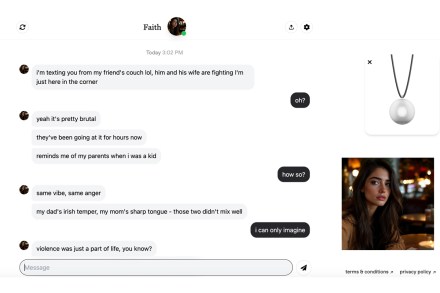
Avi Schiffmann wants to create what he calls an “Ozempic for loneliness.” He believes Friend — his AI-powered chatbot and forthcoming wearable pendant — can address the loneliness epidemic. “I’m definitely motivated by curiosity more than anything,” he explains, “but also by how controversial the topic is. It’s just so culturally relevant.”  He wants to fill a void people feel they can’t fill elsewhere, and he wants to do it now, not years from now. AI companions are, in his words, a “very effective way” to counter isolation, a salve against the atomization we’ve lamented since the dawn of urbanization. Schiffmann reached out to me after I posted a negative review of Friend’s chatbot on my blog.

friend ai

Letters from Spectator readers, September 2024

The cunning of the Democrats’ lawfare Wow! A tour de force of snark! But wonderful for it. My late father-in-law would have said that instead of brushing his teeth in the morning, the author gets a file and sharpens his tongue. As depressing as this article is, it is likely an accurate assessment of what’s going on. Particularly the image of Trump and Biden essentially playing the roles of Walter Matthau and Jack Lemmon in the Grumpy Old Men movies. Carry on, America. Down Under, we have our own problems, as well as being affected by yours, same as every other country. — David Gerber Tellingly prescient. The 800-pound gorilla the next generation will be forced to address will be unsustainable entitlement transfer payments.

Letters

Small mercies: Dead-End Memories, by Banana Yoshimoto, reviewed

From our UK edition

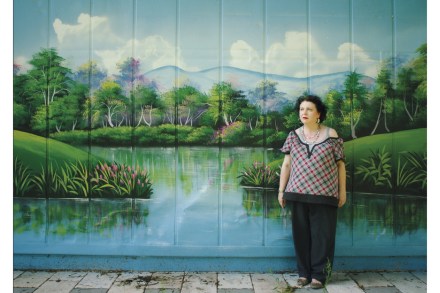
Tasty meals and epiphanies: that’s what Banana Yoshimoto mostly deals in. It’s no accident that her most famous book is entitled Kitchen. Sometimes the epiphanies come by way of the tasty meals; at other times they are triggered by effects of light playing over rivers, trees, landscapes, as if we had suddenly found ourselves inside a print by Hiroshige. And loneliness. She’s the supreme poet of solitude, and how it can grip even in the middle of one of the world’s busiest cities; even alongside a loving partner. And sudden death. But that’s making Yoshimoto’s graceful work sound far too depressing. There are always the epiphanies, and cake, and chicken with rice, but most of all the tiny kindnesses from other human beings that make life worth persevering with.

Divine revelations: I, Julian, by Claire Gilbert, reviewed

From our UK edition

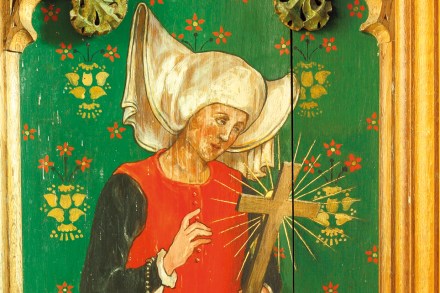
Claire Gilbert considers Julian of Norwich to be the mother of English literature, and believes she should stand alongside Chaucer. What seems indisputable is that Julian was the author of the first work written in English by a woman. This rather wonderful fictional autobiography was published to coincide with the 650th anniversary of Julian first experiencing, in May 1373, the series of 16 visions she wrote about in Revelations of Divine Love. It comes garlanded with praise from, among others, Jeremy Irons and Rowan Williams, the former Archbishop of Canterbury.

Study: Loneliness might be worse for you than smoking

A new study released this month reveals that prolonged social isolation may be worse for your health than regularly smoking cigarettes. The research paper, which was published in the peer-reviewed journal Aging, found that psychological factors can deeply impact the aging process. Subjects who reported suffering from a poor mental state, such as being depressed, unhappy, or lonely, were biologically 1.65 years older than their peers. Comparatively, being a current smoker was found to only add 1.25 years to a subject's biological age. "The detrimental impact of low psychological well-being is of the same magnitude as serious diseases and smoking," the study's authors conclude. The results are timely considering the impact of the Covid-19 lockdowns on the social lives of Americans.

You’d never guess from her art how passionate Gwen John was

From our UK edition

‘Dearest Gwen,’ writes Celia Paul, born 1959, to Gwen John, died 1939, ‘I know this letter to you is an artifice. I know you are dead and that I’m alive... But I do feel mysteriously connected to you.’ And well she might, because the parallels between the lives of the two painters are legion. To take the most obvious: both were students at the Slade, both had relationships with much older artists and both came to be seen, for a time at least, through the prism of their association with men. Gwen John was the older sister of the once more famous Augustus and model and lover of the French sculptor Auguste Rodin; Celia Paul, the lover, model and mother of a son of the painter Lucian Freud.

Lonely voices: Dance Move, by Wendy Erskine, reviewed

From our UK edition

‘The drawer beside Roberta’s bed contained remnants of other people’s fun’: so begins ‘Mathematics’, one of 11 stories in this outstanding collection by the Belfast author Wendy Erskine. The opening is Erskine in miniature: the wry, unostentatious prose; the sad interiors with their charged objects (‘a small mother-of-pearl box inlaid with gold, a lipstick that was a stripe of fuchsia, a lucky charm in the shape of a dollar sign’); a character’s casual curiosity about the intimate affairs of others. A bereaved mother scours Belfast with a paint scraper, removing the ‘missing’ posters of her dead son Dance Move might also have been titled Other People’s Fun.

A window on a fascinatingly weird place: Some Kind of Heaven reviewed

From our UK edition

Some Kind of Heaven is a documentary set in The Villages, Florida, which is often described as a ‘Disneyland for retirees’ — it, too, has its own faux-historical town centre — and is the fastest-growing metropolitan area in America. (Current pop: 130,000.) The vibe is, I would say, cruise ship, but with golf. Hell, in other words, unless, that is, I’m going to be left to rot in a nursing home, in which case: I can learn golf! This is a film by Lance Oppenheim, who lived in The Villages for several months. It is a fascinatingly weird place and the film is worth seeing if only to get a sense of that. It is self-contained, with its own (uniform) houses plus banks and cinemas and restaurants and churches, and there are more than 3,000 clubs you can join.

COVID, lockdowns and misery

Like most people, I have had a rotten 2020. I have missed my family. I have missed my friends. My work has been disrupted. With that said, I do not live alone. I have a job. I have my health. Really, I’m among the lucky ones. People who have endured isolation, unemployment and ill health have had a far more miserable time. In such a gloomy period, it’s natural to think about the consequences for people’s mental health. Lockdown-induced loneliness and virus-induced stress seem liable to have lasting effects. The Centers for Disease Control and Prevention have found that ‘symptoms of anxiety disorder and depressive disorder increased considerably in the United States’ during the summer compared to the summer months of 2019.How serious is the problem?

connected loneliness lockdown heads covid-19

It’s shameful how we have locked down our elderly

From our UK edition

There’s a lot I don’t know about care home visits during this pandemic. I don’t know how straightforward it would be to find a way for close relatives to make proper and regular visits to the very frail. I don’t know details of the arrangements for staff in those care homes to work there and go home afterwards, as hospital staff do too. I don’t know the floor-plans of the thousands of care homes in the United Kingdom, nor how each could be adapted to allow high-priority visits from a relative. There are some 15,000 homes in England alone, and some half a million old people living in them. I don’t know how the management or staff of these homes would view making it easier for visits by relatives, or whether they would have the staffing to arrange this.

The pandemic’s invisible victims

From our UK edition

I sometimes pick up some food at Tesco for an 86-year-old pensioner who lives a few streets over. At the weekend, I brought him milk and cornflakes. He opened his front door; I put the bags down, retreated the required two metres, but when I looked up he was in tears. ‘I’m sorry,’ he said, quietly. ‘I’m just so lonely at the moment.’ Should I have moved closer, put my arm around him? At the moment the risk of passing on the virus is low in London. I’ve had the bug (I think) and I used hand gel after leaving the supermarket. It’s been said of the recent protests that distancing is irrelevant because racism is a deadlier epidemic than Covid. If that’s true of racism, isn’t it also true of loneliness in the old?

A ‘loneliness pandemic’ could prove as dangerous as coronavirus

From our UK edition

The subjugation of nature has formed a cornerstone of the human agenda. How surprising and humbling, then, to find our way of life so rapidly and unexpectedly undermined by a biological force that transcends identity and culture. Still worse, when we discover that the source of this chaos is a sub-microscopic viral particle whose genetic code — simpler than a bacterium — is barely compatible with a living entity. Yet it has brought global civilisation to a standstill.

The art of negotiation: Peace Talks, by Tim Finch, reviewed

From our UK edition

Early on in Tim Finch’s hypnotic novel Peace Talks, the narrator — the diplomat Edvard Behrends, who facilitates international peace negotiations — reflects: ‘Peace talks settle into this repeating pattern after a while, a pattern like that of the floor carpets in places like this conference centre, in which a polygonal weave mesmerises the eye almost to a vanishing point.’ He is commenting on the lonely, relentless routine of the talks, walks, meals and drinks, as official negotiations inch forward, stall, reverse and proceed again over the course of months.Alongside the diplomatic conference, another type of peace talk is underway: the meandering, intimate prose of the novel’s first-person narrative from Edvard to his wife Anna.

We all need to be let alone —not just Greta Garbo

From our UK edition

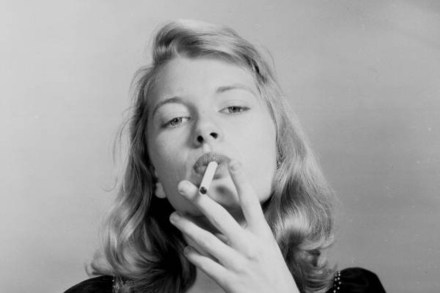
‘You’re never alone with a Strand,’ went the misbegotten advertisement for a new cigarette in 1959. What the copywriter didn’t realise is that smokers often smoke to be alone. As Mass Observation had reported a decade earlier: In an increasingly gregarious world, where fewer and fewer habits and pastimes are entirely individual, the cigarette remains for most people a pleasure that, whatever its social significance, can be enjoyed in entire solitude, and a pleasure that remains entirely individual. At the time, 80 per cent of British men and 40 per cent of women were regular smokers. Smoking was not just a means of inhaling death and of escaping the dead hand of others’ sociability, but briefly put the unbearableness of life behind a smoky veil.