Liberal democrats

Obama is playing politics<br />

FDR was plainly confident when he indicted the "practices of unscrupulous money lenders" during his 1933 inauguration address; Obama’s speech yesterday was scented with desperation. He exchanged eloquence for provocation. “If these folks want a fight a fight, it’s a fight I’m ready to have.” Bankers do not want a fight with a President seeking cheap political capital; they want to turn profits and do business. Obama’s proposals frustrate that aim - by carving up corporations and neutering investment banking on the grounds of excess risk. As Iain Martin notes, Obama has departed from the G20’s emerging narrative, and though the details are imprecise there is no doubt of the direction Obama is headed. It is the wrong one.

Confusion surrounds the Tory position on the Muslim Council of Britain

The government broke off relations with the Muslim Council of Britain over Daoud Abdullah, its deputy secretary-general, signing the Istanbul declaration, which the government believed encouraged attacks on British forces if they attempted to enforce a weapons blockade on Gaza. Last week, the government retreated; inviting the MCB back in despite Daoud Abdullah’s signature remaining on the document. The question now is whether the Tories are going to go along with this surrender. The first test of this is a fundraiser that the MCB is holding on the 22nd of February. The invitation boasts that Jack Straw and Nick Clegg will be attending and says that Chris Grayling has been invited but his attendance has yet to be confirmed.

Labour’s policy is a hostage to their internal struggles

So Gordon is selling himself as a champion of the middle classes.  There is, as various commentators have pointed out, more than a little bit of hyposcrisy about that.  But the thing that strikes me most about our PM's change of tack is how similar it is to Darling's honesty over cuts last weekend.   Like Darling's admission, it represents some sort of progress for Labour: on paper, the politics of aspiration should play better – and have wider appeal – than the crude class war that they've engaged in recently.  But, also like Darling's admission, it highlights just how inconsistent the government have been over the last few months.

Clegg has one great policy but he doesn’t know how to sell it

Nick Clegg has one policy that he should be talking about at every opportunity, his plan to make everyone’s first ten thousand pounds of income tax free. It is a radical idea that would lift millions of people out of tax altogether and be a massive step towards making work pay. As one Tory candidate fighting a marginal seat said to me this week, ‘I wish we had something like that to offer people.’ But as Clegg’s appearance on Andrew Marr this morning showed, Clegg doesn’t know how to sell his policy. Rather than emphasising the first ten thousand point, he mainly talked about his plans for a mansion tax and removing the tax breaks on pensions contributions for upper earners.

A sensible Tory rethink on marriage tax breaks

There's something quite refreshing about David Cameron's plan to offer a tax break to married couples.  It says, simply: this is what I believe.  And it does so in spite of polling data and strategic arguments to the contrary.  This is one area where you certainly couldn't accuse the Tory leader of caring too much about what other people think.  But refreshing or not, that doesn't make it good policy.  Of course, there's a tonne of empirical data which demonstrates the benefits of marriage.  That's important and persuasive.  But, as I've written before, there are reasons to doubt the efficacy of a tax break in particular.

An intriguing PMQs – overshadowed by events

After the hubbub about Hewitt ‘n’ Hoon’s plot to unseat Gordon Brown, PMQs is perhaps a distant memory. It’s certainly made my review a little later than usual. But better late than never, as today’s clash was a bloody and intriguing contest with both party leaders on combative form. Cameron seemed unusually relaxed, glib and self-confident. Perhaps he’d been tipped off about the plot. Or perhaps he’d been thrilled by the sight of his beautifully groomed coiffure in the bathroom mirror this morning. If he spent as much time on his manifesto as he did on his hair there’d be no talk of a hung parliament. But this didn’t seem to bother him today and he laid happily into the Prime Minister over the budget deficit.

PMQs live blog | 6 January 2010

Stay tuned for live coverage of PMQs from 1200. 1159: Should be kicking off soon.  You can watch proceedings live here. 1202: And here we go.  Brown starts with the usual condolences for fallen British servicemen - and adds a tribute for the late Labour MP, David Taylor. 1204: Brian Donohoe asks for an update on the attempted terrorist attack on Christmas Day.  Brown lists new security measures, and says that he's looking to better coordinate intelligence efforts. 1206: Cameron now.  He adds condolences for British servicemen and David Taylor. 1207: The Tory leader starts with our debt problem.  He lists international organisations - the OECD etc. - which have warned about Britain's debt.

Clegg keeps them guessing

Yesterday was all Labour, Tories, Labour, Tories.  So, today, enter the Lib Dems.  Nick Clegg has an article in this morning's Times which, to be fair, is actually quite noteworthy.  His main point?  That the Lib Dems are a party in their own right, and will not be engaging in "under-the-counter deals" with the Big Two: "This year’s general election is likely to be the most open and unpredictable in a generation. So you have a right to know where we stand. I can promise voters wondering whether to put an “X” against the Liberal Democrats that there are no backroom deals or under-the-counter “understandings” with either of the other two parties." You can see why Clegg is broadcasting this message.

Thinking the unthinkable

Woah, hang on there. A Labour and Conservative coalition in the event of a hung Parliament? Crazy talk, surely? But that’s what Martin Kettle devotes his column to in today's Guardian. It’s only unthinkable, he writes, “until you start thinking about it.” Hm. So rather than dismissing the prospect out of hand, I thought I’d register one particular complaint against it. While many of Kettle’s arguments about the fracturing of the party system and the blurring lines between the main parties make sense, the idea that they might coalesce in the aftermath of this year’s election ignores one crucial factor: the Labour leadership.

Will this be the game-changer that Brown needs?

So there we have it.  There will be televised election debates between the three main party leaders during the next election campaign, after all.  The first will be on ITV, then there'll be one each on Sky and the BBC.  Talk about good TV for political anoraks. Like Tim Montgomerie and Mike Smithson, I suspect that Gordon Brown and Nick Clegg will be happiest with the news.  Both of them, particularly Brown, need potential game-changing events like this to make some progress in the polls.   As for Cameron, he'd probably be better off not giving his opponents a chance to make inroads into the Tories' poll lead.  But he could hardly have resisted live debates in the current political climate.

Slightly surprising stat of the day

According to a YouGov poll in tomorrow's People (reported by the paper's political editor, Nigel Nelson, on Twitter): "1% more people would rather have G.Brown than D.Cameron round for Christmas dinner." There's better news elsewhere in the poll for the Tories: the gap between them and Labour is back in double digits.  It's the Tories on 40 percent, Labour on 28, and the Lib Dems on 18.

Festive cheer

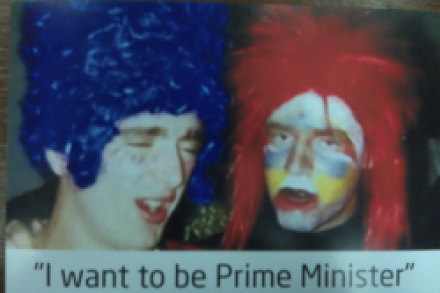
Well, Nick Clegg's reponse to the Labour chief whip's Christmas card made me smile: "Both myself and Nick Brown have good reason to be embarrassed. I posed for pictures in ridiculous fancy dress 20 years ago - and he is an MP for the Labour Party.

What will today mean for the expenses saga?

So MPs have until the end of today to declare whether they're appealing against Sir Thomas Legg's request that they repay certain expenses claims.  Three have already done just that, one from each of the main parties: Jeremy Browne, Frank Cook and Bernard Jenkin.  You imagine that more may follow throughout the day, especially given the rumblings that the Legg review contained a fair few errors. Now, it's only fair that MPs have a right of appeal – but you still wonder what it will mean for the expenses saga more generally.  From the public's perspective, a swathe of appeals could look like MPs resisting reform.

Unless they defuse the issue, the Tories will face Ashcroft questions every day until the election

If PMQs today showed anything, it's just how eager the Tories' opponents are to bring up the issue of Lord Ashcroft.  Vince Cable set the ball rolling by referring to the Tory deputy chairman as a "non dom", and Harriet Harman gleefully followed up by firing questions in William Hague's direction.  She was cut off – and rightly so – by John Bercow.  But the insinuations about the Lord and his tax status had already been made. Now, you could say that this is pretty low stuff from Labour and the Lib Dems.  After all, David Cameron pledged earlier this week to legislate so that all MPs and peers are UK taxpayers.

The Lib Dems’ hunt for an issue may lead them to an Afghan pull-out

As Anthony Wells says over at his UK Polling Report, there are plenty of reasons to doubt whether Labour could convert a third of Lib Dem voters over to their cause.  But the article in today's Times on Labour's new strategy will still give Team Clegg pause for thought. The problem for the Lib Dems is that they haven't yet managed to hit on an attention-grabbing issue to make their own – their favourite, perhaps only, election strategy.  The cause of Parliamentary reform could have done the trick, but – beyond Nick Clegg's call to prevent MPs from taking their summer holiday – very few of the Lib Dem proposals have received much coverage.  Likewise, electoral reform, which Labour now seem to be comandeering for their own manifesto.

Graph of the day

Here's a neat little graph from PoliticsHome, which plots the three main parties' opinion poll ratings alongside their "party morale rating" from the PHI100 tracker.  As PolHome put it, it kind of tells us what we know already: that party morale more or less correlates with poll position.

What if the Lib Dems are right?

James is right to say that the Lib Dems' commitment to increase the tax-free personal allowance to £10,000 trumps any obvious campaigning soundbite the Tories can offer. Isn't that a problem? Or, to put it another way, what if the Liberal Democrats are right? On balance, I think they are. Whatever one thinks of the inheritance tax brouhaha or the 50p rate for the super-wealthy and no matter how counter-productive one thinks those notions may be, the fact remains that Tory policy, in the case of the former, and Tory preferences, in the case of the latter, impact a tiny number of people. Important people, in some cases, given their wealth-generating potential, but not many people no matter how you slice it.

The return of the Mansion tax

The Liberal Democrats unveil their tax plans later today, and Nick Clegg insists that his radical plan will “put fairness back into the tax system”. It is expected to be a left of centre plan: don’t expect to hear anything about “savage cuts”. The Mansion Tax is back, albeit in slightly more expensive clothes. The original proposal levied a 0.5% charge on properties valued at over £1million, which was a determined effort at suicide. Following criticism from senior MPs, staring nervously at their irate constituents, Clegg and Cable have raised the threshold to £2million and the levy to 1% - a humiliating retreat, revealing the dangers of making policy on the hoof.

I Hope I’m Wrong

I can't help thinking that the Observer's Ipsos/Mori poll this weekend was something of a blip. What exactly has the Labour government done to narrow the gap in the last week or so? I hope I'm wrong, because I think the British people deserves a hung parliament, which would be the best result of the next election. I have been saying for some time that the Conservatives do not have the strength in depth to form a credible government and that the electorate faces the most unappealing choice since 1970. Nothing I have seen recently has made me change my mind.  Andrew Rawnsley has written the best of the political column's in the Sundays. He raises the possibility that the Liberal Democrats would demand the resignation of Gordon Brown as the price of an alliance.

A paper-thin Queen’s Speech

Even before the Queen had trundled back to Buckingham Palace, Mandy had let the cat out of the bag. Speaking on BBC News he said of the Gracious Speech, ‘All these laws are relevant … and achievable. It will be for the public to decide whether they want them or not.’  There you have it. The greatest power in the land admits the Queen’s Speech is Labour’s manifesto. The response to the Gracious Speech is an enjoyably ragged parliamentary occasion, full of ancient traditions and even more ancient jokes. Frank Dobson proposed the Humble Address and spoke with pride about his Holborn constituency where the anti-Apartheid movement had been born.