Liberal democrats

High Times for Dave and Nick

A good spot by Ewan Hoyle: The Telegraph has gone after Nick Clegg’s support for a more sensible approach to the “War on Drugs”. It seems that when he was an MEP the Liberal Democrat leader supported decriminalisation. This, we are supposed to believe, is a Bad Thing. Which makes it amusing or interesting that way back in 2005 David Cameron also called for “fresh thinking and a new approach” to drugs policy. That, as you know, means keeping at least an open mind about decriminalisation. Now proposals for a sensible drugs policy are, alas, unlikely to feature prominently in the next Queen’s Speech and I don’t expect much from

Coalition government may be minimal government

Post-election deals are tough for those on the wings of political parties – the activists, the die-hards, the idealists. Those in the middle, by definition the pragmatists, find it easier to prioritise aims or to compromise in the short-term in order to win over the long-term. Any Con-Lib deal will be tough for the left-wing of the Lib Dems and the right-wing of the Conservative party. But both will have to accept that power is better than opposition and that being able to implement part of your party programme is better than carping on the sidelines, your manifesto languishing on never-visited websites. To make the most of a political shotgun

The spotlight turns on Labour

It’s the story which has been simmering throughout the election campaign, and now it has has boiled over onto the front pages: fear and loathing in the Labour ranks.  After rumblings in the Sunday Times yesterday, its sister paper splashes with the headline “Labour in turmoil as pressure on Brown grows”.  And, inside, Francis Elliot and Suzy Jagger report on the “jockeying to replace Gordon Brown”.  Meanwhile, the front of the Independent speaks of “growing recriminations in senior Labour ranks over a lacklustre campaign that has seen the party relegated to third place in opinion polls.”  The spotlight is finally turning, white-hot, on to Labour – after ten days of

Everyone Says a Tory-Lib Dem Deal is Impossible; Everyone is Wrong

I am not surprised that Paddy Ashdown says the Liberal Democrats cannot work with the Conservatives. He would say that wouldn’t he? After all, Ashdown came close to selling his party to New Labour, lock, stock and barrel. Nevertheless, the idea that the Tories and Liberals cannot work together (though doggedly contested by this blog and a few others) is by now Westminster’s latest piece of Conventional Wisdom*. I doubt that Andrew Neil likes to think of himself as a purveyor of the CW but there you have it: even he thinks a Con-Lib arrangement highly improbable.  Guido thinks differently and so do I. True, Nick Clegg would need to

The ex-factor

One of the interesting features of this election campaign is the near-absence of ex-leaders in national election roles. Tony Blair has been stuck in the Middle East because of the eruption of the Eyjafjallajökull volcano and has, at any rate, been “Gored” by Gordon Brown, who is as keen to have his predecessor canvassing for Labour as Al Gore was to see ex-president Bill Clinton in the 2000 election. The former Deputy Prime Minister John Prescott has been more active. For the Tories, Michael Howard is standing down and has not been particularly visible. When I saw him recently in Portcullis House, he looked chipper and relaxed – not like

Just whom will the Lib Dems work with, then?

Two noteworthy entries, today, in the will-they-won’t-they game of coalition government.  The first from Nick Clegg in the Sunday Times: “You can’t have Gordon Brown squatting in No 10 just because of the irrational idiosyncrasies of our electoral system.” And the second from Paddy Ashdown speaking to the People: “Nick Clegg cannot work with David Cameron … We could not go into a coalition with the Tories, it wouldn’t work.” So, assuming both are true, it sounds as though Clegg would only work with a Labour party headed by someone other than Brown.  But don’t count on it.  I, for one, think it’s unlikely that Clegg will prop up an

Has the Lib Dem bubble burst?

Is this the end of the LibDem soufflé surge? Tomorrow’s News of the World has an Ipsos-Mori poll – conducted the day after the second debate – putting things back to where they were pre-debates: Tories with a six point lead over Labour and the LibDems lagging seven points behind Labour, i.e. 36-30-23. This is broadly where Mori had them in March. The polls are in a state of flux, to be sure. But Ipsos did a full, 1,200 weighted sample, telephone poll. Even on this basis, Cameron would be 42 seats short of a majority. But this is the best news he’s had since the first TV debate –

Tories growing used to a hung parliament in public and in private

Planting seeds, that’s what the Tories are doing – they’re planting the seeds of a Lib-Con alliance.  Yes, it’s a subtle process, and is couched in terms of denial and defiance.  But it’s still going on.  I mean, look at Cameron’s interview with Jeremy Paxman past night (video on Spectator Live), where he declined to rule out having Nick Clegg in his Cabinet – although, happily, he was more unequivocal on the subject of Vince Cable.  And then there’s Ken Clarke’s interview with the Daily Telegraph this morning, in which he says that the Conservative “starting point” for any coalition would be a refusal to compromise on their economic plans. 

In This Election Every Vote Counts: Even in Safe Seats

Jonathan Freedland is surely right: Labour’s best hope, now that the electorate appears to have decided that “change” matters* and dismissed Labour’s pretensions to offer that change, is to maximise its core vote in the hope of avoiding an electoral meltdown that would, say, leave them with fewer than 200 seats in the new parliament. If Labour aren’t quite the walking dead the Tories were in 1997 that’s because of the current constituency boundaries, not because there’s any more life in the Labour campaign. Nevertheless the prospect that Labour’s vote could fall to 25% of the vote must be considered a real one and Labour’s team, when anyone bothers to

Why Not Vote Lib Dem?

There is a terrible desperation about the Tory approach to the Lib Dem surge. There is a clear desire to find some sort of killer story about Nick Clegg or a killer strategy to reassert David Cameron’s claim to be the candidate of change. What is odd is that Cameron seems to have forgotten what made him so attractive in 2005, which was that he was the candidate of the moderate, progressive centre ground.  The recession pushed the Conservative Party into the language of austerity – a message the British public is not yet ready to hear – and they have not recovered.  I have never understood why David Cameron

The morning after the debate before

So, like last week: what’s changed?  And, like last week, it’s probably too early to judge.  The insta-polls may have Cameron and Clegg on level footing, but, really, we need to wait for voting intention polls before coming to any firm conclusions.  As we saw the day after the first debate, they can work in quite surprising ways. My instinct, though, is that things will remain relatively steady.  The Clegg surge of last week was, at root, a cry for change from the electorate – any change.  So it will probably take more than a solid Cameron victory in one TV debate to have voters flooding back to the Tories. 

Cameron starts to pull the Tory campaign out of the fire

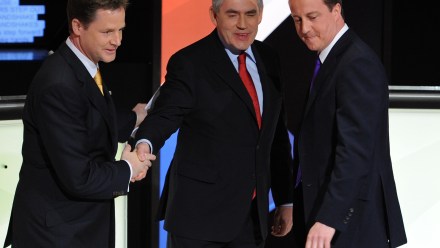
The headlines will be “score draw”, but I’d say Cameron won – and comfortably. I write this as someone who could have happily have sunk a few pins into a voodoo doll of David Cameron earlier on this evening – for taking the Conservatives (and Britain) to this appalling point where he may yet lose the election. But he raised his game, substantially. At best, he spoke with passion and authenticity. This time, he looked like he was fighting for his political life, which (of course) he is. Things are looking up. Here’s my participant-by-participant verdict: Brown Brown was his normal automaton self. He does tend to mangle his words,

Cameron is much improved - but the Lib Dem bubble hasn't burst

It seems that the general election of 2010 will turn on 90 minutes next Thursday. David Cameron was far better tonight than he was last week. This time he managed to bracket Brown and Clegg together and had the moment of the debate when he called Brown out on Labour’s leaflets claiming the Tories would scrap various things that pensioners currently get free. If there was a YouTube moment in the debate, it was that exchange when Brown said he didn’t authorise the leaflets making these claims. The Tory press team then delighted in pointing to a Labour party political broadcast where they had suggested the Tories would take away

Cameron's evening – as he and Brown fight back against the Clegg surge

Well, one thing was clear: Brown and Cameron have both been at the textbooks, staying behind for extra classes, and learning the lessons of last week.  They came into this TV debate prepared.  Not just for the very fact of Nick Clegg, but with strategies and soundbites to slow his advance.  The result was a more passionate and confrontational show than I expected. Brown was the biggest surprise on the night.  Sure, you have to apply the usual caveats and parameters: he is Gordon Brown, and being disingenuous and deluded is what he does.  But, all that considered, he was uncharacteristically sprightly, I thought.  His little prepared quips were half-way

Does Clegg go for a Love Actually moment?

The foreign policy portion of tonight’s debate offers Nick Clegg several opportunities to bracket Labour and the Tories together. Both of them supported the war in Iraq, both won’t take the military option off the table when it comes to Iran and both believe in the centrality of the alliance with the US to UK foreign policy.   On this final point, it’ll be fascinating to see if Clegg launches a full-on assault on the view that the America alliance is the cornerstone of UK foreign policy.  He sketched out the arguments against thinking about the special relationship in a speech the other day and there’s no doubt he could

Will Cleggcapping Work?

Well, yes, it probably will have some effect. But as Jonathan Freedland argues Clegg may survive the press’s assault with his dignity and credibility more or less intact. Indeed, the entire episode might have the effect of firming up some support for Clegg. There willl be some voters who see it as proof that the Liberals must be doing something right and others who feel that it will be worth endorsing Clegg just to spite everyone else. It occurs to me that the Liberal Democrat surge is not quite unprecedented. That is, it can reasonably be compared, in some respects at least, to the SNP’s campaign during the Scottish parliamentary

People loathe politicians - but do they loathe the political media too?

One thing’s for certain: the Lib Dems are coming in for greater scrutiny and attention from the media.  The covers of the Telegraph, Sun, Mail, Express and, yes, The Spectator are testament to that – even if some are less substantial than others.  But the question is: will this derail the Clegg bandwagon?  And, like Iain Dale, I’m not so sure. Iain’s point is that some of the coverage is so spiteful that it will “serve to increase his popularity and position in the polls”.  He adds that this would be a “sure sign that the power of the press to influence an election is on the wane”.  He’s right,

Paul Rowen and the anatomy of a Lib Dem expenses scam

Now the Lib Dems are riding high in the polls, they attract greater scrutiny – which, to put it mildly, they do not always stand up to. In this week’s Spectator, we look at what can be seen as the Lib Dem vice. They may not charge for duck houses, or mortgages. But they do specialise in taking money intended for MPs expenses, and finding “innovative” ways of putting it into their war chest. Here is a hard example that may interest CoffeeHousers and it stars Paul Rowen, whom Mr Clegg visited last week – and declared “has done a great job”. He certainly has: for filling the Lib Dem

Is Europe a Con-Lib deal-breaker?

Europe is likely to play a big role in tonight’s debate. It is probably the one issue that divides the Liberal Democrats and the Tories as much as electoral reform. Nick Clegg, a former MEP and adviser to then-EU Commissioner Leon Brittan, is a euro-enthusiast who would like Britain to join the Euro, even if it takes time. David Cameron is a euro-skeptic (though not, to the chagrin of many CoffeHouse readers, obsessed about the issue).   But neither wants a confrontation with the EU and other European governments over the next four years – and the Liberal Democrats have become quieter over time about their pro-EU tendencies. Their support