Liberal democrats

Where will the Welfare Reform Bill go from here?

Yep, it's that battle over ‘fairness’ again. Labour peers, along with a decent scattering of Lib Dems and independents, believe that some of the government's money-saving welfare measures are unfair – which is why they voted them down in the Lords last night. Whereas the government, of course, thinks quite the opposite. Their proposed limits to Employment and Support Allowance are designed, they say, to affect those who either can work or who have a relatively good level of income already, while keeping the ‘safety net’ in place for everyone. And that's fair not just to benefit claimants, but also to other taxpayers who are contributing towards the system.

Ed Miliband lives to flop another day

Miliband survives! That news should steady Labour nerves. For today at least. Their leader has the knack of turning near-certain defeat into absolutely-certain catastrophe, but he bumbled through PMQs this afternoon without suffering a serious setback. He has so little ground from which to attack the government that he had to lead on a niche issue. Rail fares. He asked the prime minister why the operating companies have managed to hike prices by 11 per cent on the busiest routes. Cameron: ‘Because of a power given to them by the last Labour government.’   With that lethally terse response the PM sat down. To his credit, Miliband wasn’t rattled.

What’s more important to Cameron: actual fairness or presentational fairness?

James has already blogged the Sunday Telegraph's interview with David Cameron, but some other things stand out from it — and not just the PM's unthinking attack on Ed Balls either, for which he has since apologised. Take these paragraphs on tax, for instance: ‘The Prime Minister effectively rules out any move towards a “mansion tax” — a levy on high-priced properties proposed by the Liberal Democrats — or indeed any new tax on wealth. “I don’t believe, generally speaking, we should be looking at endless additional taxes.

The scale of Clegg’s Lords challenge

Tucked away on page 15 of today's Times, there's an insightful story about Lords reform (£) by Roland Watson. And it's insightful not just for the new information it contains, but also for the familiar truth it confirms: reforming the House of Lords is going to be one helluva difficult task. You see, while both halves of the coalition committed to a fully- or ‘mainly-elected’ upper chamber in their respective manifestos, only one half of the coalition is particularly eager to force it through now.

Dave talks film, finances and Europe

It was the second of the Today Programme's New Year's interviews with the three party leaders today; this one with David Cameron. And there was plenty to digest from it. So much, in fact, that we thought we'd bash out a transcript, so that CoffeeHousers can read it through for themselves. That's below, but before we get there it's worth highlighting a couple of things that Cameron says. First, his point that ‘we've seen a level of reward at the top that just hasn’t been commensurate with success’, which is another volley in the battle against the ‘undeserving rich’ that James mentioned yesterday.

The coming battle over the ‘undeserving rich’

Who can be toughest on the ‘undeserving rich’ is shaping up to be one of the main political battlegrounds of 2012. David Cameron and Nick Clegg’s comments today on tax avoidance are an attempt to get ahead of this debate.    Clegg, though, is keen to make this issue his own. As I say in the politics column this week, he is planning a big speech later this month on ‘responsible capitalism’. He will use it to argue that there need to be more checks and balances within companies and call for more shareholder power over executive pay. One Cleggite tells me, in reference to the Labour leader’s conference speech trying to sketch out a new capitalism, ‘it is the speech Ed Miliband should have given.

Where ‘constructive engagement’ could become destructive

Those ‘cross-party talks’ over social care haven't started quite yet, but the positioning has already begun in earnest. In response to a letter by a gaggle of experts in today's Telegraph — which urges politicians to ‘seize this opportunity for urgent, fundamental and lasting reform’ — both David Cameron and Andy Burnham have tried to sound utterly reasonable and mutually accommodating. The word ‘constructive’ is being deployed generously by all sides. In his interview with the Today Programme, however, Burnham did also hint at what's likely to be the main area of contention.

The cross-party talks that may test the coalition

Whenever politicians talk about social care, they tend to promise ‘cross-party talks’. It's their little euphemism for ‘we don't want to commit to a policy by ourselves.’ Don't get them wrong, it's not that they don't have ideas for fixing a system that is straining under the weight of an ageing population; the Dilnot report, released earlier this year, gave them plenty of recommendations to work with. It's just that they don't want to be the ones to implement the tax hikes or spending cuts that will be necessary to fund it. If they can talk it through with the other parties — the thinking goes — then this crucial policy area can be detoxified, the blame spread more or less evenly.

Clegg tries to reassure his troops

Only a few weeks ago, a statement from Nick Clegg in firm support of the coalition wouldn't have been noteworthy at all. It's just what he, as Deputy Prime Minister, did. But now, after his very public palpitations over Europe, the New Year's message that Clegg has broadcast today is a little more eyecatching than it would otherwise have been. This is no provcation to rile the Tories, but a more or less sober assessment of what the Lib Dems have achieved in government, along with a few lines about how fixing the economy ‘remains the number one priority for our party and the coalition.’ Most strikingly of all, Clegg doesn't include Lords reform in his list of government policies coming next year.

Your five point guide to Balls’s highly political interview

It's a strange sort of Christmas present; interviews with Ed Miliband and Ed Balls — but that's what the papers have seen fit to deliver us this morning. There's not much political content in the Miliband one, which is more of an At Home With Ed and Justine sort of deal. But Ed Balls's interview with the Independent is a totally different matter. Here are five points distilled from the shadow chancellor's words: 1) We'd cut, I tell ya. Rarely has Balls sounded as much of a deficit hawk as he does here. Sure, he drops in the usual lines about the Tories going ‘too far, too fast’, and Labour providing an ‘alternative’ — but then he blurs his dividing lines far more than usual.

Clegg sets out his stall for 2012

Under cover of discussing the Open Society and its enemies, Nick Clegg today set out his personal agenda for the next year of this government. Indeed, Clegg's speech to Demos earlier was perhaps the purest distillation of his politics since the big set-piece number he delivered at the Lib Dem conference in 2008. It contained many of the same themes as that earlier speech: ‘social mobility’, ‘civil liberties’, and ‘democracy’. And it added a couple more for good measure: ‘political pluralism’ and ‘internationalism’. The Deputy Prime Minister described these five political impulses as ‘the source of my liberalism’.

The coalition tees up its banking reforms

That was easy. Only a few months after Sir John Vickers released his final recommendations for reforming the banking sector — and after much less intra-coalition struggle than we might have expected — the government is set to announce that it will adopt them ‘in full’. Vince Cable revealed yesterday that he and George Osborne have reached common agreement on the matter. And, for his part, Osborne will appear before MPs today with further details.  As Robert Peston has already explained, ‘in full’, in this case, doesn't quite mean 100 per cent — but it's close. The main proposal to ringfence retail banking off from riskier investment banking will be fully implemented.

The coalition’s marriage troubles

A few months after the coalition was formed, I went for lunch with a close ally of Nick Clegg. After an hour or so of discussing what the coalition’s agenda would be, this Liberal Democrat said to me: ‘now, David Cameron can’t really be serious about this marriage stuff, can he?’ When I replied that I thought he was, he looked at me with total incomprehension. He then launched into a speech about how no ‘liberal’ could possibly want to see the state promote marriage. This is the thinking that lies behind Clegg’s latest attack on the idea of tax breaks for married couple; it has become an identity issue for the Liberal Democrats.

Cable: Cameron put political gain ahead of national interest

While we're on the subject of LibCon divide, it's worth noting Vince Cable's remarks to Andrew Marr this morning. The headline above is merely a paraphrase, but it's pretty close to what the Business Secretary actually said: ‘It was largely political. Certainly the Prime Minister’s got a sort-of short-term boost from it, but it doesn’t actually deal with the long-term fundamental problems in Europe.’ Seems to me that there have been harsher words deployed this week, but few harsher sentiments. In the spirit of, erm, ‘getting on with my job as I always do’, Cable is going especially far in attacking his coalition partners. Vince, as always, remains One to Watch in 2012 — and mostly for the wrong reasons.

What phase of the coalition are we in now?

It was not so long ago — the run-up to last May's AV referendum, to be exact — that we heard the coalition would be entering a new phase. Gone was the happy synthesis of the Tories and Lib Dems that prevailed after the election, and in its place would be a government that spoke more openly, more angrily about its differences. But even if Phase 2.0 had the appearance of being more fractious, it was actually designed to keep the parties together. The idea was that, by highlighting the essential differences between the two sides, their supporters could more easily be kept on board with the overall project. I mention this, this morning, because it looks as though that strategy is either being ramped-up or taken in a new direction. During Phase 2.

Clegg tries to rebuild EU bridges

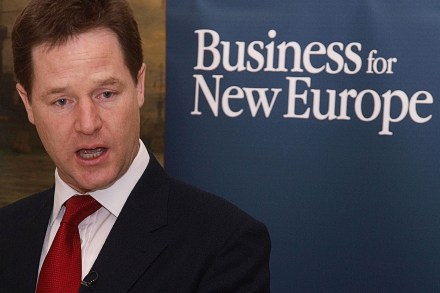
What are the Lib Dems up to? On Tuesday, Clegg, Cable, Alexander, Huhne and Laws met with 'Business for New Europe', a group of pro-European business leaders, in what the FT describes as as 'a very public display of engagement with business over Europe' and the front page of today's Mail calls 'plotting to rally business chiefs against Cameron over Europe'. It is, of course, not surprising to see senior Liberal Democrats talking to pro-EU business people and advocating more engagement with Europe. But it does highlight what will be a key goal of the Lib Dem leadership over the next few months: building bridges with Europe, particularly to reconnect with traditional, europhile Lib Dem supporters following the PM's veto last week.

A victory for Labour, but not necessarily for Ed Miliband

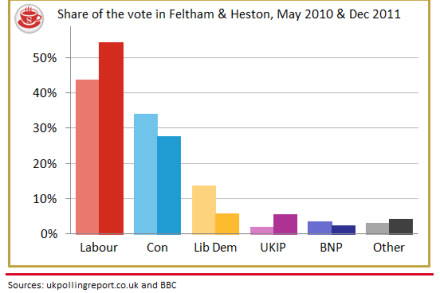
‘This result... is a victory for Labour that shows the progress we are making under Ed Miliband's leadership; a vote of confidence in the way that Labour is changing...’ Or, rather, it isn't. Whatever Labour's winning candidate in Feltham and Heston, Seema Malhotra, says, this byelection result was little more than an unsurprising Labour victory in a Labour area. The opinion polls, as we know, show more comprehensively what people think of the ‘progress’ that Labour is making under Ed Miliband's leadership. And it's far from a vote of confidence. Which isn't to say that Malhotra underperformed in her byelection victory, last night. Not at all. Labour actually increased their share of the vote — from 43.

The veto arguments rumble on

The Times has a very interesting story (£) today on page 17. It claims that David Cameron had agreed to inform Nick Clegg if it appeared that Britain was going to be isolated at last week’s European Council. The significance of this is that it suggests that the Lib Dems believed they would be consulted before the government vetoed anything. This news emerges after senior Liberal Democrats have privately questioned why their leader did not insist that Cameron only use the veto once he had Clegg’s explicit agreement. The Times also reports that this negotiating protocol did not envisage a situation where Britain was left in a minority of only a couple of countries.

Nick Clegg’s Christmas recipe

Our Christmas issue is so packed that, sadly, there wasn't enough space to include everything that was originally commissioned. Among the ejectees was a series of Christmas recipes and tips from politicians, writers and friends of The Spectator. In which case, we thought we'd put them up online, where the real estate, just like the goodwill, is endless. You can read Nick Clegg's recipe for Patridge ‘Estofada’ below.