Labour party

Helen Goodman finds herself in hot water over Jeremy Hunt tweet

From our UK edition

At this year's Tory conference Jeremy Hunt defended the government's tax credit cuts, claiming they would make the British people work as hard as the Chinese. While Hunt has since claimed that his comments were misinterpreted, tonight Labour's Helen Goodman hit out at the Health Secretary for the comments. She says if things are so great in China then why did Hunt's wife Lucia -- who is from Xi'an, China -- move to Britain: Given that the personal dig hardly fits in with Jeremy Corbyn's promise of 'a new kind of politics', Labour supporters have been quick to call on Goodman to apologise. Speaking on Westminster Hour this evening, Lady Basildon -- the Labour peer -- said Goodman should say sorry.

This is the Tories’ golden chance to seize the centre ground

From our UK edition

Political party conferences have, in recent years, felt like an empty ritual. They used to be convened in seaside towns, so grassroots activists could find affordable accommodation. Now they are usually held in cities, so lobbyists can find better restaurants. Activists have been supplanted by members of the political class who are charged £500 a ticket. In the fringe debates, speakers face a volley of questions from people paid to ask them — on pensions, subsidies for green energy and the like. Politicians spend all day talking to journalists, and real politics vanishes. This year, however, politics has returned.

When the press quivers before the powerful, no one benefits. Except, of course, the powerful

From our UK edition

Imagine living in a country where a politician could not only force a newspaper to retract a report but could then make it publish an alternative report on its front page. That would be a bad place to live, right? It would be a place where the relationship between the press and politicians — where the former is supposed to keep in check the latter, not the other way round — had been twisted beyond repair. It would be a country in which pressmen and women would be always on edge, fearful that if they were too stinging or scurrilous about a political player then they, too, might be forced into a humiliating climbdown. And no one benefits when the press quivers before the powerful. Except, of course, the powerful.

The Tories are still anxious to reach out. And that’s a very good sign

From our UK edition

Post-election party conferences usually follow a standard pattern. The winning party slaps itself on the back while the losers fret about how to put together an election-winning coalition. But this year, there’s been no talk of compromise or coalition from Labour. They seem happy to be a protest party, unbothered that voters disagree with them on the economy, welfare and immigration. And the Tories, instead of relaxing or moving to the right, have obsessed anxiously about how to broaden their appeal, to make their majority permanent. This determination to look for new converts is a product of the election campaign. Weeks of looking at polls that indicated they were on course for defeat served as a near- death experience for the Tories.

My mission: buy lunch for a protestor outside Conservative party conference

From our UK edition

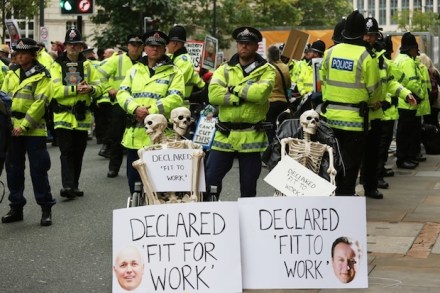
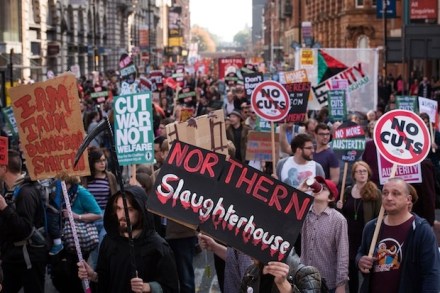
The mood at the Conservative party conference this week was a little subdued, and no wonder. As those who watched the television coverage will know, everyone entering the secure zone had to run a gauntlet of potty-mouthed protestors, their faces twisted into masks of hate. It’s not easy to celebrate after you’ve just been showered with spit and called a ‘Tory murderer’. Jeremy Corbyn made a point in his conference speech last week of asking his supporters to treat their opponents with respect and not descend to personal abuse, but I’m not sure how many of them got the message.

How the Tories are trying to make their majority permanent

From our UK edition

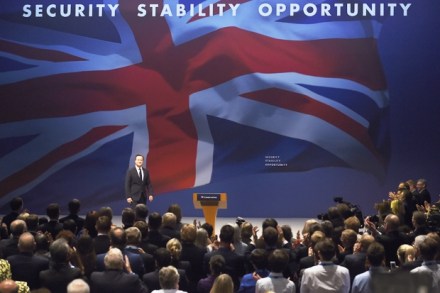
This is the first conference since the election where the Tories won a majority and the first since Labour chose an unelectable leader. But, strikingly, George Osborne chose to use his speech to emphasise how the Tories must show the millions of working people who voted Labour in May that they ‘are on their side’. Osborne is a man seized of the opportunity presented to the Tories by Labour’s lurch to the left. He has spent the last few days picking off several of Labour’s best ideas. His aim to make sure that when—or, should I say if—the Labour party attempts to return to the centre ground of British politics, it will find the Tories already camped there.

The left’s hatred of ‘Tory scum’ is both stupid and self-defeating

From our UK edition

Plenty has been written about the hatred some on the left feel towards their ‘enemies’, something on display at the moment in Manchester, with journalists being called ‘Tory scum’ for covering a party conference. I’ve bored for Britain on the subject of political hatred of the left, but less has been written about how self-defeating it is. For example, one of the best things that could happen to the Tories is for the Labour faithful to convince themselves that Corbyn was defeated only because of a biased, Tory-dominated press. This means that, rather than brutally analysing their weaknesses after Corbyn goes, they’re more likely to retreat into their own comfort zone politically.

Jeremy Corbyn: the most unpopular new opposition leader in the history of polling

From our UK edition

Labour’s conference in Brighton might not have been the disaster some expected but it hasn’t done much for Jeremy Corbyn’s standing with the public. A new YouGov/Sun poll shows the Labour leader’s personal rating is minus eight — the lowest since polls of new opposition leaders began with Hugh Gaitskell in 1955. As the chart below shows, Corbyn is eight points lower than Michael Foot in 1980 and Iain Duncan Smith in 2001. This rating also puts him 34 points behind Ed Miliband in 2010. This poll follows a trend: Ipsos MORI’s first tracker for Corbyn put him on minus three in their net satisfaction ratings — five points behind Foot in November 1980 and 22 points behind Miliband in October 2010.

Cicero on Labour taxes

From our UK edition

Heidi Alexander, Jeremy Corbyn’s shadow health secretary, has emphasised how important it is ‘to weave into [Labour’s] language, our narrative and our political mission a fundamental respect for taxpayers’ money, something that is clearly missing given our current reputation for profligacy’. Cicero would be cheering her on. Cicero’s de officiis (‘On Duties’) was composed in 44 bc, the year in which he was assassinated on Marc Antony’s orders. The work, the second to be printed in the Gutenberg revolution after the Bible, was immensely influential during the Renaissance and Enlightenment.

Diary – 1 October 2015

From our UK edition

Party conference season is the most pointless waste of money, time and liver quality ever devised. I attended these sweaty, drunken gatherings for ten years during my newspaper-editor days and achieved nothing constructive other than clarity over which is the best way to treat a monstrous hangover. (Answer: my late grandmother’s recipe of vine tomatoes on toast, laden with thick Marmite and gargantuan grinds from a pepper mill.) But they were fun, so long as I adhered to the golden rule: always leave the bar before 2 a.m., thus avoiding the moment when enough alcohol emboldens other delegates, and indeed one’s own staff, to tell you what they really think of you.

Will Spain learn?

From our UK edition

One of the unforeseen consequences of the reunification of Europe after the Cold War has been a resurgence of independence movements in western Europe. Emboldened by a greater sense of security and influenced by the rebirth of independent nations to the east, separatist parties have begun to challenge the boundaries of nation states which a quarter of a century ago we took for granted. Scotland’s near miss — a 45 per cent vote for ‘yes’ — inspired the leader of Spain’s Catalonia region, Artur Mas, to launch his own vote on secession. This week, forbidden by Madrid from calling a referendum, he called regional elections in which pro-independence parties formed a bloc: effectively a test, they claimed, of voters’ desire for independence.

VW and the truth of engineering: say what you do, do what you say

From our UK edition

Not that I was much of a boy racer, but the sexiest car I ever owned was a 1982 Volkswagen Scirocco with the lines of a paper dart and the cornering of a cheetah. I once drove it overnight from the City to Tuscany with a blind date who barely uttered a word, en route or afterwards. In an era when British factories could make nothing better than a laughable Allegro or a downmarket Escort, everyone coveted a German car — the top choice for twenty-somethings being the VW Golf convertible (Sciroccos were rarer) whose quality came as a revelation after years of broken fanbelts and burst radiators on unreliable Minis. These were machines that spoke of Teutonic perfectionism and the will to win in global markets that we Brits had lost.

Tom Watson has no intention of practising Corbyn’s ‘kinder, gentler’ politics

From our UK edition

If Jeremy Corbyn’s speech yesterday was the musings of a left-wing activist, Tom Watson’s today was that of someone who is interested in winning elections. Watson made clear to the conference delegates that what matters is getting back into office and set about explaining how he thought Labour could do that. He told the hall, that if they weren’t interested in representing small business owners, then they wouldn’t be in government again. He said that after its ‘summer of introspection’, it was time for Labour to get back to making its case to the country again. It was a strikingly different tone to Corbyn’s yesterday. Watson clearly has no intention of practising the ‘kinder, gentler’ politics that Corbyn has called for this week.

Next year’s Labour conference will be even more Corbynite

From our UK edition

Sitting in the hall during Jeremy Corbyn’s speech, one couldn’t help but be struck by how much the audience agreed with what he is saying. Corbyn was speaking to them, and they loved it. Now, as long as the Labour activists represented in that hall think Corbyn is their man then it will be almost impossible for the Parliamentary Labour Party to remove him. This week, Corbyn has done little to reach out to the country. But he has consolidated his position in the party. In casual conversations, the date at which people think a coup could be launched against him keeps slipping back. Next year, I suspect that Labour’s position in the polls will be no better, or even worse, than it is today but that conference will be even more Corbynite.

Podcast special: Labour conference review

From our UK edition

Labour's conference is rolling to a close today and it hasn't been the explosive event some predicted it might be. In this View from 22 special, Isabel Hardman, James Forsyth and I discuss the highs and lows of the past days in Brighton and the impact it has had on the party. How big was the divide between the Corbyn-friendly activists and the MPs and politicos? And will next year's conference see the promised fireworks?

Jeremy Corbyn: I wouldn’t use nuclear weapons anyway

From our UK edition

Jeremy Corbyn doesn’t want nuclear weapons. We all know that. We also know that because he has a huge mandate (a phrase bandied about so much at this conference that it’s starting to feel like a refrain in Are You Being Served?), he’s keen to turn his views into official party policy on this area at least. But we now also know that if his party determined that it would remain committed to Trident, and if Jeremy Corbyn were Prime Minister, he wouldn’t ever use his weapons anyway. Which makes it entirely pointless to fund them at all. On the Today programme, the new Labour leader was asked if he would approve the use of Trident if he were in Downing Street.

Watch: what Labour activists make of this year’s conference

From our UK edition

There may have not been fireworks at Labour’s conference in Brighton but the attendees appear to have enjoyed themselves. In the very lengthy queues for Jeremy Corbyn’s speech, I surveyed the activists to find out what they have made of the conference — you can watch what they said above. Those attending for the first time (a significant chunk of those here) generally said it has all been wonderful, while conference veterans were more split between those who think it's been inspirational and others who have sensed divides rumbling along under the sheen of the new leadership. Judging by the continuous standing ovations Corbyn received for his speech, it's a fair to say this is probably the outstanding moment for most Labour activists.

Keir Starmer: ‘I don’t think it’s about Jeremy Corbyn’

From our UK edition

Along with Dan Jarvis, Keir Starmer is one of the new intake of Labour MPs who is cited as a rising star and someone who could replace Jeremy Corbyn. The former Director of Public Prosecutions and MP for Holborn and St Pancras, spoke at a Bright Blue fringe event this evening about Labour’s general election defeat and how the party can rebuild itself. Starmer backed Andy Burnham for the leadership and had a few choice words about Corbynmania: ‘I don’t think it’s about Jeremy Corbyn – I think it’s about a disaffection that’s been growing for a very long time. We lost most of our voters in 05 and we haven’t got them back. They were yearning of something else, none of the above.