Labour party

Listen: Labour MP claims BBC ‘consciously’ undermined Corbyn

From our UK edition

The last few days have seen a rapidly coarsening Labour debate over who is ultimately responsible for the party's historic election loss. Corbyn-sceptics have criticised the leadership's perceived failures while supporters have been flailing around in a desperate attempt to blame anyone but the leader himself. One such Corbyn cheerleader is Andy McDonald, who spoke to the BBC's Today programme this morning. During the interview, Mr McDonald poured scorn on the 'alleged toxic position of Jeremy Corbyn' before engaging in a full-scale assault on the perceived anti-Labour bias of the corporation. He told Justin Webb: Don't get me started on the media Justin, I'm very worried about our public service broadcaster...

Can Labour’s moderates learn from all their mistakes?

From our UK edition

Labour’s defeat is so terrible that it provides the kind of creative destruction that could save the party. It will be extremely difficult for the Corbynites to argue with much authority that one more push or slightly nicer newspapers would have got them over the line when the party hasn’t had a result this bad since 1935. But does the failure of Jeremy Corbyn necessarily mean that the ‘moderates’ in the party are going to be able to rescue it? In 2015, centre-left Labour MPs were confident that the members were so bruised by what they’d heard on the doorstep that they would happily elect a leader who took the party back to the middle ground of politics.

The fall of Labour’s ‘Red Wall’ is a moment to celebrate

From our UK edition

The ‘red wall’ has fallen. Brick by brick. Almost every bit of it. Seats held by Labour for decades have been seized by the Tories. To me, this is the most exciting thing in this extraordinary election. It feels almost revolutionary. Working people have smashed years and years of tradition and laid to waste the nauseating, paternalistic idea that they would vote for a donkey so long as it was wearing a red rosette. The ‘red wall’ results are staggering. In Bolsover, held by Dennis Skinner since 1970, the Tories now have a 5,000+ majority. Former mining towns like Bishop Auckland and Sedgefield — Tony Blair’s old seat — fell to the Tories.

Politics has fractured along new fault lines – those elected must repair the cracks

From our UK edition

Boris Johnson stood for party leader as a One Nation Tory, he fought the campaign as a One Nation Tory and this is the agenda that has given him the largest Tory majority since 1987. Much is being made of the collapse of the Labour party’s vote, but something more profound is under way. The Tories are changing, and they have a message that was directed at – and understood by – a new cohort of voters. It has the potential to transform British politics. It’s wrong to say – as many do – that the phrase ‘One Nation Tory’ is senseless. Its meaning comes from Disraeli’s dictum, in Sybil, that Britain was divided into two nations: the rich and the poor.

The new Conservatism has begun

From our UK edition

Elections should be carnivals of democracy, yet the campaign we have just been through has felt more like amateur dramatics at times – the standard of debate has not risen to the importance of the issues at stake. Yet this election will go down as one of the most consequential in British history. It has brought a profound change to our politics: not just that Brexit is now certain to happen, but also in the way that both main parties have transmogrified before our eyes – in terms of what they stand for, and who they appeal to. The list of Tory gains shows the extent of the change that has just taken place: Leigh, Workington, Clwyd South, Darlington, Wrexham, Burnley, Redcar, Scunthorpe and a slew of other working-class seats north of the Watford Gap.

Jewish activists abused outside Corbyn’s eve of poll rally

From our UK edition

Jeremy Corbyn held a small rally last night in east London, telling supporters to go and spread the message of ‘socialism, which is about hope’. Many British Jews will have woken up this morning feeling anything but hope. They have seen a Labour party led by a man who many consider to be a harbinger of left-wing anti-Semitism. A man who has found it hard to accept that there is even a problem within his own party. This is why almost half of British Jews have said they would consider leaving this country if Jeremy Corbyn becomes prime minister on Friday. A truly appalling statistic. So how, then, might one expect some of the supporters of this man to behave when confronted by upset and dispossessed activists, hoping to share their fears?

Five places to flee to if Jeremy Corbyn becomes PM

From our UK edition

It is still too close to call. And the odds are still on a Tory victory. Even so, with the polls narrowing, with lots of constituencies likely to change hands and with plenty of voters still to make up their minds, there is still a real chance that by Friday morning Jeremy Corbyn could be moving into Number 10. For anyone with money and worst of all anyone who owns a company, a reign of terror will be about to begin. The Labour party has come up with so many different ways to harass and intimidate business it is hard for even the nerviest plutocrat to keep track of them all. Whole industries will be nationalised without much in the way of compensation. The Treasury will grab ten per cent of most companies under the guise of worker’s control. Union rights will be increased.

Labour’s anti-Semitism shame must never be forgiven

From our UK edition

Sometime around the start of this decade, before anti-Semitism was as cool as it has become, I was standing on a stage in London with a couple of rabbis and a Muslim. And if that sounds like the start of a joke then what followed wasn’t. We were there at the request of a new Jewish group to speak out against the anti-Semitism that we already saw on the rise in the UK. I’m not much given to protests myself as long-time readers will know. But the day showed some solidarity with British Jews and we all went home at least partly feeling like some good had been done. But one thing about the day stayed in my mind. During her remarks, one of the rabbis summoned up the famous phrase of anti-fascists in the 1930s. 'They shall not pass’. Or ‘No Pasaran!

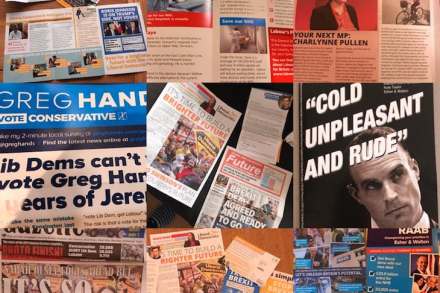
What are the parties trying to tell voters in their leaflets?

From our UK edition

What's the point of political leaflets, anyway? Many voters in target seats will be asking that very question on an almost daily basis, as they shovel the latest snowdrifts of election literature into their recycling bin. We have social media, party election broadcasts and phone banks to reach voters. Who needs leaflets? There is a (I believe only half-serious) 'test' that some Liberal Democrat campaigners apply to the amount of information they think it is possible for a voter to absorb from a leaflet they're carrying from the letterbox to the bin. Given the parties keep sending them, particularly in those marginal seats where it's just not clear where the result is going to go, it's worth having a look at what they think is going to appeal to voters as they trudge once more to the bin.

Piers Corbyn: My brother Jeremy’s green policy is ‘nonsense’

From our UK edition

Vote Corbyn, says Corbyn. That is the unsurprising message from the Labour leader's brother Piers in a video filmed at Speakers' Corner in London. But while Piers backed his sibling over accusations of anti-Semitism and Labour's position on Brexit, it wasn't an entirely ringing endorsement. Piers Corbyn, who has previously said 'man-made climate change does not exist', was asked about Corbyn's green manifesto pledges. It's safe to say he is not a fan: 'He wants to end carbon dioxide emissions.' Piers Corbyn: 'Yeah, well, that's nonsense. That's impossible.' 'Well, that's what your brother says, why are you supporting him then?' Oh dear. Mr S expects it could be a bit awkward at the Corbyn household this Christmas...

Labour’s Jonathan Ashworth caught revealing Corbyn security fears

From our UK edition

Jonathan Ashworth has been caught out this morning after a leaked tape emerged of the shadow health secretary talking about his fears for Britain's national security if Jeremy Corbyn becomes PM. Ashworth said the civil service would need to 'pretty quickly move to safeguard security' if Labour wins on Thursday. Ashworth also gave his verdict on... ...Labour's election campaign: 'It’s dire' ...What voters make of Jeremy Corbyn: '...they can’t stand Corbyn and they think Labour’s blocked Brexit'   ...and where the Labour party went wrong: '...we fucked it up in 2016 when we went too early. People like me were internally saying ‘this isn’t the right moment’ but I got kind of ignored.

Labour’s succession battle is well underway

From our UK edition

John McDonnell was insisting this morning that Labour was going to win a majority, but just in case, insiders are suggesting that the Shadow Chancellor is planning to take over as interim leader if Jeremy Corbyn resigns after a general election defeat. McDonnell has long championed Rebecca Long-Bailey as a future leader, and there is speculation that he could install her as his shadow chancellor in order to boost her credentials. This explains why those around Corbyn were so keen to try to abolish Tom Watson as deputy leader in September. They tried to force a rule change at the party's ruling National Executive Committee meeting which would scrap the post.

Labour, Question Time and the cult of youth

From our UK edition

When’s the Question Time for over-60s, then? Or maybe even over-75s? After all, elderly people face specific social problems: pension issues, care, loneliness. And yet they aren’t getting their very own QT, unlike under-30s, who are. Tonight the BBC is hosting a special youth version of its flagship political show and in the process it is sending out a pretty disturbing message: young people’s views matter more than old people’s. Presented by Emma Barnett and featuring politicians from across the spectrum, tonight’s QT for millennials promises to be an irritating affair. It’s not that I have anything against young people — I was young myself, once. It’s more that self-consciously youthful politics has become a bit woe-is-me.

‘You’re destroying confidence’: John McDonnell taken to task by John Caudwell

From our UK edition

Labour's election strategy has been to go on the attack against Britain's billionaires. Today one of them responded. Phones4U founder John Caudwell quizzed shadow chancellor John McDonnell on Labour's economic policy today and it's safe to say he wasn't impressed. Caudwell warned McDonnell that his party's plans could lead to an exodus of wealthy taxpayers from Britain. Here's what he told McDonnell: Caudwell: '...Some of the Labour rhetoric I accept. But the central ethos, when I hear phrases like nobody deserves to be a billionaire, it frightens the living daylights out of me. You know John, the thing is, if the Labour rhetoric was 'We admire billionaires and we'd like them to pay a bit more tax, be more charitable and admire their success', I would absolutely support that philosophy.

Boris should threaten to back Corbyn’s ridiculous Brexit plan

From our UK edition

The decline of the Liberal Democrats continues to give Labour a boost and rattle Tory nerves. Middle class Remainers who dislike Jeremy Corbyn are nonetheless deciding that he is their last best chance to thwart Brexit. Electing an anti-Semitic government so you don’t need to show a passport at Paris Charles de Gaulle is quite the ethical choice but there you go. It’s also a pretty big gamble. We know that Corbyn is a Brexiteer who believes freedom of movement drives down workers’ wages because he has told us as much. Voting for him to stop a hard Brexit isn’t so much holding your nose as poking your own eye, but Remainers know Labour backbenchers will hold him to his promises on a second referendum. Right?

Corbynomics won’t help the poor

From our UK edition

Here’s a curiosity of the 2019 general election: given that both the big parties agree that austerity is over and Britain wants a more generous state, why is no one doing much to help the poor? And why is no one talking about that failure? These questions start with Labour. Jeremy Corbyn’s fans see him as a radical crusader for economic justice, an almost ascetic figure utterly devoted to the disadvantaged. In the mad 'story' about Corbyn and the Queen’s speech this week, the Labour leader had a perfectly good tale to tell: he spends part of his Christmas Day in a shelter for the homeless. According to the Social Metrics Commission (SMC), a cross-party group of experts (including my Social Market Foundation colleague Matt Oakley) there are 4.

This is the most important election in modern history – so vote, and vote Tory

From our UK edition

Next week, voters will decide the future of the government, of Brexit, and perhaps of the Union. Jeremy Corbyn has been admirably clear on what he offers: a radical experiment in far-left economics, going after the wealthy to fund the biggest expansion of government ever attempted in this country. Boris Johnson proposes to complete Brexit and restore much-needed stability to government. But given that about half of voters still oppose Brexit, the race is close. Corbyn offers a new referendum on Brexit. It is easy to snigger at his declaration that he would be neutral during this campaign. But his pledge to be an ‘honest broker’ conceals the deceit that his referendum represents.

What the Tories don’t understand about Corbyn voters

From our UK edition

Until recently, the Tories seemed pretty confident about next week’s election. Despite spending three and a half years blundering over Brexit, they were still comfortably ahead of Labour in the polls. In Jeremy Corbyn, they had an opposition leader denounced as a terrorist sympathiser, an unreconstructed communist, a rabid anti-Semite and — in general — an enemy of Britain. You might regard Corbyn this way yourself. If so, then it’s worth asking: if he really is so bad, why has support for Labour been steadily increasing since the election was called? Is the nation going mad — or might there be more to it? I’ve supported and campaigned for Corbyn’s type of politics most of my adult life.

We are witnessing the death throes of Corbynism

From our UK edition

Jeremy Corbyn has given up on winning this election and is currently struggling to ensure that on 12 December Boris Johnson will be denied a Commons majority.  Last week Labour’s campaign strategy switched from trying to win seats to trying not to lose them, reflecting just how badly things are going. With polling day just around the corner, the party has been reduced to sending its chair Ian Lavery to visit once rock-sold northern seats to try and win back former miners to Labour. It should not have been this way. Indeed, according to John McDonnell, Corbyn was just a week away from becoming Prime Minister in 2017. If only that election campaign had lasted just a little bit longer he would have entered Downing Street as the victor.

Labour tries to quietly edit its manifesto

From our UK edition

During this year's general election campaign, Labour has attempted to repeat their 2017 strategy of costing each commitment made in their manifesto. Given the sums involved, it seems only fair expect the party to lay out - in detail - what they are planning to spend and how they are planning to pay for it. But perhaps this time, their so-called 'grey book' wasn't quite detailed enough. The party has been caught attempting to amend the costings document after its publication two weeks ago. In the original document, the shadow treasury team appear to have confused 'profit' with 'turnover'. Such a mistake will do nothing to allay the fears those who accuse the party of economic illiteracy.