Labour party

The best publicity Brown is ever likely to get

From our UK edition

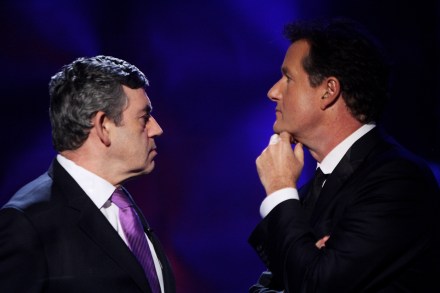
Brown is very lucky to have a friend in Piers Morgan. He did him a great service in the ITV interview tonight - and while it would have made CoffeeHousers nauseous (if they watched it), it will be the best television the PM will get this year and probably ever. Mark my words: the Labour Party will not produce anything that shows Brown in such a sympathetic light. It was powerful, I'd say, because it was not party political propaganda: Morgan genuinely likes Brown and did his utmost to project the human side of him. Those hours of coaching from Alastair Campbell paid off. He kept smiling in a credible way - telling anecdotes in exactly the way that he does, in private, when he's trying to charm people.

It is Brown and Balls versus Darling and Mandelson again

From our UK edition

If there was a story in the Sunday papers of a split between David Cameron and the two most senior figures in the shadow Cabinet over economic strategy it would be the talk of the town. But because it is about Brown and Balls versus Darling and Mandelson it is on the inside pages; it is as if the split over economic policy between these four men is priced into Labour’s standing. Patrick Hennessy reports that Brown and Balls would like to use the Budget as a pre-election springboard, announcing larger than scheduled increases in public spending and challenging the Tories to match them.

Darling enters election mode

From our UK edition

There must be something about stepping back onto Scottish soil that invigorates Alistair Darling, because his Edinburgh speech is one of the most political and confrontational he has delivered for some time.  Sure, Darling is a Labour man, so it's part of his job to oppose the Tories.  But, compared to his Cabinet colleagues, he's normally so restrained about it.  Here, though, the gloves are well and truly off. The Chancellor calls Cameron a "real risk to Scotland's future," and throws in a dash of Thatcher-baiting ("The Tories ... are as out of touch now as they were 30 years ago").  But, really, there are two passages worth dwelling on, for what they might tell us about Labour's election campaign.

The hunt for Hoon’s successor

From our UK edition

Not the most arresting headline I grant you, but bear with me. Geoff Hoon’s political corpse is still warm (well, lukewarm as it’s Hoon), but the search for his successor is underway. The indefatigable Paul Waugh has the runners and riders: John Knight (the leader of Ashfield District Council), James Connell (Hoon’s former SpAd) and Michael Dugher (another former Hoon SpAd who is now Brown’s Chief Political Spokesman). Mischievously, Waugh asks: ‘Will Labour insist on all-women shortlist? And if not, why not?’ Why not indeed? Perhaps Joanne Cash could complete her volte face and stand for Labour. What strikes me most about Waugh’s list is that all of the candidates are ‘career politicians’.

Mandelson: Public sector will face cuts this year

From our UK edition

Peter Mandelson gave the Dearing memorial lecture last night and in a section responding to the criticisms of the budget cuts for higher education said:   "Much of the rest of the public sector will receive similar constraints in the course of this year or soon after." Mandleson has implied this before, most notably on Newsnight the day of the Hoon Hewitt plot. But it is a very different from the message Brown is putting out. We in the press should demand details from Mandelson about what these cuts in financial year 2010-11 might be with the same intensity that we did when the Tories said they would make in year cuts if elected. Who knows Mandelson's plans might be more ambitious than the £1.5 billion that the Tories have been able to find.

Lance Price: Brown became PM when his skills were declining

From our UK edition

Gordon Brown is a creature of habit. Every morning at 7:30 he holds a telephone conference with his cabal of Shakespearean fools, who review the papers for him. I imagine a scene of domesticity, of coffee and muffins, an adoring wife and child milling about offering tactile affection – a hand on the shoulder, a kiss on the head. But then again Brown is a latter day John Knox and this morning he must have sat in pale fury as an aide summarised the extract from Lance Price’s latest book, published in the Independent. Price, Andrew Rawnsley and Peter Watt share the same lexicon. ‘Unforgivable’, ‘not a nice place for people to work’, ‘psychologically flawed?

The death tax ads are the sort of hardball politics the Tories should play

From our UK edition

I must admit to rather liking the Tory death tax ads. They are the kind of hardball aggressive politics that the Tories need to master if they are going to win this election. Are they dishonest? Well, I think in the grand political scheme of things they qualify as fair: Brown won't rule this out and it is definitely an option Labour is considering so it is fair game. If this attack is out of bounds, then so is most of the dossier Labour produced on Tory spending plans at the beginning of the year. The other thing that really infuriates me about this whole debate is the idea that the responsible thing to have done would have been for the three main parties to hammer out some compromise deal and then just present it to the public.

The Tories’ dirty tactics are dispiriting but effective

From our UK edition

This death tax levy is gutter politics at its most visceral and it’s thrilling drama. Brown's and Cameron's loathing for each other is pure soap opera, and they’re having a right old slanging match. I agree with Pete, it is dispiriting to see the Tories stoop to misrepresenting policies, the show-stopper in Brown’s repertoire. Together with Cameron’s personal attacks, the Tories have surrendered the high ground, but as Iain Martin notes is anyone really surprised? The Tories have been expecting, righty, Labour to fight a grubby election campaign and have decided to fight Brown’s mob with fire. Personal attacks appeal largely to those whose minds are settled, so I see little electoral advantage in delivering them.

Has that Tory poster made Brown’s job easier in PMQs?

From our UK edition

Yesterday's Guardian story about a potential death tax would have been perfect material for Cameron in PMQs. Even after Andy Burnham's denials, there are still legitimate questions to be asked about it. For instance, would the government say that they will never propose the tax? And, if not, how will they pay for their social care guarantees otherwise? Fired across the dispatch box, these enquiries could have put Brown on the back foot. But now that the Tories have jumped the gun, and released that poster attacking a Labour policy which isn't actually a Labour policy, they've rather limited that line of questioning. If the death tax comes up, all Brown need do is point to the poster and cry foul play. He can even throw in a few words like   "misleading," for good measure.

Cameron attacks tax-happy Brown

From our UK edition

A strident interview from David Cameron in today's Express, in which he touches on everything from inheritance tax to not, never, ever joining the Euro. It's this passage that jumped out at me, though: “Middle Britain has had a wretched time under Labour. This Government has taxed mortgages, marriages, pensions, petrol and travel and raised national insurance and the top rate of income tax. We cannot keep squeezing hard-working families." Why so noteworthy? Well, off the top of my head, this is the first time that Cameron has referred to the current system as a "tax on marriage".

The problem with that David Cameron ad

From our UK edition

Labour’s new ad with David Cameron facing both ways highlights what was wrong with the Tories’ opening ad of the year, that one dominated by Cameron’s face. The Tory strategy for the election campaign has to be to try and make it into a referendum on this failed government. But that ad, which emphasised Cameron so strongly, gave Labour an opening to try and turn the election not just into a choice between two parties but into a referendum on David Cameron and Tory policy. Labour’s success in doing this is largely responsible for the Tory wobble. The contrast between Cameron and Brown does work to the Tories’ advantage. But it works because it is a contrast.

Blair on Chilcot…

From our UK edition

...well, sorta.  5:25 into his interview with Mike Huckabee, our former PM gives his take on the constant stream of Iraq inquiries: You can certainly see his point. Although I doubt the government will be too impressed with Blair trawling through all the Iraq stuff on American television, only weeks before he hits the campaign trail for Labour.

The Dividing Lines Obsession

From our UK edition

This is one of those things that I don't quite understand. Gordon Brown is obsessed with dividing lines and this is supposed to be upsetting us? Sure, this need to draw a contrast (often a false one, but never mind) between his Virtuous Labour party and the Callous Toffs & Cads at Tory head office is frequently petty, prickly and pointless. But what of it? Pete's the latest Spectator gentleman to complain about the Dividing Lines Obsession: So far as the government is concerned, it matters not that these pledges have been made before – what matters is the opportunity to draw more dividing lines across the landscape of British politics.  "Caring" versus "cruel", as far as the eye can see.

How should the Tories respond to those Labour guarantees?

From our UK edition

If you're going to take anything away from Andy Burnham's press conference this morning – apart from his denials about a £20,000 "death duty" – it's how heavily those Labour "guarantees" are going to feature in the election campaign.  Here we had social care guarantees, cancer treatment guarantees, waiting line guarantees, and even a new website and poster (see above) attacking the Tories for not signing up to the same guarantees.  So far as the government is concerned, it matters not that these pledges have been made before – what matters is the opportunity to draw more dividing lines across the landscape of British politics.  "Caring" versus "cruel", as far as the eye can see.

Plenty to encourage the Tories in the Populus poll

From our UK edition

Well, the Populus poll isn't all good news for the Tories. As James pointed out last night, they have shed another point and Labour have regained some ground. But, as both Peter Riddell and Mike Smithson note, the Tories can still secure an outright majority on the basis of these figures. The numbers which lead the Times's frontpage coverage are more encouraging for Cameron & Co. They show that the public are attuned to the Tories' broad narrative. 73 percent think society is broken; 82 percent think that now is the time for change; and 64 percent believe Britain is heading in the wrong direction. After 13 years in power, Labour cannot credibly represent change; it has to defend its record, which on the evidence of these findings is not something it will manage easily.

A day to damage Brown?

From our UK edition

Contain yourselves, CoffeeHousers.  I know that we're all really excited about today's Parliamentary vote on an alternative vote referendum (it is, after all, something our Prime Minister has described as "a rallying call for a new progressive politics"), but it isn't a done deal just yet.  That "new politics" might still be put on hold. Indeed, things could get messy for Brown in just a few hours time.  You'd expect him to win the vote, what with Labour's majority and the creeping sense that Downing St very much wants this to happen.  But even the slightest hint of a Labour rebellion, or of Lib Dem disquiet, and the story could turn toxic for the PM.

If this is a suspension, what is an expulsion?

From our UK edition

Sky’s Jon Craig’s asks one of those questions you wished you had posed: wasn’t Elliot Morley suspended already? Yes, he was, on the 14 May 2009 and with immediate effect. However, showing a fine disregard for the manner in which repeat offenders are usually treated, Labour suspended Morley again for good measure. Seeking a clarification about the initial suspension, Craig was told that Morley had been denied the ‘privileges of the PLP’. What might they be? Subsidised beer and sandwiches perchance? The rumour is that Morley was either re-instated on the quiet or had escaped in the first instance, lending more weight to the sense that Labour’s response to the expenses scandal has been hopelessly ill-conceived.