Labour party

Number crunching cuts

From our UK edition

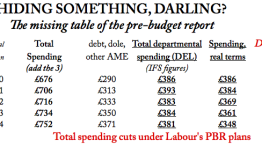
The debate about cuts so far lacks any numbers, so I thought CoffeeHouses might like some. Contrary to what he claims Darling is planning cuts – but he just didn’t print the spending totals in his Pre-Budget Report (lack of space, one presumes). The Institute for Fiscal Studies, which produces its Green Budget tomorrow, has worked out what will be left for departments after debt interest, dole et. It amounts to a 10 percent cut. Here’s the table. Yet the Tories plan for DFID to be 0.7 percent of GDP by 2013 – ie, rising by 63 percent - and health will not be cut. Cameron has indicated that he will not cut much in 2010-11, so let’s assume that the Labour spending rises for various departments go ahead as planned. Results below. The result?

Brown’s empty PR promise

From our UK edition

Gordon Brown's proposal to bring in a referendum on electoral reform has a beautiful symmetry with Tony Blair's pledge to do exactly the same thing in the 1997 manifesto. That pledge never came to pass, once Mr Blair discovered the usefulness of a majority of 178, compared to dealing with the Lib Dems all the time as coalition partners. And Mr Brown's conversion to electoral reform has the mirror-image motivation: making the system kinder to losing parties has a certain attraction, if you are heading into opposition. Debates about electoral reform are rather strange. A very small number of very passionate people can talk for hours about the minutiae of different electoral systems and how they can radically change politics.

The Tories are muddying their clear, blue water

From our UK edition

Front page of the Independent: "Vote of no confidence in Tory economic policies".  As headlines go, it's one of the worst the Tories have had for a while - even if, as Anthony Wells and Mike Smithson point out, it's kinda misleading.  Truth is, the Indy's ComRes poll finds that 82 percent of people want "Mr Cameron to be clearer about what he would do on the economy".  And 24 percent think the Tories would have ended the recession sooner, against 69 percent who don't.  They're hardly positive findings for CCHQ, but, by themselves, they don't quite add up that that two-line scarehead.

Mandelson is spinning to his heart’s content

From our UK edition

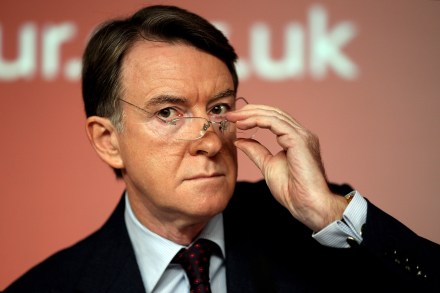
Peter Mandelson was doing his full Alan Rickman impression at Labour’s press conference this morning. His aim was to imply that every time Labour put the Tories under pressure they wobble. As so often since his return to British politics, Mandelson delivered lines that were so memorable that they were bound to make it into copy. He said that the Tories “would strangle the recovery at birth”, that David Cameron was “bobbing around like a cork in water”, and that George Osborne was the Tories’ “weakest link”. As I type, Mandleson’s sound bites are being replayed yet again on News 24. Now, these lines aren’t going to cut through to the British public.

The widening public-private divide

From our UK edition

The growth of the public sector isn't exactly new news, but the figures attached to it are always pretty eyecatching.  These courtesy of Allister Heath in City AM: "MORE evidence of a growing public-private divide: 57 per cent of extra UK jobs created during 1997-2007 were either officially on the government's payrolls or 'para-state', technically private but dependent on government funding. And that was before the private sector jobs bloodbath since 2008. Manchester University's Centre for Research on Socio-Cultural Change calculates that of the 2.24m net new jobs created in 1997-2007, 1.

Cameron has shifted the spending debate to Labour’s home ground – but the Tories still have an aggregate lead

From our UK edition

So, is David Cameron's shift in emphasis on spending cuts a u-turn, a clarification, or something else?  Well, when it comes to existing Tory policy, it doesn't actually change much.  We were always rather taking it on trust that Cameron & Co. would cut spending by much more than Labour this year.  The cuts they've announced so far aren't really that much deeper – and most folk in Tory circles were waiting for George Osborne's potential Emergency Budget to see whether that would change.  So, when Cameron says that his party wouldn't introduce "swingeing cuts" this year, the position is still remarkably similar: we still need more details to judge the true extent – not the publicised extent – of any Tory cuts.

Clarification or u-turn?

From our UK edition

Smarting from the savaging he received in Mo, Peter Mandelson characterised David Cameron’s "no swingeing cuts” comment as a u-turn, and compared Cameron and Osborne to Laurel and Hardy. This is a bit rich considering the government’s obvious confusion over the timing and extent of cuts, and that the immortal line “That’s another fine mess you’ve gotten us into” should be the Tories’ campaign slogan. Cameron’s comments are a clarification, not a u-turn. As Jim Pickard notes, Tory policy has to respond to last week’s withered growth figures.

Tony Blair: The Next Labour Prime Minister?

From our UK edition

There has been a general consensus that Tony Blair was a class act in front of the Chilcot Inquiry. Even those who see him as a liar and a war criminal must have been impressed by the way he handled himself - although choosing to show no contrition in a room of people that included the bereaved parents of fallen soldiers was a mistake.  I was not a supporter of the war. Like most people in the country I was an agnostic: I hoped the removal of Saddam would lead to a democratic domino effect across the middle east, but I thought it probably wouldn't. I thought it far more likely that an invasion would lead to the three-way split of the country into Kurdish, Sunni and Shia enclaves. I wasn't entirely right about that either.

Why does the Iraq war still fascinate the politics of the present?

From our UK edition

This week has seen confirmation that social mobility has stagnated, that the economic recovery is dangerously anaemic and that peace in Northern Ireland is threatened. Yet a conflict that was declared won nearly 7 years ago has been ever present on the frontpages. Bagehot is not at all surprised that the Iraq war remains definitive: ‘There is one way in which, despite the inquiry, Iraq has come to seem a less definitive issue: in Mr Brown’s handling of the public finances, it has a rival for the status of Labour’s worst mistake. Yet Iraq remains the most important single decision the government has made. Even taking a generous view of its behaviour—that it was cavalier and naive, rather than actively mendacious—the war remains an enormous stain.

Stimulating social mobility will take decades

From our UK edition

Another pallid dawn brings more statistics proving that Britain is riven by inequality – ‘from the cradle to the grave’, concludes the Hills report. Unless the offspring of professionals pursue a peculiar urge to be writers or enter Holy Orders, they will bequeath ever greater advantages to their children. For those in converse circumstances, Larkin’s line about inherited misery comes to mind, albeit in a slightly different context. 50 years of unparalleled prosperity, and social mobility has stagnated. Before the wailing and navel gazing begins, it must be asserted that the continued aspirations of the privileged and the fulfilment of their opportunities are not to blame.

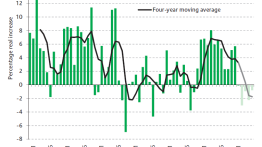
Growth but of the weakest possible sort

From our UK edition

So Britain did grow in the fourth quarter of last year but only by 0.1 percent. Many on the Labour side had hoped that the moment that the country started growing again, Brown would be able to go on the offensive; arguing that his handling of the economy had steered Britain through the crisis. But the fact that the growth number is considerably lower than expected, most predictions were for growth of 0.3 to 0.4 percent, has rather stymied that plan. There are now only one more set of GDP figures before the election, presuming that it is held in May. So, it is now almost certain that Brown will not be able to go to the country boasting of a robust recovery. (The worst case scenario for Brown is that these figures are revised downwards meaning we are still in recession).

What Tory split?

From our UK edition

He never deviates and he never hesitates; if he stopped repeating himself Brown could be the star of Just a Minute. He was at it again today: “We must reduce our deficits steadily according to a plan, but we must do nothing this year that will put our recovery at risk.” The cuts-investment dividing line has been nuanced into a question of timing. Brown cited Ken Clarke among the “major world leaders” who lend his policies authority. Brown has overreached himself.

Nest-eggs for some pre-election goodies

From our UK edition

Labour’s tax on banks that pay bonuses has failed to change behaviour and so will raise significantly more money, roughly two and a half billion more, than the Treasury budgeted that it would. How Labour uses this extra revenue will tell us a lot about how Labour intend to campaign and the balance of power within the government. At Brown’s press conference, Gary Gibbon pressed the Prime Minister on whether this money would all be earmarked for deficit reduction, the option that those close to Darling prefer. Noticeably, Brown failed to endorse that idea. He also would not commit to using any other extra revenue exclusively for deficit reduction. The significance of this is that there are rumours floating around that a bank might be sold before the election.

Out of recession and into debt

From our UK edition

The deficit is in the Tories' crosshairs this morning. George Osborne pens an article in the Times, castigating Brown's obsession with continuity: ‘We need a new British economic model that learns from the mistakes of the past. First, that new economic model requires government to live within its means. We entered the recession, after years of growth, with one of the highest deficits in the developed world and we leave the recession with our credit rating under threat. That will have potentially disastrous consequences for international confidence. If Britain starts to pay the sort of risk premiums that Greece is paying, the interest bill on a £150,000 mortgage would go up by more than £200 a month.

Darling talks sense on public sector pay

From our UK edition

How things change.  A few months ago, Alistair Darling would only go so far as to not rule out a public sector pay freeze.  By the time of the Pre-Budget Report, that became a 1 percent cap on pay rises.  And now, in an interview with the Sunday Times, he's talking explicitly about public sector pay cuts.  He cites the example of the private sector, where workers have accepted cuts to hang onto their jobs. It certainly makes sense.  Wages make up such a hefty proportion of public spending, that any serious plan to cut the deficit will have to take them into account.

Labour have Osborne in their sights (and on their fridges)

From our UK edition

It's only a small thing, but does anyone else find this detail from today's Times interview with Alastair Campbell a little, erm, peculiar: "On the [Campbell] fridge is a Christmas card from David Miliband, a clipped photo of George Osborne in the Bullingdon Club shooting pheasant, a GCSE revision schedule. It is the type of handsome but unostentatious London professionals’ house that the Blairs once owned in Islington." I mean, it's no secret that the Labour hierarchy loathes the shadow Chancellor – but putting what I assume is this photo on your fridge?  Armchair psychologists, the comments section is yours...

Don’t be surprised if Jowell is kept on by a Tory government

From our UK edition

As Ben Brogan outlined in his Telegraph column last November, there are plenty of Tories placing a good deal of emphasis on the London Olympics.  By the time it comes around, they may well have spent two years cutting spending, raising taxes, and generally struggling against the fiscal problems that Brown has hardwired into our nation's fibre.  A successful Games, the thinking goes, could be just the tonic for their midterm government – as well as for the country as a whole. Which is why today's story about the Tories somehow keeping on Tessa Jowell, the current Olympics Minister, is unsurprising.  The thinking is clear: a bit of continuity could prevent the organisational problems, as well as power struggles, which always seem to beset political handovers.

The public aren’t seeing Brown’s “green shoots”

From our UK edition

We've been rather starved of opinion polls over the past week, which is probably no bad thing.  But this PoliticsHome poll on the economy has come along to give us at least something to mull over.  And its findings aren't good news for Labour. First, only thirty-four percent of repondents think that the economy has turned a corner into recovery.  And, crucially, only 36 percent are willing to give Labour "a lot" or "some" credit for their handling of the recession (down from 40 percent last August).  That's against 29 percent saying "not very much," and 34 percent saying "none at all". As we saw on Wednesday, Labour is eager to seize on any potential "green shoots," and sell them as successes for government policy.

Dirty tricks are off and running

From our UK edition

The Tories are bracing themselves for an election campaign of smears and dirty tricks. Today the sniping begins. Attack dog Liam Byrne has criticised Cameron’s ‘Broken Britain’ speech in the following terms: “I think when people read what Mr Cameron is saying today they will see that it is quite an unpleasant speech…Mr Cameron is seizing upon one appalling crime and almost tarring the people of Doncaster and the people of Britain.” Cameron is not tarring anyone; he is clear that Doncaster was one of a number of extreme incidents (Baby P being another) that exist alongside a groundswell of anti-social behaviour. The terms ‘Broken Britain’ and ‘moral recession’ are sensational but Cameron has a point.

Obama is playing politics<br />

From our UK edition

FDR was plainly confident when he indicted the "practices of unscrupulous money lenders" during his 1933 inauguration address; Obama’s speech yesterday was scented with desperation. He exchanged eloquence for provocation. “If these folks want a fight a fight, it’s a fight I’m ready to have.” Bankers do not want a fight with a President seeking cheap political capital; they want to turn profits and do business. Obama’s proposals frustrate that aim - by carving up corporations and neutering investment banking on the grounds of excess risk. As Iain Martin notes, Obama has departed from the G20’s emerging narrative, and though the details are imprecise there is no doubt of the direction Obama is headed. It is the wrong one.