Labour party

PMQs live blog | 3 March 2010

From our UK edition

Stay tuned for live coverage from 1200. 1201: And here we go.  Obviously, with Brown meeting Zuma, it's the deputies today. Harman starts with condolences for the fallen. 1202: Incidentally, Cameron is being interviewed on TalkSport radio, if you want to listen to that. 1203: First question: why manufacturing has fallen under Labour. Harman says that this is the Tories "talking the country down". Hm. Easier than actually answering the question, I suppose... 1204: This PMQs is already getting noisily partisan.  A second question brings some "do nothing Tories" innuendo from Harman.  Jeers and cheers all round. 1206: Hague now.  His first question is whether Brown was wrong to cut the helicopter budget.

Labour will relish this opportunity to prolong the Ashcroft story

From our UK edition

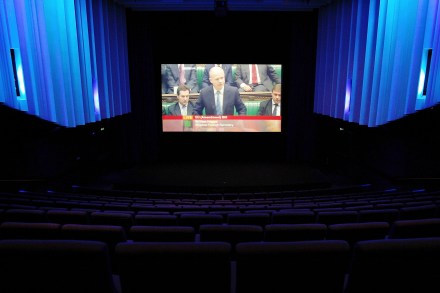
When Gordon Brown pulled out of PMQs this week because of Jacob Zuma’s state visit there was much chortling that he didn’t much fancy PMQs. But I suspect that Labour is rather glad that William Hague is up today; no Tory politician is more central to the Ashcroft peerage than Hague, and Hague’s appearance at the despatch box is Labour’s best chance of taking this story into a third day. Hague will have his line that Ashcroft would pay ‘tens of millions a year in tax’ thrown back at him repeatedly. Hague’s trips with Ashcroft to various foreign locales will also get an outing. There is something incredibly frustrating about the Ashcroft fallout.

Facing the protesters

From our UK edition

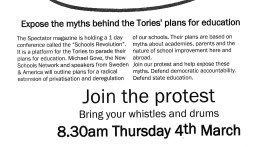
Given that school choice will only benefit those who cannot afford it at present, who could be against it? The answer is the Socialist Educational Alliance, who have decided to stage a protest at The Spectator's conference on school liberalisation on Thursday. They have produced a leaflet (see left, and click to enlarge). "Bring your whistles and drums" it says - 8.30am. I wonder if Ed Balls will join them, as he appears to agree with the thrust of their argument. "Defend democratic accountability," says the flier. This is the language which Labour left use: "democratic accountability" is code, of course, for political/bureaucratic control. Perhaps my friend Polly Toynbee will be there too, with a placard saying "what do parents think they know about schools?

How the televised leaders’ debates will work

From our UK edition

The various parties involved in the televised leaders' debate have finally come to an agreement on how they will work.  You can read full details here, courtesy of Sky.  But the main points are: i) Topics and locations. The first debate will be hosted by ITV's Alastair Stewart, in Manchester, and will cover domestic affairs.  The second will be Sky's Adam Boulton, in Bristol, and will cover foreign policy.  And the third will be the Beeb's David Dimbleby, in Birmingham, on the economy. ii) Structure. The rather rigid structure of each programme will be as follows: "Each leader will make an opening statement on the theme of the debate lasting for 1 minute. After the three opening statements the moderator will take the first question on the agreed theme.

Is this the closest that Brown’s government has come to a <em>mea culpa</em>?

From our UK edition

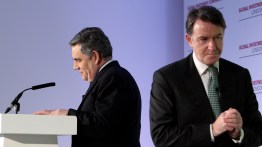
A striking passage from Peter Mandelson's speech at Mansion House last night: "Starting in the 1980s we allowed the diversity of the British economy – or lack of it - to approach the limits of what was prudent. Sometimes there was an economic fatalism about manufacturing decline and falling British goods exports, rather than seeing them as something that policy and private enterprise should address. Our economy, and certainly our corporate tax base, became too dependent on the City. We were also carrying a huge hidden insurance liability for a sector that was taking badly understood and inadequately policed risks.

Labour’s pursuit of Ashcroft could backfire

From our UK edition

I wrote yesterday that Lord Ashcroft's statement about his tax status should have drawn a "rather neat line under the issue".  Sure, it's hardly ideal that someone with such influence in our politics hasn't been paying UK taxes on much of his wealth (something which could equally be said of Labour donors like Lord Paul and Lakshmi Mittal), and was keeping mysterious about it.  But at least, now, most of the uncertainty surrounding Ashcroft's position has been removed.  And we have his indication that he will become a full UK taxpayer in due course.   But I hadn't counted on the tenacity of Labour, who are trying to spin this story as far as it will go.

Who should be the Tory attack dog?

From our UK edition

A persuasive passage (complete with a spiky, ministerial quote – highlighted) from Rachel Sylvester's column this morning: "There is growing concern among some Shadow Cabinet ministers and strategists about the increasingly aggressive tone Mr Cameron uses against Mr Brown. It is, they believe, no coincidence that the poll gap has narrowed as the Tory leader launches a series of increasingly vitriolic personal attacks on the Prime Minister. Last week, for example, by turning the bully into the victim, Mr Cameron seems to have simply solidified support for Mr Brown. There was a similar backlash to the Conservatives’ misleading 'death tax' poster campaign.

The morning after the speech before

From our UK edition

So, what did the newspapers make of Cameron's Big Speech?  A brisk stroll through this morning's coverage, and you'll come across the whole gamut of responses: from wholehearted enthusiasm in the Sun, to wholehearted scepticism in the Independent.  But the general tone is somewhere in between: the mitigated praise of, say, the Times or the Guardian.  Which is, I think, fair enough.  The speech struck me as effective, perhaps elegant, without ever quite hitting the heights. But the Tories should only be concerned by the media response insofar as it's a conduit for their own message.  What bits of that message have cut through?  Will that message resonate with voters?  And so on.

Cameron to speak ‘from the heart’

From our UK edition

There is only one topic of conversation here in Brighton, the shrinking Tory poll lead. The optimistic take is that a poll suggesting Labour would be the largest party actually makes the prospect of five more years of Gordon Brown real to people and so lets the Tories emphasise that this election is choice between them and Labour. As Cameron’s spokesperson jokes, ‘Labour’s underdog strategy has been blown apart’ The poll does give David Cameron’s speech today a whole new level of significance. Cameron will reprise his walking and talking technique that served him so well in 2005 and 2007 today. He will speak ‘from the heart’ for about half an hour. I’m told there are no new policy announcements in the speech.

Hammer blow or gift from God?

From our UK edition

Is the Sunday Times poll a hammer blow to the Tories, or a gift from God? It sounds a weird question, but think of the logic. So far, Cameron’s big mistake was to allow the campaign to become a referendum on him. He was desperate to turn that into a basic question: do you want five more years of Brown? Until now, the voters’ response would be “yeah, right. Brown is going down. The question is whether I’m enthusiastic about you lot, with your fuzzy green tree logo and your lack of any discernable agenda, and the answer is no”. As James said, the message “five more years of Brown” was the main one that the Tories were trying to convey yesterday at the conference. And now the two-point YouGov lead makes this into a realistic prospect.

A tonic to dispel doubt

From our UK edition

If any CoffeeHousers have been feeling despondent about the Tores, I have the perfect tonic: Cameron’s YouTube video released today. In my News of the World column last week, I listed five messages I thought he should give. And he ticked all of them off - and then some. It was one of those biannual events: where Cameron gives a speech that he obviously wrote himself, and put a lot of energy into it. And the result is always great. Now, this may be a wavelength thing: some CoffeeHousers may see a whole load of cliches. But I see in here an agenda for change – plus some clever debating tactics. He starts by doing what I’ve longed for the Tories to do: frame the debate.

Telling tales of his mother and father

From our UK edition

Gordon Brown does not have much of a personal “backstory” but he does talk about his family. When he’s feeling guilty about something, he mentions his father. But today, speaking to the Welsh Labour Party, he again talks about a figure we heard about a few days ago: his grandfather. “Like so many here I come from a family whose grandfather went without work during much of the 1930s. A grandfather whose small savings gave his son, my father, the chance of an education, the first in our family to go to university. And the lesson of those days is that even in the worst of times families helped each other, supported each other, came to the aid of each other through thousands of acts of friendship caring and support.

Change we must believe in

From our UK edition

Both James and Tim Montgomerie felt that William Hague must be more prominent during this campaign and Cameron has reached the same conclusion. Hague opened the spring confernece with a stark, bleak message: "And I say it is that most crucial election because I believe the choice for Britain is as stark as this: it is change or ruin." He then detailed the easiest illustration of Brown's appalling economic stweardship: a 13 year statistical progress of regression for which Brown, and Brown alone, is responsible. 'When Gordon Brown took over, this, our great country, was the 4th largest economy in the world. Now it is falling behind and forecast within 5 years to be the 11th, behind not just growing giants like China, but behind our neighbours France and Italy.

Always a murky business

From our UK edition

Lance Price is better placed than most to write about ‘spin’ in politics, having worked as a BBC political reporter and as Alastair Campbell’s deputy in Downing Street. Lance Price is better placed than most to write about ‘spin’ in politics, having worked as a BBC political reporter and as Alastair Campbell’s deputy in Downing Street. In August 1997, Price was on duty for the BBC the weekend that the story of Robin Cook’s affair broke. In Where Power Lies he describes the ‘unusually rich array’ of other stories in the papers to choose from that weekend. A juicy item in the Sunday Times stated that Chris Patten, Governor of Hong Kong, could be prosecuted under the Official Secrets Act.

An interview packed with Brownies

From our UK edition

Brownies galore in our PM’s interview with the Economist. So many, in fact, that I thought I do a quick Fisk:   The Economist: The big worry seems to be the deficit—the deficit. What should the message should be? Gordon Brown: I actually think that the first thing that we’ve got to do as a global community—and I said it this morning and I’ll say it again—is that the reforms of the global financial system are not complete. As far as Britain is concerned, we are dealing with a one-off hit as a result of globalisation. FN: Let us pause, here, to consider the brazenness. Brown’s policies pumped the UK economy up with the steroids of debt. The banking collapse hit us harder than any country because he took the wildest risks.

A tyrant surrounded by cowards no longer

From our UK edition

Well, the Chancellor’s not for budging. Alistair Darling stands by not “some of” but “all of” his “forces of hell” comments. Martin Bright wrote the politics column in this week’s mag, arguing that opponents are intimidated by the political mobsters surrounding Brown, and who Brown encourages a la Henry II. Martin names Charlie Whelan and Damian McBride as the goons, and Ed Balls is rumoured to be the consigliere.   Peter Watt claimed that Douglas Alexander admitted that most senior Cabinet ministers loathed Brown and his vicarious emotional terrorism, a sense reinforced by Darling’s comments. If that’s the case, why has Brown not been removed? Cowardice is an unpleasant but apt word.

Is Brown about to call the election?

From our UK edition

Guido’s got the inside track that the Beeb have been told not to take the weekend off, and the Tory lead has been cut to five points in the Telegraph’s Ipsos Mori poll. A five point lead is hung parliament territory and Labour could win the most seats - further evidence, as if any were needed, that the force is with Labour. There are a couple of other reasons he may go now. Peter Hain has written an article for the Guardian, wooing Lib Dem voters (more on that later) – could that article be a prelude to the big announcement? Fourth quarter growth figures have been revised upwards, to a staggering 0.3 percent, which is encouraging but still low enough for Labour to run on a ‘Not The Time For Cuts' ticket.

Cutter Brown

From our UK edition

Gordon Brown’s interview with the Economist is completely brazen. With a fine disregard for facts, and subsumed amid specious waffle, Brown declares that he’s been consistent on cuts. ‘I believe if you look at my interviews there’s absolute consistency in what I’m saying. We were saying right through the early stages of the crisis that it was important for there to be fiscal stimulus. And so the clear message was about fiscal stimulus. We said that at a certain point we would have to come in and announce our public spending plans for future years, but this was not the right time to do it. And it still isn’t the right time to have a full public spending round, because of the uncertainties.

Getting the Tories back on track

From our UK edition

At the beginning of this week the key figures in the Tory election campaign gathered together in Notting Hill to try and work out what was going wrong with the Tory campaign, why the Tory lead has halved since December. Our cover this week attempts to answer this question. My take is that the problem is largely caused by the structure of the campaign. Successful campaigns tend to have a chief strategist and a campaign manager. The strategist's job is to work out what the election is about and the campaign manager's role is to implement that vision and take charge of day to day tactics. The Tory problem is that they have no campaign manager and four men - Steve Hilton, George Osborne, Andy Coulson and George Bridges - who appear to be vying to be chief strategist.

God stand up for bankers

From our UK edition

He’ll have to because nobody else will. As Robert Peston says ‘Poor RBS, poor Britain’ – today’s figures are catastrophic. Peston’s been digging and the news gets worse: ‘But perhaps the most chilling numbers are these: we as taxpayers put in £25.5bn of new equity into this bank last autumn, the second instalment of the £45.5bn we have invested in total; but over the past year, the equity of this bank has increased by less than £16bn to £80bn. So almost £10bn of the £25.5bn we've only just put into RBS has already been wiped out by losses. Which, I think, is probably the best measure of the degree to which RBS is still haemorrhaging.