Labour party

David Miliband should join the shadow Cabinet or quit British politics

From our UK edition

David Miliband’s statement today declares that he ‘wants no part’ of the ‘soap opera’ of leadership drama. But as long as David Miliband remains outside the shadow Cabinet and, therefore by definition, not doing everything he can to support his brother it will be easy for people to say that he is just waiting for Ed to fail. If David Miliband does not wish to be a focus for discontent with his brother but cannot bring himself to join the shadow Cabinet, then he should resign his seat. Only by leaving the Commons will he persuade some of his supporters that he is not the man who can — and will — take over if his brother is deposed. Personally, I do not think David would be doing any better than his brother.

A poll to compound Miliband’s woes

From our UK edition

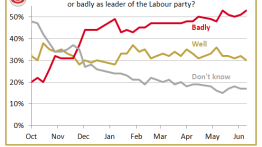
A YouGov poll for this morning's Sunday Times provides proof of mounting disgruntlement with the Labour leader. And not just among the public as a whole, but also among Labour supporters. Asked whether Ed Miliband is doing well or badly as leader, just 30 per cent say "well" (including a tiny 3 per cent who say "very well"), while 53 per cent say "badly" (including 21 percent "very badly"). The bad news for Ed is that the "well" figure has barely moved since just after he was elected, when almost half said they didn't know how well he was doing. Now an extra 31 per cent have formed an opinion of him, but without any net increase in the number thinking he's doing any good.

Labour’s blunt knives

From our UK edition

According to the Observer, and a slew of other papers, "senior Labour figures are believed to have put their leader on a timer to 'up his game' in the next few months if he is to avoid a full-blown leadership crisis later this year." Which reminded me of all this: 20 April, 2008 "The Prime Minister, who is battling a growing rebellion over his abolition of the 10p tax rate, has been given until the end of the summer to turn things round by backbenchers angry at a string of image and policy failures." (here) 24 May, 2008 "It is that Mr Brown be given until the end of July to prove himself and restore morale.

Labour is working towards a decade of Opposition

From our UK edition

Is Ed Miliband finished? That's the implication of many of the papers today — and David is portrayed as waiting in the wings, ready to claim his rightful inheritance. Dream on. Ed Miliband’s leadership of the Labour Party is hardly in crisis. If there was an election today, he’d win a Labour majority of 34. Dull men can win surprising victories, as John Major demonstrated in 1992. The Times’ notion that he has until party conference to save his leadership is just as fanciful. Labour Party Conferences are neverscenes of grassroots rebellion. The Tories are the ones who lay on fights, and some just turn up to Tory conference for the political violence. Tories can (and do) get rid of leaders to liven up a wet weekend.

The Milidrama

From our UK edition

No paper has been more critical of Ed Miliband than The Times. So it is in some ways not a surprise that the paper’s leader column today declares that he has until Labour conference to save his leadership. But this ultimatum stokes the sense of drama created by the combination of the Balls’ leaks and the publication of the speech that David Miliband would have given if he had won the leadership. Expect to hear David Cameron quoting from both these sets of documents at PMQs regularly over the next few weeks. The challenge now for Ed Miliband is to make lemonade out of these lemons.

Your three-point guide to today’s Ed Balls files

From our UK edition

Less soap opera, and more policy grit, in today's batch of Ed Balls files. There is, for instance, a lot on Gordon Brown's proposed Bill of Rights (here, here, here and here), which is as ambrosia for future political historians, but is fairly turgid reading even for today's political anoraks. Likewise the charts and doodlings related to the structure of Brown's Downing Street. Yet some things do stand out. Here are a few of them: i) What the Treasury says, Brown didn't do. You've got to admire the Treasury's attempt to inject some realism into the fiscal calculus back in 2006. "Flat real" spending — i.e. public spending that rises only in line with inflation, and not more — will be the "rule rather the exception" in the years to come, they say.

What David Miliband would have said if he had become Labour leader

From our UK edition

Tonight’s Guardian scoop revealing that the speech that David Miliband would have given if he had been elected leader makes this one of the most difficult—and leaky—weeks for Labour since its election defeat. The line in the speech that will cause the most trouble for Ed Miliband is that David Miliband intended to create a commission on the deficit chaired by Alistair Darling and charged with creating a new set of fiscal rules, an admission that Labour got it wrong on the deficit which Ed Miliband has refused to give.

From the archives: New Labour’s civil war

From our UK edition

The Telegraph's publication of all those documents today has got everyone talking about that feud again. Here is what The Spectator's former editor Matthew d'Ancona had to say about the Blair-Brown wars when things were hotting up in the autumn of 2006: The great New Labour civil war, Matthew d'Ancona, 6 September 2006 Two days before David Cameron was elected Conservative leader, I asked one of his closest allies what the founding principle of Cameronism would be. He pondered the question. Would it, I wondered, be something to do with quality of life, the public services, the environment, social justice, nationhood? ‘Our starting point,’ he finally replied, ‘is that the Tory party can never beat Tony Blair.

The welfare revolution will require much time and effort

From our UK edition

Forget Balls, today brings one of the most significant moments in the life of the coalition so far: the launch of its Work Programme. The name may be commonplace but, as Fraser suggested earlier, the policy is revolutionary. Over the next year, around one million unemployed people will be enrolled on work schemes run by private companies and charities. Those companies will then be paid between £4,000 and £13,700 for every person they return to proper, long-term work. It is, evidence suggests, an effective and cost-effective way of getting benefit claimants back into the labour market — and it reaches those claimants that the state-run JobCentres can scarcely be bothered to reach.

Volvo Distances Itself From Project Volvo

From our UK edition

Well you can't blame them, can you? Project Volvo - it just shows how out of touch senior politicians were. Leaked documents labelled Project Volvo, revealed today, that outline a plot to unseat former Prime Minister Tony Blair show just how out of touch with reality senior politicians within the previous government had become with modern Britain. The reason for the name 'Project Volvo', according to reports, relates to Mr Brown's apparent character traits of being 'dependable, robust but ultimately dour'. Clearly before labelling the plot, Labour politicians of the time hadn't acquainted themselves with the Volvo brand in the last decade with cars like the new S60 and V60 bringing a new dimension to the brand in terms of design and driver appeal.

More to come?

From our UK edition

I understand another story concerning improperly obtained documents may break shortly concerning Ed Balls, his spads, a civil servant and a journalist at the FT. Whitehall is in a febrile mood.

Balls in the limelight

From our UK edition

The most important political consequence of the leak of the Project Volvo documents is that it reminds everyone in the Labour party of what a divisive figure Ed Balls is. Ever since the leadership contest, where his reputation as a plotter crippled his candidacy, Balls has been trying to soften his image. He has sought to present himself as a more collegiate figure. But this leak is a reminder of how Balls used to operate and why some people in the Labour party will do everything they can to prevent him from becoming leader. We now wait to see what emerges about how these documents made their way into the public domain and whether retaliation follows. For the other Ed the challenge is to find a way to move Labour beyond the factionalism of the past.

Your five-point guide to the Ed Balls files

From our UK edition

Intrigue, hilarious intrigue this morning, as the Telegraph releases a bunch of documents that clarify just how far the Brownites went to oust Tony Blair. They are, it is said, from the personal files of Ed Balls, and they are copious in both quantity and variety. From straightforward poll results to 31-page reports on how Brown is a Volvo not a BMW, this is a real insight into the numerous pathologies of party and government. Here's my five-point overview: i) The leadership coup in waiting. It starts only two months after the 2005 general election, and Balls' own ascent to Parliament, with a memo setting out the structure of Brown's leadership campaign team. And it soon crescendos.

The Plot Against Tony

From our UK edition

That Gordon Brown loathed Tony Blair is hardly news. Nevertheless the details and depth of that hatred, revealed in the Daily Telegraph's scoop today*, remain hilarious. Poor Gordon. His people seem to believe - or have been told - that being compared by focus groups to a Volvo or a British Rover was a good thing. Ed Miliband's role in all this plotting and absurdity is also worth contemplating. It provides yet another opportunity for the coalition to press home the point that Little Ed's judgement ain't up to being Prime Minister. So, Mr Miliband, tell us why you plotted to remove Labour's most successful Prime Minister and replace him with the least successful Prime Minister in Labour history?

Cameron: a leader in need of ‘a people’

From our UK edition

One of the odd things about David Cameron is that he wants to be a consensual radical. Unlike Margaret Thatcher he doesn’t want to have ‘a people’, a section of the electorate that is loyal to him personally. Rather he wants to be seen as a unifying national figure. He is, to borrow a phrase from The Economist, a ‘one nation radical’ But Cameron’s persona doesn’t mean that the left aren’t going to fight him with everything they’ve got. The Archbishop of Canterbury’s assault on the coalition today in the New Statesman is a classic example of the kind of opposition he is going to face. (If you read the whole piece, it is clear that Rowan Williams identifies himself as being on the left).

The Archbishop’s Whimper

From our UK edition

When a clergyman damns a government I prefer he do so with a proper quantity of hellfire. They do it differently in the Church of England which, though lovely for evensong and all the rest of it, is not a political or particularly muscular enterprise. The Archbishop of Canterbury's much-trumpeted blast against the Cameron-Clegg regiment this morning is, really, just the usual hand-wringing stuff. Pass along quietly please, nothing new to see here. It's as threatening as being chased by a three-legged lamb. If anything, the piece is a whimpering cry for Labour to do better. (See Bagehot for more on this.

Blair is still a believer

From our UK edition

To an extent, British politics is still determined by whether or not you agree with Tony Blair. For more than a year, the coalition and the opposition have been debating whether to continue Blair’s public service reforms; this is a testament to his failure as Prime Minister as much as it to his success. Today, has given an interview to the Times (£), coinciding with the release of his memoirs in paperback. He uses it to question the Labour party’s current journey back into “nostalgia”. He says: “The attraction of a concept like Blue Labour is it allows you to say that there’s a group of voters out there we can’t reach at the moment, so what we should do is really empathise with their plight.

Cameron’s easy ride

From our UK edition

Having u-turned on two more policies in the last two days, one would have expected David Cameron to have a hard time today at PMQs. But he didn’t. Ed Miliband never got going, turning in one of his worst PMQs’ performances. Cameron pithily summed up Miliband’s performance when he joked that ‘the best thing that can be said about his performance is he wasn’t thinking about politics on his honeymoon.’ Miliband’s performance today will add to the low-level grumbling about him among some Labour MPs and members of the shadow Cabinet. Miliband has a big speech coming up on Monday and he needs it to deliver a rationale for his leadership, to give it a purpose.

Cameron stamps on Clarke

From our UK edition

Ken Clarke was summoned to Downing Street yesterday, the BBC reports. He spoke to David Cameron for half an hour, after which the controversial sentencing review was dropped: there will not be a per cent fifty discount in plea bargaining and Clarke will have to find £130m of savings from elsewhere in his department. Clarke has paid for last month’s rape victim fiasco, which so incensed the party leadership. The government is adamant that this is not a u-turn; rather, it argues, it has consulted on extending plea bargaining from the current level of 30 per cent and decided against such a move.