Labour party

Miliband: We can’t go on like this

From our UK edition

It’s odd how political leaders often address their parties in the clichéd terms of soap operas’ most tortured romances. Ed Miliband pre-trailed speech to the Labour’s National Policy Forum in Wrexham is replete with protestations of having grown apart and the need to listen and be more open with each other. “We cannot continue as we are,” he implores. But there is some substance to Miliband’s rhetoric of reconnection. He has already announced his intention to appoint his own shadow cabinet, which caused some consternation among Labour’s more reactionary elements.

Miliband tries to strengthen his hand

From our UK edition

Ed Miliband is to abolish shadow cabinet elections. Tony Blair, fearful of the reaction of the Parliamentary Labour Party (PLP), shied away from doing this. But Miliband has decided that it is a necessary move to give him the freedom to craft his own top team and to strike against the old, factional Labour culture. Miliband has asked Tony Lloyd, chair of the PLP, to hold a secret ballot of Labour MPs on the change before parliament goes down for the summer. If they approve, it will then be passed to the NEC with the process ending with a vote at conference. Under Miliband’s proposed new arrangements, the PLP will be represented in shadow cabinet by its elected chair.

Poll round-up | 23 June 2011

From our UK edition

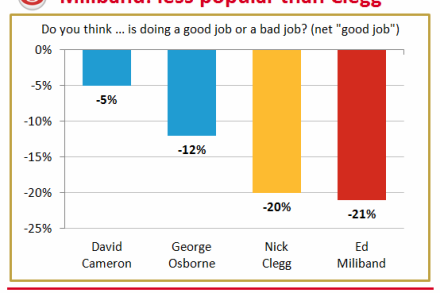
We haven't dwelt on the polls very much on Coffee House recently, although we have flagged up some nuggets on Twitter. Here are some of the measures of public opinion that provide an interesting backdrop to Westminster's machinations: Labour in trouble despite poll leads Two weeks ago I reported on a poll that showed the extent of Ed Miliband's unpopularity. There have since been a few more polls to compound his unease. ICM found that he had worse approval ratings even than Nick Clegg: YouGov find that 58 per cent of the public think he's doing a bad job, but perhaps more worrying for "Red Ed" is that he even has negative ratings among the very people who won him the leadership election: trade union members.

How the Tories intend to keep Westminster talking Balls

From our UK edition

When Ed Balls is around, there are no shortages of stories. Balls, as is so often the case, has been the talk of Westminster today. First, there was the chatter generated by the FT’s story that members of the shadow Cabinet were irritated that Balls’ proposed VAT cut hadn’t been run past them. Then, there was Alistair Darling strikingly failing to endorse Balls’ VAT cut on the Daily Politics and to round it all off the shadow Chancellor was leading for Labour in its opposition day debate on the economy. The Tories are convinced that Balls’ relations with his fellow shadow Cabinet members is a weak spot for Labour. Indeed, many of the 13 interventions that Tory MPs made on Balls today were on this point.

America and Britain turn their minds to the (fiscal) cost of war

From our UK edition

Five-thousand, ten-thousand, or fifteen-thousand? That's the question hanging in the air as Barack Obama prepares to clarify his withdrawal plan for Afghanistan this evening (or 0100 BST, if you're minded to stay up). And it relates to how many of the 30,000 "surge" troops he will decide to release from the country this year. Washington's money appears to be on 10,000, with half of them leaving this summer and half in December. But no-one outside of the President's clique really yet knows. His final decision will say a fair amount about his intentions in Afghanistan, or at least about just how fast he wants to scram out of there. What's really striking, though, is the emphasis being placed on the bill for Afghanistan.

The myth of cuts

From our UK edition

Last week, Ed Balls warned against the effect of George Osborne’s vicious, front-loaded cuts. Today, we have an update in the form of monthly state spending figures. In cash terms, a new record has been set in state largesse. The UK government’s current spending was £51.7 billion in May, up from £50.6 billion in May last year (the last month of Gordon Brown). George Osborne has so far outspent Gordon Brown every month that he’s been in the Treasury. Even adjusted for the runaway inflation, the Chancellor has on average outspent Brown during his first 12 months:     To fund this extra spending, the Chancellor borrowed £27.4 billion from the public for April and May. Labour chirp today that this is more than the £25.

Gove reaffirms his faith in free schools

From our UK edition

Invigorating, that's probably the best word for Policy Exchange's event on free schools this morning. Right from Sir Michael Wilshaw's opening address — which set out the reasons why he, as headteacher of Mossbourne Academy, is optimistic about education reform — to Michael Gove's longer, more involved speech, this was all about celebrating and promoting the new freedoms that teachers are enjoying. There were some specifics about the schools that are opening, and the numbers of them, but very little of it was new. For the first time in a week, Gove wasn't announcing policy, but instead referring back to it. Which isn't to say that this was an ornamental occasion — far from it. Sir Michael's "four reasons for optimism" were, by themselves, pretty noteworthy.

Labour’s striking attack

From our UK edition

Quite some claim from Ed Balls, writing in the Sunday Mirror today. "Let's be clear what George Osborne's game is," he blusters, "he's trying to pick a fight about pensions, provoke strikes and persuade the public to blame the stalling economy on the unions." And it is a charge that Andy Burnham repeated on Dermot Murnaghan's Sky show earlier. I was on live-tweeting duty, and lost count of how many times the shadow education secretary used phrases such as "provocation," "confrontation," "playing politics," and "back to the 1980s." This, clearly, is an attack that Labour are determined to push as relentlessly as possible. George Osborne is politicking, they are saying, at the nation's expense. It is, at the very least, an intriguing gambit on Labour's part.

From the archives: Ed Miliband, before the leadership

From our UK edition

It has been a turbulent, ol' week for Ed Miliband — all the way from those Ed Balls files, through his most substantial speech so far, to that bruising Twitter appearance. By way of putting a full-stop to it all, here's an interview that our deputy editor, Mary Wakefield, conducted with him in 2007. This is MiliMinor, aged 37, and relatively carefree:  The charm of Ed Miliband, Mary Wakefield, The Spectator, 2 June 2007 Sitting opposite Ed Miliband MP in a large and airy office, the sort of office that befits the Minister for the Third Sector, I suddenly have the surreal impression that I’m at the doctor’s. It’s the medicinal green of the carpet but, more than that, it’s Ed’s demeanour.

Balls’ bloodlust gets the better of him

From our UK edition

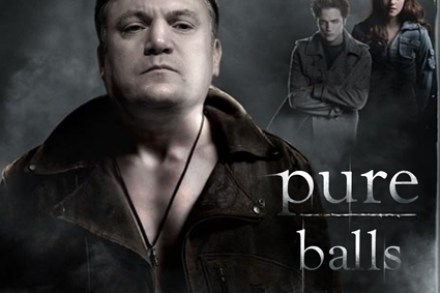
Ed Balls’ problem is his killer instinct. If he were a Twilight vampire, he’d be a Tracker: someone whose uncontrollable bloodlust takes him to places he should avoid. His position on the deficit is so extreme — more debt, more spending — that he’s pretty much isolated now. People are mocking him. John Lipsky, the acting IMF chief came two weeks ago and rubbished Balls’ alternative (as Tony Blair did) — so Balls, ever the fighter, has today given a long speech where he sinks his fangs into Lipsky and says (in effect) "I’ll take on the lot of you!" But Balls is brilliant. Often George Osborne seems not to bother arguing, and instead seeking approval from an alphabet soup of external agencies ("I must be right, the ABCD says so!

Ed Miliband volunteers for a kicking, gets kicked

From our UK edition

"First he denies his own policy, then he tries insults." So said Ed Miliband of David Cameron's performance in PMQs today. But I wonder what he'd say of the hundreds of Twitter users who went straight for the insults in a special Q&A with the Labour leader earlier. Urged on by Guido, plenty deployed the #AskEdM hash-tag to be rather unkind to MiliMinor. Here's a selection of some of the crueller, funnier and less comradely tweets: @MTPT: If a train leaves Paddington at 1136, carrying 200 commuters, what time will the RMT bring it to a standstill? @FelicityParkes: Where did Ed Balls touch you? Show us on the doll. @MShapland: hows your brother @Charlesm186: how many knives did you put in Tony Blair's back? @alexmassie: Was Brutus an honourable man? Discuss.

Miliband relieves the pressure

From our UK edition

After last week’s performance and this weekend’s headlines, Ed Miliband needed a win at PMQs — and he got one. Knowing that David Cameron would attack him over the fact Labour will vote against the welfare reform bill this week, Miliband had a string of questions for the Prime Minister on the detail of the bill and whether people recovering from cancer would lose the contributory element of their benefits. The issue was both wonky and emotive. The fact the questions were about cancer meant that Cameron couldn’t deliver his usual string of put downs to Miliband. Indeed, when one Tory backbencher heckled him, the Labour leader shot back that ‘it’s a disgrace that Conservative members are shouting as we talk about cancer.

Miliband and the past

From our UK edition

Labour's simmering resentments and self-doubts have been boiling over recently — and today is no different. Compare and contrast The Sun's interview with Tony Blair with Andrew Grice's article on Ed Balls in the Independent. For Blair, Labour ought to be claiming more credit for their preparatory role in some of the coalition's reforms, such as the Academies programme. For Balls, they ought instead to be dodging blame for the state of the public finances. As Grice reports, "Ed Balls has rejected demands from allies of Ed Miliband that he admit Labour spent too much when they were in power." From the rest of the piece, the shadow chancellor's position sounds rather like that of John Wayne's Captain Nathan Brittles: "Never apologise.

PMQs live blog | 15 June 2011

From our UK edition

VERDICT: The specifics of today's exchange between David Cameron and Ed Miliband may have everyone rushing for this Macmillan press release, but the rhetorical positions were clear enough. There was the Labour leader, angrier and more indignant than usual, painting the government's welfare reforms as cruel and insufficiently thought-through. And there was the PM, painting his opponent as yet another roadblock to reform. Neither really triumphed, although their battle will most likely set a template for in future. The coalition has extensive public backing for its changes to the welfare system. So, Miliband's challenge is to attack certain aspects of them, without making Labour appear to be — as he put it on Monday — "the party of those ripping off our society".

More than a soap opera

From our UK edition

David Miliband is considering a return to frontline British politics. At least that is what Andrew Grice has heard. He reports: ‘David Miliband is considering a surprise comeback to frontline politics in an attempt to end speculation about a continuing rift with his brother Ed. Friends of the former Foreign Secretary said yesterday that his joining the Shadow Cabinet was a "live issue" in his circle of political allies. "There is a debate going on. Some people are arguing that it would be better to be a team player than look as though he is sulking on the sidelines," said one source.’ Better for whom, I wonder?

Those three little letters

From our UK edition

The NHS saga is over at last, or so the government hopes. The coalition is expected to adopt the recommendations of the NHS Future Forum, which have been delineated by panel member Stephen Bubb in this morning’s Times (£). Last night, the prime minister and his deputy addressed their respective parliamentary brigades and each claimed the credit for re-shaping Andrew Lansley’s bill for partisan gain. The political saga continues. The Lib Dems have been crowing over their victory; the Tories are licking their wounds –a voluble Conservative MP has told Philip Johnston that a ‘once in a generation opportunity to reform the NHS has been lost.

Miliband borrows from the Cameroons for his most substantial speech so far

From our UK edition

Thematically speaking, there wasn't too much in Ed Miliband's speech that we haven't heard before. The middle is still squeezed, the Tories are still undermining the "Promise of Britain", the bankers are still taking us for fools, and communities still need to be rebuilt. Even his remarks about benefit dependency bear comparion to those he made in February. But there was a difference here, and that was his punchiness. The Labour leader may not be the most freewheelin' orator in town, but the text he delivered was less wonky than usual, more coherent and spikier. It was even — in parts — memorable. You do wonder whether Miliband has learnt from the Cameroons. Much will be made of how his speech relied on the Blue Labour stylings of Maurice Glasman.

Balls bites back (with mixed success)

From our UK edition

You certainly can't fault Ed Balls for chutzpah. After the weekend he has just experienced, the shadow chancellor has an article in today's Mirror accusing George Osborne of "spinning out of control". It is pure, triple-distilled Balls: a fiery attack on both his political opponents and their policies. So let's sup deep and read the whole thing, alongside my comments: THIS is the most exciting Formula 1 season for decades. Because it is not just about who has got the fastest car – it’s about race strategy, overtaking and adapting to the changing conditions. You can be the fastest driver on the track for 40 laps – but that’s no use if, by ignoring advice, you spin-off in the rain or run out of fuel.

Osborne’s valuable weapon

From our UK edition

Paul Waugh is tweeting that Number 10 is stressing that, pace this morning’s front pages and Lord Freud’s comments yesterday, the benefit cap remains. This is not surprising: the benefit cap was always a statement of values more than anything else. As George Osborne said at Tory conference, it was designed to ensure that, “No family on out of work benefits will get more than the average family gets by going out to work.” The cap was designed to say something both about the Tories’ values and those of its opponents. If Labour opposed it, they would put themselves on the wrong side of the whole welfare/fairness debate. It is a classic wedge issue.