Labour party

The coalition: two years in

From our UK edition

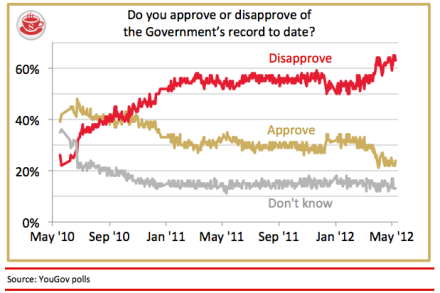
As the coalition celebrates its second birthday, it seems as good a time as any to take a look at how it’s doing in the eyes of the public. First, here’s how the government’s approval rating — as measured by YouGov — has changed since its formation: As you can see, the coalition took office with reasonably good ratings, but the first ten months or so — which included the Comprehensive Spending Review and the tuition fees vote — saw public opinion turn against it. For the rest of 2011, the ratings stayed fairly flat, with the government neither regaining ground with the public nor losing any more — and there was even a slight bump in popularity in early December, following David Cameron’s EU ‘veto’.

Jokes and jibes follow the ‘gracious speech’

From our UK edition

The Queen’s Speech debate is a unique mix of parliamentary variety show and proper politics. The debate was opened by Nadhim Zahawi — who combined humour with some serious points to good effect — and Malcolm Bruce, who gave a rather worthy speech. Ed Miliband then kicked off the more political part of proceedings. Miliband, who no longer has a kick-me sign attached to him when he gets up to the despatch box, is clearly still exulting in the local election results. He scored the best hit of the debate when he complimented Zahawi on his speech. Noting that the Tory MP was the co-founder of YouGov, Miliband joked ‘I’ve spent the last 18 months thinking he has a lot to answer for.

Have the Milibands got Hollande fever?

From our UK edition

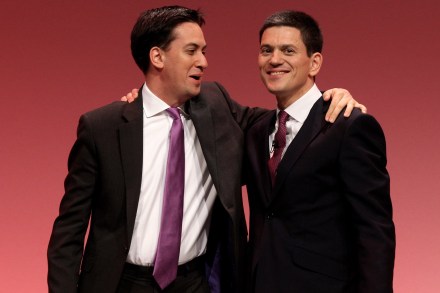
We’ve grown so used to regarding Ed and David Miliband as mutual nemeses that it’s strange to see them operating as a tag team today. The younger brother has delivered a fiery attack on the ‘unfairness and economic failure’ of the coalition, while the elder brother has an article in the Mirror arguing that the government is ‘Wrong about how to grow the economy in the modern world’. There’s also another article by the latter in the Times (£), just in case you haven’t had your fill of MiliCommentary. Much of what they say is unsurprising, but some things do stand out from their twin attacks nonetheless. The first is their insistence that the coalition isn’t just incompetent, but also ‘wrong’.

Politicians are avoiding the real problems with social care

From our UK edition

‘The smell would be even worse’, says Zoe, the social worker I’m shadowing for the week, ‘were it not for the clothes.’ Trying not to touch or breathe, I survey the mounds of sweaters and jeans and dresses interspersed across the bare floorboards. The place is a disaster — junk everywhere, filling the shelves, piling up the surfaces; the sound of broken taps from the kitchen; the living room a living ruin. I’m on a housing estate in one of the Home Counties and we’ve been called out to see about putting in place a ‘preventative measure’ for Mrs R, a 90 year-old woman at risk of falls.

Balls wants you to trust him

From our UK edition

It's only ten days or so since Ed Balls was last quizzed by Andrew Neil, but there he was rehashing many of the same lines on the Sunday Politics today. Among the things that stood out was this: the shadow chancellor’s argument on the public finances is ever more cleaving into two halves. First, he accuses George Osborne of borrowing £150 billion more over this Parliament than originally planned. (Although there’s a detail that often, conveniently, gets obscured: namely, that borrowing is still going down year-on-year under Osborne's plan). Second, that Balls's plan would decrease borrowing in the medium-term even though it would increase spending and reduce tax revenues in the short-term.

Whatever they say, Lords reform will remain on politcians’ minds

From our UK edition

Have our politicos looked at last week’s turnout numbers, and thought ‘y’know, we might be a bit cut-off after all’? Reason I ask is because they’re all tripping over themselves today to downplay the significance of Lords reform, and focus the conversation on The Issues That Actually Matter. This, as James said earlier, is what George Osborne has been up to throughout the day. Ed Balls did likewise during an appearance on the Sunday Politics with Andrew Neil. And, most significantly, even Vince Cable echoed their sentiments in his interview on Sky’s Murnaghan Show.

How the parties fared

From our UK edition

As the dust settles on these elections, it is becoming clearer how the parties did. Labour exceeded expectations, the Tories had a bad but not disastrous set of results and the Liberal Democrats took another kicking. Indeed, they actually lost a higher proportion of the seats that they were defending this year than they did last year: 44 per cent compared to 41 per cent in 2011. Given these results is it is quite remarkable how solidly behind Nick Clegg the Lib Dem parliamentary party remains. Not a single MP has called for him to go or for the party to quit coalition. I’m sure this is partly because the Lib Dems are doing better in the parliamentary seats that they hold than they are nationally. But their calm under fire is still noteworthy.

Where we stand this morning

From our UK edition

The results so far have been good but not spectacular for Labour. The BBC’s national vote share projection has them on 39 percent, the Tories on 31, and the Lib Dems on 16. These numbers would deliver a comfortable Labour majority on both the old and new boundaries. Strikingly, UKIP is averaging 14 percent in the wards it is standing in. This is an impressive result given that UKIP traditionally doesn’t do that well in local elections where Europe is less of an issue.

The early signs from the local elections

From our UK edition

Tonight, there seems to be a general acceptance that Boris has won London. The talk is of a four points plus victory. But it is worth, of course, remembering that no votes have been counted and there’s been no exit poll. But, sadly, it appears that there will be few other mayoralties created this evening. The opposition of the local political establishment appears to have triumphed in nearly all the cities holding referendums on whether or not to have a mayor. Their loss is Liverpool’s gain which will benefit considerably if it is the largest city outside London with a mayor.

15 (other) cities to watch

From our UK edition

Forget London. Odds are that Boris will win re-election while Labour becomes the largest party on the GLA. There are far more exciting battles going on around the country. Here’s the state of play in 15 cities outside the M25: 1. Birmingham. After strong gains in 2011, Labour are looking to depose the Conservative-Lib Dem coalition and regain the overall majority they held here until 2003. They need just five gains to do so — and, with 18 Tory seats and 13 Lib Dem ones up, that shouldn’t prove too difficult. Both of the coalition parties are simply in damage limitation mode. 2. Glasgow. Labour held a majority here for three decades, but lost it just a few weeks ago through resignations.

Boris wins the popularity contest

From our UK edition

So, after all that, it looks like today’s London Mayoral will be just a little bit of history repeating. YouGov’s final poll predicts that Boris will defeat Ken in the second round by 53 to 47 — exactly the same result we saw four years ago. The third place finisher will probably be the same too: the poll has Brian Paddick getting 7 per cent in the first round, ahead of Siobhan Benita and UKIP’s Lawrence Webb on 4 and Green Jenny Jones on 3. If Boris does overcome Labour’s partisan advantage in London, it won’t be mainly down to his achievements in office. In fact, voters are split 39-38 between Ken and Boris on who’s achieved more as Mayor (although Ken did, of course, have four more years than Boris has so far).

What would count as a success for Labour?

From our UK edition

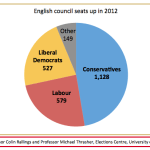
In today’s English council elections, there’s no doubt that Labour will do better than in 2008 — the last time most of these seats were contested. Experts Colin Rallings and Michael Thrasher predict that they’ll improve their ‘national equivalent vote share’ by 13 points compared to four years ago. But how many seats can they pick up of the back of that improvement? Rallings and Thrasher say a figure of 700 would justify a five-point lead in the polls. LSE’s Tony Travers expects Labour’s gains to be around 700-800, and says that: ‘If Labour only manage to put on a further 500 seats, that would be seen as seriously underperforming expectations. Ed Miliband will need 900 gains for a good night.

Why Labour supporters should shun Ken

From our UK edition

The single funniest thing about the London mayoral election has been watching the Left trying to excuse tax avoidance. After I revealed that his idol, Ken Livingstone, had saved a fortune by channelling six-figure earnings through a personal company, the Guardian’s Dave Hill pleaded that Ken’s previous condemnations of tax-dodgers ‘had been aimed at extremely rich people — which he isn't,’ so that’s all right, then. The Independent’s Owen Jones frothed that ‘the 1 per cent have an interest in demonising Ken Livingstone.’ But, Owen, Ken is the 1 per cent!

The Lib Dems jostle for airtime

From our UK edition

Yep, they’re inescapable, those Lib Dems. Even when the airwaves are dominated by Rupert Murdoch and Tom Watson, they’re there in the background, quietly adding to the day’s pile of political news. We’ve got Ken Livingstone making a pitch for their votes in the London Mayor’s contest, for instance. And we’ve also got Nick Clegg on what seems like every radio show on air, giving his account of why folk should be Lib Dem voters in the first place. There have been two more significant scraps of LibDemmery than those, though.

Tricolour Britain

From our UK edition

With unionists getting grubbed in Scotland and Labour being driven to near-extinction in vast swathes of the south, a new map of political Britain is emerging. In my latest Telegraph column, I called it ‘Tricolour Britain’ — the SNP at the top, Tories at the bottom and Labour stuck in the middle (with Wales). Policy Exchange has today released research which throws more light on this slow-mo political segregation. I thought CoffeeHousers may be interested in what strike me as the top points.   1. Scottish Tory Syndrome is when a once-dominant party loses and doesn’t recover. The party has failed to capture the imagination of voters, so when its apparatus is knocked down there’s no political force to bring it back.

Cameron goes on the attack to defend Hunt

From our UK edition

I don’t think I’ve ever seen David Cameron as angry as he was for that urgent question on Jeremy Hunt. He had clearly decided that attack was the best form of defence and went for his Labour critics in the most aggressive manner possible. But he did make one important concession in his opening answer when he said that if there is evidence of wrongdoing by the Culture Secretary, ‘I will not wait until the end of the Leveson inquiry to act’. In other words, Hunt’s appearance before Leveson will decide his fate. The dynamic in the Cameron-Miliband exchanges was genuinely personal. Cameron told the House that ‘we’ve learned something about the Labour leader today and it is something he’ll regret’.

The two Eds go electioneering

From our UK edition

The leadership duo of Ed and Ed made an appearance this morning to rev up support for Labour ahead of this week’s elections. Today was all about appealing to those who have felt hard done by the government and want something different, whatever it may be. Miliband concentrated on setting out five ‘priorities’ for next week's Queen's Speech — the sorts of policies that, he claims, Labour would be enacting in government, and which we've heard from him before. Balls meanwhile was in full attack mode, deploying the usual buzz words and phrases, such as ‘alternative’, ‘fair’ and ‘Robin Hood tax’ to back up Miliband.

An anti-Labour leaflet in a pro-Labour font

From our UK edition

The leaflet pictured above landed on my doorstep in Peckham last week. It's the most interesting piece of election literature I've received this year — not because of its words, but because of its graphic design. If you read it closely, it appears to be an official communication from the Tories. The legally mandated imprint declares it to be ‘Promoted by Ian Sanderson on behalf of the Conservative Party, both of 30 Millbank, London SW1P 4DP’ — and that would accord with its strongly anti-Ken Livingstone text. If you don't examine it closely, however, it appears to be an official communication from Labour. The highlighted details are red, and all the text is set in the Labour party's favourite font, Neo Sans.