Labour party

Tristram Hunt: Education Secretaries can send their kids private

From our UK edition

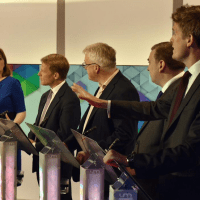
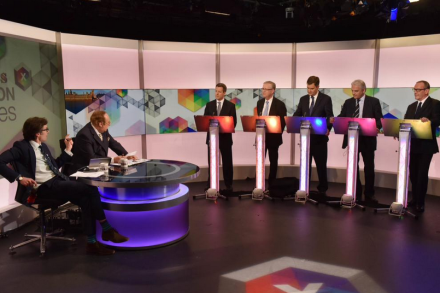
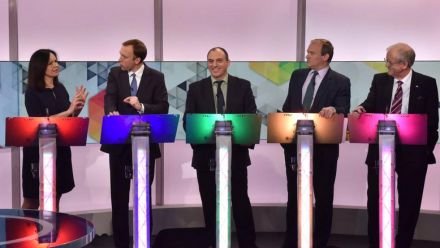
In the Daily Politics education debate just now on the BBC, Tristram Hunt declared that it was acceptable for an Education Secretary to send their own child to private school. Under questioning from Andrew Neil, Hunt said that it was fine in ‘certain circumstances.’ The other members of the panel—including Nicky Morgan and David Laws—then agreed with Hunt’s statement. Is it acceptable for an education secretary to send their child to a private school @afneil asks his #bbcdp panel? https://t.co/A5VI9mnHlz — DailySunday Politics (@daily_politics) April 23, 2015 Hunt’s remarks are politically brave.

Four things you need to know about the IFS’ manifesto analysis

From our UK edition

Nobody's perfect, are they? The IFS found something to criticise today for all the parties — the Conservatives, Labour, Lib Dems and SNP — whose tax and spending plans it has examined. The main charges are of leaving questions about spending and borrowing unanswered: The Conservatives ‘have not been completely explicit about exactly what level of borrowing they would want to achieve’ and nor have the SNP, Labour has ‘provided disappointingly little information on what they would borrow’.

Russell Brand’s The Emperor’s New Clothes reviewed: ‘uncomfortable viewing’

From our UK edition

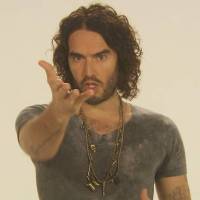
For the past year Russell Brand - who is worth an estimated £10 million - has been making a film about inequality. You may already know this. The comedian’s antics filming across the capital have regularly made the news. His attempt to storm RBS resulted in a temp angrily blogging that the palaver had caused his paella to go cold. Meanwhile, his visit to confront the Daily Mail proprietor Lord Rothermere about his non-dom tax status came to no avail as he wasn’t home. Not that such a small technicality has stopped the scene from being included in the final cut. Russell instead interrogates a woman over the telecom - a woman who I can only presume was Lord Rothermere’s housekeeper.

Cheap shots and uncosted bribes are drowning out vision, wisdom and optimism

From our UK edition

The interesting thing about Labour’s pledge to abolish non-dom tax status — a squib designed to trap Tories into expressing sympathy for the rich, in the knowledge on the part of Ed Miliband and Ed Balls that it might cause loss of tax revenues and inward investment — is that it has been welcomed by influential voices in the City. The Eds must be astonished to find Sir Roger Carr, chairman of BAE Systems and former deputy chairman of the Bank of England, bang on message: he told the FT that non-dom rules are ‘a relic of the past that unfairly favours the few at the expense of the many’.

Chris Leslie makes ‘no apology’ for Labour’s focus on the current budget deficit

From our UK edition

Senior Labour figures have looked uncomfortable during this campaign when speaking of their own party’s policy on balancing the books – the day-to-day spending books, that is. But this afternoon Chris Leslie gave an endorsement of the pledge that is as clear and enthusiastic as voters are likely to get. Challenged by Andrew Neil on today’s Daily Politics debate on the economy, the Shadow Chief Secretary to the Treasury said he made ‘no apologies’ for his party’s focus on clearing the current budget deficit, rather than the overall deficit. Leslie said: ‘The distinction is this…having a balance on the current budget is not the limit of our ambitions.

Was food poverty actually higher under the last Labour government?

From our UK edition

I’m looking forward to tonight’s Spectator debate in which Fraser Nelson, William Cash and I will be taking on Owen Jones, Jack Monroe and Molly Scott Cato MEP over the issue of whether the rich should pay more in tax. One thing I’m sure Owen and his colleagues will do is point to figures released today from Trussell Trust food banks that seem to show that over a million people are now using their facilities. In fact, this figure is misleading, as Full Fact has pointed out: 'The claim that over a million people are using Trussell Trust food banks is inaccurate. It comes from confusing the number of different people using Trussell Trust food banks in a year with the number of times they use the food banks.

Campaign kick-off: 15 days to go

From our UK edition

The general election campaign is beginning to feel a little staid. Maybe there was too much excitement over the attacks and TV debates, or maybe the parties are running out of big policies. But there are still some announcements: Labour will continue its ‘NHS week’ with promises of more health care spending while the Tories will talk up their caring side. To help guide you through the melée of stories and spin, here is a summary of today’s main election stories. 1. Vote Labour, save the Union The Tories’ attacks on the dangers of voting Labour and getting the SNP have hit a road bump. Two senior former cabinet minsters have suggested that Conservative voters in Scotland should back Labour in the upcoming election, to keep out the nationalists.

The Tories are gaining momentum with their ‘Labour-SNP pact’ message

From our UK edition

Complain all you like about the way the Tories are campaigning at the moment, but it's getting the message across. The party has hit on the SNP, which is fascinating the media anyway, as the best line of attack to undermine Labour. Tory candidates report being pleasantly surprised by how much cut-through the Labour-SNP message is getting, while pollsters now say members of their focus groups are raising the issue unprompted. Focusing on the SNP may well have a number of serious side effects for the Tory party. It may reinforce the perception that they are a nasty, negative party. It may mean they do not give voters sufficient reason to back them, even if they succeed in putting them off Labour.

Cautious Miliband doesn’t want to talk about borrowing

From our UK edition

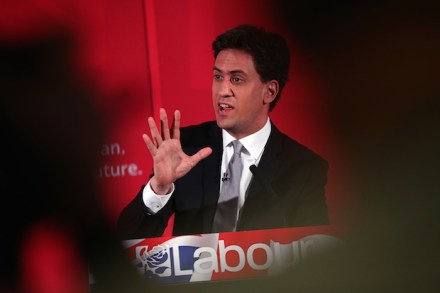
Labour is proposing to balance the current not the overall budget. This is presumably because they think that borrowing to spend money on capital projects is a sensible policy. But you wouldn’t have known that from watching Ed Miliband on BBC1 just now. In response to questions from Evan Davis, Miliband was determined not to say that Labour would borrow to invest. In a highly disciplined performance, Miliband would also not engage with Davis’ questions about inequality and whether it was a good thing if everyone got richer even if the gap between rich and poor widened. Indeed, Miliband was so cautious that you began to wonder if he’s started to think that this is now his election to lose.

Tories in the lead according to ICM and Lord Ashcroft

From our UK edition

The Conservatives are ahead once again in the latest Guardian/ICM poll. They are two points ahead on 34 per cent - but that’s a five point drop since their surprising 39 per cent last week. Labour has dropped one point to 31 per cent. Two of the smaller parties have seen their vote increase, with Ukip on 11 per cent, up four points on last week, and the Liberal Democrats on 10 per cent, up two points. Last week’s ICM poll was clearly an outlier — few believed that the Tories had jumped into majority territory — but Conservatives will still be pleased that this poll has them ahead. But be aware that this lead is within the margin of error.

Campaign kick-off: 17 days to go

From our UK edition

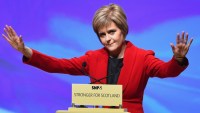
The campaign’s focus will swing back to Scotland today, with Nicola Sturgeon launching the SNP’s manifesto in Edinburgh. Ed Miliband is also heading north, to address the Scottish TUC and kick off Labour’s latest efforts to attack the Conservatives on the NHS. To help guide you through the melée of stories and spin, here is a summary of today’s main election stories. 1. Last chance to vote More important than any of the news stories, today marks the deadline for registering to vote on May 7. As the splash of today’s Daily Mirror puts it, ‘you can make a difference’.

Labour’s gamble for SNP support

From our UK edition

The SNP launches its manifesto today in Edinburgh. Nicola Sturgeon will be arguing that the policies in the document are for the benefit of the whole of the United Kingdom, which is a way of reassuring former no-voters who might back the SNP, and also of appealing to the left wing faction of the Labour party. Scottish Labour will be claiming that many of those policies such as voting for lower tuition fees in England are in fact a theft from their own party's ideas, and that the SNP is in fact using Labour as a think tank for its own manifesto. But what is also interesting is how the party that is scrutinising Sturgeon’s claims today could end up working with her parliamentary colleagues from May.

John Major to enter the electoral fray this week

From our UK edition

David Cameron’s inner circle are always keen to talk up the parallels between this campaign and 1992. This week, the winner of that election will enter the fray on their behalf. As I report in the Mail on Sunday, John Major will give a speech warning of the dangers to the Union itself if the United Kingdom ends up with a Labour government propped up by the SNP. The Tories hope that Major’s intervention will elevate this point above the usual party political knockabout. They also believe that a former Prime Minister speaking out will make voters pay attention; they were much struck by how much coverage Tony Blair’s speech on the dangers of an EU referendum received a few weeks back. That the Tories have asked Major to get involved is telling.

Nigel Farage: David Cameron’s ‘fanaticism’ is to blame for Libya migrant crisis

From our UK edition

Nigel Farage tends to stick to one line on foreign affairs: no more foreign wars. On the Sunday Politics today, the Ukip leader claimed that the migrant crisis and tragedies in the Mediterranean are the fault of countries such as Britain and France who bombed Libya in 2011: ‘Actually, it was the European response that caused this problem in the first place — the fanaticism of Sarkozy and Cameron to bomb Libya and what they’ve done is to completely destabilize Libya; to turn it into a country with much savagery; to turn it into a place where for Christians the situation is now virtually impossible and we ought to be honest and say have we directly caused this problem.

Angela Eagle: Labour would speak to other parties to get a Queen’s Speech through

From our UK edition

On the Sunday Politics just now, Angela Eagle shifted Labour’s position on what it would do in the event of a hung parliament. Previously, Labour has insisted that if it was a minority government it would simply propose a Queen’s Speech and dare the other parties, and in particular the SNP to vote it down. listen to ‘Angela Eagle: we'd speak to any party to get a Queen's speech through’ on audioBoom But Eagle told Andrew Neil that in the event of a hung parliament Labour 'would speak to any party that has got representation in the House of Commons in order to try to build a majority for a Queen's Speech that the country desperately needs'. What makes Eagle’s comments so significant is that she is the shadow Leader of the House of Commons.

Feisty Cameron warns English voters of the ‘frightening prospect’ of the SNP propping up a Labour government

From our UK edition

David Cameron has just delivered his feistiest performance of the election campaign yet. In a combative interview with Andrew Marr, the Tory leader repeatedly described the prospect of a Labour government propped up by the SNP as ‘frightening’, telling English voters that the SNP wouldn’t ‘care’ about them and their needs. He implicitly warned that SNP MPs supporting a Labour government would result in less money for English constituencies. He had been given this opening by Nicola Sturgeon, who in her interview had made clear how the SNP would use the fixed term parliament act to give them maximum influence on a Labour government.

The coming battle for legitimacy

From our UK edition

Jonathan Freedland has written a compelling column on the challenge that Ed Miliband will face to establish his legitimacy if he becomes Prime Minister despite Labour not having won the most seats or votes. But I suspect that whoever becomes the government after May the 8th will have difficulty in persuading everyone that they have a right to govern. The Tory-Liberal Democrat coalition could claim that 59 per cent of voters had backed its constituent parts. It also had a comfortable majority in the House of Commons with 364 out of 650 seats. Now, unless something dramatic happens, no governing combination is likely to have anything like that kind of support this time round.

‘Naughty’ Nicola Sturgeon reveals the saucy portrait that hangs in her home

From our UK edition

Nicola Sturgeon's style transformation over the past decade has been well-documented. The Mail on Sunday journalist Liz Jones went so far as to suggest that she had gone from being a woman with a 'Krankies haircut and orthopaedic shoes' to a 'golden halo of Princess Diana-like loveliness'. However, Mr S suspects that such naysayers may think differently about Sturgeon in her formative years if they take a glance at a portrait of her dating back six years. Speaking to Sky's Kay Burley, the First Minister of Scotland revealed that she has a saucy painting of herself hanging in her home. The oil painting of Sturgeon is by the French artist Laetitia Guilbaud, and went up for sale in 2009 at Glasgow's ArtDeCaf Gallery.