Julian assange

Bradley Manning awaits sentence. Would the real Julian Assange please stand up?

From our UK edition

Bradley Manning’s relationship with Wikileaks has, inevitably, brought Julian Assange back into the papers. Viewed on the frontpage, Assange is egimatic. We know what he’s done; but we know little of him. Alex Gibney’s compelling new documentary film We Steal Secrets: The Story of Wikileaks presents an extensive and revealing biography of Assange — and much more besides. Gibney’s camera is impartial. We hear from Assange cultists, former collaborators and alleged rape victims. No two people will react in the same way to what they see. A white-haired Icarus formed before my eyes; a charismatic brought down by his own narcissism and hubris.

Could Malcolm Tucker take on Alan Rusbridger?

From our UK edition

Sad news has broken. If the online speculation is true, it appears that casting agents for the upcoming Guardian movie have overlooked Daniel Radcliffe for the part of Alan Rusbridger. Given that Harry Potter and AR are dopplegangers, Mr Steerpike reckons that the agents have missed a trick. For those who haven’t heard, the film will chart the paper's stormy relationship with Wikileaks. Benedict Cumberbatch is already getting to grips with the role of Julian Assange; the question now is, who will play Rusbridger? Incongruous rumours are circulating that the softly spoken editor will be portrayed by Scottish actor Peter Capaldi, aka Malcolm Tucker.

The metro left turns on Julian ‘L. Ron Hubbard’ Assange

From our UK edition

Ah, at last the scales have fallen from Jemima Khan’s lovely fluttery little doe eyes. Having forked out £20,000 towards Julian Assange’s bail, the pouting metro-lefty socialite has come to the conclusion that the bloke is a bit of a rum chap, all things considered. She has even compared him to the barking charlatan who founded Scientology, L. Ron Hubbard and described Assange as demanding from his followers ‘blinkered, cultish, devotion.’ Well, sure – we tried to tell you that at the time, poppet. But you’re still not getting your money back. I wonder if the Ecuadoreans are sick of Assange yet, sitting in the basement of their embassy, referring to himself in the third person and tapping away at his laptop with a messianic look in his eyes?

Down-turn Abbey, the movie

From our UK edition

A brief flurry of excitement in Guardian-land over the festive period as the news trickles out about who might be cast in Dreamworks' silver-screen adaptation of the paper's turbulent love-in with Julian Assange and subsequent fall out with the Wikileaks chief. Benedict Cumberbatch will play the reclusive protagonist, but enter stage (liberal) left Dan Stevens, who was last seen with blood pouring out of his ear on Christmas Day after being clumsily written out of Downton Abbey. Last week’s Mail on Sunday reports that he is now in talks to play Guardian deputy editor Ian Katz. Being played by such a high profile star would surely do wonders for Katz's on-going quest for the top job at the paper.

Steerpike returns in this week’s Spectator

From our UK edition

Mr Steerpike is delighted to appear in print this week, with several pieces of juicy  gossip. First off, Team Miliband are serenading Westminster’s favourite left-wing Tory, ResPublica director Phillip Blond: ‘A new rumour suggests that Miliband’s wingman, Lord Wood, has been despatched to persuade the Conservative oddball to disappear into the changing room and re-emerge as a Blue Socialist. ‘Good God no,’ Blond says when I ask if he’s tempted to join the Two Eds’ I also reveal that outgoing Tory MP Louise Mensch attempted to pursue some future employment opportunities before running away to her family in New York: ‘Shortly before the ex-MP dashed off to Manhattan to spend less time with her party, she asked No.

Why did Pete Townshend play the finale to the Olympics?

From our UK edition

I returned from holiday to discover that the silly season has turned into something much more serious. The daily list of horrors from Syria, the Eurozone crisis and the terrifying state of the UK economy: they had all been there when I left (for Greece by the way, where people are genuinely scared about the future — stockpiling food and preparing for civil conflict in some cases). But the Olympic fiesta atmosphere seems to have been replaced by something darker following George Galloway's moronic comments about the Assange case. There are plenty of men of the Left whose sexual politics don't bear much scrutiny, but Galloway really is the prize poseur of radical chic. The Assange case is a deeply troubling one for the Left.

Galloway and Murray’s smears ignore how simple the Assange case is

From our UK edition

The remorseless smears of the alleged victims of serious sexual assault by George Galloway MP and Craig Murray, our former ambassador to Uzbekistan will have serious consequences for the victims of sexual assault on British shores. Both men are guilty of some of the most callous behaviour of modern political times in their intemperate outbursts, which are about much more than Julian Assange. The victims of these crimes in this country already suffer from a unique combination of trauma and stigma. It is no surprise that rape and associated crimes are perennially underreported. An authoritative study commissioned by the Home Office in 2007 found that 'between 75 and 95 per cent of rape crimes are never reported to the police'.

‘Rape as most people understand it’

From our UK edition

George Galloway got a spade out today and made a statement in which he attempted to clarify his comments about the allegations against Julian Assange. He dug himself a little deeper, saying that 'what occurred is not rape as most people understand it'. Assange is wanted in Sweden - but not yet charged - on allegations of rape, unlawful coercion and sexual molestation. Rod Liddle blogs that he thinks Galloway has a point. The law says he does not. There is a lesson to be learned from Galloway's comments, though, which is that rape is not well understood at all. When he says something is 'not rape as most people understand it', this is because society still largely imagines rape as an unexpected attack on a woman walking down a dark alley late at night.

Appearing on TV with a fevered Assange campaigner

From our UK edition

I had the pleasure of doing Al Jazeera’s 'Inside Story' programme yesterday on Julian Assange's positively pontifical balcony scene at the Ecuadorian Embassy the other day.  I was at pains to point out that: 1 – Listening to Mr Assange a stranger to the case would never have got the impression that he had skipped bail in order to avoid being questioned on serious sexual assault allegations made by two women in Sweden. 2 – Even if the US government were interested in Wikileaks it would not constitute a ‘witch hunt’ but rather a legitimate investigation into the stealing and publishing of secret government communiques.  Witches do not exist.  Someone who stole those cables does.

George Galloway’s fifty shades of rape

From our UK edition

The supporters of that exhibitionist monkey Julian Assange are becoming ever more bizarre. George Galloway MP, for example, has been sounding like a High Court judge in 1973: those women were not 'raped', he says of the accusations against Assange; calling that sort of thing rape diminishes the concept of rape — it was just "bad sexual etiquette". So, there are — as Ken Clarke once pointed out before he was eviscerated by the liberal hate mob – different gradations of rape and some things which are called rape are not rape at all. As it happens, I think Galloway has a point. But as far as George is concerned this application of common sense is to be made only when a hero of the nursery left is accused. Otherwise, rape is rape is rape etc.

Assange’s balcony scene

From our UK edition

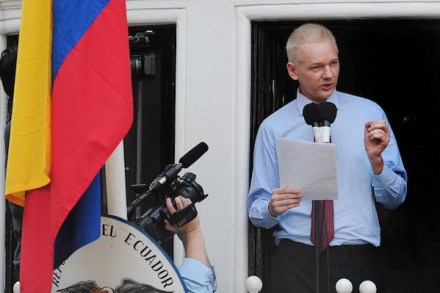
Julian Assange appeared in public for the first time in two months this afternoon to make a statement about his continuing resistance to attempts to extradite him. The Wikileaks founder made a number of claims and arguments which it's useful to have a look at in further detail: 1. 'If the UK did not throw away the Vienna conventions the other night, it was because the world was watching'. Foreign Secretary William Hague has insisted that there are no plans to 'storm' the Ecuadorian embassy to arrest Assange. Either officers will attempt to arrest him when he leaves the building for Ecuador (although there is an interesting theory he may try to do this disguised in some sort of package, as diplomatic parcels cannot be examined by the police. Let's see how well that one works out...

Julian Assange has nowhere left to run

From our UK edition

Julian Assange is one of my best enemies.  For my part it was hatred at first sight.  He was only slightly slower on the uptake.  Our relationship was consummated last year when we debated in London, and he fluttered those strange dead eyes at me, and threatened to sue me, and then didn’t, and I wrote about it afterwards and revealed to the world (or Spectator diary readers at least) that his backstage chat is like aural rohypnol. Anyhow – in recent months I have not had the time to keep my hatred active.  Partly because Julian has now even discredited himself with the left.

Hague stands firm on Assange

From our UK edition

William Hague took a robust line on Julian Assange at his press conference this evening. He made clear that the British government would not allow the Wikileaks founder safe passage out of the UK, and warned against using diplomatic immunity as a means of 'escaping regular process of the courts'. Assange is wanted in Sweden on allegations that he raped one woman and sexually assaulted another in August 2010. He denies both charges and has spent the past 56 days hiding in Ecuador's embassy, where it was today confirmed that he is being granted political asylum. The police still intend to arrest Assange as soon as he leaves the embassy, but Hague's press conference locks the foreign secretary into stand-off with his Ecuadorian counterpart, Ricardo Patino.

Julian Assange, hero of the highborn left

From our UK edition

I wonder how long it will be before Julian Assange’s highborn leftist supporters finally think, um, hang on, are we on the right side here? The self-obsessed albino mental is now cowering inside the Ecuadorian embassy as a last ditch attempt to get out of his extradition to Sweden. As you are aware, he faces charges of rape and sexual assault in Sweden. His objection to complying with British and international law is that he might be extradited to the USA and put in a gas chamber, if they still have them. There is not the remotest evidence to suggest this would happen. Can you imagine how the left would react if any other alleged rapist attempted to evade justice by hiding in the basement of a banana republic’s embassy?

When a leak starts to smell

From our UK edition

Bill Keller, the executive editor of The New York Times, has written a highly readable piece chronicling his paper’s tempestuous relationship with Julian Assange. Keller does a good job defending how The New York Times handled the documents that Wikileaks passed it, the steps it took to minimise the risk posed to the lives of the people mentioned in the documents. But the part of the piece that sticks in the mind is how the man Keller sent to meet Assange described the source to his editor: “He’s tall — probably 6-foot-2 or 6-3 — and lanky, with pale skin, gray eyes and a shock of white hair that seizes your attention,” Schmitt wrote to me later.

A tale of ego and hypocrisy

From our UK edition

Sarah Ellison has profiled Julian Assange and his relationship with the Guardian for Vanity Fair. Read the whole piece for each petulant tantrum, sordid disclosure and twist of hypocrisy, but here are the opening paragraphs to get you started. ‘On the afternoon of November 1, 2010, Julian Assange, the Australian-born founder of WikiLeaks.org, marched with his lawyer into the London office of Alan Rusbridger, the editor of The Guardian. Assange was pallid and sweaty, his thin frame racked by a cough that had been plaguing him for weeks. He was also angry, and his message was simple: he would sue the newspaper if it went ahead and published stories based on the quarter of a million documents that he had handed over to The Guardian just three months earlier.

This year’s biggest story

From our UK edition

This year was so rich in stories - Expensesgate, the election and historic coalition, the Icelandic volcano, General McChrystal's dismissal, the Pakistani floods, Haiti's earthquake, Greece's near-collapse, the Will n' Kate engagement, Wikileaks, the Chilean miners and so on - that it is hard to pick just one story. Looking back over the year, however, I think two stories stand out - because they may herald a seismic change.  The first is, of course, the establishment of coalition. By now, the novelty of government by cross-party compromise has worn off. But, despite the gossipy complaints of a few Lib Dem ministers, a new kind of politics is being forged.

Wiki-danger

From our UK edition

Now the Wikileaks are beginning to become dangerous. Before, the leaks contained high-level tittle-tattle, confirmation of existing analyses and embarrassingly accurate portraits of world leaders. I still thought it wrong to regurgitate this data, as it will lead to more secrecy, bilateral problems and potentially even conflicts – the things that Julian Assange claims he is seeking to avoid. Yet I told NPR that the idea of prosecuting the Wikileaks founder for treason was far-fetched; he is not a US citizen and it was not clear to me what kind of charges could be brought against him in the US courts. Now, however, with the publication of data which will be useful background reading for any would-be terrorist, the situation has changed.

The truth about Wikileaks

From our UK edition

Isn't he a character that Julian Assange? With his shades, white hair and globe-trotting antics, the founder of Wikileaks is the perfect 21st century villain or hero depending on which side of the embassy cables debate you find yourself.  I have met Julian a few times and worked with him on stories concerning the Iraqi billionaire Nadhmi Auchi. I can say no more than that because of the writs that fly from Mr Auchi's lawyers, Carter-Ruck, when any journalist who tries to write about him. But I can say that I always found Julian professional and honest in all my dealings with him. But he is a freedom of information fundamentalist and anyone working with him should realise this.  I sympathise with his approach.

Chinese burns

From our UK edition

The latest cache of Wikileaks has done America no end of good. The Saudis urged the US to bomb Iran – a sign that the Arab world can make common cause with the States and Israel. It has also emerged that North Korea has sold the Iranians long range rockets – Moscow, Berlin and Istanbul are all within the Ayatollah’s range. But the most important revelation is that China has tired of North Korea’s lunatic machinations, recognising that the rogue state is an impediment to global and regional security. China is also convinced that the country will not survive Kim Jung-il’s death and favours a union of the two Koreas, provided the new state is pro-Chinese (could it be anything but?).