Israel

The wild life and times of Ariel Sharon

From our UK edition

When Ariel Sharon slipped into a coma in January 2006, The Spectator was just beginning to rather like him. Days after his stroke, the magazine ran a piece arguing that Sharon’s legacy would be ‘not his military exploits but his final major political act: unilateral withdrawal from Gaza’. Douglas Davis described Gaza as a lawless gangland where terrorism was the major growth industry. Yasser Arafat had sown the seeds of anarchy and Mahmoud Abbas was too weak to do anything about it. ‘The terror war appears to be on the verge of entering a new, more dangerous, phase,’ he wrote. ‘Israelis have cause to be grateful that Sharon dragged them out when he did.’ Before 2006, The Spectator would have often made less comfortable reading for Ariel Sharon.

Absolute moral squalor on display at a London church

From our UK edition

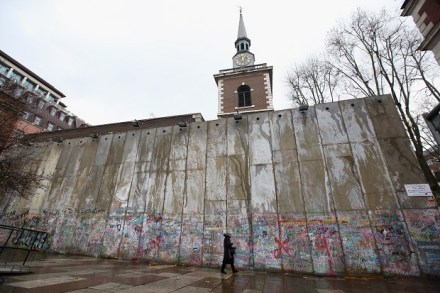
‘Did Israel spoil Christmas again?’ I only ask because the claim that they did is becoming a modern tradition in Britain. The softest and most commonplace expression of the claim comes from those vicars or congregation members who claim that they find it ‘hard’ to sing ‘O little town of Bethlehem’ nowadays because of how dreadful the situation in Bethlehem is today compared with how little, still and dreamlessly sleepy it was back in Jesus’s time. This Christmas I had already attended one church which perpetuated this new conceit. And earlier this week I went to the church of St James in Piccadilly, which has made anti-Israeli propaganda its signature dish in recent years.

William Hague: We will need to reassure Saudi Arabia and Israel about Iran deal

From our UK edition

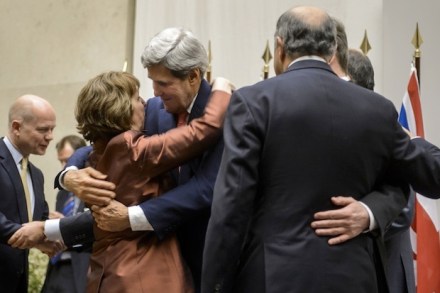
The Commons was in congratulatory mode this afternoon when William Hague gave his statement on the deal with Iran. Baroness Ashton, not familiar with heaps of praise falling on her, came in for congratulations from across the House, particularly from Hague and Douglas Alexander. Both men also agreed that this deal is the first step towards what Alexander called 'that more difficult and complex agreement' that will secure long-term stability in the region.

Would you trust this man?

From our UK edition

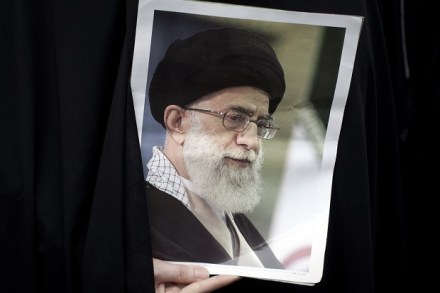
In Geneva, America and her allies are limbering up for another round of negotiations over Iran's nuclear project. In a sign of the thaw Barack Obama and our own Prime Minister seem desperate to declare, David Cameron has spoken directly with President Rouhani for the first time. According to a Downing Street spokesman, the two men ‘agreed to continue efforts to improve the relationship’. Meantime, ahead of the Geneva talks, the man with the power in Iran, the Supreme Leader, has just given a speech to 50,000 Baseejis (government militia).  Here is some of what he said: ‘Is the Islamic regime after war with others? This is the statement that is heard from the mouth of the region's dog with rabies, i.e. the Zionist regime, that 'Iran is a threat to the world'.

Israel still needs diplomatic support, even if Iran seems less aggressive

From our UK edition

Israel's Prime Minister revealed a crucial truth about the foreign policy of the United Kingdom and our allies in his speech to the United Nations, the gravity of which is difficult to overstate.  His speech affirmed once more that when it comes to Iran, we and all our allies are negotiating under the cover of Israel's credibility alone. Mr Netanyahu rightly dispensed with diplomatic charades to speak explicitly about Iran’s nuclear weapons programme.  If you believe President Rouhani’s lies from the same podium that there isn’t one, no Western or Arab government agrees with you.  This is not Iraq or even Syria.

Is President Rouhani’s Iran serious?

From our UK edition

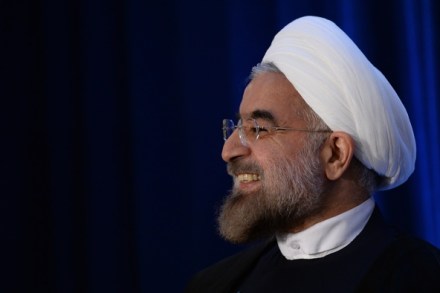
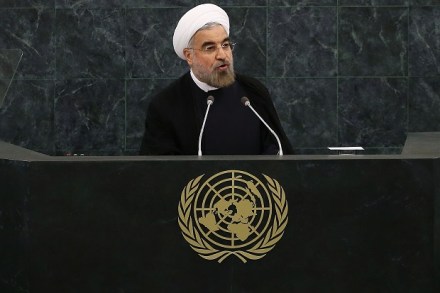
Is Iran serious? That is the question everybody has been asking for the last 24 hours since the new Iranian President went to the UN in New York and gave an interview to CNN. A colossal outbreak of wilful optimism has followed from policy makers, ex-policy makers and media. This has been based largely on the fact that an Iranian President may have just acknowledged that the Holocaust of European Jewry occurred. Well huzzah. For what it’s worth, President Rouhani didn’t quite say that. In the CNN interview he said that it was the job of historians to look at such things. And to the extent that he acknowledged that a ‘crime’ had occurred, Rouhani did so in order to put the Holocaust on an even pegging with the creation of the state of Israel.

George Galloway blames Israel for the use of chemical weapons in Syria

From our UK edition

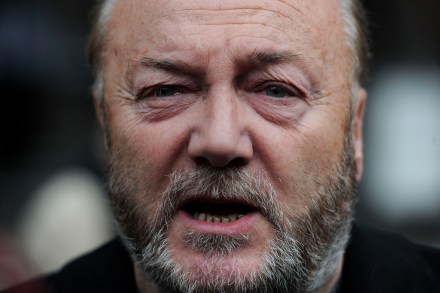
Say this for George Galloway: every time you think he cannot sink any lower he finds new ways to surprise you. His latest contribution to Press TV, Iran's propaganda station, speaks for itself. Parody is pointless. Given his history and his paymasters, we would expect him to defend the Assad regime in Syria. Even so, under-estimating his ability to sniff out the true villains is never sensible. Here's his "analysis" of the use of chemical weapons in Syria: "If there's been any use of nerve gas it's the rebels that used it. [...] If there has been a use of chemical weapons it was al-Qaeda who used chemical weapons. Who gave al-Qaeda chemical weapons?

Stone the soothsayer

From our UK edition

When the history books tell the story of peace in the Middle East, the name of Lord Stone of Blackheath, managing director of Marks & Spencer and a Labour peer, will be up there in lights. For he is a soothsayer with unique insights on the region. At least, that is the impression given by his ‘out of office’ email message: ‘I am in Israel for August back Sept 3rd. I said there'd be talks by then! Peace in 9 months!’ You read it here first.

Freeing terrorists for peace?

From our UK edition

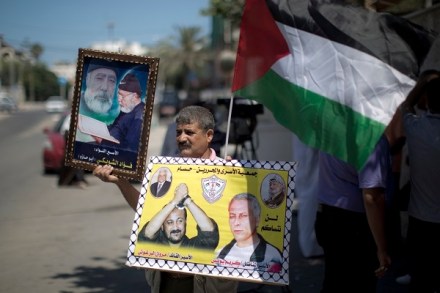
Amid all the bloodshed in Egypt and Syria at the moment the fact that the Israelis and Palestinians are once again at the negotiating table has received less notice than usual. Which is not necessarily a bad thing. The intense international focus on the dispute seems to me a minor contributing reason why the dispute remains unresolved. But there is one aspect of the talks which really ought to be highlighted. That is the Palestinian demand that Israel release 104 Palestinian terrorists from prison before talks commence. While agreeing to this precondition, Israel has not asked for – and is not getting – anything in return. Of course Israel has been here before. Many times.

China: the Middle East’s new power broker

From our UK edition

It’s exactly ten years since Iranian dissidents first blew the cover of a secret uranium-enrichment facility under a mountain at Natanz, in a bleak stretch of desert near Isfahan. Ever since, relations between Israel and Iran have headed inexorably towards war. Israeli leaders have insisted that they are ready to launch a military strike — unilaterally if necessary — against Iran if the uranium enrichment continues. Iranian leaders, liberals and hardliners alike, have been equally adamant that the centrifuges will continue to spin. For Israeli hawks like prime minister Benjamin Netanyahu, the question has been not whether to strike Iran, but when.

Turkey redux

From our UK edition

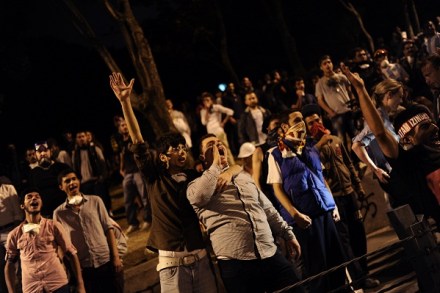
It must be boring for you too, returning to the same complaint, over and over again. Report on the BBC’s 10 O’Clock News about the trouble in Turkey. Not a single mention, in the three minutes, of the words Islam, or Muslim, or Islamification. You had to infer everything. Without prior knowledge of what was going on, you would have been utterly mystified as to why people were unhappy. You noted that all of the protestors were young, middle class, educated and the women fashionably unveiled; well spoken, good English and so on. And you would have wondered then who the alleged ‘50 per cent’ who support the Prime Minister might be; what are they dressed like? Is this an argument about poverty, or what? Not a mention of the causes.

The real significance of Israel’s strikes on Syria

From our UK edition

It is hard to overstate the significance of Israel’s surgical strikes against Syrian military positions over the weekend. The raids targeted missiles bound for Hezbollah in Lebanon while also destroying battery launchers and other delivery systems. Beyond the obvious damage this inflicted on Syrian military capabilities, its real significance lies in the broader political objectives it achieved. Benjamin Netanyahu made a strategic miscalculation last November when he launched Operation Pillar of Defence against Hamas operatives in Gaza. He failed to inflict any meaningful damage on the group while the Hamas administration secured a number of victories, not least hitting Tel Aviv.

Peter Oborne should stop apologising for Mahmoud Ahmadinejad

From our UK edition

There was an extraordinary meeting of the Juche Ideas Study Group (England) in London last week, held to commemorate the 81st anniversary of the foundation of the Korean People’s Army. For various domestic reasons I was unable to be present, but I think it went off quite well. Sandwiches, tea and coffee were served after the various speeches. Juche is the political ideology of North Korea, emphasising a steely self-reliance in the face of Yankee and Jap imperialist aggression. The meeting was taken by a chap called Dermot Hudson, who may or may not have recited the poem he wrote a while back about Kim Il Sung, the founder of the DPRK. I hope he did, because it deserves to be recited whenever three or four people are gathered together.

Is that a ‘no’ then, Owen?

From our UK edition

To my simple suggestion that Owen Jones apologise for claiming that an 11-month old child killed by a Hamas rocket was in fact killed by an Israeli ‘so-called targeted strike’, Owen appears to have answered ‘no’. He starts his reply: ‘In the last couple of years I've learned one thing: the right don't like me very much, and expend a sizeable amount of energy attacking me personally rather than my writing.’ In saying that he has learned even ‘one thing’ I fear Owen exaggerates. He begins his next paragraph: ‘Hard right pseudo-intellectual [Douglas] Murray…’ Nothing worse than attacking a person rather than their writing is there?

Death of the Two-State Solution

From our UK edition

At the (rejuvenated) New Republic, Ben Birnbaum has a comprehensive and comprehensively-depressing survey of the last-gasp prospects for a two-state solution to the Middle East 'peace process'. If the two-state solution (TSS) is not yet on life-support it is hardly a picture of health. The prognosis is not good and time is running out. According to Birnbaum, Mahmoud Abbas and Bibi Netanyahu are, in their different ways, the last remaining men who could make it work. Yet neither man, as he also demonstrates, has much room for manoeuver.

Will Owen Jones apologise?

From our UK edition

Last November, during another exchange between Israel and Hamas in the Gaza, the left-wing columnist Owen Jones appeared on BBC Question Time. Invited to comment on recent events, what he read out (or so it appears from the tape) was a catalogue of errors about Israel. Among them were big, sweeping incorrect allegations – such as the claim that Israel is enforcing ‘a siege which stops basic supplies’ getting into Gaza. But there were also some new and more specific errors. Take his striking and emotive claim that Israel’s ‘onslaught’ included ‘targeted strikes’ which killed children. Here is one of the things he said: ‘I don’t want to just throw statistics around – I’ll give you one example of one of those children.

A lesson in solidarity, from the Jewish community in Britain

From our UK edition

This week I wrote my last Bright on Politics column for the Jewish Chronicle. Here it is in full: This is my last Bright on Politics column. After three-and-a-half years at the JC, I will leave with a lump in my throat, so please forgive me if this piece is a little sentimental or, dare I say it, schmaltzy. When I started work at the paper, some of my former colleagues warned me I was consigning myself to a backwater. Nothing could be further from the truth. Even before I joined the paper I had always felt it to be a unique publication: an ultra-local community newspaper with global ambitions. From my very first days in the job, I found myself slammed into the middle of an international news story with serious implications for UK politics.

Ed Miliband’s Convenient, Part-Time, Cowardly, Zionism

From our UK edition

For a few hours this morning it looked as though Ed Miliband might do something uncharacteristically courageous. The Jewish Chronicle reported that the Labour leader had described himself as a Zionist at a meeting organised by the Board of Deputies. It may be sad that this would need to be considered, as Dan Hodges put it, 'a brave and welcome statement' but that's the modern British left for you. Mr Hodges wondered if Miliband would 'stand by' this statement. His scepticism was sensible. And sure enough, word comes that Miliband's views have been 'misinterpreted' by the Jewish Chronicle. As Hodges relates the story: 'Asked at the event whether he was a Zionist Miliband reportedly responded, “Yes, I am a supporter of Israel”.

David Ward and the Ruthless Suppression of Anti-Israel Criticism – Spectator Blogs

From our UK edition

David Ward, Liberal Democrat MP for Bradford East, is unhappy that his recent comments about The Jews attracted such widespread criticism. You see: "There is a huge operation out there, a machine almost, which is designed to protect the state of Israel from criticism. And that comes into play very, very quickly and focuses intensely on anyone who's seen to criticise the state of Israel. And so I end up looking at what happened to me, whether I should use this word, whether I should use that word – and that is winning, for them. Because what I want to talk about is the fundamental question of how can they do this, and how can they be allowed to do this." As machines go, this one seems a pretty Heath Robinson contraption, idiosyncratically constructed and wildly inefficient.