Ireland

Bad science

From our UK edition

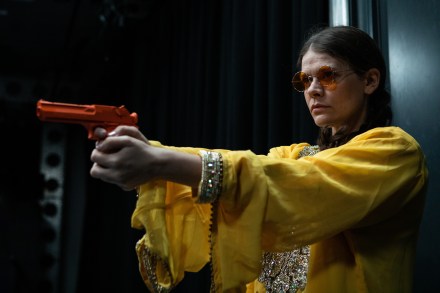
Kill Climate Deniers is a provocative satire by Australian theatre-activist David Finnigan. The title sounds misanthropic and faintly deranged but the show is a comedy delivered with oodles of verve and fun. Finnigan is a skilful writer of dialogue, a gifted farceur and, at times, an astute analyst of power and its corrupting tendencies. Like most Aussies, he’s incapable of pomposity and his show takes a pop at every player in this game: the politicians, the shock jocks, the sainted Greens and the media. A TV journalist has the surname ‘Ile’ — an anagram of ‘lie’. Finnigan reminds us that the bulk of eco-warriors are white middle-class malcontents whose priority is not to save planet Earth but to get themselves noticed.

Derailing Brexit isn’t Leo Varadkar’s only aim

From our UK edition

I agree with much of Liam Halligan’s analysis of the Irish government’s approach to Brexit (‘Good Friday disagreement’, 20 April). However, I think he omits an important point. Leo Varadkar is not merely attempting to derail Brexit; he is also hoping to achieve a united Ireland. For decades politicians, officials and journalists in the south have privately peddled the line to gullible counterparts in Britain that the Dublin establishment has been ambiguous about whether it really wanted the North with all of its myriad problems, but this is and always has been a lie. The Good Friday Agreement was clearly perceived behind closed doors in Dublin as a key transition stage to eventual reunification.

Back door to Britain

From our UK edition

I was working in Johannesburg when I first got wind of the fact that Ireland has become an illegal back door to the UK. If you’re from a country such as South Africa, Swaziland, Lesotho, Fiji or Guyana, you need, not just a passport, but a prearranged visa, obtained from the local embassy for a fee, before you can even board a plane to Britain. It takes time, your details are checked, and you need to show a reason why you’ll go home at the end of your stay. In the 1980s most African nationals could come to Britain visa-free. But worries about terrorism and crimes committed once in the UK meant that, one by one, African countries had to join the visa scheme.

Lyra McKee’s murder is nothing to do with Brexit

From our UK edition

Emily Thornberry reached a new low today. At Prime Minister’s Questions, she turned the Commons’ heartfelt offering of condolences to the family and friends of Lyra McKee into a tirade against a Hard Brexit. In reply to David Lidington — who was standing in for Theresa May, who is attending McKee’s funeral — Thornberry said the murder of McKee by the New IRA is a ‘sickening’ reminder of the violence of the past and evidence why a solution to the Irish border question is necessary. She appeared to land on the argument that in order to avoid a hard border in Ireland – and to avoid the kind of terrorist violence we witnessed on the night McKee was murdered – we ultimately need to keep the UK in a Customs Union.

Good Friday disagreement

From our UK edition

The relationship between the UK and the Republic of Ireland has ‘reached a hunger-strike low’, says a new study by an academic from Trinity College, Dublin. ‘Relations have not been as tense since the early 1980s and political rhetoric that had vanished by the 1990s has re-emerged,’ the paper grimly concludes. The fragility of relations between Britain and Ireland is hard-wired into me. Having grown up ‘London-Irish’ in the 1970s and 1980s, all I ever wanted was for the two countries that define my ethnicity to get on.

Bonne chance, Ireland

From our UK edition

Seventy years ago this month, a prime minister led a divided nation towards the exit from what was then one of the world’s most important organisations. On that occasion, Ireland was the country wanting to leave and there was no backstop to hold things up. Despite the pleas of the other member states, the Irish walked out of the Commonwealth. I was reminded of that moment this week as the budding bromance between the Irish Prime Minister Leo Varadkar and France’s President Emmanuel Macron unfolded. Relations have never been better, Mr Varadkar cooed to nods from M. Macron. As well he might. For Varadkar has just returned his nation to the Commonwealth fold — by signing up to the French Commonwealth.

Would the real St Patrick have appreciated the contemporary marketisation of his Saint’s day?

From our UK edition

St Patrick’s Day, on 17 March, is now regarded as a prime opportunity for Irish politicians to travel abroad on a mission for ‘brand Ireland’. They fly off overseas, armed with the symbol of the shamrock, alerting their hosts to the shiny new liberal Ireland which is such a fabulous investment opportunity — and don’t forget the low corporation tax! Few national saints have the global reach of Patrick: it has been calculated that church bells ring out in 800 worldwide locations to celebrate the feast day of this Roman Briton who brought Christianity to Ireland in the early 5th century. Jewish bakeries in New York sell green bagels and horses run at Cheltenham in his honour.

Why reawaken the IRA?

From our UK edition

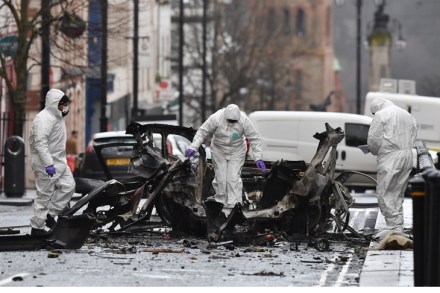
When politics goes round in circles, the columnist inevitably revisits issues that would have been sorted if only everyone read The Spectator. So: back to the Irish border — a demarcation that takes up no geographical space, but has still mysteriously dominated a dozen years of my life. Oh, well. What’s one more afternoon, then? Derry’s recent car bomb underscores a curious omission in all the Brexit argy-bargy about a ‘hard border’. Throughout, neither May, nor Barnier, nor even Varadkar ever utters the letters I, R and A. Yet the scummy residue of this vanquished potato blight lies at the heart of the hysteria about hypothetical border infrastructure that could present a ‘target’. Decorously, no one ever says target for whom.

Death becomes her | 6 December 2018

From our UK edition

‘Without death,’ says Salena Godden, ‘life would be a never-ending conveyor belt of sensation.’ For her death is what gives meaning to life and to be able to imagine your own death should make you try harder to be a better person. Mrs Death Misses Death on Radio 4 (produced by Cecile Wright) is not a programme for the faint-hearted. Godden, a poet, novelist and musician, faces with robust clarity what many of us would prefer to distract ourselves from thinking about. She argues that Death is much more likely to be a woman; not the usual caricature of a hooded male figure carrying a sickle.

Letters | 29 November 2018

From our UK edition

The Irish border Sir: Contrary to the assertion that the Irish border ‘only hit the headlines’ after Leo Varadkar became Taoiseach in June 2017, as Liam Halligan claims (‘Irish troubles’, 24 November), the negative impact of Brexit on the peace process and the Good Friday Agreement was clearly signalled during the referendum campaign itself, including by the Irish government and by two former British prime ministers, Sir John Major and Tony Blair. There was no discontinuity in policy when Leo Varadkar succeeded Enda Kenny as Taoiseach, as reflected in the latter’s statement in February 2017. ‘The Irish government will oppose a hard border… This is a political matter, not a legal or technical matter.

Irish troubles

From our UK edition

How did we get into this Brexit mess? Why is it proving so difficult to leave the EU? Was it Theresa May’s botched 2017 election, which vaporised her Commons majority? Or perhaps her general incompetence and lack of vision? How about the fierce determination of Europhile civil servants to save stupid Leave voters from themselves, cooking up a half-in-half-out withdrawal guaranteed to split the Tories? Maybe it was the cynical ambivalence of HM’s Opposition, with Labour simultaneously backing both Brexit and a second referendum, having always intended to cause chaos and spark a general election by voting down the UK’s exit, contradicting its own manifesto?

The Irish border issue is no mere sideshow – and UK ministers are mostly to blame

From our UK edition

We may or may not hear news soon of a settlement of the Irish border issue that will allow Brexit to proceed without the calamity of ‘no deal’. Word this week was that Irish taoiseach Leo Varadkar might offer a compromise ‘review mechanism’ for the ‘backstop’ which might otherwise leave the UK locked in a customs union — but like me, you’re probably none the wiser as to what that actually means.

The Spectator Podcast: Brexit, Bellingcat, and bondage with ethics

From our UK edition

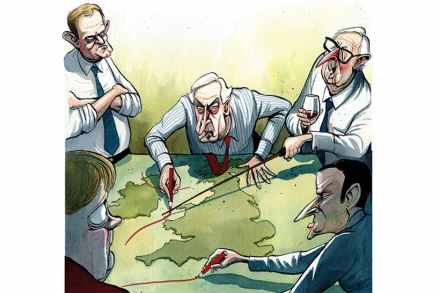
This week, Brexit negotiations grind to a halt again as Brussels and the UK draw mutually exclusive red lines on the Irish border problem. We talk to James Forsyth and Dan Hannan on what next for Brexit. We also look a little deeper into the methods and mission of Bellingcat, the investigators that unveiled the true identities of the Salisbury suspects. And last, we investigate a sex industry that is trying to become more ethical. Brexit negotiations have hit a brick wall again, and this time, no deal looks closer than ever before. The latest snag over the Irish border seems impossible to solve. But all this is a EU strategy to divide and conquer, argues James Forsyth in this week’s cover piece – Brussels has used Ireland to carve up the UK and back it into a corner.

The Irish problem | 18 October 2018

From our UK edition

The story of Britain and Ireland’s relationship has, all too often, been one of mutual incomprehension: 1066 and All That summed up the view on this side of St George’s Channel with the line that ‘Every time the English tried to solve the Irish question, the Irish changed the question.’ But Theresa May’s problem right now is that the Irish — and the European Union — won’t change the question and the only answers they’ll accept are unacceptable to Mrs May and her cabinet. To the astonishment of many, the Irish border has become the defining issue of Brexit.

Paddy powerless

From our UK edition

In February, I spoke at the first ‘Irexit’ public meeting in Dublin, a discussion about options for Ireland in the event of various eventualities arising from Brexit or some more fundamental disintegration of the EU. Nigel Farage was among the speakers, so what might otherwise have been ignored became the focus of finger-wagging by the media ayatollahs. Punctuating the speeches were videos about Ireland’s economy, resources, history--in-the-EU and so forth. One featured a classic Irish rock song by the venerable fivesome Horslips, a rock band of the 1970s. The song was ‘Dearg Doom’ (Red Destroyer), which turns on a riff based on an Irish march, ‘O’Neill’s Cavalry’.

Opposites attract

From our UK edition

‘Marianne had the sense that her real life was happening somewhere very far away, happening without her, and she didn’t know if she would ever find out where it was and become part of it.’ This is the most frustrating part of being alienated and young. You hope that there’s a better life in store for you but you can’t yet bank on it. Sally Rooney appeared two years ago with Conversations with Friends and has rightly been fêted as one of the most important writers of her generation. The question of generation matters because she’s writing about young people. Both novels feature protagonists who are undergraduates in Rooney’s own Dublin.

Posh people move house

From our UK edition

Non-stop chatterbox and mystifyingly revered fabricator of sub-Chekovian paddywhackery, Brian Friel has received another production at the Donmar. His play Aristocrats cadges shamelessly from Three Sisters and The Cherry Orchard. The setting is a crumbling mansion in Donegal occupied by four adult members of the O’Donnell clan (three girls, one boy), who idle around the place waiting for Dad to clock out so they can get their mitts on the bricks. Lindsey Turner’s production is curiously stripped of ornament. The characters are assembled on a lime-green patio, suggestive of mown grass, which is surmounted by a white frame with the dimensions of the goalposts at Wembley.

Pope Francis has his work cut out to appease the church’s critics

From our UK edition

No one on earth could fulfil the expectations that have been invested in the visit of Pope Francis to Ireland. He is meant to  respond to the crisis of clerical child abuse and institutional self preservation within the global church during his first official address at Dublin Castle in a fashion that appeases the church’s critics in Ireland, who are, frankly, in no mood to be appeased. What he did do in his speech was express once again perfectly decent sentiments of abhorrence at the violation of children by members of the clergy.

Did Ed Balls mean to make a documentary on the joys of Trump’s America?

Ed Balls has become the left’s Michael Portillo, reviled as a politician, now a game, well-loved, almost cuddly TV personality. I met him once on This Week and I was instantly struck by how easy, funny and genuinely likeable he was: as engaging in person as he was totally bloody awful as chancellor. Happily it was the gentle man rather than the leftist bruiser who dominated Travels in Trumpland (BBC2, Sun). One fatuous previewer I read in the papers grumbled that he hadn’t challenged Trumpism enough. Tosh.

Top Trump

From our UK edition

The thing I most regret having failed ever to ask brave, haunted, wise Sean O’Callaghan when I last saw him at a friend’s book launch was ‘So tell me about Shergar.’ It has long been known, of course, that the legendary racehorse — one of the five greatest in the last century, according to Lester Piggott who rode him to victory in the Irish Derby — was kidnapped in 1983 by the IRA and never seen thereafter. What I didn’t realise, till after O’Callaghan died last year, was that the ex-IRA man is the only insider ever to have gone on the record as to his fate. Turns out that poor Shergar was executed within hours.