Invasion

What’s next for Taiwan?

From our UK edition

When Portuguese traders sailed past a verdant, mountainous land on the fringe of the Chinese empire in the mid-16th century, they named it Ihla Formosa – ‘beautiful island’. But Kangxi, the third emperor of the Manchu Qing Dynasty, was less impressed when his naval forces captured it in 1683, scoffing: ‘Taiwan is no bigger than a ball of mud. We gain nothing by possessing it, and it would be no loss if we did not acquire it.’ Beautiful or not, Taiwan was a pirates’ lair, inhabited by tattooed head-hunters and best left alone. Yet the Qing clung on to Taiwan for two centuries, with Chinese settlers gradually displacing the indigenous Austronesian population.

How does the Russian public view the invasion of Ukraine?

From our UK edition

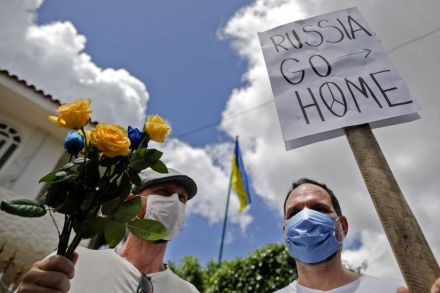
‘It’s too soon,’ said an anti-war Russian friend about the crop of books which have been emerging since late last year on Putin’s invasion of Ukraine. Perhaps he is right. Yet, mindful of Lenin’s maxim that ‘there are weeks when decades happen’, many may feel the period since February last year to have been one of the longest of their lives. Amid the fog of war – an endless news cycle in which events pile up, too enigmatic or episodic for the big picture to emerge – one is grateful to any writer who sets out to give the wider narrative. ‘To look at Russia now, as someone who loves the country, is to despair’ One such is Serhii Plokhy, the Zaporizhzhia-born historian and Ukrainian specialist, in The Russo-Ukrainian War.

The Ukraine invasion is nothing compared to Iraq

Of the war in Ukraine, New York Times columnist Thomas Friedman writes, “Our world is not going to be the same again because this war has no historical parallel.” In the very next sentence, he describes the Russian invasion of Ukraine as “a raw, eighteenth-century-style land grab by a superpower,” thereby acknowledging that the episode actually has innumerable historical parallels — just not ones that Friedman cares to acknowledge as legitimate. Friedman figures prominently among those claiming to have divined the essential character of the present age. His key finding: tech-driven globalization has rendered old-fashioned power politics obsolete. The rules of the game have changed irrevocably. Practically speaking, nations have no choice but to submit.

invasion iraq

Putin’s path to war in three speeches

With regard to the illegal war being waged by Russia against Ukraine, no one has any right to be surprised. For all the understandable and justifiable outrage over Russian president Vladimir Putin’s decision to abandon diplomacy and launch what appears to be an unprovoked act of aggression, a look at prior statements by Mr. Putin shows that, with the passage of time, patience and rationality gave way to irrationally, paranoia and ultimately the decision to launch an armed conflict. Any proper accounting of the history of the downturn in US-Russia relations must include Putin’s 2007 address to the Munich Security Conference. To many, this was a kind of point of no return, with Putin putting the US and its European allies on notice: there are red lines not to be crossed.

The stakes for Europe are even higher than in 1938

Any analysis of the Ukraine situation risks lagging behind the news. As of the time this article was published, Russia had conquered the former Chernobyl nuclear power plant. Its forces are only about sixty miles away from Ukraine’s capital, Kyiv, which has already experienced shelling. Russians have also attempted to capture Antonov International Airport, just fifteen minutes away from the capital’s ring road. Meanwhile, European leaders are resorting to the usual responses: “concerned,” “strongly condemning." There is even a Twitter account mocking the EU’s approach to all major crises, called “Is EU Concerned?” The response to the invasion of Ukraine is not spared from similar mockery. Here in Europe, it feels like 1938 all over again.

Diplomacy is Ukraine’s last hope

Amid a pile of Russian disinformation, a mass evacuation of civilians from the self-proclaimed separatist republic and reports that Russian commanders are preparing to execute an invasion order, diplomacy (or at least the hope of it) reared its beautiful head late Sunday night. After a frantic series of calls orchestrated by French president Emmanuel Macron, the White House released a statement confirming President Biden’s openness to a direct meeting with Russian president Vladimir Putin. Whether or not the leader-to-leader discussions happen, however, won’t be fully up to Biden or Macron. It takes two to tango, as the hackneyed phrase goes. And right now, Moscow has been habitually cryptic about its intentions.

ukraine

Why did Hitler’s imperial dreams take Stalin by surprise?

From our UK edition

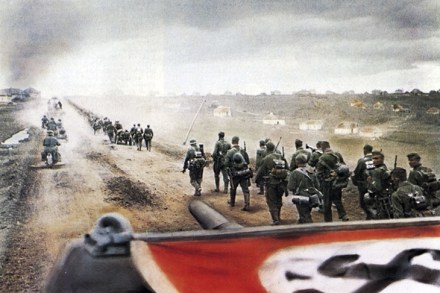
The most extraordinary thing, still, about Operation Barbarossa is the complete surprise the Wehrmacht achieved. In the early hours of 22 June 1941 the largest invasion force in history, ultimately some three million men, struck at the Soviet Union on a front of nearly 2,000 miles. When Stalin was woken with the news, he wouldn’t believe it. It couldn’t be Hitler’s doing, he insisted; surely just sabre-rattling by Wehrmacht generals? Hours passed before he would accept his calamitous misjudgments and issue a general order to fight back by every means. Hitler’s strategic challenge in the late 1930s had been essentially the same as the Kaiser’s in 1914: how to make war simultaneously on two fronts.