Immigration

Is the Labour Party Thinking Seriously About Downing Street or Planning to Become BNP-lite?

I have yet to get really excited about the Labour Party leadership race. I was deeply depressed by the manner of Andy Burnham’s entry into the fray. Too many Labour politicians and activists were over-impressed by talk of immigration on the doorstep. They think that because the subject was raised again and again, then it is the key to Labour’s failure and therefore its potential future success. The point is that the issue was raised in 2001 and 2005, but Labour knew it would win on both occasions on so chose to ignore what its core voters were saying about foreigners. They believed they had their votes in the bag.

Frank Field would complete the Tories' welfare reform jigsaw

So now the coalition stretches as far as Labour, with the news that Frank Field is being lined up as an anti-poverty advisor for the government.  In itself, this is an encouraging development: Field is one of decent men of Westminster – committed, informed and passionate.  But when you look at it beside the Tories’ other appointments in this area, then it really becomes exciting.  Field, IDS, Grayling and Lord Freud – all are deeply knowledgable about the welfare reform agenda, to the point where it’s difficult to think of many more impressive teams in recent political history.  So perhaps there is hope for this most difficult of policy areas,

Why Labour is still within striking distance

Things are looking good for Cameron – his coalition has 60 percent approval rating, he has managed to persuade the Lib Dems to support what always was a liberal Tory agenda. There is plenty for Conservatives to celebrate, especially on welfare reform and education. But, still, things could be a lot worse for the Labour Party than they are now. I say in my News of the World column today that, rather than being “out for a generation” as Tory strategists were hoping only a month ago, Labour remains (amazingly) in striking distance of winning the next election. And there is no telling when that election will be. Clegg and

Tories win Today's first post-debate debate

Today’s debate was riveting. It showed two candidates who were miles away from each other. One was clear, honest and able to avoid the traps set by the interviewer. The other was dissembling and unclear, his line of argument collapsing under the barrage of questioning. If a doubting voter had heard the debate, unsure beforehand whether to vote Tory or Lib Dem, they would likely have plumped for the former, afterwards. Oh yes, there was a debate yesterday, too, among the three party leaders. But that’s not what I’m talking about. No, with the debates now firmly part of the British political system, an equally important feature has arrived with

The Tories' final push

Fresh from David Cameron’s victory in the final TV debate, the Tory campaign has taken another assured step this morning.  As Tim Montgomerie reports over at ConservativeHome, they’re going to flood the doorsteps with the leaflet, ‘A contract between the Conservative Party and you’ (pdf here).  Inside, a list of clear policy commitments from “publishing every item of government spending over £25,000,” to “reducing immigration” to the levels of the 1990s – meaning tens of thousands a year, instead of the hundreds of thousands a year under Labour.”  And, on the back page, a refutation of some of Labour’s most misleading claims about the Tories.  Clear, simple and direct. You

Ten reasons why this is a catastrophe for Brown and Labour

Every politician will be thinking “there but for the grace of God…” today – but the Gillian Duffy incident is not just a gaffe. It is bad for Gordon Brown and Labour on very many levels. Here are ten of them.   1. The image of the Politburo pulling away in the Jag, slagging off the proles. This confirms the idea of an elite, who sneer at voters in private but try to charm them in public. And the idea that politicians (of all parties) say one thing on camera, and another when they think no one is listening. 2. The is not just a gaffe, but the PM on

Oh Dear: Calling Voters "Bigots" Doesn't Often End Well

Well the only good thing, from Labour’s perspective, is that this has happened the day before the final debate and not several days before it. So there’s just a chance it will be a 36 hour story, not a 72 hours one. Clearly it’s not a great idea for the Prime Minister to be heard calling a middle-aged widow he’s just encountered on the mean streets of Rochdale a terrible “bigoted woman”. The video is excruciating and demonstrates why Labour have generally been wise to keep Gordon away from the general public during this campaign: The comments once Brown has escaped to the supposed-safety of his car are pretty awful,

Brown v The Voters

We have just witnessed the biggest moment of the 2010 election campaign. It wasn’t that Brown let off steam: it was that he instinctively described as “bigoted” a woman who represents what should be Labour’s core vote. Sure, she mentioned immigration – but just said “where are they coming from”? Her main concern was the national debt, and what her grandchildren will have to pay. Neither Cameron or Clegg would have thought these points bigoted – and neither would Tony Blair. The thought would not have crossed his mind. Nor that of Kinnock, Foot or Callaghan. Labour’s campaign is led by a man who dislikes campaigning, having to get down

Clegg will be hurt by this too

Brown calling Gillian Duffy that ‘bigoted woman’ from the safety of his car having ended his conversation with her cordially is, obviously, hugely damaging for Labour’s campaign. But I suspect Nick Clegg will also suffer some collateral damage as it will push immigration to the top of the political agenda, an area where the Lib Dems with their plan for an amnesty for illegal immigrants are on the wrong side of public opinion.

Britain's brain drain

Voting with one’s feet is always the most sincere sign of faith – or despair – in a country and its government. And for many the departure lounge, rather than the ballot box, is the surest route to better schools, lower tax and safer streets. The phrase “brain drain” was used in the 1970s and isn’t now – strange, because the emigration rate has doubled to 1,080 a day (ONS data here).  It’s not just Brits: over the years, even the immigrants who have lived here for long enough are scarpering. But because of our obsession with immigration, we haven’t really paid attention to those leaving. And incomers do outnumber

Grayling wins the perceptions battle

Another day, another TV debate – only this time it was Alan Johnson, Chris Grayling and Chris Huhne behind the lecterns, talking crime on the Daily Politics.  Just like yesterday’s debate, the questions were incisive and insistent.  But the politicians conspired to turn proceedings into a mush.  There was very little clarity, a sizeable dollop of bickering, and proof, were it needed, that Huhne really can go on a bit. To my mind, it all boiled down to likely audience perceptions.  Chris Grayling was cornered on a number of issues (including a question addressing his “homophobic comments”), but he probably gauged those perceptions right when he emphasised the “sense” that

A bumpy ride for Brown on Radio One

Gordon, meet disillusionment.  Disillusionment, the Prime Minister.  Ask him questions on whatever you want: the economy, jobs, immigration, expenses – the ball is in your court.  Make him squirm, if you like.  Confront him.  He is, after all, here at your pleasure. For that was the set-up of Radio One Newsbeat’s interview with Gordon Brown earlier this afternoon.  It was one of those impossible situations for the PM.  He could hardly decline to be quizzed by a group of first time voters, aged between 18 and 28.  But it put him at the mercy of some pretty disgruntled members of the public.  And they took full advantage. The questions were

Cameron has a policy agenda to change Britain – he should tell us about it

Cameron has not, alas, broken free of the never-ending opinion poll bungee jump which is the story of his leadership of the Conservative Party. Cleggmania is a bubble – but the thing about bubbles is that one can never quite tell when they will burst. The Tories, who have lost the most votes due to this bubble, will have their needles out. But in my News of the World column today I suggest they focus on policy because they do have hard ideas that could radically change Britain. Cameron missed a trick by failing to mention his single best policy, Gove’s school reform, last week.  On immigration, his plan for reducing it

Come out, come out wherever you are

Chris Grayling, the Shadow Home Secretary and former attack dog, seems to have been cast into outer darkness. As with Oliver Letwin’s disappearing act in the 2001, Labour is toasting this unofficial scalp. Denis MacShane has been adding poison to the potion this morning. The Tories are paying a heavy price for Grayling’s B&B gaffe, but it’s self-inflicted. Grayling’s comments were cackhanded and I think he is wrong, but they were nowhere near as controversial as was claimed – he was seeking a clarification of the law, not calling for Sandi Toksvig to be lynched. I doubt Grayling will be Home Secretary but such a senior Shadow minister can’t hide

Three lessons for the Tories on immigration

The witterings of Phil Woolas about immigration yesterday – where he accused The Spectator of contorting immigration figures and double-counting immigrants – have landed him in plenty trouble. Stephen Timms was on the Daily Politics today and conceded that Woolas was talking out of his hat. They weren’t our figures, they were from the ONS – and compiled under orders from Eurostat with its Labour Force Survey (LFS) scheme. Andrew Neil has written it up in a blog here. The government is at sea because even ministers in charge of the relevant departments have no idea about the scale of immigration in Britain. This wee farrago brings three lessons for

Woolas on the rack

Phil Woolas has just been confronted on Daily Politics about immigration figures which we uncovered on Coffee House yesterday, showing 99 percent of new jobs since 1997 are accounted for by immigration. His response is (unintentionally) hilarious. He is immigration minister, yet appears not to know what immigration figures mean. Here’s the transcript: Phil Woolas: I think that the Spectator’s analysis, perhaps not surprisingly, is confusing two completely separate things Andrew Neil: These are Office of National Statistics figures.which we checked this morning. Do you accept that there are 1.7 million new jobs for people of working age between 16 and 64, correct? PW: Yes AN: And according to the

Where the Mail's cover story came from

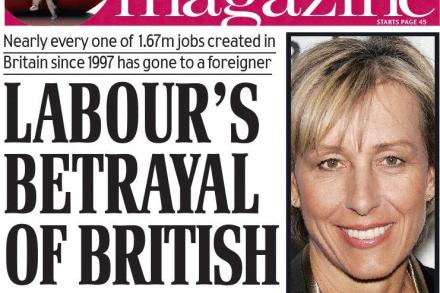
It’s always gratifying to see Coffee House posts followed up in the newspapers, and I almost admire the way the Daily Mail has just splashed the newspaper on one of our posts without mentioning the source. CoffeeHousers will recognise the story on the Mail’s front page (left) – some 99 percent of jobs created since 1997 are accounted for by immigration. But the reader is left wondering where this figure came from. Was it released by the ONS? Erm, no. The only source for these figures is an email I was kindly sent by the ONS after specifically requesting the data. I used it in a line from The Spectator’s

British jobs for British workers...

Did you know that there are fewer British-born workers in the private sector than there were in 1997? I’d be surprised if so: these official figures are not released. The Spectator managed to get them, on request from the Office of National Statistics. We use the figures in tomorrow’s magazine, but I thought they deserves a little more prominence here. See the graph above, which shines a new light on the boasts Gordon Brown has been making. He said his Glasgow speech last month that: “If we had said twelve years ago there would be, even after a global recession, 2.5 million more jobs than in 1997 nobody would have

No-one is Talking About Immigration

Well, on Day One of the Great Campaign no-one seemed to be talking about immigration. This is understandable given that it’s a subject that discomfits most of the parties and, for that matter, many voters. This is to say nowt about the potential it offers for demagoguery and cheap and easy populism. But while one understands why the subject arouses fierce passions it remains the case that we probably ought to talk about it at some point over the next month. Because we’re going to need more immigrants. Yup, we are. Or, at any rate, we’re going to need more people over the course of the next few decades. For