Havana

Cuba is a lovesick country

When I first moved to Cuba, an ex-girlfriend said: “That sounds lovely, Ruaridh. What next, Thailand?” The Caribbean island has always come with a certain reputation – the writer A.A. Gill noted that the Cubans are the “most libidinously choreographed people in the world.” It wasn’t the revolution that made Cuba known for sex. The sleaze goes way back, probably to 1492 and beyond (naughty Tainos), but by the 1950s, Havana’s infamous Shanghai Theater was putting on live sex shows, performed by a gentleman called “Superman” – and not because he could fly. Such libertine ways – and the mob that controlled then – were part of the reason Fidel Castro gave for tumbling the then dictatorship.

Cuba is next on Trump’s hit list

It’s hot in Havana. The summer’s electrical storms have arrived, lighting up the sky, while down on the ground we’ve been without power for 16 hours, meaning no sleep. The four-month-old US oil blockade is biting, but Cuba’s government still refuses to bend the knee to Washington, so surveillance aircraft are circling. An aircraft carrier, the USS Nimitz, has arrived in the neighbourhood. We expect an attack at any moment. Donald Trump has made it clear that after Venezuela and Iran, Cuba is next on his list for decapitation. His administration wants a change of government and the economy opened up. Cuba’s 95-year-old ex-president Raul Castro has been indicted for murder, opening the way for an abduction like the one in Caracas in January.

In Cuba, we’ve all become preppers

We may not be happy campers here in Havana. But increasingly we are campers. Enter any home, from the most privileged (a relative term these days as the blackouts rise to 22 hours a day) to the poorest, and the trappings of off-grid living are everywhere. Some of the kit wouldn’t shame the back of a hedge-fund weekend warrior’s tricked out Jeep as it wended its way into the wilds of Glacier National Park. Do you know what an Ecoflow Delta Ultra 3 is? Well I didn’t, until recently. It’s the latest in “portable power stations.” Basically a big battery, it can keep a freezer running for 12 hours, or power several fans through the night. But at $1,500, it’s 150 times the average Cuban monthly pension.

Road-tripping across blockaded Cuba

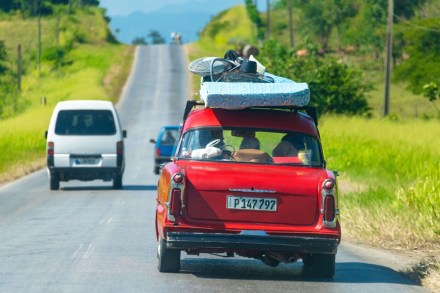
My wife Camila doesn’t drive, but she does direct. Studying the map, she’ll say, “This road!”, and before I know it, we’re off down some track, startling locals who haven’t seen a “yuma” – technically an American but really any foreigner – for years. Cuba is a country that lends itself to country road adventure. Besides drinking daiquiris, it’s perhaps my favorite thing to do. And it’s what I miss most now that it’s impossible: the US oil blockade that began in January means there is no gasoline. ‘Is this ceviche the red snapper or the snook?’ I asked. The waiter shrugged, ‘Once it’s ceviche it’s hard to tell’ Few others seem to do it.

Inside blockaded Cuba, life is getting odder by the day

From our UK edition

It’s nearly two months since Donald Trump signed an executive order imposing a total oil blockade on Cuba, and life is becoming odder. At the weekend, in a down-island town called Moron, teenage kids burnt down the local Communist party headquarters. Meanwhile, here in Havana, we’re awaiting the arrival of the Irish hip-hoppers Kneecap at the head of a humanitarian relief armada carrying solar panels. I live in a rooftop apartment. At night, it’s a good spot from which to look out over a city that once sent up music and light but is now as dark as a desert. The oil blockade, designed to either force the bankrupt Communist government into major reform or the population to rise up against them, is worsening what were already terrible blackouts.

Hurricane season in Cuba

A cold front blew in off the Florida Straits, sending waves over Havana’s famous corniche, the Malecón, and announcing what has traditionally been the end of the hurricane season. After 13 named storms, it seems as if the 2025 season finale was Hurricane Melissa, a humdinger. She paused south of Jamaica, getting herself into a lather, before killing 32 on that lovely island and causing at least $7 billion of damage. Fortunately for Cuba to the north, Jamaica’s mountains plucked the murder from Melissa’s eye – but she still cut a devastating trail through this bigger island’s eastern reaches a day or so later.

Hurricane Melissa

In Cuba, a revolution is over

If you’ve ever thought of visiting the crocodile-shaped island of Cuba, or run into someone recently returned from sultry nights in the country’s salsa halls, there’s a good chance you’ll have heard the phrase “See it before it changes.” And I don’t mean because of Hurricane Melissa. The idea is that the centrally planned communist state, one of the last on Earth, will soon morph into America and a balmy Brigadoon full of people unencumbered by money, modern cars or Alexa will evaporate. I think most people, if they knew what Cubans have endured, wouldn’t use that phrase, which is up there in its lack of tact with “they’re poor but they’re happy.

cuba havana

Norman Lewis – a restless adventurer with a passion for broken-down places

From our UK edition

The travel writer Norman Lewis, the son of a Welsh psychic medium, died in Essex in 2003 at the age of 94. In his darkly comic autobiography, Jackdaw Cake, he relates how, in 1937, his mother built a spiritualist church in the north London suburb of Enfield as a sort of Taj Mahal memorial to her late husband (who was a retail pharmacist as well as a psychic). Enfield is not a likely pocket of the paranormal, but the Enfield Beacon of Light is still going strong. During its table-rapping and other spook-dabbling sessions no one is allowed to make jokes about striking a happy medium. Spiritualism is dead serious. Lewis’s humdrum upbringing in Edwardian Enfield – aspidistras, astral-planing – was far removed from the social privilege of most literary travellers.

Christopher Caldwell, Gus Carter, Ruaridh Nicoll, Tanya Gold, and Books of the Year I

From our UK edition

34 min listen

On this week’s Spectator Out Loud: Christopher Caldwell asks what a Trump victory could mean for Ukraine (1:07); Gus Carter argues that leaving the ECHR won’t fix Britain’s immigration system (8:29); Ruaridh Nicoll reads his letter from Havana (18:04); Tanya Gold provides her notes on toffee apples (23:51); and a selection of our books of the year from Jonathan Sumption, Hadley Freeman, Mark Mason, Christopher Howse, Sam Leith and Frances Wilson (27:08).  Produced and presented by Patrick Gibbons.

The dark side of life in Cuba

From our UK edition

The first scent of trouble came when Cuba’s government ordered all its non-essential workers home. By packing them off (and there are plenty of them, given Cuba is one of the world’s last centrally planned communist states) the government hoped the island’s exhausted national power grid would get a breather. It didn’t work, the main power station crashed, and Cuba went dark. At first, I didn’t think it was a big deal. Power cuts in this all-but-bankrupt state have long been a daily scourge. But it turns out there’s a categoric difference between 20 and 24 hours of blackout. I came to Cuba in 2018 for a three-month stay and here I am, now married with a three-year-old son. Friends call this my ‘Cuban midlife crisis’, which I resent.

Why Russia is flaunting its ships in the Caribbean

Two Russian ships docked Tuesday in Venezuela’s La Guaira port, twenty miles away from Caracas. The stop comes after military exercises were conducted in the Atlantic, with four vessels stopping in Havana late last month. This is all part of a decades-long “look-at-us” operation, also known as a “show the flag” move, as Russia’s defense ministry puts it. While Russia’s presence in Cuba and Venezuela is not a new phenomenon, conflict in the East has only accelerated their muscle-flexing in the West. These movements mark Russia’s first extensive military exercises in the hemisphere in five years, as well as their first deployment of a nuclear submarine in close proximity to the US since the Cold War.

Russia

How ever did the inbred Habsburgs control their vast empire?

From our UK edition

In 1960, Felipe Fernández-Armesto and Manuel Lucena Giraldo tell us, Lucian Freud went to the Goya Museum in Castres in search of a particular painting. He wanted to create portraits that were character studies and ‘not mere likenesses’, and Goya’s collective portrait ‘La Real Compañía de Filipinas’,a study in human nullity that represented ‘absolutely nothing’, was just what he was looking for. Fernández-Armesto explains: The work belongs in the tradition of what might be called Spanish ‘anti-portraiture’, from Velázquez’s ‘Las Meninas’ to Goya’s own devastatingly candid royal family group, ‘Familia de Carlos IV’, moral as well as physical delineations of regal vacuity.

Could street protests finally topple Cuba’s communist regime?

From our UK edition

Could the growing tide of protests finally topple Cuba's communist government? Many Cubans are certainly angry: Sunday marked the largest-ever demonstration against the island’s regime. Organised through social media, the protests, which began in a town twenty miles outside Havana, quickly spread across Cuba. Thousands of demonstrators marched along some of Havana’s most iconic streets, chanting ‘Freedom!’, ‘Fatherland and Life’ and ‘Down with the dictatorship!’ Discontent with the regime, which took power in 1959, has been rising for the past year. Before this weekend, the most high-profile protests had been from artists and intellectuals demanding freedom of expression. But this discontent is spreading rapidly.