Greece

Portrait of the week | 9 April 2015

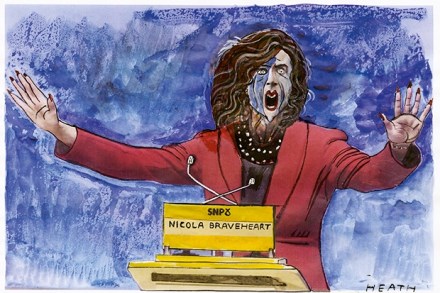
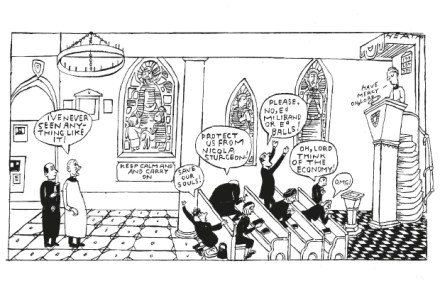
Home Tony Blair, the former prime minister, opposed a referendum on membership of the EU. In a speech at Sedgefield he said that, following the Scottish referendum, David Cameron, the Prime Minister, knew ‘the perilous fragility of public support for the sensible choice’. Opinion polls following a television debate by seven party leaders, which drew an audience of 7.7 million, were inconsistent. Nicola Sturgeon, the leader of the Scottish National Party, was held to have made a mark, while Leanne Wood, the leader of Plaid Cymru, and Natalie Bennett polled at between 2 and 5 per cent. Nigel Farage, the leader of Ukip, was seen to sweat profusely.

Switch over to the Greek debt drama: the final episode must be coming shortly

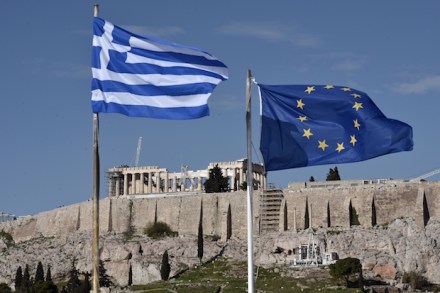
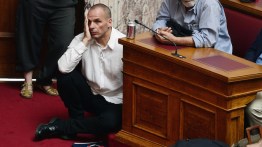
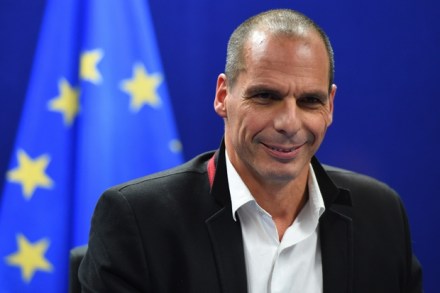
Bored with the election? Switch over to the Greek debt drama. In this week’s cliffhanger, silver-tongued finance minister Yanis Varoufakis visited IMF chief Christine Lagarde on Sunday, promised to meet his country’s obligations ‘ad infinitum’, and was expected to meet a €450 million repayment to the IMF on Thursday. But more troublesome members of the ruling Syriza party denounced the IMF and Brussels for treating Greece as ‘a colony’, threatening a snap election ‘if creditors insist on an inflexible line’, and warning that public-sector salaries and social security payments must rank ahead of debt as cash runs out. Which it will before August.

Here’s what a real reform of business rates would look like

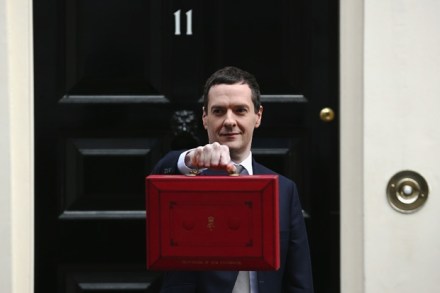
Of all the measures talked up ahead of the Budget, the reannouncement of a ‘radical’ review of the business rates was the least concrete in content but the most important in potential impact on the domestic economy, and especially on business investment. This column has banged on for years about the iniquity of a system that imposes the highest local taxes on businesses of any EU country, based on pre-crash rental assessments and bearing no relation to the value of diminishing local authority services. It’s a system that, on top of other economic woes, has brought devastation to town centres — and gets away with all this because it has no democratic accountability, since businesses have no votes.

Where Alcibiades once walked, amateur tax spies are trying to entrap poor pistachio-sellers

 Athens I am walking on a wide pedestrian road beneath the Acropolis within 200 meters of the remaining Themistoclean wall and the ancient cemetery to eminent Athenians. One side is lined with splendid neoclassical houses, none of them abandoned but most of them shuttered and locked up. This is the area where once upon a time Pericles, Themistocles and Alcibiades — to name three — trod, orated and debated non-stop. Back in those good old days we Athenians ruled supreme. Reason, logic and restraint placed us at the head of the queue, and genius also helped. I am climbing to the Pnyx, where Themistocles rallied his fellow citizens to defy the Persian juggernaut, and, except for a couple of stray dogs, I am alone with my hangover.

Old age is not for sissies

The secret of eternal youth, according to Alice Roosevelt Longworth, is arrested development, and the penny dropped last week. The mountains were misty, snow was falling and I went to the dojo for some karate training. I was sparring with a tough, fifth-degree black-belt instructor, Roland, and kept nailing him, something I hadn’t been able to do previously. That’s when it dawned on me. Respecting my advanced age, he was taking a dive. ‘If you don’t stop this crap, I’ll beat the crap out of you,’ I threatened. He didn’t — and nor did I. We ended up laughing and doing kata instead. I felt great after 45 minutes of punching and kicking, but what a bore old age is.

Grim, generous, decaying and hip: the paradoxical charms of Athens

My first visit to Athens as a student gave me a set of impressions that the present crisis has only validated. The man designated to meet us at the airport did not turn up. I will never forget his name. It was Nic Katsoudis. So we got in a taxi anyway. It crashed twice on the way to our apartment in the Vouliagmeni resort south of the city. Once inside, the plumbing was Periclean in age if not in grandeur. That was when local colonels and not German bankers were the devil. Since then I have been back often, en route to my sister-in-law’s house on lovely, neglected Skopelos — an island not so much unspoilt as unimproved in the first place. Athens is where you change planes, get on a bus or find a boat.

For modern-day Assyrians their present is under attack from Isis, as is their past

The historian Tom Holland tweeted this morning: ‘What ‪#ISIS are doing to the people & culture of ‪#Assyria is worthy of the Nazis. None of us can say we didn’t know.’ What #ISIS are doing to the people & culture of #Assyria is worthy of the Nazis. None of us can say we didn't know: http://t.co/Ndi02TeueK — Tom Holland (@holland_tom) February 27, 2015 He linked to a Washington Post article about how the Islamist group had kidnapped at least 200 Assyrian Christians from their homes in north-east Syria, and may well be preparing to murder them.

Paul Mason’s diary: My Greek TV drama

It’ll be a Skype interview, says the producer from Greek television, and not live. In TV-speak that usually means not urgent and not important, but I’ve become vaguely interesting to Greeks because of the ‘Moscovici draft’ — a doomed attempt to resolve the crisis, leaked to me amid denials of its existence. The interview goes on a bit and the tone is deferential. At the appointed time, I fire up Greek television to see how many clips they’ve used. Instead of me, a panel of five bearded men in an expansive studio are conducting an earnest preview of my interview.

The Greek crisis isn’t over

The more you read about the deal between Greece and the Eurozone, the clearer it becomes how temporary a deal it is. First, the Syrzia-led government has to submit on Monday a list of the reforms that it intends to implement over the next four months before the bailout is extended. Then, negotiations will have to start on a third Greek bailout for when this one runs out in the summer. These negotiations will be particularly fraught because of the lack of goodwill on all sides. Last night, Wolfgang Schauble, Germany’s finance minister, declared ‘The Greeks certainly will have a difficult time to explain the deal to their voters.

The future was looking bleak for a poor little Greek Boy who had turned 30, but then I met Arnaud de Borchgrave

I hate to start with a cliché, but Count Arnaud de Borchgrave d’Altena, who died in Washington DC last week, aged 88, was the last of the great foreign correspondents — trench coat, suntan, title and 17 wars under his belt included. One accomplishment none of his obituaries mentioned (perfectly understandably, mind you) was his role in introducing to journalism, and subsequently mentoring, the greatest Greek writer since Homer, yours truly — something Arnaud kept quiet about throughout our close 48-year friendship. Here’s how it began: it was May 1967, the Greek junta had taken over the government the previous April, and Arnaud had flown in to interview the Greek strongman Colonel George Papadopoulos.

If Greece leaves the euro could others follow?

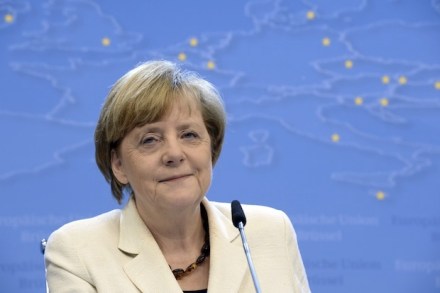
Germany wants nothing less than an unconditional surrender from the new Greek government. It is hard to draw any other conclusion from Berlin’s decision to reject Greece’s proposal for a six month extension of the current bailout, which counted as an almost total climb-down by the Syriza-led government. But it seems that the Germans—with an eye on the Spanish elections later this year —want to show that voting for radical, anti-austerity parties gets you absolutely nothing. However, the Germans may well have miscalculated. The Greek Finance Minister wants Greece to leave the euro but, because the vast majority of Greeks wants to stay in the single currency, he has had to stop agitating for that.

Greece isn’t the only country that wants to leave the euro

With EU budget talks breaking down on Monday night, there was, for a time, an outside chance that Greece would leave the euro. Worryingly for EU leaders, there are plenty of people across the rest of the continent who would like to do the same. As research by ComRes for New Direction Foundation across nine European countries shows, significant minorities would like to return to domestic currencies, although the majority of people in major Eurozone countries would like to retain the euro. While the German Finance Minister, Wolfgang Schäuble, has been doling out the conditions to Greece about what it will have to do to stay in the euro, one in three people from his own country want to return to the Deutschmark.

Bet on a swift Grexit | 19 February 2015

‘Will Greece exit the eurozone in 2015?’ Paddy Power was pricing ‘yes’ at 3-to-1 on Tuesday, with 5-to-2 on another Greek general election within the year and 6-to-4 on the more cautious ‘Greece to adopt an official currency other than the euro by the end of 2017.’ I’m no betting man — as I reminded myself after backing a parade of point-to-point losers on Sunday — and I defer to our in-house speculator Freddy Gray, who will offer a wider guide to political bets worth having in the forthcoming Spectator Money (7 March).

Bet on a swift Grexit

'Will Greece exit the eurozone in 2015?’ Paddy Power was pricing ‘yes’ at 3-to-1 on Tuesday, with 5-to-2 on another Greek general election within the year and 6-to-4 on the more cautious ‘Greece to adopt an official currency other than the euro by the end of 2017.’ I’m no betting man — as I reminded myself after backing a parade of point-to-point losers on Sunday — and I defer to our in-house speculator Freddy Gray, who will offer a wider guide to political bets worth having in the forthcoming Spectator Money (7 March).

The Eurozone crisis is as much a political problem as it is an economic one

Veterans of Eurozone crisis summits, hoping for another nail-biting drama, had queued to get ringside seats. But yesterday’s meeting over Greece with Eurozone Finance Ministers ended without result. And you shouldn’t be surprised. We’ve been here many times before – Eurozone committees keep minutes but lose hours – and this was not a meeting during which decisions were to be taken. While some Eurozone watchers have convinced themselves that there is now a new script for Greece’s relation with its Eurozone creditors, no Eurozone government but the Greek share that view. It’s not just that other capitals are hostile to Greece’s own game plan of forcing other governments to make a new decision about its debt terms.

Greek debt talks break up – can the eurozone hold together?

Are we now closer to Grexit? Tonight’s talks between eurozone finance ministers broke up after a few hours with Greece slamming the draft statement prepared by the group as ‘unacceptable’ and ‘unreasonable’. That statement was leaked by the Greek camp while the talks were happening, which can’t have helped the atmosphere in the room. The talks broke up acrimoniously. Finance ministers have told Athens it has until Friday to agree to maintain the current bailout under the troika, but Varoufakis said in a press conference this evening that ‘we are going to meet halfway during the next couple of days. Europe will do the usual trick, it will pull a good agreement, an honourable agreement, out of what appears to be an impasse’.

Taki’s recipe for the survival of the Greek nation

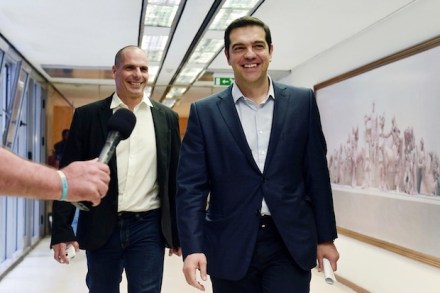
The good news is that a Greek suppository is about to relieve the EU’s economic constipation. The bad is that there’s a Castro in our midst posing — just as Fidel did 56 years ago — as a democratically elected populist. Back then it was Uncle Sam who was the bogyman. Now it’s the EU. Back then the Soviet Bear came to Fidel’s rescue. Now it’s Putin. Personally, I’d take Vlad over the faceless unelected Brussels gang anytime. The problem is Tsipras, a vulgar-sounding name if ever there was one. Add to it the fact that he has two sons, one named after Che Guevara, the other after Carlos, the murdering Venezuelan terrorist at present languishing in a French jail.

This time next year Greece will be out of the euro or Syriza will be out of power

There has been much interest in the European Central Bank making a new call on Greek government bonds, saying that 'it is currently not possible to assume' the bonds to be safe assets once the bailout programme expires. This is as you might expect: after all Yanis Varoufakis, the new Greek Finance Minister, has been touring European capitals this week to remind creditors that Greece is bankrupt. Yet markets and Twitter – our two modern messengers of truth – 'spooked', along, of course, with the poor souls who thought Greece’s Attica or Piraeus banks to be worthy an embrace by their savings. Loans to the Greek government fetch a 9.7 per cent rate of interest - in comparison to German, British, and even French levels of less than 2 per cent.

Osborne uses meeting with Greek finance minister to tell people to vote Tory

Even though he wasn’t quite prepared in the sartorial stakes for the visit of Greek finance minister Yanis Varoufakis, George Osborne was ready to use the meeting between the two as another messaging moment. Following their discussions, the Chancellor has released this quote: ‘It’s clear that the standoff between Greece and the Eurozone is fast becoming the biggest risk to the global economy, and it’s a rising threat to our economy at home. In Europe as in Britain now is the time to choose competence over chaos. I urged the Greek finance minister to act responsibly, but it’s also important that the Eurozone has a better plan for jobs and growth. We have that plan in Britain and in these uncertain times, now is not the time to abandon that plan.