George osborne

Setting the scene for Osborne’s speech

From our UK edition

George Osborne will make a brief statement to the house this afternoon, responding to the Office for Budget Responsibility’s revised growth forecasts. Reuters reports: ‘As expected, the Office for Budget Responsibility raised its 2010 growth forecast to 1.8 percent from its 1.2 percent June forecast to factor in a surprisingly strong performance in the middle of the year.’ The upgrade fuels Osborne’s positive narrative: the coalition pulled Britain from the abyss and international confidence in Britain's economy is growing. These forecasts vindicate the government’s ‘cut with care’ strategy. Concrete savings are now being made and they enable the Chancellor to announce that public sector net borrowing will fall.
Some early statistical vindication for IDS

From our UK edition

The Observer has news that will warm the government’s hearts. Ernst and Young have conducted a report that suggests 100,000 public sector jobs will be saved thanks to the savings made by welfare reform. The report’s other finding, a crucial one, is that the Treasury will be raking in £11bn by 2014-15. So then, a statistical vindication for IDS’ reforms, the economic side of them at least. It also gives the government some defensive hardware ahead of tomorrow’s Chancellor’s autumn statement. Not that it really needs it. On the back of Britain’s strong economic performance in the third quarter, the Office for Budget Responsibility is expected to raise its 2010 growth forecast from 1.2 percent to 1.7 percent.

Ireland’s crisis is the fault of Fianna Fáil, not just the euro

From our UK edition

In all likelihood, George Osborne will rise this afternoon to groans if not jeers. Britain looks set to lend Ireland £7bn as part of multilateral and bilateral bailouts. Many, particularly the Eurosceptic right, question our involvement, given our straitened financial circumstances and the apparent fact that Britain is sustaining the eurozone’s monetary and debt union, and will have to borrow to do so.     George Osborne has been adamant throughout: Ireland is too important to Britain’s recovery to risk collapse – British and Irish banks are closely linked, debts and borrowing are often co-dependent, trade is very profitable. That the bailout should strengthen the euro is a natural consequence of Ireland being a member of the euro.

The British taxpayer should not be bailing out Ireland

From our UK edition

Everyone is talking about the royal wedding today.  It will be a great occasion but the public finances are tight and people are already asking about the cost.  There is a bigger issue for British taxpayers, though.  Our politicians have arranged for them to get hitched to the bride from hell: the ongoing fiscal disaster in the eurozone.   Under current plans it is reported that we could be liable for up to £7 billion in any Irish bailout.  At the TaxPayers’ Alliance, we have just this morning started a petition against British taxpayers’ money being put at risk for a euro-bailout of Ireland; you can sign it here.   The eurozone is fundamentally broken.

Sovereignty, and the loss of it

From our UK edition

The superb Slugger O'Toole blog highlights what is certainly the most resonant quote if the day: "When you borrow, you lose a little bit of your sovereignty, no matter who you borrow from." Those words were uttered by the Irish finance minister Brian Lenihan this morning, and they capture his country's grisly predicament perfectly. The Irish government has been fighting the European attempt to bail them out because they believe, quite understandably, that it would mean a final handover of control to Brussels and Berlin. But their loose economic policy – built on debt, and structured around a stubborn currency – has already seen them lose control to the point where the IMF is dispatching its observers to the scene.

The pledge divide

From our UK edition

Over at the FT's Westminster blog, Alex Barker asks why it is that David Cameron's expensive personal pledge on pensioner benefits has survived the spending review while Nick Clegg's personal pledge to scrap tuition fees, which would have cost roughly the same amount, has been spectacularly ditched. As Alex argues, one reason is that Clegg himself was not particularly attached to his pledge on fees. Indeed, he had tried to change the policy several times in opposition. The other is that George Osborne, who is the Tories' chief election strategist as well as the Chancellor, is determined to protect the Cameron brand.

Ten things you need to know about the welfare White Paper

From our UK edition

I've sifted through yesterday's welfare White Paper, and thought CoffeeHousers might appreciate a ten-point guide to its contents. This is by no means the entire picture – and some of it will be familiar from past Coffee House posts – but hopefully it should capture the broad sweep of IDS's reforms: 1) The problem. Fundamentally, the issue is that there are a lot of people stuck on out-of-work benefits: around 5 million at the last count. This means different things for different groups. For the Treasury and taxpayers it contributes towards an unwieldy working-age welfare budget that has increased by 45 percent, in real terms, over the past decade – to around £80 billion.

50p tax: the coalition’s most expensive policy

From our UK edition

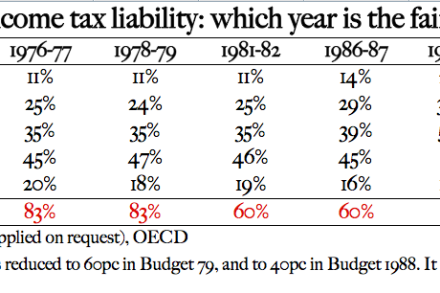
In my cover story for this week’s magazine, I say that the damage of the 50p tax, various bank levies and general banker-bashing is far greater than Osborne realises. Here are the top points I seek to make:   1. We may hate to admit it but the British tax base, and our chances of reducing the deficit, are heavily reliant on a handful of very rich people. The highest-paid 1 percent will generate 23 percent of income tax collected in the UK in the year before the 50p tax (see the table below). And spot the correlation between the top tax rate, and the burden shouldered by the richest and the poorest. Which are the most progressive – the figures on the right, or the figures on the left? 2.

All is not quiet of the welfare front

From our UK edition

Welfare is fast becoming this parliament’s Ypres Salient - strategically critical, it is constantly contested. £20bn on social housing, £100bn on out of work benefits and £billions on universal benefits: welfare reform is where spending cuts are most conspicuous. A rhetorical confrontation is building and various tactical dispositions are being made. The Staggers’ George Eaton has an analysis that assumes that Labour’s current wedge-strategy (which I critiqued here) is not working because it is avowedly sectional, privileging those who might be caricatured as ‘undeserving’. Eaton argues that Labour must ‘launch a defence of the hard pressed majority’; those who work but still stand to lose, particularly families.

Labour tries to prise Osborne and IDS apart

From our UK edition

Labour’s spin is less dexterous now that Alistair Campbell and Peter Mandelson have passed into night; but it can still artfully disguise politics as principle. Douglas Alexander is at in the Guardian, fanning the dull embers of George Osborne and IDS’ summer spat. He renews the offer of cross-party dialogue that he made on Andrew Marr last Sunday, before retreating, saying: ‘But beneath the talk of "we're all in this together" (a phrase specifically recommended for repeated use by Republican pollster Frank Luntz), what the chancellor announced on welfare was largely a laundry list of cuts that penalise the vulnerable and the working poor.

Stronger than expected growth

From our UK edition

The growth figures for the third quarter of the year have just been released, and it's better than we thought: 0.8 percent, twice the 0.4 percent figure that was expected, but down on the 1.2 percent achieved in the spring. In any case, it should play well for Osborne & Co. We've just witnessed the fastest third-quarter expansion of the economy for a decade. Double speed, rather than double dip. Really, though, these figures throw up more questions than conclusions. By far the most important is: where next? The coalition would have been untroubled by an even larger reduction in growth now (caused by weak consumer spending, among other variables), so long as we get stronger growth in future.

Reading between Laws’ lines

From our UK edition

In The Guardian today, David Laws argues for increasing funding for the pupil premium to £5 billion in the next parliament. But, revealingly, rather than talking about achieving this through the Liberal Democrat manifesto, Laws want to secure the increase this side of the next election and so writes about how it relies on persuading George Osborne of the premiums’ worth. Laws appears to be putting down a marker that increased funding for the premium needs to be part of Osborne’s pre-election spending review which should be in autumn 2014. If everything goes according to the coalition’s economic plan, the coalition will be able to announce plans to cut taxes and increase spending in the months before the next election.

Cable takes his wind-up act to the stage

From our UK edition

A luminous streak of self-aggrandisement in Vince Cable's speech to the CBI this afternoon, which began thus: "I should acknowledge that that the CBI has been remarkably far sighted; Digby Jones first invited me to speak to you eight years ago, the first Lib Dem asked to do so. I recall some members wondering 'Vince Who?'" And continued, as Paul Waugh notes in a typically insightful post, with a passage that will wind up the Business Secretary's detractors in the Tory party: "Just a few years ago, most people in politics, not only Gordon Brown, thought the growth problem had been solved.

Why a LibCon coalition might last beyond 2015

From our UK edition

May 2015 is an age away in political terms. But the question of what happens to the coalition after the next election is too politically interesting to be able to resist speculating on; even if this speculation is almost certainly going to be overtaken by events. Over at ConservativeHome, Paul Goodman asks if Cameron and Osborne share Francis Maude’s view that the coalition should continue after the next election even if the Tories win an outright majority. My impression is that they do. If the Tories won a majority of between 10 and 30, I’d be surprised if Cameron didn’t try and keep the coalition going. There are four main reasons why I think the Tory leadership would want to keep the Liberal Democrats in the government in these circumstances.

Osborne’s Paul Daniels strategy

From our UK edition

Is George Osborne the first British Chancellor to hide good news in the small print? I ask this in my News of the World column (£) today, and ask what he’s up to. Listening to Nick Clegg on Marr this morning, even he can’t quite say that the same forecasts that predict 500,000 public sector job losses also envisage three times as many jobs created in the private sector. Why so coy? I suspect because it would spoil the magic. That there is a deliberate gap between what this government is saying and what it believes it is doing.   James Forsyth was the first to write (in his political column, now available to non-subscribers) about ‘Gordon Osborne’, using Brownite tactics. But whereas Brown hid the bad stuff, Osborne is hiding the good stuff.

The government goes for growth, as Cable tackles takeovers

From our UK edition

As Benedict Brogan observes, the government's renewed emphasis upon growth is hardly deafening – but it is certainly echoing through this morning's newspaper coverage. Exhibit A is the Sunday Telegraph, which carries an article by David Cameron and an interview with Vince Cable – both of which sound all the same notes about enterprise, infrastructure, deregulation, tax and trade. There's a letter by George Osborne in the Sunday Express, which contains the word "growth" a half-dozen times. And then there's Cameron's claim that the next decade will be "the most entrepreneurial in Britain's history," in a podcast on the Downing St website. Welcome to two weeks devoted, apparently, to growth and reform.   This shift in emphasis is welcome, wise and well-timed.

Living costs – where the real threat lies

From our UK edition

Déjà-lu is a feeling that Spectator subscribers become familiar with. Part of the reason for subscribing (which you can now do from £12, including free iPad access) is to get ahead of the competition - and read today what the newspapers will be saying tomorrow. We’re delighted that the cover story of Thursday’s edition, by Allister Heath, is the main OpEd slot in the Daily Mail today - and with good reason. All of the focus has been on the cuts, 500,000 jobs to go etc. As CoffeeHousers know, jobs are not expected to be the issue over the next few years: the same forecasts suggest 1.5m jobs will be created. (This 3-1 ratio may sound optimistic, but it is what happened under Major.

The point of Osborne’s scalpel

From our UK edition

To govern is to choose. For nine years, Gordon Brown delayed choosing between higher taxes or lower spending, which is why the last time he balanced the government’s books was 2001–02. Since then, we have been building up to the spending cuts announced this week. No matter who won the election, there would have been cuts. Labour’s figures suggested they intended to cut departmental budgets by only marginally less than George Osborne has done. There is no great ideological divide between the parties on the total amount of cuts, so let us dispense with any pretence to the contrary. The Chancellor deserves credit on several fronts. He has stuck to the pace of cuts laid out in the Budget, and limited the impact on defence and education.

George Osborne is making the going

From our UK edition

There are several interesting columns on George Osborne in the papers today. In The Times, Tony Blair’s former speechwriter Phil Collins warns Labour to stop underestimating the Chancellor, who is defining the political battle on his terms at the moment. Peter Oborne, by contrast, is highly critical of Osborne in his Telegraph column, warning that Osborne’s partisan presentation of the cuts risks undermining support for the whole project. For once, I find myself disagreeing with Peter. I think Osborne is doing some of the political heavy-lifting that Cameron could not do without undermining his standing as a national leader; Osborne’s praise for the 2004 Republican campaign is instructive in trying to understand what is going on here.