George osborne

Osborne gets behind infrastructure

From our UK edition

One of the most significant things we have seen today is George Osborne’s announcement that Crossrail, Mersey Gateway, the big science project Diamond synchrotron and universal broadband would all go ahead. Osborne has decided that it is worth cutting deeper now in other areas to protect the kind of investments that will make Britain a more attractive place to do business down the line. As I said after the Budget, Osborne’s desire to protect this kind of capital spending is a key part of his plan – along with his reductions in corporation tax – to boost the private sector in Britain as the public sector is downsized. The Crossrail announcement is also a big boost to Boris Johnson’s re-election bid.
The axe hovers over welfare (and welfare cheats)

From our UK edition

As we know, education and defence have now had their budgets settled – another two ticks alongside the checklist. But that still leaves the third member of the coalition's trio of sticky settlements unresolved: welfare. The "quad" of David Cameron, George Osborne, Nick Clegg and Danny Alexander will meet today to bash out the final details. Yet some of their key talking points and decisions have already made it into the papers (especially in this article (£) in the Sunday Times). Here's my round-up, along with brief comments: 1) Crackdown on welfare cheats. George Osborne sets the tone with his article in the News of the World (now also behind a paywall). "A welfare cheat," he writes, "is no different from someone who comes up and robs you in the street.

The coalition’s liberal approach to sentencing could be the final straw for the middle class

From our UK edition

Today brings another couple of reminders of the coalition’s potential political problem with the middle class. In the Telegraph, Peter Oborne attacks Cameron and Osborne for a “morally disgusting” policy of targeting the middle class for an outsize share of the fiscal pain. While the Mail’s front page screams ‘What does get you locked up?’ as it details how 2,700 criminals who have more than fifty convictions were not sent to prison. Now, this is, obviously, the result of the last government’s sentencing policies. But, as the Mail points out repreatedly, this is a regime that Ken Clarke wants to make more liberal. In other words, even fewer people would be put away for the crimes they commit.

The true scale of the cuts

From our UK edition

George Osborne likes to spend his weekends at Dorneywood, the chancellor’s official residence near Slough, but I doubt this one will be  particularly enjoyable. He will be burning the midnight oil as he prepares next Wednesday’s spending review. No doubt he will also be taking calls from ministerial colleagues, muttering dark threats about aircraft carriers, the arts, sport, the roads budget, overseas consulates – you name it. And just when the numbers all add up he will probably have to start all over again after discovering that No10 has  promised to save some wind turbines because Steve Hilton bumped into somebody at a drinks party.

The Postie’s twinkle

From our UK edition

The Postman's eyes twinkled as he met George Osborne across the dispatch box for the first time this afternoon. With the air of an apologist who isn't remotely contrite, Alan Johnson told the House of his 'vast experience in this job' and gave the impression he was having a blast. This jolly masque hid an insubstantial performance. Johnson latched on to Chris Huhne's vow that he would not be 'lashed to the mast' of needless spending cuts - Johnson wondered if the deficit might not be eradicated within one parliament. Osborne said that it would. Then Johnson repeated the substance of his attacks of the weekend.

Alan Johnson, from affable to aggressive  

From our UK edition

If Alan Johnson continues as he has started, then he may be a surlier, snarlier shadow chancellor than many of us expected. He's got an article in today's News of the World and an interview in The Observer – and, in both, he's on unusually combative form. Osborne's cuts are labelled as "deep and irresponsible," and the VAT rise is highlighted as a measure that will affect "those on middle and low incomes the most." Johnson even claims, with Balls-like stridency, that the coalition could drag us screaming into double-dip. And there's more. With a disingenuousness that would impress even Gordon Brown, Johnson glowers that the coalition's cuts are deeper than those during the Thatcher years. Depending on which metric you use, that's true enough.

Rochdale, revisited

From our UK edition

Putting Ed Balls into Home Affairs is like trapping a bee in a jar: he’ll come out furious, and anxious to sting. In his new brief, he has immigration. And he’ll know Cameron’s vulnerabilities. The greatest threat facing the coalition doesn’t come from Ed Miliband. It comes from a deep dysfunction in Britain’s economy: that when it grows, we just suck in more workers from overseas. Balls knows this, and the resentment it causes in affected communities – which is why he was talking tough on immigration during the leadership contest. He knows where the economic bodies are buried: he dug the graves. He also knows that unless Cameron manages to make work pay, he’ll end up with what is – for UK workers – a jobless recovery.

The consequences of the child benefit row

From our UK edition

"You only get cut through when there’s a row," one Tory observed to me on Friday as we discussed the anger that had followed George Osborne’s announcement on child benefit. So in one way, the Tories are not unhappy with the fact that this story is still rumbling on. It is imprinting on the public mind that the Tories have hit the well-off. This is in advance of a spending review that is bound to hit hardest those people and regions that are most dependent on the state. Following the media coverage of the child benefit row, it will be much harder for Labour to make the charge that the cuts are socially divisive stick. It really does appear that "we are all in this together."   But there are two things that do worry the Tories about the row.

Huhne and the universal benefit conundrum

From our UK edition

Chris Huhne has given an interview to the Telegraph. According to the front page report, the Energy Secretary has nothing to say about nuclear power, new wind farms or energy security; but rather a lot to say about economic and social policies that are strictly beyond his purview. Jeremy Hunt’s belief that child benefit should be limited across the board is dismissed because there are ‘limits to how much we can achieve through changes in the tax and benefits system’ – this week’s Spectator argues otherwise. Huhne also registers his profound cynicism for the marriage tax break – no surprises there and he has a point that austerity should not pass over matrimony.

Osborne has a laid a trap

From our UK edition

One of the most intriguing questions about the decision to take child benefit away from households with a higher rate taxpayer in them is whether it marks the beginning of the end for universal benefits. The quotes today from Michael Fallon, the Tory vice-chairman, certainly suggest that it does. Fallon ridicules Ed Miliband with the line: “He wants to tax the poor to give benefits to the better off.” Now, if you accept that the poor are currently being taxed to provide child benefits for the rich (a slight exaggeration given that higher rate taxpayers contribute far more than they take out in services) then this argument applies with equal force to all other universal benefits.

Cameron’s tangled web

From our UK edition

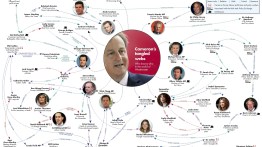
How do you get from David Cameron to Simon Cowell in two, easy steps? Answer: Andy Coulson. The former News of the World editor is, of course, Cameron's director of communications – but he also happens to be on friendly terms with the X-Factor impresario. We set out this, and all the other tangled relationships around the Prime Minister, in a spider graph for this week's magazine. From Nick Clegg to the designer Anya Hindmarch, from Steve Hilton to Baroness Ashton: it's not a map of the government, but rather of the people both in and around No.10 who form what we call the New Establishment. To see them in their entirety, all CoffeeHousers need do is click on the image above, or download a pdf .

More encouragement for George Osborne

From our UK edition

If there’s one thing the financial crisis has proved, then it’s that the heads of global financial institutions are fickle with their favour - for stimulus one minute and against it the next. Still, I suppose every little helps. Last night, Robert Zoellick, President of the World Bank spoke to Jeff Randall and gave George Osborne a resounding vote of confidence.

Delaying the cuts

From our UK edition

Put aside all the post-match analysis of David Cameron's speech: the most intriguing story in the papers this morning is this one in the FT. It claims that the Treasury is working on plans to "reprofile" the spending cuts, which basically means "delay" them. The idea would be to push the bulk of the cuts back to the end of this Parliament. And the underlying concern is, apparently, that early cuts could trigger various financial penalties, such as those for breaking contracts. The paper even suggests that ministers are worried that, "deep deficit reduction in 2011-12 could undermine the fragile recovery." The Treasury have firmly denied the story, and I'd certainly be surprised if we saw significant delays in the cuts.

Britain’s welfare families

From our UK edition

We have a new facts and figures column in the magazine, Barometer, and I thought CoffeeHousers might like a preview of one of the data series we have dug up for tomorrow’s edition. George Osborne has this week pledged that, from 2013, no family on benefits should receive more than the average family does through work. But how many will it affect? Those living in expensive areas, for example, but also those with large families. CoffeeHousers may remember Karen Matthews, who lived on benefits with seven children. She was demonised, understandably, but I was left thinking: we paid her to do that. The more kids she has, the more money she received – so shouldn’t the system take some of the blame?

Cameron stumbles onto the stage

From our UK edition

Who'd have guessed that David Cameron would go into his conference speech on the backfoot? This was supposed to be a moment tinged, if anything, with jubilation: the first Tory PM for thirteen years addressing a party that seems to have fallen in love with him. But instead we've got the child benefit row, and with it apologies, rebuttals and hasty repositioning. It is to Cameron's credit that he can breath the two words that evade other, more culpable politicians: "I'm sorry". But on the eve of his big speech? Far from ideal. This exercise in damage limitation may have slightly eased Cameron's situation today – but it has put him in a more difficult long-term position.

Taxing issues

From our UK edition

Today was a reminder of the tax change that would give Tory re-election chances a massive boost, raising the threshold at which the higher rate kicks in. Indeed, electorally dealing with this is far more important than the abolition of the 50p rate and has been made more so by the decision to link the withdrawal of child benefit to the higher rate. During Gordon Brown’s time at the Treasury, the number of people paying the higher rate almost doubled - principally because of fiscal drag, Brown didn’t link the threshold to earnings. This means there are a whole slew of people paying higher rate tax who are comfortably off but are not members of the super rich by a long stretch.

Is there an alternative to cutting child benefit?

From our UK edition

Beware a mother scorned. George Osborne’s copping some stick on Mumsnet, social forum for the Latte-drinking classes, and with good reason. 'Hard-working families’, many of them far from rich, will feel abandoned by the party that ought to be theirs. IDS, Cameron and Osborne have taken a huge a political gamble, as James noted earlier, and they have also taken an enormous social risk. It is telling that the Centre for Social Justice, IDS’ think tank, are lukewarm about the proposal, describing it as ‘probably appropriate’ but calling for an alternative.  Skipping through the comments on Mumsnet and you can see why.

Welfare dominates Osborne’s speech

From our UK edition

George Osborne delivered everything we expected, and then some. This was a confident and wide-ranging speech from a Chancellor who has suddenly discovered a central message: what's right about burning £120 million of taxpayers' cash in debt interest payments every day? Wouldn't it be better to get to grips with that waste as soon as possible? And that message percolated down through everything from his attack on Ed Miliband to his case for reforming our public services. "It's like a credit card," Osborne growled, "the longer you leave it, the worse it gets." But if that was the theme of Osborne's symphony, then the motif was certainly welfare.

Osborne’s benefit risk

From our UK edition

George Osborne’s announcement that child benefit will be taken away from any family with a higher rate taxpayer in it to help fund welfare reform shows how far Cameron and Osborne were prepared to go to keep Iain Duncan-Smith on board. During the campaign and in the Budget, Cameron and Osborne had strongly implied that child benefit would remain universal. The move carries it with considerable political risks. The measure takes effect from 2013, so before the country will have seen the benefits of welfare reform.