George osborne

The Autumn Statement: What you need to know

From our UK edition

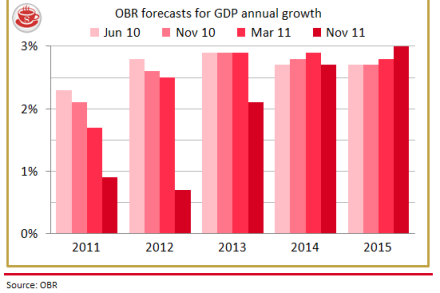
We've been posting some of these charts on Twitter, but here they are, collected, for CoffeeHousers. You can expect more as we mine deeper into the OBR's supplementary document. Do shout out, also, if you spot anything yourself. 1. Weaker growth — except for a very optimistic figure for 2015 2. Higher debt — both in real terms and as percentage of GDP   3. Osborne borrowing more than he'd hoped 4. More persistent — and deeper — ILO unemployment 5.
On the road to break-up?

From our UK edition

Before we plunge into the Autumn Statement, we really ought to mention the poison cloud hanging over Brussels today. European finance ministers, including George Osborne, are meeting there later — and it's certainly not going to be good for their collective health. Klaus Regling, the head of the European Financial Stability Facility (EFSF), is expected to tell them that there's basically no chance of them boosting the bailout fund to €1 trillion in the near future, as was promised at the end of last month. Back then, David Cameron urged eurozone leaders to bring a ‘big bazooka’ to the fight. They have barely managed a cap gun. This is far from surprising.

Your Autumn Statement check-list

From our UK edition

I very much doubt today’s Pre-Budget Report will be memorable; a shame, given the circumstances. The supplementary Office for Budget Responsibility document will be more interesting — and relevant to people’s lives — than the Budget itself. Sure, everyone focuses their attention on the Red Book (or Green Book, as it is for the PBR) and GDP projections. But even GDP isn’t really useful. You can manipulate GDP by printing money, or by borrowing money. Gets you nowhere. GDP is only useful insofar as it’s a proxy for national prosperity. And thanks to the OBR we’ll have other, more useful metrics today. Here's my guide to them:   1. Net debt: up or down? How much will national debt rise by? It’s due to hit £1.

Osborne has a few cards up his sleeve, but no aces

From our UK edition

In some ways, George Osborne will always be haunted by his 2007 Tory conference speech. That speech and the reaction to his commitment to raise all estates worth less than £1 million out of inheritance tax contributed to Gordon Brown not calling an early election. It has a claim to be one of the most important speeches in modern British politics — it is certainly the one that saved the Cameron project. But it has also created an expectation that Osborne has a set of aces up his sleeve every time he stands up to give a big speech. Tomorrow’s speech won’t see the Chancellor pull out any unexpected trumps.

Tobin tactics

From our UK edition

The biggest bone of contention between the UK and its EU allies these days is the ‘Tobin tax’, the idea of levying a tax on financial transactions. To the UK this is folly. Unless it is levied globally, a tax will force business to move elsewhere. And there is a greater chance of Silvio Berlusconi being elected ECB chief than the Tobin tax being levied globally.   Based on the experiences of Sweden in the 1990s, the tax will achieve none of what its proponents believe it will — and at a considerable cost to Britain's and Europe's economy, as companies look to list elsewhere to avoid it. As Ryan Bourne from CPS points out, even the European Commission found that the tax may hurt the economy. The EC thought it could reduce Europe's GDP by up to 1.

Why infrastructure isn’t a magic tonic for the economy

From our UK edition

Growth plans are a high growth industry — with every day bringing yet another set of ideas, from one quarter or another, for how the government can fix the economy. And one suggestion pops up quite frequently in all these plans: bring forward spending on infrastructure. This is often presented as a simple thing to do, with few (if any) downsides. But how realistic is this? We know that infrastructure is important for growth. Economic texts generally suggest that the ‘multiplier effect’ (when government spending leads to more private spending later on) from is higher for infrastructure spending than for spending in other areas, such as health and welfare. We also know that the UK’s infrastructure needs to improve.

The shape of the Budget battleground

From our UK edition

There are still two days and a couple of hours to go until George Osborne's Pre-Budget Report — but, already, we have a good idea of what will be said. The emphasis, beyond just plain ol' jobs and growth, will be on combatting youth unemployment; helping smaller businesses; and relaxing the squeeze on middle-income folk. Most of the measures either announced or suggested so far — from the Youth Contract to the credit easing scheme to the suspension of January's fuel duty rise — fall into one of those compartments. Whether they'll work or not is a different matter entirely.      As for Labour's response, they're already making it — and I doubt anything in the actual Budget document, or the growth review, will change it much.

Wrestling over cuts

From our UK edition

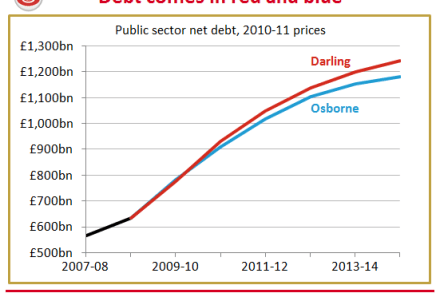
Britain's economic debate has been reduced to WWE-style wrestling, where two figures adopt semi-comic personas and have at each other for the entertainment of the crowd — while not doing any real fighting at all. So it is with Osborne and Balls. Rhetorically, they are poles apart; one championing cuts, the other spending. But you'll notice that neither quantifies the cuts. That's because Osborne is simply enacting an only-slightly-souped-up version of Darling's plan and the real difference between the two parties is tiny. This was the point of last night's Newsnight, where David Grossman filed a report (in which yours truly was interviewed) about the great pretend fight between two parties whose plans only differ by less than 1 per cent a year.

Without growth, Osborne’s best-laid schemes will go awry

From our UK edition

Strikes, Olympic boycotts and obesity league tables — it's a dreary set of newspaper front covers this morning. But none of them are quite so dreary as the Telegraph's, which speaks of ‘The return of recession’. According to their story, the OECD has told ministers that its latest set of forecasts, released on Monday, will have the UK economy shrinking for the first six months of next year. They're not the first forecasting organisation to suggest a double-dip — going by the Treasury's overview of indpendent forecasts, Schroders Investment Management have economic ‘growth’ at -0.4 per cent in 2012 — but they are the most prominent so far. Shudder ye might. Of course, one forecast does not make a recession by itself.

The dangers of ever-closer union

From our UK edition

Yesterday, Fraser wrote that 'reporting of European issues tends to ignore public opinion'. Today, Philip Stephens has neatly illustrated Fraser's point in his Financial Times column. Musing on Britain's possible exit from the European Union, Stephens writes: 'I am not sure this is what the prime minister intends; nor, when it comes to it, that British voters will accept such an outcome.' Stephens' conjecture ignores the European Union's own polling, which, as Fraser says, shows most Britons to be hostile to the EU. That said, Stephens' article is substantial. He argues that 'fiscal union carries its own remorseless logic: the progressive exclusion of Britain from Europe’s economic decision-making'.

Osborne chooses more debt over more cuts

From our UK edition

Reading today's newspapers, it seems that the biggest decision of Osborne's mini-Budget has already been made. Evaporating growth means lower tax revenues, so the choice is between protecting his deficit reduction plan or keeping total spending cuts at less than 1 per cent a year. Increasing savings to, say, 1.3 per cent a year would mean he could easily meet his deficit targets. But it seems the decision has been taken to borrow even more. In his March budget, Osborne laid out plans to increase government debt by 51 per cent over the course of a parliament – lower than the 60 per cent that Labour had planned. It now looks as if Osborne will increase debt by even more than that 51 per cent.

The vote in Spain

From our UK edition

The expected triumph of the centre-right Popular Party in today’s Spanish elections promises to have some interesting consequences for British politics. The PP have been in close touch with the Tories here and plan to introduce an emergency budget based on the Osborne model: a clear deficit reduction plan combined with an increase in the retirement age. They hope that this will reduce the ever-upwards pressure on Spanish bond yields. Certainly, if the PP approach does succeed in gaining Spain credibility with the bond markets, it will bolster the coalition’s arguments about the importance of sticking to Plan A.

Assessing the sick

From our UK edition

Should GPs determine whether people on long-term sick leave are too ill to work? Perhaps not, according to the draft copy of a government-commissioned review into sickness absence. It proposes setting up a new, separate and independent body to assess those on long-term sick leave, on the grounds that doctors have no incentive — nor, perhaps, the specific knowledge — to prod and coax them back towards employment. The new service, it is said, would advise sick leavers, and their employers, about just what they can and can't manage. If the government does introduce this, it will be another sign of their intent to untangle the problems with sickness benefits.

What does the ‘carbon floor price’ mean? More emissions and fewer jobs

From our UK edition

After the Conservative Party Conference, Fraser described this statement in George Osborne’s speech as the Osborne Doctrine: ‘Let’s at the very least resolve that we’re going to cut our carbon emissions no slower but also no faster than our fellow countries in Europe.’ The Government’s current climate policy clearly fails that test, as I set out for this site at the time, and there is no more egregious violation than the carbon floor price. It is one of those policies that can sound reasonable in theory: the EU Emissions Trading System creates a carbon market. That market produces a carbon price that is supposed to encourage business to invest in cutting emissions by doing things like building nuclear plants.

Some context for the ongoing growth debate

From our UK edition

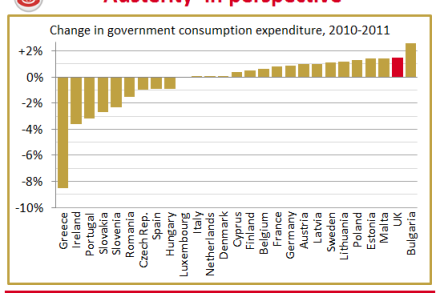
Listening to Ed Miliband's speech today, you'd be left with the impression that the UK is suffering a huge decline in government spending this year, and that this is to blame for most of our economic ills. The facts are a little different, as the below chart shows. The European Commission estimates that the UK is likely to have the second largest growth in government spending of any of the EU’s 27 members this year, clocking in at a robust 1.5 per cent increase for the year. Yet this has done nothing to help the UK’s relative growth performance. The UK is forecast to be the fifth slowest growing economy in the EU this year, ahead of only Greece, Portugal, Cyprus and Italy.

Some advice for Osborne

From our UK edition

In the latest issue of the magazine, a flock of politicians, commentators and economists offers George Osborne some advice for growing the economy. There are ten contributions in total, but here are three for CoffeeHousers' consideration: Arthur Laffer Chairman, Laffer Associates Cut the 50p tax Reducing the burden which government places on the economy, through tax cuts, is the surest way to promote growth. I have never heard of a country that taxed itself into prosperity. Yet Britain last year raised the top rate of income tax from 40 per cent to 50 per cent. For more economic growth, and more tax revenue, this rate should be lowered immediately.

Osborne sells off the Rock

From our UK edition

‘Sir Richard Branson set to buy Northern Rock.’ So read the headlines in November 2007 — and now they're finally true. It has been announced this morning that Virgin Money is going stump up £747 million to return the bank to the private sector. This, says George Osborne, ‘is an important first step in getting the British taxpayer out of the business of owning banks.’ By the looks of it, Virgin will be paying less than they would have done four years ago, but they have also had to make various assurances about how they will handle the Rock. When Branson's bid failed in 2007, and the bank was nationalised, it was because the government started worrying about what they saw as 'extortion' on Virgin's part.

Cameron stamps on the SpAds

From our UK edition

David Cameron summoned all Tory special advisers to Downing Street for a meeting this afternoon. He wanted, I understand, to warn them that too much of the coalition's internal workings were being briefed out to journalists. He made it clear that he wants an end to process stories appearing in the papers.   Downing Street has been infuriated by recent reports of tensions between Steve Hilton, Cameron’s senior adviser, and George Osborne and is keen to stamp on anything that keeps this — rather misleading — story going. There are also worries about the party being seen as divided again, a return to the old Tory wars stories of the 1990s.    Interestingly, Cameron said that he did not think that many leaks came from officials.

Halfon seeks to cool the inflationary fires

From our UK edition

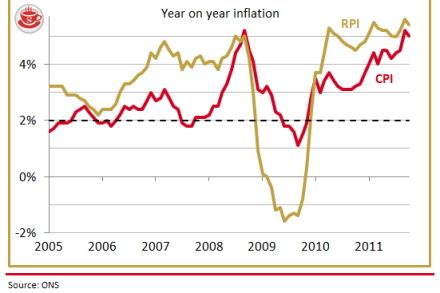
Don't whip out the cava just yet, CoffeeHousers. Inflation, in both its CPI and RPI incarnations, may be down on last month's figures, but the latest numbers are hardly cause for jubilation. At 5.0 per cent in October, CPI is still over double the Bank of England's target figure, and it's far outpacing the average growth in people's wages. The truth is that living costs remain constrictive, and at a time when the economy could teeter back into cataclysm at any moment.      Hence Robert Halfon's motion on fuel prices, which will be debated in the Commons today. It's another one of those motions triggered by an e-petition (112,189 signatures and rising), and it makes a simple plea: people are struggling, so how about doing more to cut the cost of fuel?

Alexander drags Labour closer towards the Tories on Europe

From our UK edition

You know, having read through Douglas Alexander's Guardian article a couple of times now, and listened to his appearance on the Today programme earlier, I'm still not sure how Labour's new stance towards Europe is particularly different from the official Tory one. The shadow foreign secretary tries to suggest that Dave and George's position is reckless — ‘they seem worryingly complacent about the prospect of a two-speed Europe’ — but he goes on to echo much of it himself. And so, he suggests, ‘We should engage now with the fact that Germany is seeking treaty change and seize this opportunity to safeguard the rights of non-euro members.