George osborne

Peston: Hester will not take bonus

From our UK edition

Stephen Hester’s decision to waive his bonus, revealed by Robert Peston just after 10 o’clock, will be a source of great relief to David Cameron and George Osborne. A story that could have dragged on for weeks, undermining their argument about fairness has just lost most of its potency. Ed Miliband, though, will be able to claim — with some justification — that it was the threat of a Commons vote on the matter that led to Hester renouncing his bonus. But this isn’t quite the end of this business. There’s now the question of what happens to the bonuses for other members of staff at RBS and then there is next year’s round. There’s also the whole issue of RBS’ status.
Osborne needs to come up with radical growth policies, and soon

From our UK edition

When it comes to defending the free market, and making the case for fiscal sanity, there's scarcely anyone better than David Cameron. He was on superb form in Davos yesterday, giving much-needed blunt advice to the continentals. ‘Eurozone countries must do everything possible to get to grips with their own debts,’ he said. And he's right. The snag, as I say in my Daily Telegraph column today, is that Cameron's definition of getting to grips with debt involves increasing it more than Labour planned to, more than France, Germany, Italy or Portugal. On the first sign of trouble, his government gave up on its deficit reduction timetable – it will now halve the deficit over five years, whereas Darling promised to do it in four.

A Lib Dem demand that the Tories should get behind

From our UK edition

Remember those Lib Dem calls for a mansion tax at the weekend? I said at the time that, ‘the Lib Dems appear to be drawing more attention to which of their own policies they are fighting for within government, whether those policies make it to the statute books or not.’ Well, now they're at it again. Nick Clegg is giving a speech this morning in which he'll urge George Osborne to go ‘further and faster’ in raising the income tax threshold to £10,000 a year. It was the stand-out policy of the Lib Dem manifesto, so it's hardly controversial that Clegg should want to see it enacted ASAP. But it's still striking that he's making this appeal in public. A year ago, he'd have emphasised what the coalition was already doing to raise the threshhold.

Europe gives Osborne the context he needs

From our UK edition

The political implications of today’s growth numbers are complex. On one level, a contraction in the economy should provide Miliband and Balls with an opportunity to make their economic case against the government. Indeed, Balls is already out with a statement calling the GDP figures a ‘damning indictment of David Cameron and George Osborne’s failed economic plan’. I suspect that Miliband is also looking forward to PMQs rather more than normal.   But on the other hand, as long as Cameron and Osborne enjoy a big lead on the economy — 18 points in the last ICM survey — bad economic news will reinforce voters’ tendency to stick close to nurse for fear of something worse.

Bad news doesn’t have to be surprising

From our UK edition

I'm still of the mind that Westminster fusses too much about these quarterly growth figures, particularly when parts of the country have been in economic decline for decades. But there's no doubting that they have the capacity to shift the political mood, both here and around the country. There is something disheartening about the idea that the economy returned to shrinkage in the final quarter of last year (even if today's preliminary figure of -0.2 per cent might be revised upwards, or downwards, in due course). You can expect Ed Miliband to make much of it in this afternoon's PMQs. The politics of the situation are not stacked entirely against George Osborne, though. His major consolation today is that everyone expected this sort of minor contraction.

Osborne owes Darling an apology

From our UK edition

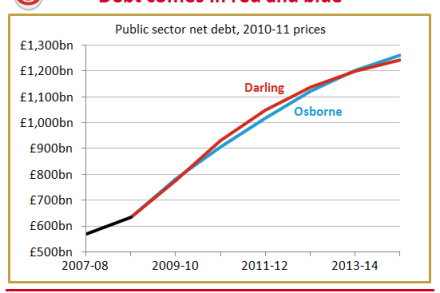
Britain's national debt rose to over £1 trillion last month, and will never return below this threshold. George Osborne is increasing net debt by 61.5 per cent in real terms over this parliament, more than the 59.9 per cent which Labour proposed when it fought the last election. Here's how the OBR's current projections for debt contrast with what Darling proposed in his last Budget: At the time, Osborne said Labour's debt plan was reckless and unsustainable. I think he owes Alistair Darling a generous apology. Then, Darling said he'd halve the deficit over four years. Too slow, said Osborne. Now, he's taking five years to do it – as the below graph shows: Osborne has kept to his spending plans, which cut departmental totals by 2.

Cameron’s capitalism

From our UK edition

Ever since Ed Miliband’s ‘predatory capitalism’ speech at the Labour Party conference, the future of capitalism has been a subject that has much occupied our MPs. Clegg made his speech on Monday, and Cameron delivered his yesterday. I have had plenty to say about the coalition government’s inadequate economic policy, and its inability to stoke growth. But Cameron’s speech was impressive, and it’s worth going into in some detail. I look at it in my Telegraph column today. Much rot is spoken about capitalism. It is not an ideology, there is no rule book you can tweak: it is simply the name given to the system where people trade with each other the world over.

Scottish independence by numbers

From our UK edition

It's far from the first poll on Scottish independence in recent years, or even in recent days, but YouGov's effort for Channel4 this evening contains some noteworthy findings nonetheless. What is does is replicate the conditions that — for the reasons that Peter Kellner explains in a very useful blog post here — Alex Salmond would like in 2014. Which means two questions, one after the other. First, status quo or ‘devo-max’? Second, status quo or full independence? And the results? By YouGov's count, 58 per cent of people are in favour of ‘devo-max’ for the first question, with 42 per cent against. And, for the second question, 39 per cent back full independence, with 61 per cent against.

Osborne visits China, but can’t escape Europe

From our UK edition

Yet another day here in Westminster that's all about the economy. Nick Clegg has just delivered a speech on the subject to Mansion House, focusing on ‘responsible capitalism’, which we'll blog shortly. And two prominent forecasting groups, the Ernst & Young ITEM Club and the Centre for Economic and Business Research, have suggested that we're effectively back in recession. They both reckon that the economy shrank in the final quarter of last year, and is wilting even further in this current quarter. But, like the OECD, they also predict that this ‘double dip’ will be relatively short-lived and relatively mild. Against that backdrop, enter George Osborne.

Labour’s new strategy in the cuts blame game

From our UK edition

Even as Ed Balls embraces the need for austerity today, he takes a very different position to the coalition on why it’s necessary. The government has always blamed the need for cuts on the ‘awful economic inheritance’ bequeathed it by Labour. Balls, on the other hand, puts the blame squarely at George Osborne’s door. In his Fabian Society speech, he said: ‘George Osborne’s economic mistakes mean more difficult decisions on tax, spending and pay.’ His argument is that, by cutting ‘too far and too fast’, the coalition has caused the economy to stagnate and thereby created the need for more austerity. Labour has, of course, long been trying to shift the blame for the cuts away from themselves and onto the coalition.

Simon Hughes speaks out against the benefit cap

From our UK edition

In the Cameroon effort to redefine the politics of fairness, the benefit cap of £26,000 a year is key. When George Osborne announced it in his 2010 conference speech, he explained it – rightly – as a matter of fairness that ‘no family on out-of-work benefits will get more than the average family gets by going out to work’.   The Tories were also aware of just how potent a wedge issue it would be. If Labour opposed the cap, they would be in favour of some households in which no one is working receiving more from the state than the average salary people achieve by working. This is, to put it mildly, not a position that would go down well on the doorsteps.   But the cap has hit a snag: Simon Hughes.

Balls’ attempt at credibility falls short

From our UK edition

‘I must be responsible and credible in what I say.’ No, it's not Bart Simpson writing on the blackboard at the start of The Simpsons, although it may have been said with just as little enthusiasm. It's Ed Balls on the Today programme this morning, explaining his decision to endorse George Osborne's public sector pay freeze. Balls' interview in today's Guardian is his biggest effort so far to sound 'responsible and credible' on the economy.

Osborne sparks the unionists’ fightback

From our UK edition

Edinburgh It became clear last night why George Osborne was put in charge of the Coalition Government’s fightback against Alex Salmond and separatism: he is the only one who has the ability to really score points off the Nats. The Chancellor’s intervention on currency and bank notes – suggesting that an independent Scotland might not be able to keep the pound and that, if it did, it might be banned from producing Scottish bank notes – hit the SNP hard. Osborne’s remarks shook one of those comfortable certainties which the SNP has been peddling for so long – that Scotland would simply keep sterling after independence and everything would progress as normal.

Osborne the Unionist

From our UK edition

There’s much chatter in Westminster today about the fact that George Osborne is chairing the Cabinet committee on Scotland. Osborne is, of course, the Conservatives’ chief electoral strategist as well as the Chancellor of Exchequer. This has led to some suggestions that he wouldn’t be too upset by a referendum defeat that would make it an awful lot easier for the Tories to win a majority at Westminster. This is unfair: Osborne is a Unionist. What those around Osborne have long been interested in is the option that the coalition seems to be ruling out: fiscal autonomy. The circle around Osborne have long believed that it is only when Scottish politics is about how to raise money as well as how to spend it that the Tories will revive north of the border.

Cameron’s fairness agenda

From our UK edition

The politics of the ‘undeserving rich’ is again dominating the news this morning. David Cameron tells the Sunday Telegraph that ‘The market for top people isn’t working, it needs to be sorted out’. While the Mail on Sunday reports that George Osborne is planning to create a new criminal offence of ‘criminal negligence’ that could be used against those bankers who endanger the financial system. Perhaps the most significant aspect of Cameron’s Sunday Telegraph interview, though, is his attempt to redefine ‘fairness’. Cameron has tried to do this before, arguing that it isn’t just about redistribution but about people getting out what they put in.

The cross-party talks that may test the coalition

From our UK edition

Whenever politicians talk about social care, they tend to promise ‘cross-party talks’. It's their little euphemism for ‘we don't want to commit to a policy by ourselves.’ Don't get them wrong, it's not that they don't have ideas for fixing a system that is straining under the weight of an ageing population; the Dilnot report, released earlier this year, gave them plenty of recommendations to work with. It's just that they don't want to be the ones to implement the tax hikes or spending cuts that will be necessary to fund it. If they can talk it through with the other parties — the thinking goes — then this crucial policy area can be detoxified, the blame spread more or less evenly.

Miliband’s New Year message: The same, but different

From our UK edition

Well, folks, the 2012 model of Ed Miliband looks and sounds rather like the unfancied 2011 model. Just compare the New Year message that he released today with the one that he issued a year ago; the similarities are plenty. His main argument this year is that the Tories are the party of gloom — resigned to years of stagnancy, unemployment, pestilence, etc — whereas Labour are the party of a bright new future, there to show that ‘optimism can defeat despair’. Or, as he put it at the end of last year, ‘Even in these tough times, we must keep the flame of optimism burning.’ There are some differences, though. Compared with last year, Miliband talks much less about the coalition going ‘too far, too fast’ with deficit reduction.

A sliver of Christmas comfort for George Osborne

From our UK edition

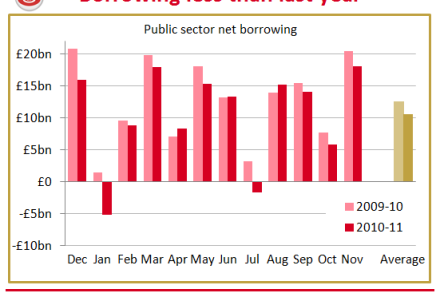
There's some rare good news for the government in today's public finance statistics. Public sector net borrowing in November is estimated at £18.1 billion, down from £20.4 billion last year. This means that total borrowing for the first eight months of this financial year is £88.3 billion, down 11 per cent on last year. That's lower than expected, and puts us on target to undershoot the OBR's forecast of £127 billion in 2011-12. That'd be a relief for the coalition, after Labour hit them hard when the OBR upped their borrowing forecasts last month. But this deficit reduction cannot be put down to spending restraint in Whitehall. In fact, central government is spending around £1 billion a month more than it did last year.

Another fine mess at HMRC

From our UK edition

Today's report by the Public Accounts Committee hasn't so much been released as detonated onto the Westminster scene. The Exchequer is owed around £25 billion, it suggests, from major companies that have been handled too leniently, or just plain wrongly, by HM Revenue & Customs. And much of the blame is attached to Dave Hartnett, the outgoing civil servant in charge of revenue collection. Interviewed on the Today Programme earlier, the chair of the committee, Margaret Hodge, implied that Hartnett had too ‘cosy’ a relationship with big business.

Obsorne’s banking reforms are only the start of a solution

From our UK edition

‘The most far-reaching reforms of British banking in modern history.’ That's how George Osborne called it in Parliament this afternoon, in a statement that contained few surprises. What the government's doing, in large part, is to follow exactly the recommendations contained in September's Vickers Report. But is that really as far-reaching, or as radical, as the Chancellor would have us believe?   Certainly, many of these reforms are encouraging: measures such as ‘bail-ins’ and ‘living wills’ should facilitate the orderly winding-up of insolvent institutions, and reduce the necessity for taxpayer bailouts. But other parts of the government's reform package are less convincing.