George osborne

Son of Brownies

From our UK edition

How generous of Ed Balls to publish a transcript of his interview on the Politics Show earlier, so that we can amble through it on a Sunday evening. It contains, as you'd expect, more disagreeable parts than agreeable, and nothing more so than his comments about the national debt, deficit and all that. Two of his arguments, in particular, are worth alighting on because they're Brownies in the classic mould, and will probably be served up again and again: 1) ‘After the Second World War we took a number of years to repay our much higher level of debt. The government and Vince Cable have tried to get this done in one Parliament and it is backfiring.

If Clegg wants to reduce youth unemployment, then he’s going to have to look at regulation

From our UK edition

Nick Clegg’s interview in The Times today presages a major Lib Dem effort to try and promote policies to reduce youth unemployment. With figures out on Wednesday expected to show youth unemployment going over a million, the Lib Dem leader is keen to show that the government is acting. But as The Times reports, the quad—Cameron, Osborne, Clegg and Alexander—are divided on what to do about the matter. The Tories are keen to do Beecroft for young people, removing some of the employment protections that make firms so reluctant to hire new staff. But given how the Lib Dems have set themselves so firmly against the Beecroft review and its principal idea of replacing unfair dismissal with severance pay based on length of service, they won’t accept this.

Britain: a safe haven?

From our UK edition

The Bond Bubble is growing even larger over Britain, pushing 10-year yields down to 2.1 per cent. The FT splashes on it this morning, and uses the “safe haven” line, which is also being advocated by the Conservatives. Understandably. If I were George Osborne, I’d spin this as a standing ovation from the markets for my deficit reduction plan. In fact, it’s just a grim reflection of the fact that Britain’s low-growth, high-debt economy is less unattractive than Italy’s. But it does have another side effect, that people won’t quite admit to. Osborne’s cost of borrowing is going down (partly due to expectations of more QE) and since the Budget, ten-year yields are off about 130bp.

Osborne gets frank with Europe

From our UK edition

George Osborne’s attack on the European Commission and his fellow finance ministers, for wasting time talking about a financial transactions tax when it is not going to happen, is quite a significant moment. It marks an attempt by Britain to knock this idea, which would hit this country far harder than anywhere else in Europe, off the agenda.   The Treasury, the Foreign Office and Number 10 have become increasingly exasperated about how this issue keeps coming up again and again. This feeling has been intensified by the fact that this issue is being discussed even as the crisis in the Eurozone is worsening by the hour.

Palestine presses on in the UN

From our UK edition

While the Palestinian bid for membership at the United Nations moved closer to rejection, it turned out that Palestine has a veto over which UN agencies the United States funds. For after Palestine gained admission to UNESCO, the US administration followed through on its threats and cut the organisation's funding. As UNESCO is based on assessed contributions from member-states, others cannot make up the short-fall. The Palestinian Authority is now considering making applications to the WHO, WIPO and the International Telecommunications Union – technocratic bodies that actually play a large in role. For example, the WHO is crucial for dealing with global pandemics like SARS and Swine Flue.

The euro is destroying Europe

From our UK edition

This week's issue of The Spectator hits the newsstands today. Here, for CoffeeHousers, is James Forsyth's Politics column from it: Last week’s rebellion by David Cameron’s backbenchers in support of an EU referendum ended eight years of peace in the Tory party on the European question. Now, the offer by the Greek Prime Minister of a referendum on the bailout package — designed to appease nervous Greek Socialist party backbenchers — means that the uncertainty surrounding the eurozone will drag on into the New Year. George Osborne regards the confusion surrounding the future of the single currency as the single biggest obstacle to a British economic recovery.

Growth hits 0.5% in Q3 — a nation shrugs

From our UK edition

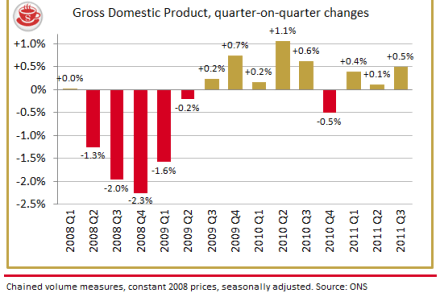
The growth number for the third quarter of this year is out, and it's a little bit better than expected: 0.5 per cent. Many economists were saying that we'd have to hit around 0.4 per cent to recoup the growth lost to the Royal Wedding and Japanese Tsunami in Q2, so we've managed that. But, that aside, this is not the time for party poppers and champagne corks. It may not be Econopocalypse, but it's not Mega Growth either. We are still living in a bleak, borderline stagflationary environment. Besides, I still reckon that we oughtn't get especially worked up about these quarterly figures anyway. For starters, the obsession over micro-percentage points can obscure the fact that many parts of the country are already in effective recession — and have been for decades.

Breaking: Ed Balls has a point

From our UK edition

The games have started a day early, folks. The latest quarterly growth figures are set to be released tomorrow morning, but already Ed Balls is waxing insistent about what they have to be: "Simply to stay on track for the Office for Budget Responsibility’s most recent forecast, already downgraded three times, we will need to see growth in the third quarter of 1.3 per cent. And to reach the OECD’s latest and more pessimistic forecast, we will need to see a figure next week of 0.9 per cent." To be fair — and this is not something you'll read often on Coffee House — the Shadow Chancellor has a point, although he's not making it explicitly. When he says that growth needs to hit 1.

Clegg’s tall tales won’t boost growth

From our UK edition

“The Deputy Prime Minister, Nick Clegg, will today announce proceeds from the government growth fund which will protect or safeguard 200,000 jobs.” This sentence contains everything that’s wrong about this government’s schizophrenic approach to economic recovery. Rather than cut taxes and let the economy grow, they increase tax — and then give people back a portion of the cash, expecting to be thanked as they do so. And, for good measure, dropping in a spurious jobs number. Nick Clegg was on the Today programme this morning, showcasing the phenomenon that retards so many economies: politicians seeking credit for giving one man’s money to another.

The Great Repatriation Question

From our UK edition

And the word of the weekend is ‘repatriate’. Not only do we have yet another poll showing that the British public, when asked, would prefer to tug powers back from Brussels, but there's also this eyecatching story in the Daily Telegraph. No.10, we're told, is pushing Whitehall departments to determine just exactly where Europe's influence could be counteracted. There is also a backbench group of Tory MPs providing covering ideas.  So why hasn't this been happening before now, particularly given how frustrated those around David Cameron have become with the constant torrent of EU directives? Part of the answer is that the events of the past week have made all this more urgent. But part of it is that, actually, this work has already been going on in Whitehall.

The government’s European tribulations continue

From our UK edition

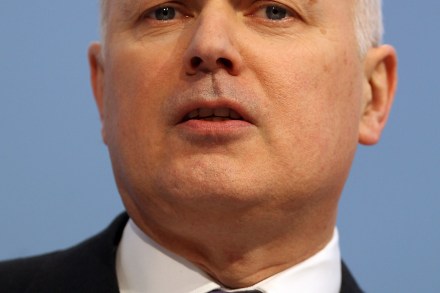
It has been a fraught and ill-tempered week in Westminster. And — whether it is the rumour that Tory backbencher Andrea Leadsom told George Osborne to "f**k off", or David Cameron's dismissal of Ed Miliband as a "complete mug" — most of it has had Europe at its root.  So it is, too, with the latest news of government strife. Iain Duncan Smith, it's reported, had a ferocious row with the Tory chief whip, Patrick McLoughlin, over the EU referendum . Apparently, he warned that, “If you ever put me in this position again, that’s it”. As it happens, there is more on IDS's disgruntlement in Charles Moore's column for the latest Spectator, out today.

Cameron battles it out

From our UK edition

David Cameron came out swinging today at PMQs. Knowing that Ed Miliband would try and exploit the Tory rebellion over Europe on Monday night, Cameron went for the Labour leader. He called him a "complete mug" and mocked him as being detached from reality. At the end of the exchange, Osborne gripped Cameron's shoulder in congratulation – a sign that the pair knew that they needed a strong performance today to calm their backbenches. The other notable aspect of PMQs was its emphasis on the new political battleground: women. The Labour MP Gloria Del Piero asked the PM why the government was more unpopular with women than men, which gave Cameron a chance to rattle off the government's female-friendly initiatives.

Cable’s latest embarrassment

From our UK edition

"None of this will stop me talking out against tax avoidance." So says Vince Cable, rather hilariously, in response to being fined £500 for failing to pay £25,000 of VAT on his media work. You've got to hand it to the Business Secretary: it is an ingenious, if convoluted, way to top up the public finances. Although there are questions about whether other people would have got off quite so lightly.    You might say, as Vince's people are this morning, that this is the sort of mistake that can befall anyone — particularly someone so busy as a Cabinet minister. But this isn't just anyone. This is Vince Cable, who has staggered between embarrassment, inconsistency and insubordination ever since the coalition government was formed.

How to untie the tax knot

From our UK edition

Yet another HMRC scandal this week, as a new HMRC computer discovered millions who have paid too much or too little in tax. A letter from the tax man will land on their doorstep in the next few months. Some will enjoy the dubious pleasure of getting money back that should never have been taken in the first place. Others face the painful task of finding the money to catch-up on tax they didn’t pay before.   As Pete said in his post on Wednesday, this isn't the first time. When the House of Commons Public Accounts Committee looked at similar problems last year, they said that the Department had 'failed' in its duty to process people’s taxes 'accurately and on time'.

The austerity myth

From our UK edition

CoffeeHousers may remember an odd New York Times editorial recently where they tried to blame the evaporation of British economic growth on austerity. Perhaps the newspapers’s famed fact-checkers had taken the day off, because the slightest piece of research would have exposed the premises of the piece as bunkum. This morning, the ONS has produced monthly public finance figures, showing current spending is still rising in Britain.

The government’s never-ending European problem

From our UK edition

We thought CoffeeHousers might appreciate an advanced viewing of James' political column from tomorrow's issue of The Spectator, so here it is: In the hours after the coalition was formed last May, a minister and a group of Tory MPs sat around a table in a parliamentary cafeteria discussing what it all meant. One new MP said to the minister that it was a pity that, in the course of the talks, the Tories had agreed to ‘park Europe for the next five years’. The minister, high on the Panglossian spirit of the early days of the coalition, reassured her that this was for the best. The party could devote its full attention to Europe when the economic situation was less pressing.

Competition: Help Osborne to explain his growth strategy

From our UK edition

Yesterday, Lord Wolfson — the new Tory peer and CEO of Next — made an extraordinary offer: £250,000 of his own money to whoever comes up with the best plan to break up the Euro. It's the second biggest prize in economics, after the Nobel, and a great and patriotic idea from Wolfson, an original and forceful thinker with plenty real world experience from whom I hope we'll hear more. Inspired by this, we at Coffee House would like to make our own offer: a bottle of Pol Roger, our house champagne, to whoever can explain George Osborne's growth strategy. The chancellor needs some help on this front, with some unkind souls suggesting he has no strategy. This is not about suggesting a policy to Osborne — we may have a second competition for that one.

The dawdling eurozone

From our UK edition

For all the attention that is being focused in Westminster on the publication of the Cabinet Secretary’s report into the links between Adam Werritty and Liam Fox tomorrow, the real story is the countdown to Cannes. It is now three weeks since George Osborne declared that the eurozone countries had three weeks to save the Euro. So far, they haven’t done anywhere near enough. There’s also little sign that this weekend’s summit will see them make much progress. The Germans are already busy playing down expectations. From a British perspective, the intriguing question is: what does the coalition do if the eurozone continues to show no sign of getting its act together?

Trust in bricks and mortar

From our UK edition

If George Osborne is serious about growth, a relatively easy decision awaits him: to stimulate the economy by spending more on housebuilding. David Cameron knows there's a problem, and during Tory conference announced a "Tory Housing Revolution" to tackle the failing housing market, and plans to boost Right to Buy and release more land for house building that will deliver 200,000 new homes and create 400,000 jobs. All welcome, suggesting the government has recognised the role that housing can play in creating growth. But if the Treasury is looking to stimulate demand in the short term, there's still much more that could be done. Investment in housing can happen fast.

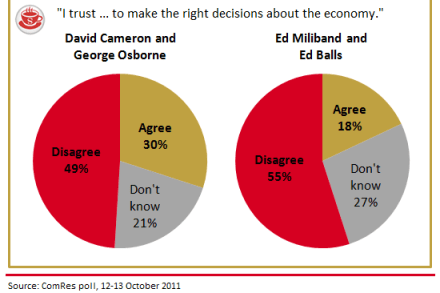
Labour failing to regain economic credibility

From our UK edition

Labour may have a narrow leads in the polls, but they continue to lag behind the Tories on the public's number one issue: the economy. Today's ComRes poll finds that just 18 per cent trust Eds Miliband and Balls "to make the right decisions about the economy", compared to 30 per cent for Cameron and Osborne. Worse, the two Eds don't even have the confidence of the majority of Labour voters: only 48 per cent trust them on the economy. YouGov also find Labour behind when it comes to the economy. 30 per cent think the Conservatives would handle it best, while just 26 per cent think Labour would. And that's despite the fact that 58 per cent of the public think the Coalition is managing the economy badly.