George osborne

Cameron loyalists say his Tory critics are a small minority

From our UK edition

The drumbeat of criticism of David Cameron and George Osborne by various Tory MPs, summed up on the front page of today’s Telegraph, has drawn a reaction from those MPs loyal to the leadership. Kris Hopkins, the founder of the 301 group of Tory MPs, complains that the trouble is being whipped up by a ‘small group of disaffected people’ and that ‘the nature of their criticisms shows that this is about their egos not making the country a better place.’ At issue here is who speaks for Tory MPs.

Now Cameron and Osborne take flak from their own side

From our UK edition

The bad headlines continue for Downing Street this morning, with the Telegraph front page declaring ‘Tory MPs round on Cameron and Osborne’. Of course, Tory backbenchers griping about their leadership is nothing new and, usually, ‘concern that Government policies are being poorly explained to voters’ or a suggestion that ‘a senior MP should be appointed as full-time Conservative Party chairman’ wouldn’t make the front page. But after the two week onslaught Downing Street has just suffered — from granny tax to cash for access to petrol panic to pasties — the disgruntled chattering reverberates that bit louder.

The politics of pasties

From our UK edition

The row over the so-called pasty tax is a proxy. It is really a row about whether David Cameron and George Osborne get what it is like to worry about the family budget each week.   In truth, I suspect that they don’t. But I think the same probably goes for Ed Miliband, Nick Clegg and the vast majority of journalists. Most of the politics of class in Westminster, as opposed to the country, is the narcissism of small difference.   The best thing the coalition could do now is hold its nerve. The Budget did reveal that support for it is shallow. But, as one leading pollster said to me yesterday, if they handle the tanker strike right, they’ll be ahead again by May — the next time anyone is voting in an actual election.

Revealed: the grey recovery

From our UK edition

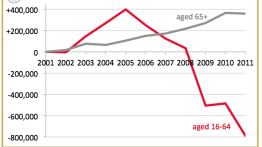
Are pensioners doing their bit for the recovery? The agenda of ‘intergenerational fairness’ has arisen in response to the idea that they are not, and ought to be taxed more. Daniel Knowles has made the case, in our cover story this week. Carol Sarler responds to him. In the leader, we reveal some data hitherto undisclosed: the way the oldies are responding to the recession. They're working as never before — the below graph shows (stripping out foreign-born workers) the change over the past decade: Between 2001 and 2011, all the employment increase for UK-born people was from pension-aged workers, while working-age employment dropped. This challenges the idea of the over-65s as a burden on the rest of society.

Your guide to Osborne’s fiscal rules

From our UK edition

George Osborne's two fiscal rules have been around since his very first Budget, delivered almost two years ago, so they're hardly news. But they do underpin much of what he's done since, including last week's statement, so they're also worth knowing about. Fraser touched on ome of the detail in a post last weekend, but here's a supplementary guide for CoffeeHousers: 1) The deficit rule. This is the one that seems to cause the most confusion, perhaps because it has often been simplified — wrongly — as something like ‘eliminate the deficit by the end of this Parliament’. Fact is, the ‘end of this Parliament’ doesn't come into it.

A plan that could change the face of future Budgets

From our UK edition

‘I’ve never seen a government document with a Laffer curve in it before’, declared Ed Balls last week. Well it looks like he might be seeing a lot more of them, if George Osborne gets his way. Yesterday, as James noted, the Chancellor told the Treasury select committee that: ‘I think the Treasury can now, and I've asked this to happen, start undertaking some real research into dynamic scoring, and what the broader economy effects are of changes to taxation’. Now, it’s hard to get all that excited about something with a name like ‘dynamic scoring’. It was never going to make the front pages, especially when there’s a ‘pasty tax’ to get worked up about.

Osborne opens the door to dynamic costings

From our UK edition

George Osborne’s announcement that the Treasury is going to start looking at the dynamic effect of tax changes is significant. The aim, I understand, is for them to gather data on this which could then be used to work out the costs of various tax and spending changes. This would mean that most tax cuts would, in the Budget Red Book, cost the government less. The decision, though, about what system to use is no longer in the Treasury’s hands. The independent Office for Budget Responsibility now does all forecasts and policy costings so the decision on what model to use ultimately rests with them. Osborne made this announcement in his appearance before the Treasury select committee today, an absurd amount of which was taken up by questions about Budget leaks.

Transparency, not state funding

From our UK edition

Cutting the 50p rate was economically the right thing to do, but the politics of it are hugely complicated. The biggest danger is that it bolsters the sense that the Conservatives are the political wing of the privileged classes. For this reason, it is particularly unfortunate for the Conservatives that it is this Sunday that The Sunday Times has done an expose (£) on how potential donors were being lured with the offer of supper with Cameron and Osborne and the chance to influence policymaking. Labour are already trying to link the two, asking the Prime Minister to ‘provide details of all donors who have made representations, both written and orally, on changes to the 50p tax rate’.

The borrowing behind Osborne’s Budget

From our UK edition

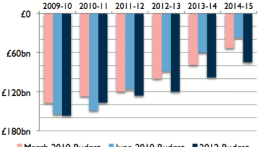
Will George Osborne’s refusal to look again at high levels of state spending become the greatest risk to Britain’s economic stability? There have been plenty of rude comments about the Chancellor’s supposed tactical ineptitude in the weekend press, but he has still managed to keep on borrowing and have almost no one notice. Osborne’s iron commitment is to spending, and a programme of cuts which total just under 1 per cent a year. His commitment to deficit reduction is flexible, as his three Budgets have demonstrated: Osborne spent the election campaign berating Labour for its lack of ambition in halving the deficit in four years. He’s now doing it in five, but no one points this out. Quite a result.

Why access Cameron? The Lib Dems would be an easier target…

From our UK edition

Why would anyone pay £250,000 to change Tory policy when the Liberal Democrats would do it for £2.50 and a hug? The brilliant Sunday Times investigation today makes you wonder whether businessmen don't actually realise that out that, in this coalition, it doesn't matter what you persuade David Cameron of. Policy is decided by horsetrading with the Lib Dems, who wield disproportionate power (for good or for ill). For example, Osborne was personally inclined to bring the top rate of tax down to 40p, but the Lib Dems told him they'd only allow this in exchange for their mansion tax. Cameron refused to do the deal, so 45p it was. The rise in capital gains tax was a Lib Dem demand, and would only be changed by Lib Dem agreement.

The ‘next big scandal’ detonates under Cameron

From our UK edition

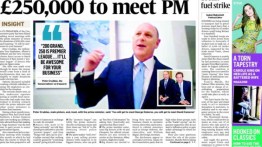
‘It will be awesome for your business.’ So said Peter Cruddas, co-treasurer of the Tory party, as he tried to peddle access to David Cameron for £250,000 a shot. Only he wasn't talking to businessmen this time; he was talking to a couple of investigative reporters from the Sunday Times (£), who were armed with dictaphones and video cameras. And, as the resulting footage shows, he blustered himself over the edge. A ‘premier league’ of donors was spoken of, whose ideas are ‘fed in’ to Downing Street's policy process. There was a claim that the biggest donors can be invited for dinner at Cameron's private flat in No.10, where they can ask him ‘practically any question [they] want’.

What did the public make of the Budget?

From our UK edition

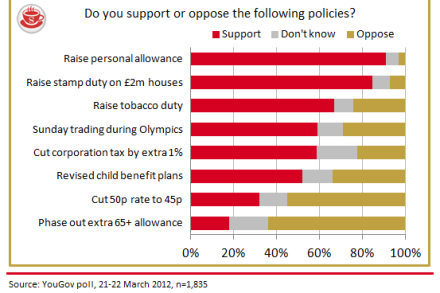
After weeks of hearing what people think about the policies that Osborne might’ve adopted, we now have the first evidence of what they make of the Budget itself. Today’s YouGov poll lists eight of its main policies, and it seems they fit into three broad groups. First, the very popular ones: raising the personal allowance and increasing stamp duty for £2 million houses. Second, those backed by the majority but not so overwhelmingly: the corporation tax cut, the child benefit changes, Sunday trading during the Olympics and the tobacco duty rise. And finally, the unpopular measures: cutting the 50p tax rate and phasing out the extra personal allowance for over-65s.

Osborne needs to speed up

From our UK edition

Will the Budget make a difference? Nowadays, we have a quick and easy guide: Box 3.1 from the Office for Budget Responsibility — otherwise known as the ‘blind bit of difference’ test. Sure, Budgets can make your hot takeaway lunch 20 per cent more expensive and your cigarettes cost £7.50 a packet, but the question, in a recession, is whether any stardust can be found between its pages. Whether it will be do anything for jobs, the deficit or economic growth. The Budget nowadays is handed to the OBR in advance of publication and assessed for its impact on the economy. The verdict: speeding up the corporation tax cut (another welcome move, and brave of Osbrone to do it during a deficit period) may add 0.

The IFS gives its Budget verdict

From our UK edition

The Institute for Fiscal Studies’ briefing is always a good place to pick up a few interesting nuggets of detail about the Budget — and this year’s is no exception. Here are five of the most striking points from their presentation this morning: 1. Beyond the next election. In November, Osborne caused a stir by announcing that — in order to meet his fiscal target — further spending cuts would be needed after 2015. Annex A of the Budget gives some more detail on this, and the IFS has crunched the numbers even further. They calculate that the fiscal consolidation from 2009-10 to 2016-17 will total £123 billion and that the overall ratio of spending cuts to tax rises will be 83:17. But where will those extra spending cuts come from?

Why Osborne saved Wallace and Gromit

From our UK edition

‘It is the determined policy of this government to keep Wallace and Gromit exactly where they are.’ So proclaimed George Osborne in his Budget speech yesterday, as he announced new tax credits for the video games, animation and televesion industries. But what prompted this? Had he been reading The Spectator? In an interview for the magazine a couple of months ago, Miles Bullough — head of broadcast at Aardman Animations, the studio that produces Wallace and Gromit — told Lloyd Evans of the competition that the British animation industry faces from other countries where the governments do offer subsidies, and the need for something similar here. Here's the full interview: Shaun the Sheep is at the meeting too.

Osborne hopes business will see past the bad headlines

From our UK edition

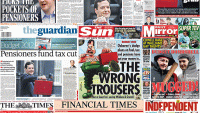
Today’s front pages concentrate on the so-called ‘granny tax’, the surprise of the Budget. But the real test of this Budget is going to be whether it delivers growth. If it does, then it will make a Tory majority in 2015 more likely. If it doesn’t, then the decision to cut the 50p rate will become even more politically problematic.   Given that the Budget is fiscally neutral, this growth is going to have come from either the couple of supply side measures in the Budget or by finding a way to unleash those elusive animal spirits. Indeed, I think this desire to boost confidence is one of the main reasons that the 50p rate has been cut.

The Spectator’s Budget briefing

From our UK edition

What was really in George Osborne's Budget? Last night we held an event, in association with Aberdeen Asset Management, to discuss just that. Click here for a free pdf copy of the briefing paper produced for the event.

Tory MPs welcome the Budget

From our UK edition

George Osborne and David Cameron have just addressed the 1922 Committee of Tory backbenchers. They received the traditional desk banging reception and Tory MPs seemed in good spirits as they left the meeting. Interestingly, they were nearly all relaxed about the increase in the personal allowance, believing that they would get the credit just as much — if not more than — the Liberal Democrats. One told me that ‘the public view this as a Conservative government when things are going well and a coalition one when things are going badly’. Perhaps the biggest piece of news out of the meeting is that Osborne offered Tory MPs considerable encouragement that the 45p rate will not become a permanent feature of the tax system.

Balls goes on the attack against 45p

From our UK edition

Ed Balls committed Labour to voting against the reduction in the 50p rate at his post-Budget briefing. But he wouldn’t say whether or not Labour would pledge to restore it in their manifesto; sticking to the classic opposition line that all decisions on tax will be made in the manifesto and not before. Balls, though, was on typically pugilistic form; few politicians relish a scrap as much as he does. The Labour leadership clearly view the abolition of the 50p rate as a major political opening for them. Balls went out of his way to attack the HMRC report that Osborne used to justify the move. He mockingly declared that he’d ‘never seen a government document with a Laffer curve in it before.’ This 50p fight is a classic Labour / Tory struggle.