George orwell

George Orwell’s lesson for Jamie Oliver

From our UK edition

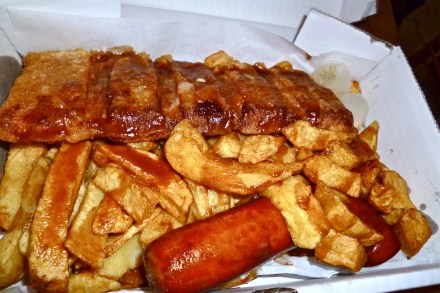
Jamie Oliver, eh, what a card? Why can't Britain's revolting poor eat better food? If they can afford televisions they can afford mussels and rocket too, don't ya know? Something like that anyway. But instead they loaf in front of the goggle-box stuffing their fat faces with lardy ready-meals and fast food. What is to be done with them? And why can't they be more like the Spanish or the Italians? Never mind that Italian children are more likely to be obese than British children. Never mind, too, that kids in impoverished southern Italy are more likely to be overweight than children in the wealthier north. Instead just fantasise about a future in which poor British families will dine on fresh vegetables and the finest seafood.
In defence of paranoid hysteria

From our UK edition

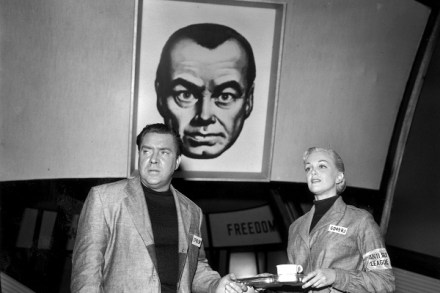
Compare a democracy to a dictatorship and world-weary chuckles follow. The last thing a citizen can do in true tyrannies is call them tyrannies. He or she has to pretend that the glorious socialist motherland or virtuous Islamic republic is not only as free as democracies but has a level of freedom that those who rely on universal suffrage and human rights cannot attain. If you are free to call your country a tyranny, then it is almost certainly is not. In the United States, the politically sophisticated are enjoying themselves immensely as they tear into leftish claims that America is now George Orwell’s all-seeing totalitarian state.

Blogging Barbarossa

From our UK edition

Perhaps the most horrific battle of them all began 70 years ago today. Here's Orwell: The Germans invaded the U.S.S.R. this morning. Everyone greatly excited. It is universally assumed that this development is to our advantage. It is only so, however, if the Russians actually intend to fight back and can put up a serious resistance, if not enough to halt the Germans, at any rate enough to wear down their air force and navy. Evidently the immediate German objective is not either territory or oil, but simply to wipe out the Russian air force and thus remove a danger from their rear while they deal finally with England. Impossible to guess what kind of show the Russians can put up.

Things I Don’t Want to Know, by Deborah Levy – review

From our UK edition

In her powerful rejoinder to Orwell’s 1946 essay ‘Why I Write’, Deborah Levy responds to his proposed motives for writing — ‘sheer egoism’, ‘aesthetic enthusiasm’, ‘historical impulse’ and ‘political purpose’ — with illuminating moments of autobiography. Levy begins one spring when she was crying on escalators, ‘at war with my lot’. She flies to Majorca, where, stuck on a mountain the night she arrives, she takes comfort in ‘being literally lost when I was lost in every other way’. Reading her notebooks later, she alights on a Polish director’s advice to a young actress: ‘to speak up is not about speaking louder, it is about feeling entitled to voice a wish’.

Every tabloid’s worst nightmare

From our UK edition

What would George Orwell write about today? asked the Guardian. Here’s our nomination: an EU report that recommends giving the EU more powers to sack hacks, regulate the press and dole out subsidies to 'good' journalists, a pan-European press and failing newspapers. The report is called 'A free and pluralistic media to sustain European democracy'. Be very afraid. Its preamble cites the misconduct of certain British journalists, before the report recommends a set of EU-sanctioned media regulations. All EU countries should have 'independent media councils' set up to investigate complaints, it says, and these media councils should police newspapers to make sure they have strict codes of conduct, prominently displayed — also ownership details, all conflicts of interest declared.

Down the memory hole for Orwell Week

From our UK edition

Amid much Twitter self-congratulation, the New Statesman has declared this 'Orwell week'. Oddly, however, it has yet to mention some of the most notable aspects of its relationship with the great man. In his long, long introductory piece Philip Maughan allows that Orwell went through a certain amount of 'disagreement' with the magazine's editor, Kingsley Martin. He even admits that, in aspects of this disagreement, Orwell might have been right: 'Nobody can forgive the decision by editor Kingsley Martin not to publish reports sent from Barcelona, fearing they were “liable to be taken as propaganda against socialism.

Some literary thirteens for 2013

From our UK edition

I suspect I might not be the only one who finds it unnerving to be at the start of a year that features, so prominently, the number thirteen. 2013 – it feels like bad luck just to read it in my head, let alone say it aloud! But worry not, I have assuaged my fears by turning to literature. There are some remarkable books which make use of the number thirteen, making me think that this number can be better understood as a source of inspiration, rather than a bringer of bad luck. Most infamous must be Orwell’s 1984 with its opening line: It was a bright cold day in April and the clocks were striking thirteen. At least 2013 was rung in with just twelve strikes of the clock. How terrifying to be in a world where thirteen strikes is normal! (Of course the day would be in April, T.

To take or not to take a pseudonym

From our UK edition

Literary pseudonyms have been on my mind lately, for a couple of reasons. The first is Salman Rushdie’s revelation that he chose ‘Joseph Anton’ as his cover name when in hiding during his fatwa, in tribute to Messrs Conrad and Chekhov. The second (and brace yourself, because this is going to hurt like pluggery) is that my own literary alter ego, Charlie Croker, has a new book out. Why do writers use pseudonyms, and how does it feel to see a book you’ve written get published with someone else’s name on the cover? Strictly speaking this isn’t what happened to Rushdie. Joseph Anton was his actual pseudonym rather than his literary one; his fictional books continued to appear under his real name, while his real life was lived under a fictional one.

China bans Haruki Murakami’s ‘1Q84’: George Orwell would have seen the irony

From our UK edition

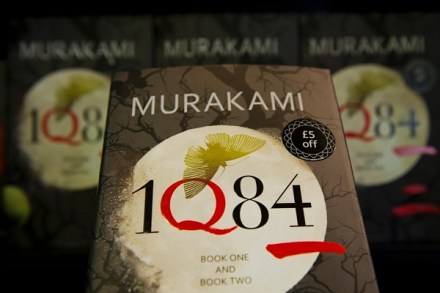
Books – or lack thereof – are the latest manifestation of anti-Japanese sentiment in China. The escalating dispute over the Senkaku/Diaoyu Islands has provoked some Beijing bookshops to remove Japanese books from their shelves. The most prominent book to be made to disappear is Haruki Murakami’s recent novel 1Q84, a critically acclaimed worldwide bestseller. Rather ironically, given the circumstances, the title echoes Orwell’s 1984 – in Japanese, ‘Q’ and ‘9’ are homonyms. Orwell has an uncanny knack of turning up at the choicest moments. Remember the glitch in July 2009 when Amazon deleted 1984 from everyone’s Kindles?

Life & Letters | 12 September 2009

From our UK edition

Sad, but for the most part the newly published edition of Orwell’s Diaries is a bore. Not altogether, of course, but much of what is interesting — some of the wartime stuff — isn’t new, but has already appeared in the Collected Essays, Letters, Diaries etc. And what is new, the Domestic Diary, a record of the kitchen garden at his Wallingford cottage, isn’t interesting — though it may come to be so in time. I suspect that contemporaries would have found little of interest in Parson Woodforde’s journal, which nevertheless delights many today, with its picture of a vanished way of life.

Nick Cohen, George Orwell and Me

From our UK edition

I can't stay silent on the issue of Nick Cohen's intervention at the Orwell Prize shotlisting event earlier this week. But I can't really say too much either as Nick, in an act of over-extravagant loyalty, claimed it was a travesty that I had not made it from the longlist to the shortlist. I have already thanked Nick in person for his kind words. I have to say it was an honour to be nominated at all and congratulations to all those that made it to the shortlist (including Peters Hitchens and Oborne). But I was disappointed for my fellow former-New Statesman writers Michela Wrong and Lindsey Hilsum who really did deserve to go further.