Gender

Lifting the veil

From our UK edition

Finally I realise why women are so pissed off. It all goes back to the first codified laws — circa 2,400 bc — when rules like this were invented by men: ‘If a woman speaks out of turn then her teeth will be smashed by a brick.’ Before that, apparently, women lived on a pretty equal footing with their future male oppressors.

There’s a simple reason why the Stonewall trailer doesn’t feature more ‘trans women of colour’

From our UK edition

Aping Isis, trans activists have defaced a historical monument to make a political point. They blacked-up — seriously, with spray paint and afro wigs — the Christopher Street Gay Liberation statue in New York, which commemorates the 1969 Stonewall riots and the birth of the modern gay-rights movement. Their beef? That the monument and a new movie about Stonewall don’t give enough credit to the black and Latino trans women who apparently were among the first to hurl bottles at homophobic cops on that fateful night. Let’s leave to one side the ugliness of sticking a comedy afro on a statue to make it appear black — a PC version of the black-and-white minstrels show.

Sorry, Kellie Maloney, but to be a woman you must first be a girl

From our UK edition

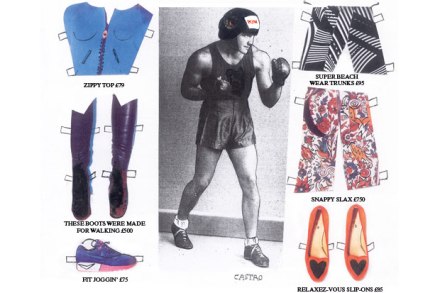
Anybody with an ounce of compassion would have been doffing caps in recent days to Frank Maloney — as, indeed, absolutely everybody with an ounce of compassion vigorously and noisily was. His announcement that he is undergoing a sex change has been met by plaudits from far and wide, notably from within the muscularly male world of boxing in which he made his name and from where his former client, Lennox Lewis, has led the cheerleading. Quite right, too. Maloney’s appalling, sometimes suicidal misery of half a century is beyond imagination; his eventual admission to his beloved wife was heartbreaking to read and his courage, now, in going public — albeit forced by the threat of media exposure — is admirable. But... oh yes, there is a but.

The lying game | 14 May 2015

From our UK edition

My favourite scene in the first episode of the new series of Benefits Street (Mondays, Channel 4) — now relocated to a housing estate in the north-east, but otherwise pretty much unchanged — was the one where the street’s resident stoner and low-level crim Maxwell has to attend a court summons. Really, if the whole thing had been scripted and faked by the film-makers (as I’m sure it wasn’t: no need), it couldn’t have worked out better. With just 15 minutes to go before Maxwell’s court hearing seven miles away, his brother turns up to give him a lift on his motorbike. But there’s one small problem. Maxwell’s brother is still under the influence of the vast quantities of diazepam he’s carrying with him in his bag.

Rock bottom

From our UK edition

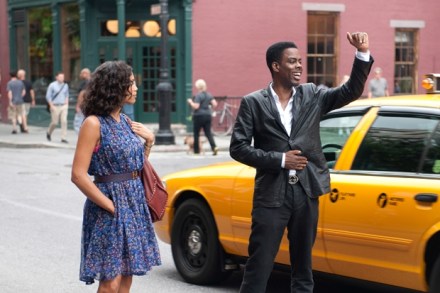
The oeuvre of Chris Rock may not be fully known in this parish. He was the African-American stand-up who made a packet out of saying the unsayable about race. Richard Pryor kicked down the door, but it was Rock who stamped a registered trademark on the N-word. He also had a rapper’s sensibility in the area of gender politics: his breakthrough set had much to say about — and I merely quote — dick and pussy. And what about the movies? For children, Rock voiced a jive-talking zebra in the Madagascar mega-franchise, perhaps a quadrupedal hommage to Eddie Murphy’s donkey in Shrek. Alas Rock’s own pet projects have a tendency to misfire. Head of State posited the cockamamie notion of a black dude running for POTUS and winning.

Force Majeure reviewed: meaty and hilarious – but it may wreck your relationship

From our UK edition

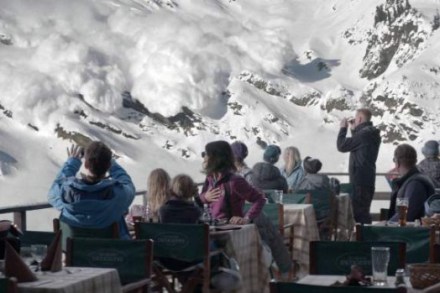
If you’re unsure about the man (or woman) you’re dating, go and see this film. It’ll cause rifts in a weak relationship, and yield powerful debate – or perhaps agreement on the central themes – in a strong one. It asks men to defend or disown the role of hero, and begs us to consider whether motherhood naturally graces its host with more altruistic instincts than fatherhood. Who’s braver: men or women? Or, let’s cut to the chase, you or me? At the core of this slick and sometimes hilarious Swedish film by Ruben Östlund is the non-rhetorical question: when push comes to shove, what would you do? I’ve always been a believer in the universal – and the humorous – springing from the particular.

The Falling reviewed: a film of beauty and magic

From our UK edition

Long live the glockenspiel, that typically dull percussion stalwart usually relegated to primary school memories, along with humdrum gym classes and endless repetitions of Kumbaya. Here the glock is like a new instrument altogether. Its eery, metallic tones haunt the early scenes of Carol Morley's The Falling, filling them with an unexpectedly ethereal quality that is both childlike and yet somehow sophisticated at the same time - just like the longed for worldliness of the impatient teenage girls at the heart of this warped coming of age story. The music (recorded by Everything but the Girls’s Tracey Thorn) is the backbone of this flawed yet deeply atmospheric film, which gets under your skin and stays there.

Trans activists are effectively experimenting on children. Could there be anything more cruel?

From our UK edition

Can you think of anything more cruel than telling a five-year-old boy who likes Lady Gaga that he might have gender dysphoria? Or telling a nine-year-old tomboy who hates Barbie and loves Beckham that she might really be male - in spirit - and therefore she should think about putting off puberty and possibly transitioning to her 'correct gender'? Saying such things to kids who are only doing what kids have done for generations - messing about, discovering their identity - turns playfulness into a pathology. It convinces boys who aren't boyish and girls who aren't girly that they must have some great gender problem, a profound inner turmoil that their tiny minds must address, when in truth they're just having fun. What an awful trick to play on children.

Free speech is so last century. Today’s students want the ‘right to be comfortable’

From our UK edition

[audioplayer src="http://rss.acast.com/viewfrom22/8f1c0b97-698e-45c6-b50a-84e0e4b3773a/media.mp3" title="Brendan O'Neill and Harriet Brown discuss the rise of the Stepford student" startat=41] Listen [/audioplayer] Don't be a Stepford student — subscribe to The Spectator's print and digital bundle for just £22 for 22 weeks.  Have you met the Stepford students? They’re everywhere. On campuses across the land. Sitting stony-eyed in lecture halls or surreptitiously policing beer-fuelled banter in the uni bar. They look like students, dress like students, smell like students. But their student brains have been replaced by brains bereft of critical faculties and programmed to conform.

Liberate women…from the rotten dictatorial group-think of ‘feminism’

From our UK edition

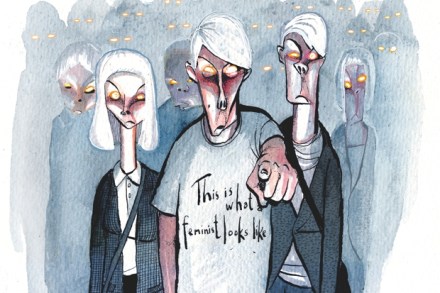
Good on David Cameron for refusing to wear that hideous T-shirt. Feminists these days spend an awful lot of time telling people what to think and what to wear. It’s easy to forget the heady days of feminism’s innocence, when it lobbied for freedom, the freedom for women to operate telegraphs, for example. The deft fingers of women were to set in action the wires of the telegraph with as much swift dexterity as they do those of the piano. They were to write messages about iron and steel and stocks and shares with the same easy celerity that they corresponded about the last new ribbon or baby's first tooth.

Marriage and foreplay Sharia-style

From our UK edition

Needless to say, it’s not uncommon to hear single British women in their thirties and forties saying that all the good men are married. But in The Men with Many Wives (Channel 4, Wednesday) this came with a twist: it turned out to be precisely the reason why you should marry them too. Polygamy may be illegal in Britain, but it’s permitted under the Sharia law that many Muslims here apparently live by — and, as several of the programme’s participants told us, there’s no better guide to whether a man is husband material than the fact that he’s a husband already. Take Nabilah, who came to Britain from Malaysia to do a PhD in engineering at Cambridge. By then she was divorced and wanted someone with a proven track record of staying with his spouse.

Now the BBC is censoring the word ‘girl’ – it really is in a different world

From our UK edition

It’s beyond parody, isn’t it? Mark Beaumont, a BBC presenter, has made a documentary about the Commonwealth Games and during the course of it he was filmed grappling with a judo champion. After he was sent crashing to the floor he said: 'I am not sure I can live that down - being beaten by a 19-year-old girl.' Mr Beaumont is 31. So inflammatory was the remark that though it was broadcast in full when the programme was broadcast in April, it was removed for the repeat, presumably lest, as the broadcaster Mariella Frostrup observed, the word might come across as 'dismissive'. I think we can assume that Mariella speaks for received opinion on these matters when she says 'the BBC has to consider the sensitivities of everyone who might be watching'.

If you’re after equality, don’t show women’s football. Show Badminton.

From our UK edition

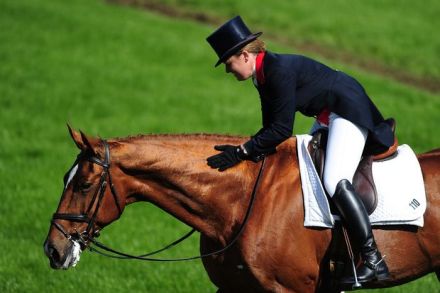
Over the next two days, one of the most important events in the British sporting calendar takes place. No, not the final day of the Premier League season. Badminton Horse Trials, obviously. This is one of only two annual horse trials in the UK (and six in the world) at which eventers compete at the top level. Oh, and one of the favourites to win is British. So of course the BBC is broadcasting it on one of their main channels, right? Wrong. During the London Olympics, equestrianism was one of the most popular sports on the BBC red button channel, with the freestyle musical dressage (aka horse dancing) in particular attracting a wide audience.

There’s cause to worry about our sons as well as our daughters

From our UK edition

The graph below shows one of the most unsettling trends I've come across. It's the female and male suicide rates, and while the former has halved since the 1980s, the latter has fallen by just 8 per cent. Men account for 77 per cent of all suicides, and the group now most likely to take their lives are men aged 40-44. [datawrapper chart="http://static.spectator.co.uk/flzpM/index.html"] These are the starkest statistics in what I argue in this week's magazine is a 'crisis of masculinity' in our country. There are male-specific problems ranging from catastrophic mental health conditions to boys falling behind girls at every stage of their education. Men get ahead in the workplace only because women are forced by high childcare costs to leave. That's not true equality, is it?

Why do boys outperform girls at university?

From our UK edition

According to the university’s own statistics, Oxford is one of the worst places in the country to be a female student if you’re hoping for a First Class degree. In all three of Oxford’s academic divisions, men were more likely to get a First in 2013 than women: there was a gender gap of 5% in the humanities, 10% in mathematical, physical and life sciences and 8% in medical sciences. As a Historian, I’m 10% less likely to get a First than one of my male counterparts. Nationally, there’s virtually no discrepancy at all - in 2013, 18.3% of women got Firsts compared to 18.5% of men. But it’s odd that there’s any male bias at all, since girls have long been getting more top grades at A-Level. What it is about university that suits boys better?

Don’t knock ‘benevolent sexism’ – it makes us happy

From our UK edition

The American-led Left has a new fixation: ‘benevolent sexism’. Recent examples found here, here and here. According to one definition: ‘Ambivalent or benevolent sexism usually originates in an idealization of traditional gender roles: Women are “naturally” more kind, emotional, and compassionate, while men are “naturally” more rational, less emotional, and “tougher,” mentally and physically.’ I don’t want to say anything that could get me arrested in Belgium, but men are on average physically tougher than women. And I would have thought that stating women have – on average – greater empathy is was not likely to get you an auto-da-fé.

Nigel Farage missed the point about ‘young, able women’

From our UK edition

Nigel Farage isn’t afraid ‘to court controversy’ over the issue of women’s pay. Speaking on the issue of equal pay, he described how a pay gap exists because women who have children are ‘worth less’ to their employer than men. This may well be true; it’s a high-octane industry, and anyone who flakes out – man or woman - is clearly worth less than someone who slogs away for years. But then Farage goes onto say the following: ‘I do not believe there is any discrimination against women at all... And young, able women who are prepared to sacrifice the family life and stick to their career will do as well or better than men.

Stella Creasy’s stance on gendered toys misses the point

From our UK edition

I felt a touch of sadness on Tuesday when Marks & Spencer caved in to demands that they de-gender their toys, which must make me the worst person on earth. After her triumphant campaign, MP Stella Creasy tweeted: if it annoys some so much girls might want 2 play with cars, imagine how they’d feel if they knew also wanted 2 run companies & stuff! ;-@ — stellacreasy (@stellacreasy) December 18, 2013   Is that why, though? What annoys a lot of people is that a vocal pressure group professing outrage, the universally accepted currency of public discourse, has limited customers’ options. It’s like when people complain about Amazon selling costumes that offends some victim group whom they claim to represent.

‘The left’ doesn’t matter; but its cowardice does

From our UK edition

I know it’s not quite the year’s end. But I think the sweetest words I heard in 2013 are already set: ‘The left doesn’t really matter’. Those words were said to me by a pollster. The point he was making was that although the commentating classes obsess about the state of the left, it doesn’t really matter. Among the public as a whole only a handful of people take any interest in where the left does or doesn’t stand on issues and what this does or doesn’t mean. If there is anyone who thinks that a shame they should just look at the contortions ‘the left’ is going through now over the issue of gender segregation.

Why is ‘feminism’ such a dirty word?

From our UK edition

A few years back I did one of those online debates on the Times website, the subject being why feminism had fallen out of favour. Within about 60 seconds four people had used the phrase ‘gender is a social construct’ and, well, I sort of switched off at that point. It’s strange that the F-word is now so unpopular that even David Cameron, a man with a desperately keen ear for metro-liberal opinion, refused to identify as such last week. When asked by Red magazine, he said: ‘I don’t know what I’d call myself... it’s up to others to attach labels. But I believe men and women should be treated equally.